Gold Trading Alert: Gold Prices Plunge After Reaching a High of $4374! The Allure of Inflation Hedging Fades as Bulls Take Profits! The Long-Term Trend Remains Bullish, Aiming for $5000.
2025-12-19 06:33:38
Gold, considered the king of safe-haven assets by global investors, once again experienced a thrilling rollercoaster ride in the financial markets at the end of 2025. On Thursday (December 18), gold prices surged to a near two-month high of $4,374 per ounce, only to quickly give back those gains, barely holding on to close at $4,332.31 per ounce. This volatility was not an isolated event, but rather a product of the latest US Consumer Price Index (CPI) data. Lower-than-expected inflation data, on the one hand, stimulated expectations of a Federal Reserve rate cut, pushing down US Treasury yields and providing a temporary boost to gold prices; on the other hand, it weakened gold's appeal as an inflation hedge, leading to profit-taking by long positions. Combined with other precious metal market dynamics such as silver hitting a record high and palladium reaching a three-year peak, this gold price fluctuation reveals the uncertainty in the global economic recovery, providing investors with an excellent window to examine the future trend of gold.
The release of the US November CPI data triggered the recent gold price volatility. According to the Bureau of Labor Statistics, consumer prices rose 2.7% year-on-year in November, far below economists' expectations of 3.1%. This data should have been a shot in the arm for the market, as it suggested easing inflationary pressures and would help the Federal Reserve maintain its loose monetary policy. However, the reality was far more complex. Due to the 43-day federal government shutdown, data collection was severely hampered, resulting in the absence of most October price data, and even the cancellation of the October CPI release. This report, jokingly referred to by economists as "Swiss cheese," was riddled with gaps and biases. The carryover method, which assumes the October price index remained unchanged when dealing with missing data, introduces a downward bias statistically, making the inflation trend appear more moderate than it actually is.
Against this backdrop, household affordability remains a prominent issue. Beef prices surged 15.8% year-on-year, the largest increase since June 2020; coffee prices jumped 18.8%; and electricity prices rose 6.9%, the highest since April 2023. These sharp price increases in necessities have led consumers to perceive inflation far more acutely than official figures suggest.
The core CPI, excluding food and energy, rose 2.6% year-on-year, the smallest increase since March 2021, but housing prices climbed only 0.2%, which was considered unrealistic given that the average monthly increase for the first nine months was 0.3%.
Economists warn that prices may rebound in December as businesses continue to pass on import tariff costs, while the rise of artificial intelligence and cloud computing data centers is further driving up electricity demand. While White House officials welcomed the report, with President Trump's economic advisors even calling it "surprisingly good," high living costs will remain a political hotspot ahead of the 2026 congressional elections. This distorted CPI report not only slowed inflation expectations but also indirectly affected safe-haven demand for gold, as investors began to question whether inflation was truly out of control.
Gold prices experienced a textbook example of a surge followed by a pullback on Thursday. Lower-than-expected CPI data slightly increased the probability of a Fed rate cut in January, causing US Treasury yields to fall to a one-week low, with the two-year yield at 3.462% and the 10-year yield at 4.12%. This environment injected momentum into gold prices, pushing them to $4374 per ounce, close to the record high reached on October 20th. However, this rally was short-lived; as the market digested the data, gold's appeal as an inflation hedge quickly faded.
Analyst Fawad Razaqzada points out that inflation is falling faster than expected, reducing the appeal of buying "inflation insurance." Part of the reason for gold's significant price increase over the years has been that high inflation eroded the value of fiat currencies; the current slowdown in inflation is shaking this logic.
Furthermore, technical pressures cannot be ignored. Gold prices approached their all-time high of $4381, prompting profit-taking by bulls and causing a rapid evaporation of gains. The decline in the US dollar against a basket of currencies should have been beneficial for gold, but the rise in Wall Street stocks diverted funds away from gold.
Razaqzada added that gold's strength in recent years stemmed from inflationary erosion, but current data makes its weakness understandable. Meanwhile, the volatility in employment data caused by the government shutdown has exacerbated uncertainty.
Tuesday's jobs report showed an unexpected rise in the unemployment rate, while Thursday's initial jobless claims fell by 13,000 to 224,000, and continuing claims rose to 1.897 million, suggesting a stable but not overheated labor market. Employers' reluctance to engage in large-scale hiring or layoffs has dampened the safe-haven demand for gold. Overall, this pullback is not a trend reversal, but rather a short-term adjustment after the market digests multiple signals.
Amidst this turbulence, expert opinions, though divided, reveal an optimistic tone. Peter Grant, Vice President of Zaner Metals, emphasized that the overall trend for gold is very positive, and an upward breakout is expected eventually. He set an upside target of $4515.63, with even $5000 remaining a valid target. This reflects that despite short-term volatility, gold's long-term appeal remains undiminished.
Chicago Fed President John Goolsby welcomed the data, saying that if inflation continues to move toward the 2% target, the door will be open for further rate cuts next year. He believes that terminal interest rates are far below current levels, which provides policy support for gold. Goolsby's shift to a dovish stance is particularly significant, given that he was one of the policymakers who opposed rate cuts last week.
However, not all viewpoints are without merit. Jan Nevruzi of TD Securities acknowledges that the data supports a decline in inflation but emphasizes the difficulty of interpreting it, with concerns arising from its lack of interpretation. Federal Reserve Chairman Powell previously stated that he would view delayed data with caution. Traders are taking a wait-and-see approach to the Fed's policy outlook, with only a 27% probability of a rate cut in January and over 50% in March. Trump's nomination of the next Fed chairman is also in focus; he has stated that candidates will believe in "significant rate cuts," and known candidates such as Hassett, Walsh, and Waller all advocate for low interest rates. This could further depress yields, benefiting gold.
However, Bill Adams of Comerica Bank warned that consumers are feeling the worst about inflation, with prices for many necessities still rising rapidly. Gregory Daco of EY-Parthenon criticized the report's downside bias, cautioning investors against excessive optimism.
These conflicting viewpoints highlight that while gold prices are trending upward, caution is warranted against data distortions and political uncertainty.
Gold price fluctuations are not isolated; the performance of silver and palladium has injected vitality into the overall precious metals market. On Wednesday, silver hit a record high of $66.88 per ounce. On Thursday, silver only slightly retreated, while palladium rose 2.6% on Thursday, marking its fourth consecutive day of gains and reaching a near three-year high of $1712. Platinum rose 1% on Thursday, its sixth consecutive day of gains, hitting a more than 17-year high of $1978.70 during the session. This reflects a recovery in investor demand for industrial metals; silver's applications in photovoltaics and electronics, and palladium's role in automotive catalysts, are benefiting from the global economic recovery.
Compared to gold's safe-haven appeal, these metals are more driven by real demand, but inflation data also influences their price movements. The correlation among precious metals enhances gold's attractiveness, as new highs in silver may foreshadow a broader rebound in inflation, while palladium's peak suggests a manufacturing recovery. These dynamics present gold investors with diversification opportunities, but attention should also be paid to the transmission effects of Federal Reserve policies across the sector.
Commerzbank stated in a report: "The surge in precious metal prices has now spread from silver to platinum... Platinum prices are being driven by strong demand from China."
Unemployment claims data showed labor market resilience, with a decline in initial jobless claims suggesting stable employment in December, but an increase in continuing claims reflecting long-term unemployment pressures. This echoes the distortions in the CPI, suggesting the Federal Reserve will be more cautious in its policy-making. Bond yields declined, with the spread between two-year and 10-year yields narrowing to 66 basis points, indicating easing market concerns about the economic outlook. Strong demand at the Treasury's auction of five-year Treasury Inflation-Protected Securities (TIPS), with a winning bid rate of 1.433%, shows investors are still seeking hedging tools. Trump's televised address focused on affordability, and political factors may amplify the inflation issue. Overall, the macroeconomic environment supports gold as part of asset allocation, but concerns about data reliability require investors to remain vigilant.
In conclusion, the recent surge and subsequent pullback in gold prices is a result of the interplay between US inflation data and market sentiment. Despite short-term weakness, the long-term trend for gold remains positive, with experts pointing to even higher peaks. Investors should pay close attention to the Federal Reserve's actions, data revisions, and political nominations, avoiding blindly chasing high prices. Amid global uncertainty, gold remains a reliable safe haven, but a flexible strategy should be developed by considering the dynamics of silver and palladium prices and macroeconomic indicators. Looking ahead to 2026, with inflation potentially rising, investment opportunities in gold may shine again.
The highly anticipated US October PCE data will be released today, and investors should pay close attention. In addition, the impact of the revised US Q3 GDP figure and the Bank of Japan's interest rate decision should also be noted.
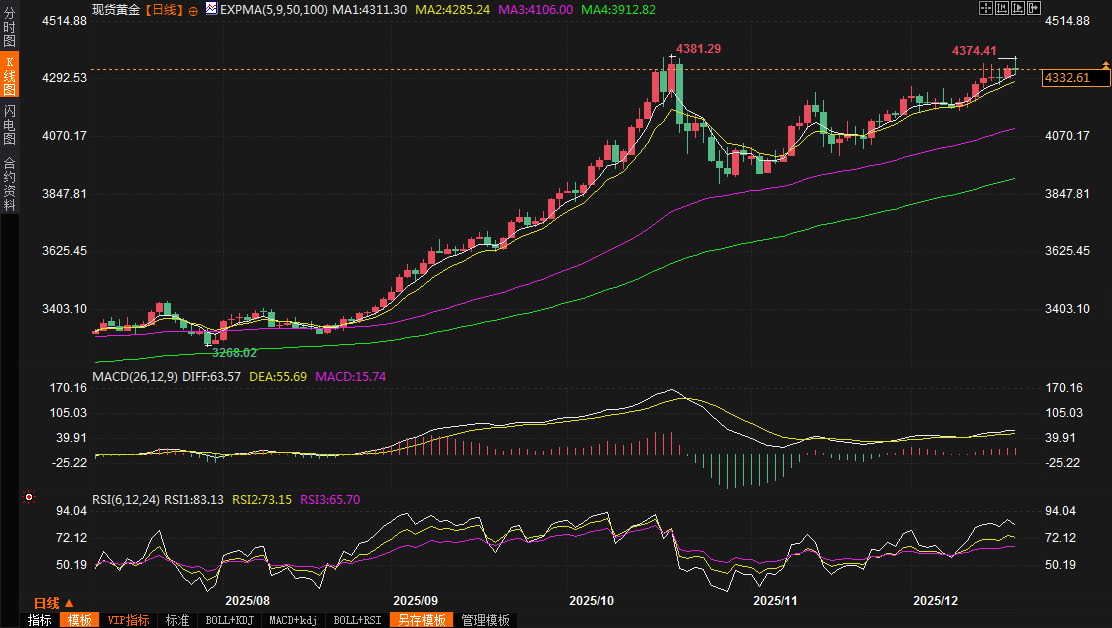
(Spot gold daily chart, source: FX678)
US CPI data falls short of expectations: a double-edged sword effect of slowing inflation.
The release of the US November CPI data triggered the recent gold price volatility. According to the Bureau of Labor Statistics, consumer prices rose 2.7% year-on-year in November, far below economists' expectations of 3.1%. This data should have been a shot in the arm for the market, as it suggested easing inflationary pressures and would help the Federal Reserve maintain its loose monetary policy. However, the reality was far more complex. Due to the 43-day federal government shutdown, data collection was severely hampered, resulting in the absence of most October price data, and even the cancellation of the October CPI release. This report, jokingly referred to by economists as "Swiss cheese," was riddled with gaps and biases. The carryover method, which assumes the October price index remained unchanged when dealing with missing data, introduces a downward bias statistically, making the inflation trend appear more moderate than it actually is.
Against this backdrop, household affordability remains a prominent issue. Beef prices surged 15.8% year-on-year, the largest increase since June 2020; coffee prices jumped 18.8%; and electricity prices rose 6.9%, the highest since April 2023. These sharp price increases in necessities have led consumers to perceive inflation far more acutely than official figures suggest.
The core CPI, excluding food and energy, rose 2.6% year-on-year, the smallest increase since March 2021, but housing prices climbed only 0.2%, which was considered unrealistic given that the average monthly increase for the first nine months was 0.3%.
Economists warn that prices may rebound in December as businesses continue to pass on import tariff costs, while the rise of artificial intelligence and cloud computing data centers is further driving up electricity demand. While White House officials welcomed the report, with President Trump's economic advisors even calling it "surprisingly good," high living costs will remain a political hotspot ahead of the 2026 congressional elections. This distorted CPI report not only slowed inflation expectations but also indirectly affected safe-haven demand for gold, as investors began to question whether inflation was truly out of control.
Gold prices surged and then retreated: a combination of market sentiment and technical pressures.
Gold prices experienced a textbook example of a surge followed by a pullback on Thursday. Lower-than-expected CPI data slightly increased the probability of a Fed rate cut in January, causing US Treasury yields to fall to a one-week low, with the two-year yield at 3.462% and the 10-year yield at 4.12%. This environment injected momentum into gold prices, pushing them to $4374 per ounce, close to the record high reached on October 20th. However, this rally was short-lived; as the market digested the data, gold's appeal as an inflation hedge quickly faded.
Analyst Fawad Razaqzada points out that inflation is falling faster than expected, reducing the appeal of buying "inflation insurance." Part of the reason for gold's significant price increase over the years has been that high inflation eroded the value of fiat currencies; the current slowdown in inflation is shaking this logic.
Furthermore, technical pressures cannot be ignored. Gold prices approached their all-time high of $4381, prompting profit-taking by bulls and causing a rapid evaporation of gains. The decline in the US dollar against a basket of currencies should have been beneficial for gold, but the rise in Wall Street stocks diverted funds away from gold.
Razaqzada added that gold's strength in recent years stemmed from inflationary erosion, but current data makes its weakness understandable. Meanwhile, the volatility in employment data caused by the government shutdown has exacerbated uncertainty.
Tuesday's jobs report showed an unexpected rise in the unemployment rate, while Thursday's initial jobless claims fell by 13,000 to 224,000, and continuing claims rose to 1.897 million, suggesting a stable but not overheated labor market. Employers' reluctance to engage in large-scale hiring or layoffs has dampened the safe-haven demand for gold. Overall, this pullback is not a trend reversal, but rather a short-term adjustment after the market digests multiple signals.
Clash of Expert Opinions: Gold Trend Positive but Risks Need to Be Watched
Amidst this turbulence, expert opinions, though divided, reveal an optimistic tone. Peter Grant, Vice President of Zaner Metals, emphasized that the overall trend for gold is very positive, and an upward breakout is expected eventually. He set an upside target of $4515.63, with even $5000 remaining a valid target. This reflects that despite short-term volatility, gold's long-term appeal remains undiminished.
Chicago Fed President John Goolsby welcomed the data, saying that if inflation continues to move toward the 2% target, the door will be open for further rate cuts next year. He believes that terminal interest rates are far below current levels, which provides policy support for gold. Goolsby's shift to a dovish stance is particularly significant, given that he was one of the policymakers who opposed rate cuts last week.
However, not all viewpoints are without merit. Jan Nevruzi of TD Securities acknowledges that the data supports a decline in inflation but emphasizes the difficulty of interpreting it, with concerns arising from its lack of interpretation. Federal Reserve Chairman Powell previously stated that he would view delayed data with caution. Traders are taking a wait-and-see approach to the Fed's policy outlook, with only a 27% probability of a rate cut in January and over 50% in March. Trump's nomination of the next Fed chairman is also in focus; he has stated that candidates will believe in "significant rate cuts," and known candidates such as Hassett, Walsh, and Waller all advocate for low interest rates. This could further depress yields, benefiting gold.
However, Bill Adams of Comerica Bank warned that consumers are feeling the worst about inflation, with prices for many necessities still rising rapidly. Gregory Daco of EY-Parthenon criticized the report's downside bias, cautioning investors against excessive optimism.
These conflicting viewpoints highlight that while gold prices are trending upward, caution is warranted against data distortions and political uncertainty.
Precious Metals in Sync: Market Signals Behind New Highs in Silver and Palladium
Gold price fluctuations are not isolated; the performance of silver and palladium has injected vitality into the overall precious metals market. On Wednesday, silver hit a record high of $66.88 per ounce. On Thursday, silver only slightly retreated, while palladium rose 2.6% on Thursday, marking its fourth consecutive day of gains and reaching a near three-year high of $1712. Platinum rose 1% on Thursday, its sixth consecutive day of gains, hitting a more than 17-year high of $1978.70 during the session. This reflects a recovery in investor demand for industrial metals; silver's applications in photovoltaics and electronics, and palladium's role in automotive catalysts, are benefiting from the global economic recovery.
Compared to gold's safe-haven appeal, these metals are more driven by real demand, but inflation data also influences their price movements. The correlation among precious metals enhances gold's attractiveness, as new highs in silver may foreshadow a broader rebound in inflation, while palladium's peak suggests a manufacturing recovery. These dynamics present gold investors with diversification opportunities, but attention should also be paid to the transmission effects of Federal Reserve policies across the sector.
Commerzbank stated in a report: "The surge in precious metal prices has now spread from silver to platinum... Platinum prices are being driven by strong demand from China."
Investment considerations in the context of macroeconomic factors: the dual impact of unemployment and the bond market
Unemployment claims data showed labor market resilience, with a decline in initial jobless claims suggesting stable employment in December, but an increase in continuing claims reflecting long-term unemployment pressures. This echoes the distortions in the CPI, suggesting the Federal Reserve will be more cautious in its policy-making. Bond yields declined, with the spread between two-year and 10-year yields narrowing to 66 basis points, indicating easing market concerns about the economic outlook. Strong demand at the Treasury's auction of five-year Treasury Inflation-Protected Securities (TIPS), with a winning bid rate of 1.433%, shows investors are still seeking hedging tools. Trump's televised address focused on affordability, and political factors may amplify the inflation issue. Overall, the macroeconomic environment supports gold as part of asset allocation, but concerns about data reliability require investors to remain vigilant.
In conclusion, the recent surge and subsequent pullback in gold prices is a result of the interplay between US inflation data and market sentiment. Despite short-term weakness, the long-term trend for gold remains positive, with experts pointing to even higher peaks. Investors should pay close attention to the Federal Reserve's actions, data revisions, and political nominations, avoiding blindly chasing high prices. Amid global uncertainty, gold remains a reliable safe haven, but a flexible strategy should be developed by considering the dynamics of silver and palladium prices and macroeconomic indicators. Looking ahead to 2026, with inflation potentially rising, investment opportunities in gold may shine again.
The highly anticipated US October PCE data will be released today, and investors should pay close attention. In addition, the impact of the revised US Q3 GDP figure and the Bank of Japan's interest rate decision should also be noted.
(Spot gold daily chart, source: FX678)
- Risk Warning and Disclaimer
- The market involves risk, and trading may not be suitable for all investors. This article is for reference only and does not constitute personal investment advice, nor does it take into account certain users’ specific investment objectives, financial situation, or other needs. Any investment decisions made based on this information are at your own risk.