Interest rates unchanged, a huge signal! The European Central Bank releases hawkish signals.
2025-12-18 21:41:13
The European Central Bank (ECB) concluded its two-day monetary policy meeting on Thursday, December 18, announcing that it would maintain its main interest rates unchanged, in line with market expectations. This marks the fourth consecutive time the ECB has paused rate adjustments. The main refinancing rate remains at 2.15%, the deposit facility rate at 2.00%, and the marginal lending facility rate at 2.40%. Despite the lack of policy changes, the latest macroeconomic forecasts and policy statement released at this meeting sent a clear signal: facing a slowing decline in inflation and strengthening economic growth momentum, the ECB is demonstrating greater policy patience and a potentially hawkish stance.

Prior to the announcement of this interest rate decision, the market's expectation of the European Central Bank maintaining its current interest rate was as high as 98%, and traders had already fully priced in the "hold steady" outcome. The focus then shifted to the newly released staff forecasts and Lagarde's guidance in her press conference. In the preceding months, the Eurozone economy demonstrated unexpected resilience, with the Harmonized Index of Consumer Prices (HICP) rising 2.1% year-on-year in November, and the core HICP remaining at a high level of 2.4%, indicating that price pressures remained persistent. At the same time, major economies such as Germany have adopted expansionary fiscal policies, with domestic demand becoming the main engine of growth, providing a new dimension for assessing the central bank's policy stance.
Against this backdrop, market attention is focused on three main areas: first, whether inflation forecasts will be revised upwards, particularly regarding service price trends; second, whether the economic growth outlook will be revised upwards; and third, whether the European Central Bank will hint at a possible tightening of future policy. These factors collectively determine the short-term direction of the euro exchange rate, bond yields, and cross-asset allocation.
(1) The inflation path has been slightly revised upward, with service inflation becoming a key variable. According to the latest staff forecast released by the European Central Bank, the overall inflation rate is expected to average 2.1% in 2025, fall to 1.9% in 2026, further slow to 1.8% in 2027, and rebound to 2.0% in 2028. Although the medium- and long-term target remains anchored at 2%, it is worth noting that the inflation forecast for 2026 has been revised upward compared to the previous one, mainly because the decline in service prices is slower than expected.
Core inflation forecasts, excluding energy and food, also reflect this trend: 2.4% in 2025, 2.2% in 2026, declining to 1.9% in 2027, and returning to 2.0% in 2028. The wage transmission effect in the service sector continues to manifest, and the stickiness of rents and labor-intensive industry prices is becoming more prominent, making it difficult for the central bank to easily declare a "victory against inflation."
This move indicates that although energy price volatility has stabilized, endogenous inflationary pressures have not completely subsided. By raising its medium-term inflation forecast, the European Central Bank is sending a cautious message to the market—monetary policy has not yet entered a phase where it can be systematically eased.
(2) Growth forecasts have been revised upwards across the board, and the recovery pattern driven by domestic demand has been consolidated. The significant upward revision of economic growth forecasts reflects the increased confidence of policymakers in the economic fundamentals. The latest forecasts show that the Eurozone's GDP growth rate will reach 1.4% in 2025, 1.2% in 2026, and remain at 1.4% in both 2027 and 2028. Compared with the September forecast, the figures for each year have increased, mainly driven by strong domestic demand, including growth in private consumption and government spending.
Although manufacturing PMI data showed a moderate pace of output expansion, with the preliminary December reading at 51.2, marking a record year-on-year increase, the growth rate was the slowest in three months, indicating that weak external demand continues to constrain the performance of the industrial sector. However, service sector activity remained robust, supporting the overall economic resilience.
In this "uneven recovery" scenario, the European Central Bank is more inclined to believe that growth is sustainable, thereby reducing its reliance on further interest rate cuts to stimulate the economy.
The meeting statement reiterated that monetary policy will continue to be formulated "on a meeting-by-meeting basis" and "data-dependently," without presupposing a future path. This stance maintains Lagarde's consistent communication style, emphasizing flexibility and prudence.
However, in reality, this resolution does not simply maintain the status quo. Instead, by raising both inflation and growth expectations, it constructs a logical loop that supports keeping interest rates high in the long term.
Higher growth expectations mean the economy does not need additional easing support;
Higher inflation forecasts weaken the case for starting a new round of interest rate cuts sooner.
Especially with the 2026 inflation forecast revised upwards, the market's initial bet on a "2026 rate cut window" faces repricing risks. Some institutions have begun discussing that the ECB's next policy move might be a rate hike rather than a rate cut, possibly occurring in the third quarter of 2027.
This "hawkish inaction" strategy avoids market turmoil caused by radical statements, effectively manages long-term interest rate expectations, and limits the space for excessive bets on easing in the bond market.
Exchange Rate: The euro strengthened in the short term, breaking through a key psychological level. The euro/dollar exchange rate was at 1.1727 before the decision was announced, and quickly rose to 1.1755 after the news was released. This round of gains was mainly driven by two factors: first, the upward revision of the 2026 inflation forecast strengthened expectations that interest rates would remain high; second, the improved economic growth outlook increased the attractiveness of euro assets.
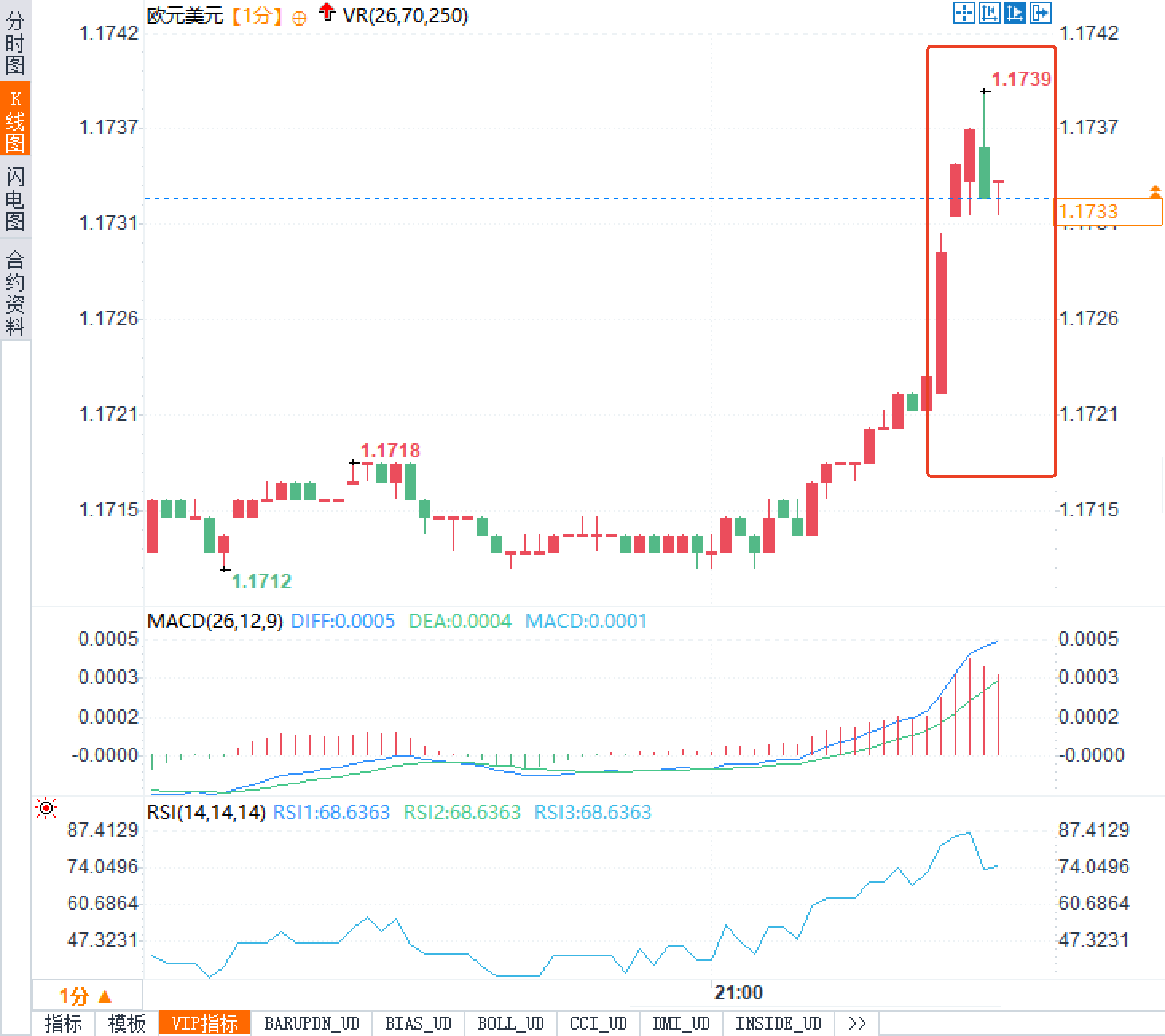
The current exchange rate has stabilized above 1.1730, approaching the technical resistance zone of this year's high of 1.1918. If subsequent US economic data is weak or the Federal Reserve releases more dovish signals, the euro is expected to challenge 1.1800 or even higher.
Bond Market: German bond yields rose under pressure. The yield on Germany's 10-year government bond rose by about 4 basis points to 2.87% after the decision, with the market expecting it to break through 3.00% in the second half of 2026. French and Italian bonds of the same maturity also rose in tandem, reflecting investors' growing perception that the overall financing cost center of the Eurozone is rising.
Analysts point out that in an environment of fiscal expansion and sticky inflation, the pressure on Eurozone bond supply and the risk of rising real interest rates will persist, and long-term yields still have upward momentum.
Major investment institutions generally believe that although the ECB's operation did not bring about any substantial changes, it was rich in information. Research reports from Goldman Sachs, Morgan Stanley, and other banks pointed out that the upward revision of the 2026 inflation forecast is an "underestimated hawkish signal" that may prompt the market to reassess the probability distribution of next year's interest rate path.
The market's pricing in the probability of the European Central Bank's first rate cut in 2026 has fallen from 68% two weeks ago to 52%, reflecting a subtle shift in expectations.
Looking ahead, the following key milestones will determine whether the Eurozone's monetary policy narrative can continue to strengthen:
1. Economic data in the first half of 2026 will confirm that if GDP growth and the job market continue to show resilience, and the pace of decline in core inflation does not accelerate, the likelihood of the European Central Bank maintaining interest rates unchanged will further increase.
2. Germany's fiscal implementation progress: If the expansion of infrastructure and green transition spending in the new budget is successfully implemented, it will enhance the sustainability of aggregate demand expansion, but may also increase the risk of inflation rebound.
3. Comparison of Federal Reserve policy trends: If US inflation cools down faster than expected and the Fed begins a rate-cutting cycle, while the European Central Bank remains on hold, the narrowing interest rate differential between the US and Europe will directly benefit the appreciation of the euro.
Data Release Background and Macro Environment
Prior to the announcement of this interest rate decision, the market's expectation of the European Central Bank maintaining its current interest rate was as high as 98%, and traders had already fully priced in the "hold steady" outcome. The focus then shifted to the newly released staff forecasts and Lagarde's guidance in her press conference. In the preceding months, the Eurozone economy demonstrated unexpected resilience, with the Harmonized Index of Consumer Prices (HICP) rising 2.1% year-on-year in November, and the core HICP remaining at a high level of 2.4%, indicating that price pressures remained persistent. At the same time, major economies such as Germany have adopted expansionary fiscal policies, with domestic demand becoming the main engine of growth, providing a new dimension for assessing the central bank's policy stance.
Against this backdrop, market attention is focused on three main areas: first, whether inflation forecasts will be revised upwards, particularly regarding service price trends; second, whether the economic growth outlook will be revised upwards; and third, whether the European Central Bank will hint at a possible tightening of future policy. These factors collectively determine the short-term direction of the euro exchange rate, bond yields, and cross-asset allocation.
Data Performance and Interpretation
(1) The inflation path has been slightly revised upward, with service inflation becoming a key variable. According to the latest staff forecast released by the European Central Bank, the overall inflation rate is expected to average 2.1% in 2025, fall to 1.9% in 2026, further slow to 1.8% in 2027, and rebound to 2.0% in 2028. Although the medium- and long-term target remains anchored at 2%, it is worth noting that the inflation forecast for 2026 has been revised upward compared to the previous one, mainly because the decline in service prices is slower than expected.
Core inflation forecasts, excluding energy and food, also reflect this trend: 2.4% in 2025, 2.2% in 2026, declining to 1.9% in 2027, and returning to 2.0% in 2028. The wage transmission effect in the service sector continues to manifest, and the stickiness of rents and labor-intensive industry prices is becoming more prominent, making it difficult for the central bank to easily declare a "victory against inflation."
This move indicates that although energy price volatility has stabilized, endogenous inflationary pressures have not completely subsided. By raising its medium-term inflation forecast, the European Central Bank is sending a cautious message to the market—monetary policy has not yet entered a phase where it can be systematically eased.
(2) Growth forecasts have been revised upwards across the board, and the recovery pattern driven by domestic demand has been consolidated. The significant upward revision of economic growth forecasts reflects the increased confidence of policymakers in the economic fundamentals. The latest forecasts show that the Eurozone's GDP growth rate will reach 1.4% in 2025, 1.2% in 2026, and remain at 1.4% in both 2027 and 2028. Compared with the September forecast, the figures for each year have increased, mainly driven by strong domestic demand, including growth in private consumption and government spending.
Although manufacturing PMI data showed a moderate pace of output expansion, with the preliminary December reading at 51.2, marking a record year-on-year increase, the growth rate was the slowest in three months, indicating that weak external demand continues to constrain the performance of the industrial sector. However, service sector activity remained robust, supporting the overall economic resilience.
In this "uneven recovery" scenario, the European Central Bank is more inclined to believe that growth is sustainable, thereby reducing its reliance on further interest rate cuts to stimulate the economy.
Policy Stance Analysis: Implicit Hawks within a Data-Driven Framework
The meeting statement reiterated that monetary policy will continue to be formulated "on a meeting-by-meeting basis" and "data-dependently," without presupposing a future path. This stance maintains Lagarde's consistent communication style, emphasizing flexibility and prudence.
However, in reality, this resolution does not simply maintain the status quo. Instead, by raising both inflation and growth expectations, it constructs a logical loop that supports keeping interest rates high in the long term.
Higher growth expectations mean the economy does not need additional easing support;
Higher inflation forecasts weaken the case for starting a new round of interest rate cuts sooner.
Especially with the 2026 inflation forecast revised upwards, the market's initial bet on a "2026 rate cut window" faces repricing risks. Some institutions have begun discussing that the ECB's next policy move might be a rate hike rather than a rate cut, possibly occurring in the third quarter of 2027.
This "hawkish inaction" strategy avoids market turmoil caused by radical statements, effectively manages long-term interest rate expectations, and limits the space for excessive bets on easing in the bond market.
Market Immediate Reaction
Exchange Rate: The euro strengthened in the short term, breaking through a key psychological level. The euro/dollar exchange rate was at 1.1727 before the decision was announced, and quickly rose to 1.1755 after the news was released. This round of gains was mainly driven by two factors: first, the upward revision of the 2026 inflation forecast strengthened expectations that interest rates would remain high; second, the improved economic growth outlook increased the attractiveness of euro assets.
The current exchange rate has stabilized above 1.1730, approaching the technical resistance zone of this year's high of 1.1918. If subsequent US economic data is weak or the Federal Reserve releases more dovish signals, the euro is expected to challenge 1.1800 or even higher.
Bond Market: German bond yields rose under pressure. The yield on Germany's 10-year government bond rose by about 4 basis points to 2.87% after the decision, with the market expecting it to break through 3.00% in the second half of 2026. French and Italian bonds of the same maturity also rose in tandem, reflecting investors' growing perception that the overall financing cost center of the Eurozone is rising.
Analysts point out that in an environment of fiscal expansion and sticky inflation, the pressure on Eurozone bond supply and the risk of rising real interest rates will persist, and long-term yields still have upward momentum.
Comparison of institutional and market sentiment
Major investment institutions generally believe that although the ECB's operation did not bring about any substantial changes, it was rich in information. Research reports from Goldman Sachs, Morgan Stanley, and other banks pointed out that the upward revision of the 2026 inflation forecast is an "underestimated hawkish signal" that may prompt the market to reassess the probability distribution of next year's interest rate path.
The market's pricing in the probability of the European Central Bank's first rate cut in 2026 has fallen from 68% two weeks ago to 52%, reflecting a subtle shift in expectations.
Market Outlook
Looking ahead, the following key milestones will determine whether the Eurozone's monetary policy narrative can continue to strengthen:
1. Economic data in the first half of 2026 will confirm that if GDP growth and the job market continue to show resilience, and the pace of decline in core inflation does not accelerate, the likelihood of the European Central Bank maintaining interest rates unchanged will further increase.
2. Germany's fiscal implementation progress: If the expansion of infrastructure and green transition spending in the new budget is successfully implemented, it will enhance the sustainability of aggregate demand expansion, but may also increase the risk of inflation rebound.
3. Comparison of Federal Reserve policy trends: If US inflation cools down faster than expected and the Fed begins a rate-cutting cycle, while the European Central Bank remains on hold, the narrowing interest rate differential between the US and Europe will directly benefit the appreciation of the euro.
- Risk Warning and Disclaimer
- The market involves risk, and trading may not be suitable for all investors. This article is for reference only and does not constitute personal investment advice, nor does it take into account certain users’ specific investment objectives, financial situation, or other needs. Any investment decisions made based on this information are at your own risk.