The yen fell despite the central bank governor's hawkish stance! Kazuo Ueda hinted at an interest rate hike, but why is the market still not buying it?
2026-01-05 15:37:22
On Monday (January 5), Bank of Japan Governor Kazuo Ueda hinted that if the economy and prices move in line with the Bank of Japan's expectations, further interest rate hikes may be possible in the future.
Speaking to a lobbying group of Japanese banks, Ueda confirmed that the Japanese economy maintained a moderate recovery last year, withstanding the impact of US tariffs on corporate profits. He stated that he expects wages and prices to rise moderately in tandem, adding that adjusting monetary policy is crucial for achieving sustained economic growth.

The Bank of Japan governor's remarks followed the central bank's landmark decision last month to raise the policy rate from 0.5% to 0.75%, a 30-year high. This move marked a significant step forward for Japan in unwinding decades of ultra-loose monetary support and near-zero borrowing costs.
Despite interest rate hikes, Japan's real borrowing costs remain deeply negative. Consumer inflation has exceeded the Bank of Japan's 2% target for nearly four consecutive years, putting pressure on further policy tightening.
All eyes are now on the Bank of Japan's quarterly outlook report, to be released at its policy meeting on January 22-23. Investors and analysts will scrutinize it closely for clues about how the policy committee views the recent inflationary pressures stemming from the yen's depreciation.
The weaker yen has pushed up import costs and exacerbated broader inflation, prompting some members of the Bank of Japan's policy board to advocate for further, steady interest rate hikes. This sentiment has already been priced into the market.
Kazuo Ueda's remarks confirmed the long-term upward trend in yen interest rates, which is the fundamental support for its value. However, with global markets still focused on US policy and the Bank of Japan adopting an extremely cautious approach, the yen is unlikely to reverse its weakness immediately. The current impact is that "long-term positive factors are laid, while short-term caution is suppressing performance." Investors should pay more attention to the sustainability of its policy normalization rather than the timing of a single rate hike.
On Monday during the Asian and European sessions, the US dollar rose about 0.13% against the Japanese yen and is currently trading around 157.00. It had previously touched 157.28, the first time since December 23, 2025.
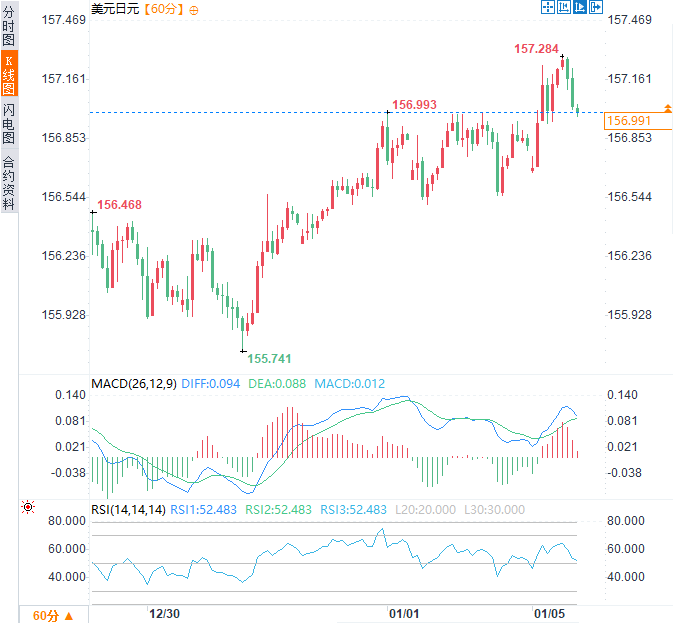
(USD/JPY hourly chart, source: FX678)
Meanwhile, market expectations of further interest rate hikes by the Bank of Japan pushed the yield on benchmark 10-year Japanese government bonds up to 2.133%, a 27-year high.
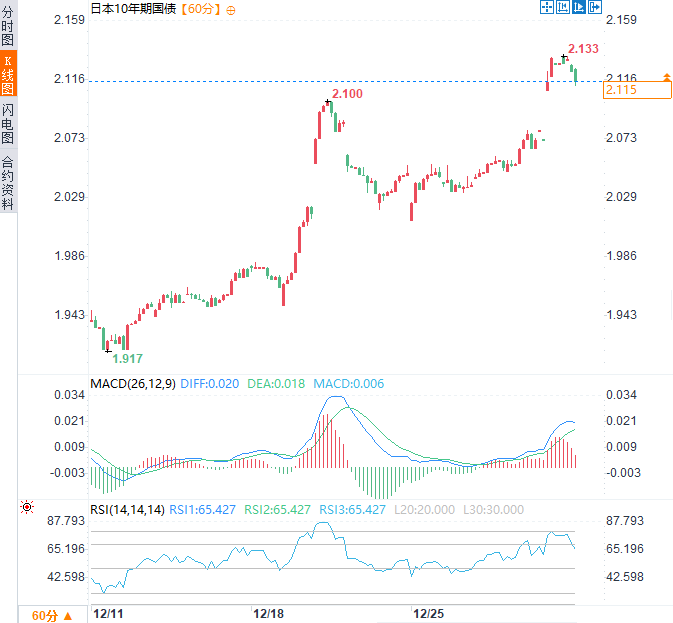
(Hourly chart of 10-year Japanese government bonds, source: EasyForex)
In his remarks at the same event, Finance Minister Satsuki Katayama offered a broader perspective on the current situation. He stated that Japan is at a crucial stage of economic transformation, shifting from a prolonged period of deflation to a growth-driven economic model.
At 15:33 Beijing time, the US dollar was trading at 157.02/03 against the Japanese yen.
Speaking to a lobbying group of Japanese banks, Ueda confirmed that the Japanese economy maintained a moderate recovery last year, withstanding the impact of US tariffs on corporate profits. He stated that he expects wages and prices to rise moderately in tandem, adding that adjusting monetary policy is crucial for achieving sustained economic growth.
A landmark shift in zero interest rate policy
The Bank of Japan governor's remarks followed the central bank's landmark decision last month to raise the policy rate from 0.5% to 0.75%, a 30-year high. This move marked a significant step forward for Japan in unwinding decades of ultra-loose monetary support and near-zero borrowing costs.
Despite interest rate hikes, Japan's real borrowing costs remain deeply negative. Consumer inflation has exceeded the Bank of Japan's 2% target for nearly four consecutive years, putting pressure on further policy tightening.
Markets focus on Bank of Japan report, yen continues to weaken
All eyes are now on the Bank of Japan's quarterly outlook report, to be released at its policy meeting on January 22-23. Investors and analysts will scrutinize it closely for clues about how the policy committee views the recent inflationary pressures stemming from the yen's depreciation.
The weaker yen has pushed up import costs and exacerbated broader inflation, prompting some members of the Bank of Japan's policy board to advocate for further, steady interest rate hikes. This sentiment has already been priced into the market.
Kazuo Ueda's remarks confirmed the long-term upward trend in yen interest rates, which is the fundamental support for its value. However, with global markets still focused on US policy and the Bank of Japan adopting an extremely cautious approach, the yen is unlikely to reverse its weakness immediately. The current impact is that "long-term positive factors are laid, while short-term caution is suppressing performance." Investors should pay more attention to the sustainability of its policy normalization rather than the timing of a single rate hike.
On Monday during the Asian and European sessions, the US dollar rose about 0.13% against the Japanese yen and is currently trading around 157.00. It had previously touched 157.28, the first time since December 23, 2025.
(USD/JPY hourly chart, source: FX678)
Meanwhile, market expectations of further interest rate hikes by the Bank of Japan pushed the yield on benchmark 10-year Japanese government bonds up to 2.133%, a 27-year high.
(Hourly chart of 10-year Japanese government bonds, source: EasyForex)
A key turning point in Japan's transition from deflation to growth
In his remarks at the same event, Finance Minister Satsuki Katayama offered a broader perspective on the current situation. He stated that Japan is at a crucial stage of economic transformation, shifting from a prolonged period of deflation to a growth-driven economic model.
At 15:33 Beijing time, the US dollar was trading at 157.02/03 against the Japanese yen.
- Risk Warning and Disclaimer
- The market involves risk, and trading may not be suitable for all investors. This article is for reference only and does not constitute personal investment advice, nor does it take into account certain users’ specific investment objectives, financial situation, or other needs. Any investment decisions made based on this information are at your own risk.