The US dollar needs a new catalyst, and the yen's status is wavering: a tug-of-war between interest rate differentials and safe-haven demand is unfolding.
2026-01-05 20:35:07
Monday, January 5th. The US dollar remained relatively strong among most major currencies, but the USD/JPY pair saw a more representative intraday reversal: after briefly rising to around 157.30, it retreated, returning to around 156.60 before the US market opened. This indicates that the market's reaction to "safe-haven buying of the dollar" was not linear, and in the short term, it resembled a rebalancing of positions and expectations during the return of liquidity. This article attempts to answer a key question: when both the US dollar and the Japanese yen face structural constraints, why has the USD/JPY pair maintained a relatively large trading range instead of forming a one-sided trend?

Geopolitical events often drive safe-haven demand in the short term, with the US dollar typically benefiting first. However, when the market realizes that the risk has not been transmitted to financial conditions and equity market volatility is limited, such capital flows can easily shift from "chasing safe havens" to "profit-taking on rallies," causing the USD/JPY exchange rate to rise and then fall. In other words, whether the safe-haven logic can be sustained depends on whether the risk spreads to a broader risk aversion, rather than just a single event.
Meanwhile, the dollar's medium-term narrative is not one-way strengthening. In recent times, market pricing in the Fed's policy path has emphasized "data-driven and reassessment," making it difficult for the dollar to sustain a sustained unilateral strengthening without new catalysts. More importantly, this "uncertain but not out of control" environment often leads funds to prefer relatively value investing in highly liquid assets rather than significantly increasing allocations to a single safe-haven currency. Therefore, even if the dollar is generally stronger among major currencies, its performance against the yen may exhibit a more complex rhythm due to positioning structure and expectation differences: upward movement requires new interest rate differentials or increased risk premiums, while pullbacks may stem from profit-taking after the impact of events has diminished.
The contradictions on the yen side are equally prominent, repeatedly testing the traditional framework of the "yen as a natural safe haven." Increased market discussions about Japan's fiscal risks and debt levels, coupled with the tension between expansionary fiscal policy and the Bank of Japan's willingness to further raise interest rates, will weaken the yen's passive appeal in risk events. If fiscal expansion strengthens expectations of inflation and financing pressures, the yen may not be able to attract stable buying interest every time risks escalate, as it has in the past. Conversely, when the Bank of Japan hopes to address prices and expectations through policy normalization, it will be constrained by economic capacity and policy coordination. The result is that the yen oscillates between the identities of a "safe-haven currency" and a "carry trade funding currency," causing its reactions to become inconsistent in different scenarios, and the USD/JPY exchange rate is more likely to exhibit a "rise followed by fall, range-bound" trading pattern.
The most noteworthy aspect of the USD/JPY pair in this round is not its daily direction, but rather its range and pace. The pair fell from around 157.30 to around 156.52 during the day, and is currently hovering around 156.60, reflecting short-term funds' relative caution regarding chasing higher levels. This also indicates that the support below has not significantly collapsed: bulls and bears seem to be waiting for clearer macroeconomic clues to determine the dominant narrative for the next stage.
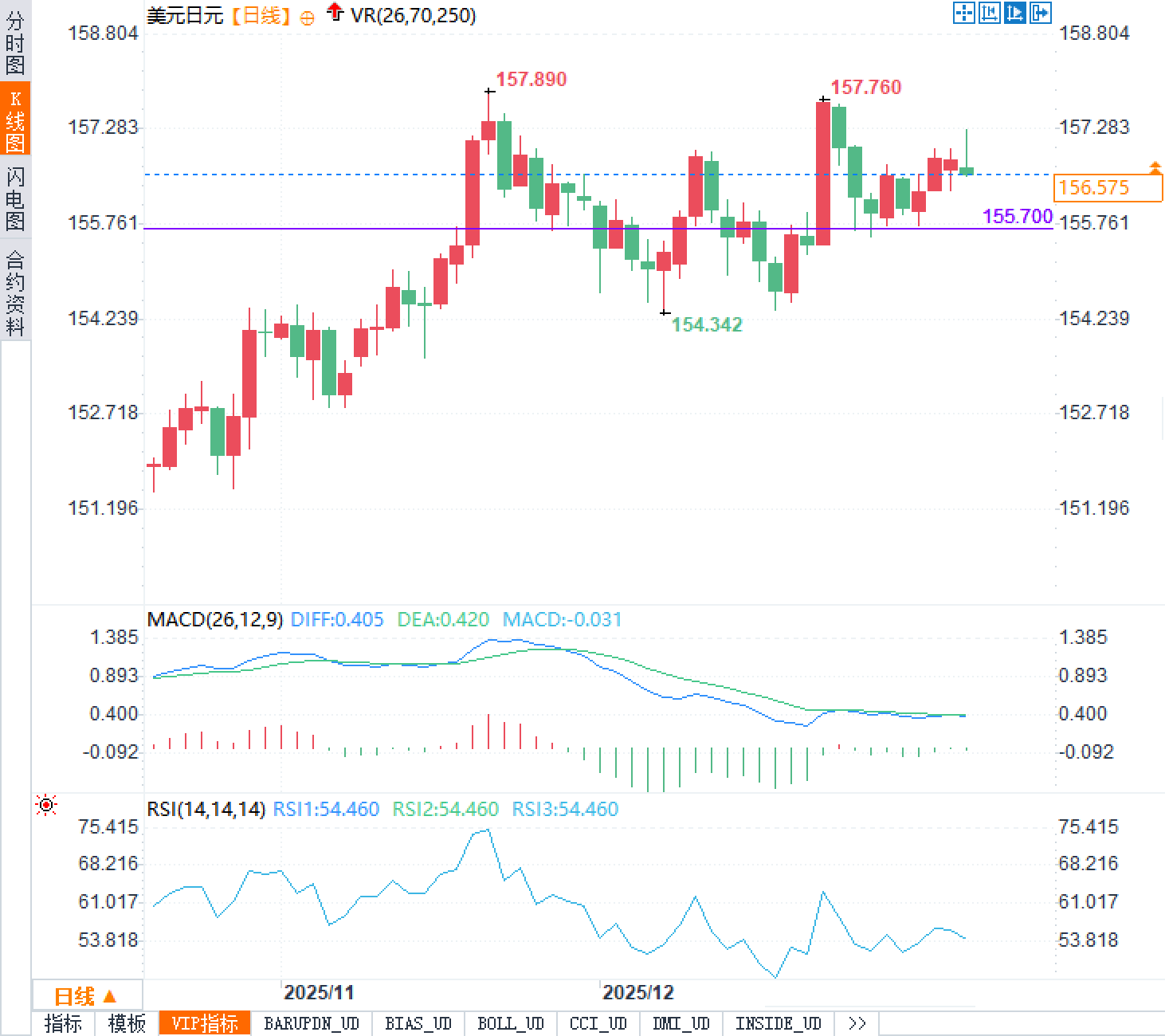
Combining the daily chart and technical indicators, the current price of 156.60 is positioned in the upper-middle part of the trading range over the past two months. Previous highs around 157.760 and 157.890 indicate that the supply zone remains high, and each time the price approaches this area, it is more likely to trigger short-term profit-taking. The area around 154.342 corresponds to the previous low, forming a clearer lower boundary reference for the range. The horizontal level around 155.700 has been repeatedly "seen" by the market recently, and its influence on trading behavior is more sentiment-anchored: when the price fluctuates around this area, the market tends to process the noise by "returning to the range center" rather than immediately following the trend expansion. In terms of momentum, the MACD is close to the zero line and the histogram is slightly weak, reflecting weak trend momentum; the RSI is hovering around 54, indicating that the bullish and bearish forces are closer to equilibrium, consistent with the structural characteristics of "fluctuations exist, but the direction is not firm." Technical and macroeconomic factors complement each other here: in the absence of a single strong driver, prices are more likely to digest the divergence through a longer period of consolidation rather than quickly drawing a trend conclusion.
The current USD/JPY exchange rate is a result of the combined effects of short-term geopolitical shocks and medium-term divergences under policy and fiscal constraints. Geopolitical disturbances can boost safe-haven demand in the short term, but if risk assets do not decline in tandem, the safe-haven premium can easily be diluted. After the main themes return to normalcy, the market will re-examine the policy paths of the Federal Reserve and the Bank of Japan, as well as the coordination challenges between fiscal expansion and interest rate normalization in Japan. Overall, the hovering around 156.60 does not simply indicate the relative strength of bulls and bears, but rather reflects the market's confirmation of whether the safe-haven logic can continue, whether the interest rate differential logic can regain its dominance, and whether the yen's "safe haven" status will remain stable and attractive under the new fiscal and policy mix.
Geopolitical events often drive safe-haven demand in the short term, with the US dollar typically benefiting first. However, when the market realizes that the risk has not been transmitted to financial conditions and equity market volatility is limited, such capital flows can easily shift from "chasing safe havens" to "profit-taking on rallies," causing the USD/JPY exchange rate to rise and then fall. In other words, whether the safe-haven logic can be sustained depends on whether the risk spreads to a broader risk aversion, rather than just a single event.
Meanwhile, the dollar's medium-term narrative is not one-way strengthening. In recent times, market pricing in the Fed's policy path has emphasized "data-driven and reassessment," making it difficult for the dollar to sustain a sustained unilateral strengthening without new catalysts. More importantly, this "uncertain but not out of control" environment often leads funds to prefer relatively value investing in highly liquid assets rather than significantly increasing allocations to a single safe-haven currency. Therefore, even if the dollar is generally stronger among major currencies, its performance against the yen may exhibit a more complex rhythm due to positioning structure and expectation differences: upward movement requires new interest rate differentials or increased risk premiums, while pullbacks may stem from profit-taking after the impact of events has diminished.
The contradictions on the yen side are equally prominent, repeatedly testing the traditional framework of the "yen as a natural safe haven." Increased market discussions about Japan's fiscal risks and debt levels, coupled with the tension between expansionary fiscal policy and the Bank of Japan's willingness to further raise interest rates, will weaken the yen's passive appeal in risk events. If fiscal expansion strengthens expectations of inflation and financing pressures, the yen may not be able to attract stable buying interest every time risks escalate, as it has in the past. Conversely, when the Bank of Japan hopes to address prices and expectations through policy normalization, it will be constrained by economic capacity and policy coordination. The result is that the yen oscillates between the identities of a "safe-haven currency" and a "carry trade funding currency," causing its reactions to become inconsistent in different scenarios, and the USD/JPY exchange rate is more likely to exhibit a "rise followed by fall, range-bound" trading pattern.
Market performance
The most noteworthy aspect of the USD/JPY pair in this round is not its daily direction, but rather its range and pace. The pair fell from around 157.30 to around 156.52 during the day, and is currently hovering around 156.60, reflecting short-term funds' relative caution regarding chasing higher levels. This also indicates that the support below has not significantly collapsed: bulls and bears seem to be waiting for clearer macroeconomic clues to determine the dominant narrative for the next stage.
Combining the daily chart and technical indicators, the current price of 156.60 is positioned in the upper-middle part of the trading range over the past two months. Previous highs around 157.760 and 157.890 indicate that the supply zone remains high, and each time the price approaches this area, it is more likely to trigger short-term profit-taking. The area around 154.342 corresponds to the previous low, forming a clearer lower boundary reference for the range. The horizontal level around 155.700 has been repeatedly "seen" by the market recently, and its influence on trading behavior is more sentiment-anchored: when the price fluctuates around this area, the market tends to process the noise by "returning to the range center" rather than immediately following the trend expansion. In terms of momentum, the MACD is close to the zero line and the histogram is slightly weak, reflecting weak trend momentum; the RSI is hovering around 54, indicating that the bullish and bearish forces are closer to equilibrium, consistent with the structural characteristics of "fluctuations exist, but the direction is not firm." Technical and macroeconomic factors complement each other here: in the absence of a single strong driver, prices are more likely to digest the divergence through a longer period of consolidation rather than quickly drawing a trend conclusion.
In summary
The current USD/JPY exchange rate is a result of the combined effects of short-term geopolitical shocks and medium-term divergences under policy and fiscal constraints. Geopolitical disturbances can boost safe-haven demand in the short term, but if risk assets do not decline in tandem, the safe-haven premium can easily be diluted. After the main themes return to normalcy, the market will re-examine the policy paths of the Federal Reserve and the Bank of Japan, as well as the coordination challenges between fiscal expansion and interest rate normalization in Japan. Overall, the hovering around 156.60 does not simply indicate the relative strength of bulls and bears, but rather reflects the market's confirmation of whether the safe-haven logic can continue, whether the interest rate differential logic can regain its dominance, and whether the yen's "safe haven" status will remain stable and attractive under the new fiscal and policy mix.
- Risk Warning and Disclaimer
- The market involves risk, and trading may not be suitable for all investors. This article is for reference only and does not constitute personal investment advice, nor does it take into account certain users’ specific investment objectives, financial situation, or other needs. Any investment decisions made based on this information are at your own risk.