Employment data fuels expectations of an interest rate cut, putting the dollar at a crucial juncture with support at 98.30.
2026-01-07 21:49:38
On Wednesday (January 7), the highly anticipated US ADP private sector employment report was released as scheduled. Data showed that US private sector employment increased by 41,000 in December 2025, a significant rebound from the previous figure (revised to a decrease of 29,000), but lower than the market consensus of around 50,000. Regarding wages, the year-on-year wage growth rate for those remaining employed remained at 4.4%, unchanged from November; while the wage growth rate for those changing jobs rose slightly from 6.3% to 6.6%. This report, based on anonymous pay data from over 26 million employees, clearly depicts a labor market that, while halting its decline, shows significantly insufficient growth momentum and internal structural divergence. Following the data release, financial markets reacted swiftly, with investors making a new round of pricing adjustments to their expectations for the US economic outlook and the Federal Reserve's policy path.

A deeper analysis of the December ADP report reveals many noteworthy details hidden beneath the seemingly overall rebound.
Significant industry divergence was observed: the service sector was the main contributor to job growth, adding 44,000 jobs. Education/health services (+39,000) and leisure/hospitality (+24,000) performed strongly, reflecting the relatively inelastic demand in these sectors. However, goods-producing industries as a whole lost 3,000 jobs, with manufacturing continuing its downward trend, losing 5,000. Particularly noteworthy was the significant decrease of 29,000 jobs in professional/business services, considered a barometer of the economy, and a further 12,000 in the information technology sector, potentially indicating a weakening of corporate capital expenditure and expansionary intentions.
Regional imbalances are prominent: While the South (+54,000) and Northeast (+40,000) saw robust employment growth, the West experienced a sharp decline of 61,000 jobs, with the Pacific region alone seeing a decrease of 59,000. This significant regional disparity likely reflects a divergence in industrial structure and economic vitality across different regions, warranting further attention.
Wage growth is stabilizing: Wage data signals a marginal easing of inflationary pressures. Overall, wage growth for those remaining employed remained flat at 4.4%. By sector, manufacturing maintained at 4.8%, financial services at 5.2%, while construction, trade/transportation/utilities, and professional/business services saw slight declines. While wage growth for job-hoppers accelerated somewhat, the absolute level is significantly lower than the mid-year peak. This suggests that the supply and demand imbalance in the labor market may be easing, helping to alleviate the upward pressure of the wage-price spiral.
The immediate reaction of the financial markets after the data release was consistent with the characteristic of "the data falling short of expectations but not to the point of disaster," and the overall interpretation was dovish.
Bond Market: The Treasury market, most sensitive to interest rate prospects, reacted first. The 10-year Treasury yield, already lower due to other factors before the data release, continued its decline afterward, falling approximately 3.9 basis points to close around 4.14%. This indicates that investors view weak job growth as further evidence of an economic slowdown, thus strengthening expectations for future interest rate cuts by the Federal Reserve.
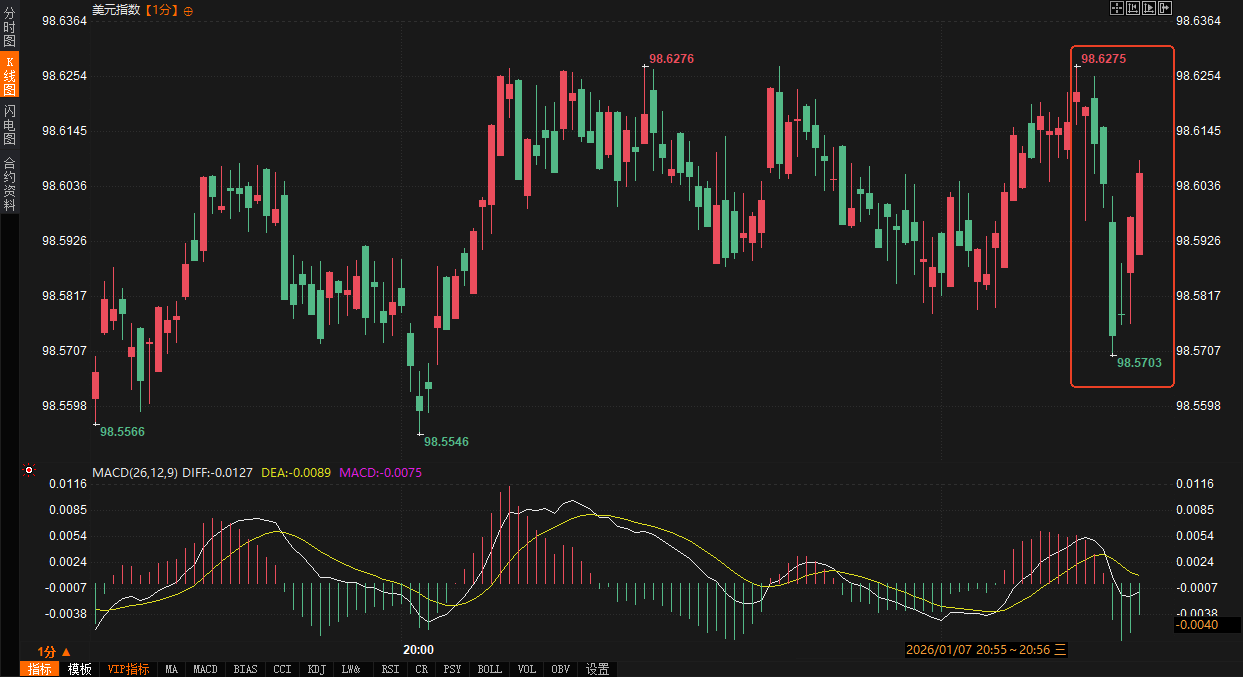
Foreign Exchange Market: The US dollar index fluctuated only slightly after the data release, moving by about 2 points, and ultimately settled at around 98.61, maintaining a narrow range of fluctuation at a relatively low level this week. The dollar failed to gain upward momentum from the data, reflecting the market's view that the weak employment data reduced the likelihood of the Federal Reserve turning hawkish more quickly or delaying rate cuts, thus weakening expectations of the dollar's interest rate advantage.
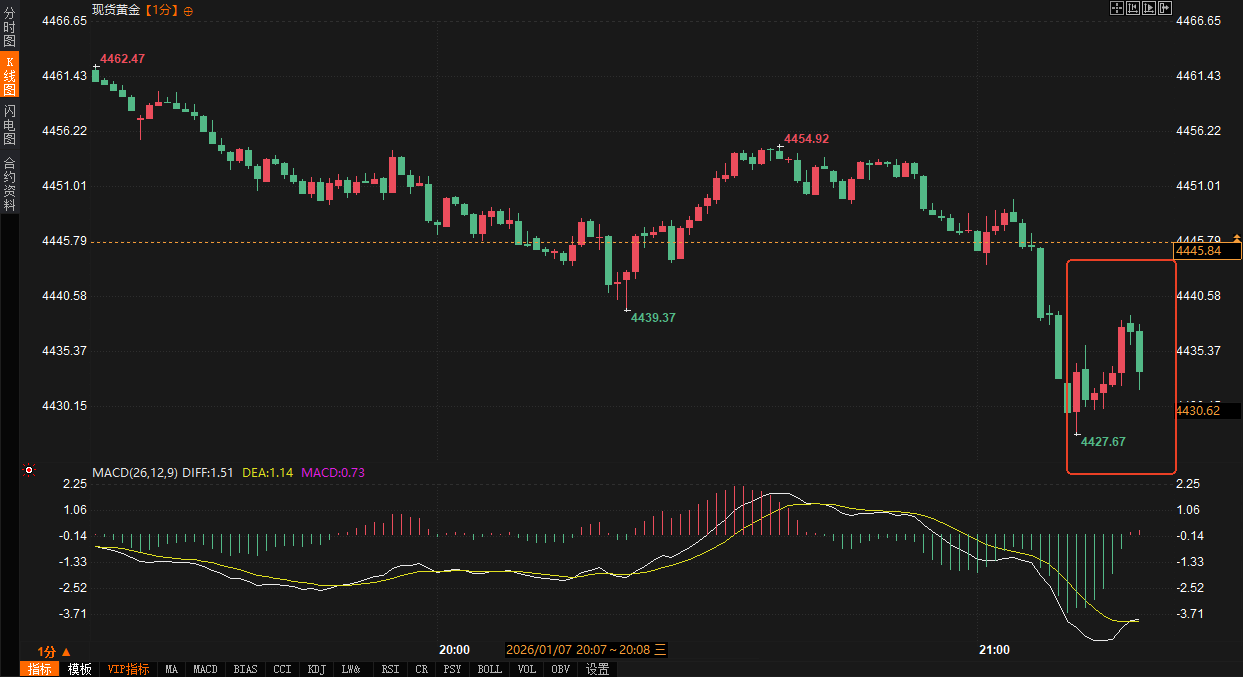
Market Sentiment Shift: Prior to the data release, some market participants anticipated a stronger rebound in employment (such as the expected 50,000). While the actual data was positive, it fell short of expectations, causing market sentiment to shift from "optimistic expectations of a rebound" to "cautious assessment of resilience." An analyst from a well-known institution noted in a report that the data "confirms that the labor market is cooling in an orderly manner, rather than experiencing a precipitous decline," providing the Federal Reserve with room to launch easing policies if necessary, consistent with current market pricing in expectations of a rate cut this year. Another analytical perspective suggests that the weak ADP performance increases the likelihood that Friday's official non-farm payroll data will also fall short of strong expectations, and market attention has completely shifted to subsequent data to confirm the trend.
The current market trend is the result of the combined effect of fundamental data and technical patterns.
From a fundamental perspective, weak ADP employment growth, coupled with stable wage growth, reinforces the narrative that the US economy is experiencing a moderate slowdown. This helps to curb inflation expectations and creates conditions for a shift in the Federal Reserve's monetary policy. Recently, economic concerns from Europe and uncertainties arising from geopolitical situations (such as the Russia-Ukraine conflict), along with trade environment anxieties triggered by tariff rhetoric, have collectively created a risk-averse atmosphere, driving funds into assets such as US Treasuries and lowering yields. This, combined with the impact of weak employment data, creates a synergistic effect.
From a technical analysis perspective, taking the US dollar index as an example, its short-term trend continued to be suppressed after the ADP data release. Referring to the price movements of major US dollar index futures contracts, the key short-term support zone is located in the 98.30-98.50 area. The logic behind this zone is that it not only represents a technical level that has been tested multiple times recently, but also corresponds to a psychological support level formed when market disappointment with economic data intensified. If subsequent data (especially non-farm payrolls) is further weak, or if global safe-haven demand weakens temporarily, the US dollar index may test this zone. The primary resistance zone above is located in the 99.00-99.20 area, which is a cluster of previous rebound highs and a key threshold for the US dollar index to shift from weakness to neutral. Unless future US economic data (such as inflation and retail sales) continues to exceed expectations, it will be difficult to effectively break through this resistance in the short term.
Key points to watch during the trading session include: First, the further movement of US Treasury yields. If the 10-year yield effectively falls below 4.10% and seeks support at 4.0%, it may strengthen the downward pressure on the US dollar. Second, observe the coordinated reactions of major currency pairs such as EUR/USD and USD/JPY to determine whether the dollar weakness is widespread or localized. Third, pay attention to subtle changes in market expectations for Friday's non-farm payroll report. Any adjustment in expectations may trigger volatility in advance positioning or position adjustments.
Looking ahead, the December ADP report set a "moderately cooling" tone for the US labor market in the final month of 2025, but this is just one data point. Market focus has quickly shifted to the official non-farm payroll report due on Friday. If the non-farm payroll data also shows slower job growth and moderate wage inflation, it will significantly strengthen market expectations that the Federal Reserve will begin a rate-cutting cycle in the first half of the year, potentially leading to a further flattening of the US Treasury yield curve and the dollar maintaining a weak and volatile pattern.
However, it's important to recognize that ADP data is inherently volatile and differs from official non-farm payroll statistics. Structural demand in service sectors such as education and healthcare continues to provide fundamental support. Therefore, assessing the overall picture of the labor market and the economy requires a comprehensive evaluation, incorporating subsequent data such as JOLTS job openings, the ISM Services PMI, the Consumer Confidence Index, and the core PCE price index.
This weaker-than-expected ADP employment report, like a pebble thrown into a calm lake, has stirred renewed market reflection on an economic slowdown and policy shift. While it doesn't change the fundamental fact that the economy is still growing, it reinforces signals of weakening growth momentum. With inflation already declining from its highs, any signs of weakness in the labor market could be amplified by the market and translated into bets on the Federal Reserve cutting interest rates sooner or more aggressively. In the coming period, the market will likely oscillate between expectations of a "soft landing" and a "mild recession," and the release of each key data point could become a catalyst for short-term volatility.
Detailed Data Analysis: Mild Rebound Fails to Mask Structural Weakness
A deeper analysis of the December ADP report reveals many noteworthy details hidden beneath the seemingly overall rebound.
Significant industry divergence was observed: the service sector was the main contributor to job growth, adding 44,000 jobs. Education/health services (+39,000) and leisure/hospitality (+24,000) performed strongly, reflecting the relatively inelastic demand in these sectors. However, goods-producing industries as a whole lost 3,000 jobs, with manufacturing continuing its downward trend, losing 5,000. Particularly noteworthy was the significant decrease of 29,000 jobs in professional/business services, considered a barometer of the economy, and a further 12,000 in the information technology sector, potentially indicating a weakening of corporate capital expenditure and expansionary intentions.
Regional imbalances are prominent: While the South (+54,000) and Northeast (+40,000) saw robust employment growth, the West experienced a sharp decline of 61,000 jobs, with the Pacific region alone seeing a decrease of 59,000. This significant regional disparity likely reflects a divergence in industrial structure and economic vitality across different regions, warranting further attention.
Wage growth is stabilizing: Wage data signals a marginal easing of inflationary pressures. Overall, wage growth for those remaining employed remained flat at 4.4%. By sector, manufacturing maintained at 4.8%, financial services at 5.2%, while construction, trade/transportation/utilities, and professional/business services saw slight declines. While wage growth for job-hoppers accelerated somewhat, the absolute level is significantly lower than the mid-year peak. This suggests that the supply and demand imbalance in the labor market may be easing, helping to alleviate the upward pressure of the wage-price spiral.
Market reaction: Bonds led the gains, the dollar came under pressure, and sentiment turned dovish.
The immediate reaction of the financial markets after the data release was consistent with the characteristic of "the data falling short of expectations but not to the point of disaster," and the overall interpretation was dovish.
Bond Market: The Treasury market, most sensitive to interest rate prospects, reacted first. The 10-year Treasury yield, already lower due to other factors before the data release, continued its decline afterward, falling approximately 3.9 basis points to close around 4.14%. This indicates that investors view weak job growth as further evidence of an economic slowdown, thus strengthening expectations for future interest rate cuts by the Federal Reserve.
Foreign Exchange Market: The US dollar index fluctuated only slightly after the data release, moving by about 2 points, and ultimately settled at around 98.61, maintaining a narrow range of fluctuation at a relatively low level this week. The dollar failed to gain upward momentum from the data, reflecting the market's view that the weak employment data reduced the likelihood of the Federal Reserve turning hawkish more quickly or delaying rate cuts, thus weakening expectations of the dollar's interest rate advantage.
Market Sentiment Shift: Prior to the data release, some market participants anticipated a stronger rebound in employment (such as the expected 50,000). While the actual data was positive, it fell short of expectations, causing market sentiment to shift from "optimistic expectations of a rebound" to "cautious assessment of resilience." An analyst from a well-known institution noted in a report that the data "confirms that the labor market is cooling in an orderly manner, rather than experiencing a precipitous decline," providing the Federal Reserve with room to launch easing policies if necessary, consistent with current market pricing in expectations of a rate cut this year. Another analytical perspective suggests that the weak ADP performance increases the likelihood that Friday's official non-farm payroll data will also fall short of strong expectations, and market attention has completely shifted to subsequent data to confirm the trend.
Market Outlook Based on a Combination of Technical and Fundamental Analysis
The current market trend is the result of the combined effect of fundamental data and technical patterns.
From a fundamental perspective, weak ADP employment growth, coupled with stable wage growth, reinforces the narrative that the US economy is experiencing a moderate slowdown. This helps to curb inflation expectations and creates conditions for a shift in the Federal Reserve's monetary policy. Recently, economic concerns from Europe and uncertainties arising from geopolitical situations (such as the Russia-Ukraine conflict), along with trade environment anxieties triggered by tariff rhetoric, have collectively created a risk-averse atmosphere, driving funds into assets such as US Treasuries and lowering yields. This, combined with the impact of weak employment data, creates a synergistic effect.
From a technical analysis perspective, taking the US dollar index as an example, its short-term trend continued to be suppressed after the ADP data release. Referring to the price movements of major US dollar index futures contracts, the key short-term support zone is located in the 98.30-98.50 area. The logic behind this zone is that it not only represents a technical level that has been tested multiple times recently, but also corresponds to a psychological support level formed when market disappointment with economic data intensified. If subsequent data (especially non-farm payrolls) is further weak, or if global safe-haven demand weakens temporarily, the US dollar index may test this zone. The primary resistance zone above is located in the 99.00-99.20 area, which is a cluster of previous rebound highs and a key threshold for the US dollar index to shift from weakness to neutral. Unless future US economic data (such as inflation and retail sales) continues to exceed expectations, it will be difficult to effectively break through this resistance in the short term.
Key points to watch during the trading session include: First, the further movement of US Treasury yields. If the 10-year yield effectively falls below 4.10% and seeks support at 4.0%, it may strengthen the downward pressure on the US dollar. Second, observe the coordinated reactions of major currency pairs such as EUR/USD and USD/JPY to determine whether the dollar weakness is widespread or localized. Third, pay attention to subtle changes in market expectations for Friday's non-farm payroll report. Any adjustment in expectations may trigger volatility in advance positioning or position adjustments.
Future Trend Outlook: Focus on Non-Farm Payroll Verification and Economic Data Chain
Looking ahead, the December ADP report set a "moderately cooling" tone for the US labor market in the final month of 2025, but this is just one data point. Market focus has quickly shifted to the official non-farm payroll report due on Friday. If the non-farm payroll data also shows slower job growth and moderate wage inflation, it will significantly strengthen market expectations that the Federal Reserve will begin a rate-cutting cycle in the first half of the year, potentially leading to a further flattening of the US Treasury yield curve and the dollar maintaining a weak and volatile pattern.
However, it's important to recognize that ADP data is inherently volatile and differs from official non-farm payroll statistics. Structural demand in service sectors such as education and healthcare continues to provide fundamental support. Therefore, assessing the overall picture of the labor market and the economy requires a comprehensive evaluation, incorporating subsequent data such as JOLTS job openings, the ISM Services PMI, the Consumer Confidence Index, and the core PCE price index.
This weaker-than-expected ADP employment report, like a pebble thrown into a calm lake, has stirred renewed market reflection on an economic slowdown and policy shift. While it doesn't change the fundamental fact that the economy is still growing, it reinforces signals of weakening growth momentum. With inflation already declining from its highs, any signs of weakness in the labor market could be amplified by the market and translated into bets on the Federal Reserve cutting interest rates sooner or more aggressively. In the coming period, the market will likely oscillate between expectations of a "soft landing" and a "mild recession," and the release of each key data point could become a catalyst for short-term volatility.
- Risk Warning and Disclaimer
- The market involves risk, and trading may not be suitable for all investors. This article is for reference only and does not constitute personal investment advice, nor does it take into account certain users’ specific investment objectives, financial situation, or other needs. Any investment decisions made based on this information are at your own risk.