Despite $6.7 billion in selling pressure, gold remains strong! Is a rise likely regardless of the non-farm payrolls report?
2026-01-09 21:17:03
On Friday (January 9), spot gold (XAU/USD) barely held above the 5-day moving average during the Asian and European sessions. Under the influence of multiple factors, it failed to accumulate substantial upward momentum and maintained a defensive and volatile trend overall.
Compared to silver and copper, gold's recent gains have been somewhat restrained, and technically it is consolidating strongly above the 5-day moving average, making a new high highly likely.
Traders are focusing on the US non-farm payrolls report, trying to find clear clues about a Fed rate cut. The strengthening dollar and commodity index rebalancing pressure, along with expectations of a dovish Fed policy and geopolitical risks, are offsetting each other and jointly dominating the short-term trading logic for gold.
The dollar continued to strengthen ahead of the crucial US non-farm payrolls report, suggesting that the non-farm payrolls data might exceed expectations, causing gold to hesitate to make any moves.
But is this employment data really that important for gold? Due to Trump's interference in the White House, even if the employment data exceeds expectations, the White House still has a reason to make the Federal Reserve cut interest rates, which will ultimately affect the weakening of the dollar and inject new momentum into gold, which has no yield attribute.
In other words, if the non-farm payroll data is lower than expected, the US dollar index is likely to pull back, and the probability of a Fed rate cut increases, which is good for gold. If the non-farm payroll data is better than expected, the dollar has already risen in advance to reflect the positive impact of the non-farm payroll data, so gold will also rise in the opposite direction as the dollar index falls due to the realization of the positive impact of the dollar index.
Market expectations indicate that the U.S. economy added 60,000 jobs in December, down from 64,000 in the previous month; the unemployment rate is expected to fall slightly to 4.5% from 4.6% in November.
Meanwhile, regardless of whether the non-farm payroll data is better than expected, if it remains within a relatively low range, it indicates that the US economy is contracting. Therefore, the market is paying more attention to the unemployment rate, as it is crucial for calculating the US neutral interest rate. A rising unemployment rate implies a downward shift in the observed neutral interest rate, so a falling unemployment rate may be the only negative factor for gold.
Meanwhile, before the Federal Reserve makes its interest rate decision, regardless of the non-farm payroll data, they will need to refer to the Beige Book jointly released by the regional Federal Reserves next week to observe employment and inflation in various regions of the United States. In addition, the US will release the CPI next week, which can be used to verify the Beige Book. Therefore, regardless of the non-farm payroll data, as long as gold pulls back because of the non-farm payroll data, it will be a point where a rebound is highly likely.
However, the bullish factors supporting gold should not be ignored. U.S. Treasury Secretary Scott Bessant clearly stated that interest rate cuts are the only missing element to drive stronger economic growth, and the Federal Reserve should not delay the process of interest rate cuts.
Against this backdrop, traders have begun pricing in the possibility of the Federal Reserve starting a rate cut in March and further reducing rates later in the year, an expectation that has become a key cornerstone supporting gold prices.
At the same time, the significant increase in geopolitical uncertainty has also provided strong support for this safe-haven asset.
Trump stated that he expects the United States to take control of Venezuela in the coming years and exploit its vast oil reserves, and expectations of US military action against Venezuela continue to escalate.
German Chancellor Friedrich Merz also pointed out that the nearly four-year-long war between Russia and Ukraine is unlikely to end in the short term, and the plan to deploy European troops to Ukraine carries significant risks.
The largest clashes between Israel and Hezbollah since 2006, Russia's saturation missile and drone strikes against Ukraine, and Ukraine's counterattacks are all recent geopolitical events.
Multiple geopolitical risks have increased market demand for gold as a safe-haven asset.
Besides policy and geopolitical factors, the annual rebalancing of the commodity index has become another key variable suppressing gold prices. On Thursday, spot gold prices came under pressure and declined. The core reason was that traders were preparing for a large-scale sell-off of gold futures in order to cooperate with the commodity index rebalancing, coupled with the relatively strong dollar weakening the demand for gold allocation.
According to Citigroup's calculations, based on fund data from the Bloomberg Commodity Index and the S&P GSCI Commodity Index, the liquidation volume of gold futures is expected to reach $6.8 billion between January 9 and January 15.
Gold is projected to record a historic increase of over 60% by 2025, far exceeding the average annual return of 9%-14% over the past decade. This makes this year's commodity index rebalancing a landmark market event. Citigroup strategist Kenny Hoogewerf stated bluntly, "I have been working in this field for many years and have never seen such a large-scale flow of funds."
In addition, some traders began closing out previous long positions and locking in profits as concerns about geopolitical risks related to Venezuela eased, which further exacerbated the weakness in gold prices.
It is worth noting that the short-term downward pressure on gold prices has not changed the core fundamental support logic for gold. I have been emphasizing the industrial attributes of precious metals. The recent correction in US tech stocks has been synchronized with precious metals. Therefore, once the market bets that the correction in US stocks has ended, precious metals may start to rise ahead of time.
The core factors driving gold price increases in 2025 include continued gold purchases by central banks, the start of the Federal Reserve's interest rate cut cycle, and a weak dollar, coupled with the expectation that new industrial demand will remain stable.
Market analysts believe that this pullback triggered by index rebalancing may actually push gold prices back to key support levels and value allocation ranges, providing opportunities for long-term bulls to position themselves.
Meanwhile, Asian gold stocks also performed well, even though spot gold did not rise significantly, which proves that the market is still actively positioning itself for future gold price increases.
From a technical perspective, spot gold has seen the smallest recent gains among silver, copper, and aluminum. Its technical pattern is also relatively healthy, having held above the 5-day moving average and standing above the 4434 level, a key support/resistance level. Going forward, gold may have the opportunity to continue its upward trend, potentially reaching new highs, as the US dollar index corrects or the Nasdaq consolidates and begins its upward climb.
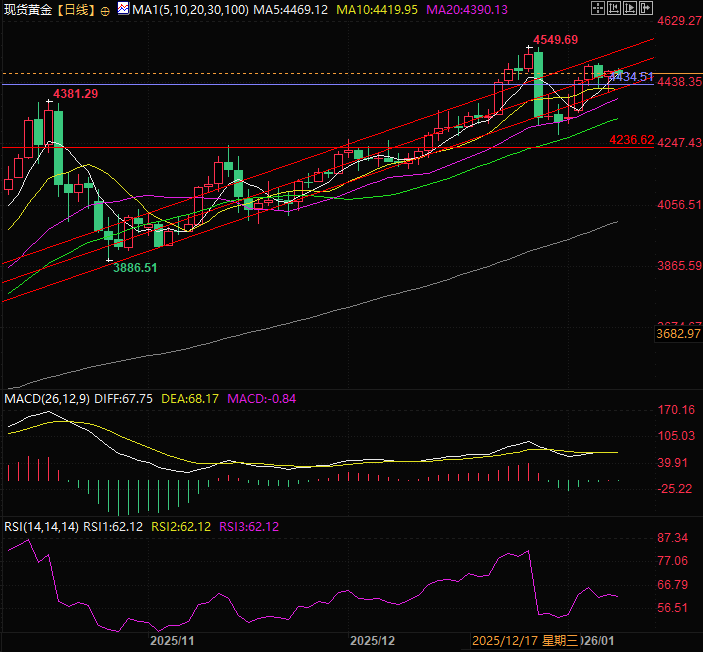
(Spot gold daily chart, source: FX678)
At 21:15 Beijing time, spot gold was trading at $4,465 per ounce.
Compared to silver and copper, gold's recent gains have been somewhat restrained, and technically it is consolidating strongly above the 5-day moving average, making a new high highly likely.
Traders are focusing on the US non-farm payrolls report, trying to find clear clues about a Fed rate cut. The strengthening dollar and commodity index rebalancing pressure, along with expectations of a dovish Fed policy and geopolitical risks, are offsetting each other and jointly dominating the short-term trading logic for gold.
Ahead of the non-farm payroll report, a wait-and-see attitude prevailed, and a stronger dollar weighed on gold prices.
The dollar continued to strengthen ahead of the crucial US non-farm payrolls report, suggesting that the non-farm payrolls data might exceed expectations, causing gold to hesitate to make any moves.
But is this employment data really that important for gold? Due to Trump's interference in the White House, even if the employment data exceeds expectations, the White House still has a reason to make the Federal Reserve cut interest rates, which will ultimately affect the weakening of the dollar and inject new momentum into gold, which has no yield attribute.
In other words, if the non-farm payroll data is lower than expected, the US dollar index is likely to pull back, and the probability of a Fed rate cut increases, which is good for gold. If the non-farm payroll data is better than expected, the dollar has already risen in advance to reflect the positive impact of the non-farm payroll data, so gold will also rise in the opposite direction as the dollar index falls due to the realization of the positive impact of the dollar index.
Market expectations indicate that the U.S. economy added 60,000 jobs in December, down from 64,000 in the previous month; the unemployment rate is expected to fall slightly to 4.5% from 4.6% in November.
Meanwhile, regardless of whether the non-farm payroll data is better than expected, if it remains within a relatively low range, it indicates that the US economy is contracting. Therefore, the market is paying more attention to the unemployment rate, as it is crucial for calculating the US neutral interest rate. A rising unemployment rate implies a downward shift in the observed neutral interest rate, so a falling unemployment rate may be the only negative factor for gold.
Meanwhile, before the Federal Reserve makes its interest rate decision, regardless of the non-farm payroll data, they will need to refer to the Beige Book jointly released by the regional Federal Reserves next week to observe employment and inflation in various regions of the United States. In addition, the US will release the CPI next week, which can be used to verify the Beige Book. Therefore, regardless of the non-farm payroll data, as long as gold pulls back because of the non-farm payroll data, it will be a point where a rebound is highly likely.
Interest rate cut expectations and geopolitical risks form a support line for gold.
However, the bullish factors supporting gold should not be ignored. U.S. Treasury Secretary Scott Bessant clearly stated that interest rate cuts are the only missing element to drive stronger economic growth, and the Federal Reserve should not delay the process of interest rate cuts.
Against this backdrop, traders have begun pricing in the possibility of the Federal Reserve starting a rate cut in March and further reducing rates later in the year, an expectation that has become a key cornerstone supporting gold prices.
At the same time, the significant increase in geopolitical uncertainty has also provided strong support for this safe-haven asset.
Trump stated that he expects the United States to take control of Venezuela in the coming years and exploit its vast oil reserves, and expectations of US military action against Venezuela continue to escalate.
German Chancellor Friedrich Merz also pointed out that the nearly four-year-long war between Russia and Ukraine is unlikely to end in the short term, and the plan to deploy European troops to Ukraine carries significant risks.
The largest clashes between Israel and Hezbollah since 2006, Russia's saturation missile and drone strikes against Ukraine, and Ukraine's counterattacks are all recent geopolitical events.
Multiple geopolitical risks have increased market demand for gold as a safe-haven asset.
Index rebalancing triggered selling pressure, putting short-term downward pressure on gold prices.
Besides policy and geopolitical factors, the annual rebalancing of the commodity index has become another key variable suppressing gold prices. On Thursday, spot gold prices came under pressure and declined. The core reason was that traders were preparing for a large-scale sell-off of gold futures in order to cooperate with the commodity index rebalancing, coupled with the relatively strong dollar weakening the demand for gold allocation.
According to Citigroup's calculations, based on fund data from the Bloomberg Commodity Index and the S&P GSCI Commodity Index, the liquidation volume of gold futures is expected to reach $6.8 billion between January 9 and January 15.
Gold is projected to record a historic increase of over 60% by 2025, far exceeding the average annual return of 9%-14% over the past decade. This makes this year's commodity index rebalancing a landmark market event. Citigroup strategist Kenny Hoogewerf stated bluntly, "I have been working in this field for many years and have never seen such a large-scale flow of funds."
In addition, some traders began closing out previous long positions and locking in profits as concerns about geopolitical risks related to Venezuela eased, which further exacerbated the weakness in gold prices.
Summary and Technical Analysis:
It is worth noting that the short-term downward pressure on gold prices has not changed the core fundamental support logic for gold. I have been emphasizing the industrial attributes of precious metals. The recent correction in US tech stocks has been synchronized with precious metals. Therefore, once the market bets that the correction in US stocks has ended, precious metals may start to rise ahead of time.
The core factors driving gold price increases in 2025 include continued gold purchases by central banks, the start of the Federal Reserve's interest rate cut cycle, and a weak dollar, coupled with the expectation that new industrial demand will remain stable.
Market analysts believe that this pullback triggered by index rebalancing may actually push gold prices back to key support levels and value allocation ranges, providing opportunities for long-term bulls to position themselves.
Meanwhile, Asian gold stocks also performed well, even though spot gold did not rise significantly, which proves that the market is still actively positioning itself for future gold price increases.
From a technical perspective, spot gold has seen the smallest recent gains among silver, copper, and aluminum. Its technical pattern is also relatively healthy, having held above the 5-day moving average and standing above the 4434 level, a key support/resistance level. Going forward, gold may have the opportunity to continue its upward trend, potentially reaching new highs, as the US dollar index corrects or the Nasdaq consolidates and begins its upward climb.
(Spot gold daily chart, source: FX678)
At 21:15 Beijing time, spot gold was trading at $4,465 per ounce.
- Risk Warning and Disclaimer
- The market involves risk, and trading may not be suitable for all investors. This article is for reference only and does not constitute personal investment advice, nor does it take into account certain users’ specific investment objectives, financial situation, or other needs. Any investment decisions made based on this information are at your own risk.