Crude oil trading alert: Expectations of ample supply continue to put downward pressure on oil prices, and US crude oil may open up further downside potential.
2026-01-08 09:27:44
International oil prices fluctuated slightly during Asian trading hours on Thursday, trading around $56.40 per barrel, as investors digested US President Trump's latest statement that the US had reached an agreement to import up to $2 billion worth of Venezuelan crude oil.
The market generally believes that this move will increase the supply of crude oil from the world's largest oil consumer, thereby reinforcing expectations of ample global supply this year.
Market research indicates that the initial arrangements between Washington and Caracas may require diverting oil tankers originally destined for Asian countries. Since Trump imposed the export blockade in mid-December, millions of barrels of Venezuelan crude oil have been stranded on tankers and in storage facilities, unable to enter the international market.

Trump said on social media on Tuesday that Venezuela would "hand over" 30 to 50 million barrels of "sanctioned oil" to the United States.
SEB commodities analyst Ole Hwalbi points out: "From a broader perspective, this is not a large amount. The U.S. Strategic Petroleum Reserve is currently around 413 million barrels, so 30 million or 50 million barrels is relatively limited."
Meanwhile, geopolitical risks have not completely subsided. Two U.S. officials revealed on Wednesday that the U.S. is attempting to seize an oil tanker linked to Venezuela. The tanker had previously escaped during operations against sanctioned vessels and refused boarding by the U.S. Coast Guard; incidents were seen as potentially escalating regional tensions, but market reaction was relatively limited.
On the fundamental data front, the U.S. Energy Information Administration (EIA) reported that U.S. crude oil inventories fell by 3.8 million barrels to 419.1 million barrels in the week ending January 2, significantly better than the market's previous expectation of an increase of 447,000 barrels, providing some support for oil prices.
However, gasoline inventories increased by 7.7 million barrels and distillate fuel inventories increased by 5.6 million barrels during the same period, both significantly exceeding expectations, reflecting continued weak end-user demand.
Morgan Stanley analysts predict that the global oil market may experience a supply glut of about 3 million barrels per day in the first half of 2026, based on weak demand growth last year and increased production from OPEC and non-OPEC oil-producing countries.
In a report released Wednesday, analysts at BMI, a division of Fitch Solutions, pointed out that the prospect of Venezuelan crude oil exports, with lower prices and extraction costs, could dampen the pace of capacity expansion in the United States and other regions.
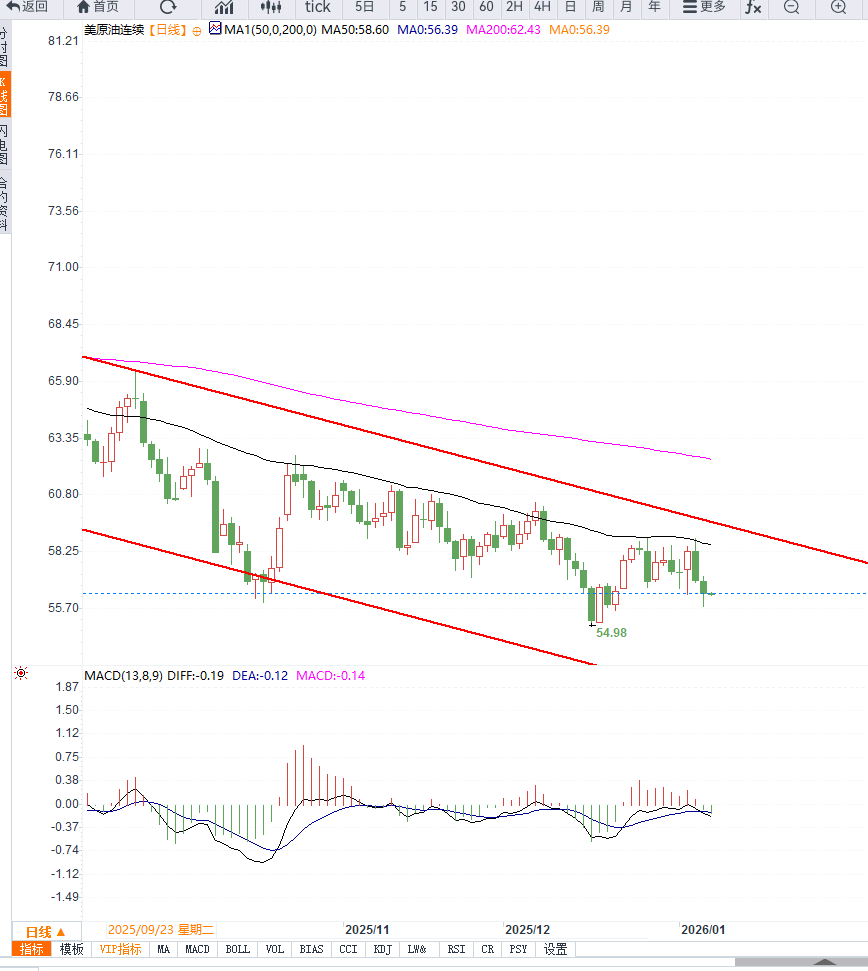
From the perspective of the daily technical structure, the price of US crude oil is generally operating in a medium-term downward channel. The recent rebound was clearly blocked near $60, which has now become an important technical resistance level.
The moving average system is in a bearish alignment, with short-term moving averages continuing to decline and suppressing prices, indicating that the market remains in a weak and dominant phase. The Relative Strength Index (RSI) is hovering around 40, not yet entering the extremely oversold zone, meaning that the downside potential has not yet been fully realized.
If WTI falls below the $55 mark, it may test the previous low support level; only by effectively stabilizing above $60 can the short-term technical pressure be significantly alleviated.
Editor's Note:
Overall, the core logic behind the current decline in oil prices remains the continued improvement in medium-term supply expectations. Even if short-term inventory declines provide support for prices, the upside potential for oil prices will still be limited as long as expectations of low-cost crude oil flowing back into the international market persist.
Going forward, it is crucial to closely monitor the actual progress of Venezuelan crude oil exports and whether there is a substantial recovery in demand, as this will determine whether oil prices can escape their current weak trend.
The market generally believes that this move will increase the supply of crude oil from the world's largest oil consumer, thereby reinforcing expectations of ample global supply this year.
Market research indicates that the initial arrangements between Washington and Caracas may require diverting oil tankers originally destined for Asian countries. Since Trump imposed the export blockade in mid-December, millions of barrels of Venezuelan crude oil have been stranded on tankers and in storage facilities, unable to enter the international market.
Trump said on social media on Tuesday that Venezuela would "hand over" 30 to 50 million barrels of "sanctioned oil" to the United States.
SEB commodities analyst Ole Hwalbi points out: "From a broader perspective, this is not a large amount. The U.S. Strategic Petroleum Reserve is currently around 413 million barrels, so 30 million or 50 million barrels is relatively limited."
Meanwhile, geopolitical risks have not completely subsided. Two U.S. officials revealed on Wednesday that the U.S. is attempting to seize an oil tanker linked to Venezuela. The tanker had previously escaped during operations against sanctioned vessels and refused boarding by the U.S. Coast Guard; incidents were seen as potentially escalating regional tensions, but market reaction was relatively limited.
On the fundamental data front, the U.S. Energy Information Administration (EIA) reported that U.S. crude oil inventories fell by 3.8 million barrels to 419.1 million barrels in the week ending January 2, significantly better than the market's previous expectation of an increase of 447,000 barrels, providing some support for oil prices.
However, gasoline inventories increased by 7.7 million barrels and distillate fuel inventories increased by 5.6 million barrels during the same period, both significantly exceeding expectations, reflecting continued weak end-user demand.
Morgan Stanley analysts predict that the global oil market may experience a supply glut of about 3 million barrels per day in the first half of 2026, based on weak demand growth last year and increased production from OPEC and non-OPEC oil-producing countries.
In a report released Wednesday, analysts at BMI, a division of Fitch Solutions, pointed out that the prospect of Venezuelan crude oil exports, with lower prices and extraction costs, could dampen the pace of capacity expansion in the United States and other regions.
From the perspective of the daily technical structure, the price of US crude oil is generally operating in a medium-term downward channel. The recent rebound was clearly blocked near $60, which has now become an important technical resistance level.
The moving average system is in a bearish alignment, with short-term moving averages continuing to decline and suppressing prices, indicating that the market remains in a weak and dominant phase. The Relative Strength Index (RSI) is hovering around 40, not yet entering the extremely oversold zone, meaning that the downside potential has not yet been fully realized.
If WTI falls below the $55 mark, it may test the previous low support level; only by effectively stabilizing above $60 can the short-term technical pressure be significantly alleviated.
Editor's Note:
Overall, the core logic behind the current decline in oil prices remains the continued improvement in medium-term supply expectations. Even if short-term inventory declines provide support for prices, the upside potential for oil prices will still be limited as long as expectations of low-cost crude oil flowing back into the international market persist.
Going forward, it is crucial to closely monitor the actual progress of Venezuelan crude oil exports and whether there is a substantial recovery in demand, as this will determine whether oil prices can escape their current weak trend.
- Risk Warning and Disclaimer
- The market involves risk, and trading may not be suitable for all investors. This article is for reference only and does not constitute personal investment advice, nor does it take into account certain users’ specific investment objectives, financial situation, or other needs. Any investment decisions made based on this information are at your own risk.