Gold Trading Alert: Gold Prices Engulfed in Fierce Battle at High Levels; HSBC Expects Gold to Break $5,000 in the First Half of the Year; Non-Farm Payrolls Report May Trigger a Decisive Battle Between Bulls and Bears!
2026-01-09 07:50:19
On Thursday (January 8), spot gold rebounded strongly after an early morning dip, ultimately closing near $4477.28 per ounce, a gain of approximately 0.5%. It touched an intraday low of $4407.73, reflecting cautious sentiment in the market amidst high-level consolidation. Although gold prices have stabilized above $4400, they still face some pressure in the short term, primarily due to the annual weighting adjustment of the Bloomberg Commodity Index. This adjustment mechanism aims to make the index more closely reflect market realities, but since its implementation this week, it has created significant selling pressure on precious metals such as gold and silver. Market strategists point out that such index rebalancing often triggers passive selling by funds, leading to short-term pressure on gold prices, but this is more of a technical factor than a deterioration in fundamentals. On Friday (January 9) in early Asian trading, spot gold fluctuated at high levels, currently trading at $4476.51 per ounce.

Investors' attention has turned to the upcoming US December non-farm payrolls report, due on Friday, January 9th. This data is considered a key indicator of the Federal Reserve's monetary policy direction. Surveys show economists expect only 60,000 new jobs to be added in December, far below the 64,000 in the previous month, and the unemployment rate is expected to fall slightly from 4.6% to 4.5%. If the data meets or falls short of expectations, it will further strengthen market expectations for two Fed rate cuts this year.
A series of leading indicators have recently suggested that the U.S. labor market is cooling. Initial jobless claims rose modestly to 208,000 last week, which was lower than some extreme forecasts, but continuing jobless claims surged to 1.914 million, indicating that structural weakness is emerging.
November job openings fell more than expected, and private sector job growth also lagged behind expectations. Meanwhile, the number of companies announcing layoffs in 2025 surged 58%, reaching a five-year high, primarily concentrated in the federal government and the technology sector, linked to AI integration and cost-cutting measures.
On the other hand, labor productivity growth hit a two-year high in the third quarter, with companies achieving more output by improving the efficiency of existing employees. This is considered a typical characteristic of a "jobless economic expansion." This situation forces the Federal Reserve to balance weak employment and still slightly high inflation. Further significant interest rate cuts in the short term are unlikely, but expectations for medium- to long-term easing remain.
As a non-yielding asset, gold naturally has an advantage in a low-interest-rate environment. If the non-farm payroll data is weak, reinforcing expectations of interest rate cuts, gold prices are likely to receive strong support; conversely, if the data is stronger than expected, it may trigger a short-term pullback.
The market currently widely expects the Federal Reserve to cut interest rates twice in 2026, contrasting with some internal divisions within the Fed. At its December meeting, the Fed hinted at only one rate cut this year, but traders believe labor market signals will drive further easing. The January meeting is expected to keep rates unchanged, but the probability of a rate cut in March is about 40%. Fed Chairman Powell's term ends in May, and changes in leadership add uncertainty, but overall, the downward trend in the central level of interest rates is beneficial to gold.
In addition, the US dollar index rose slightly to 98.922, a near one-month high, which partially offset the gains in gold. However, if employment data weakens, the dollar is expected to come under pressure and fall, further boosting gold prices. The rise in US Treasury yields and the steepening of the two-year and ten-year yield curve also reflect the market's complex expectations for the economic outlook.
Beyond economic data, geopolitical tensions continue to support safe-haven demand for gold. US actions in Venezuela and Greenland, as well as potential tariff policy changes by the Trump administration, could amplify market uncertainty. While a significant narrowing of the trade deficit and a surge in productivity demonstrate economic resilience, rising fiscal debt and the potential risk of tariff refunds also encourage investors to allocate gold as a hedging tool.
HSBC's latest forecast is the most optimistic: driven by geopolitical risks and fiscal debt, gold will rise to $5,000 per ounce in the first half of 2026. This contrasts sharply with the current high-level consolidation, suggesting that once the pressure from the index correction eases, long-term investors will have an excellent entry opportunity. Strategists emphasize that after the index correction settles next week, gold prices are expected to resume their upward trend.
Looking at the current global gold market, gold prices are fluctuating steadily within the $4400-$4500 range. Short-term factors include commodity index adjustments and uncertainty surrounding non-farm payroll data, but fundamental support remains strong. A weak labor market reinforces expectations of interest rate cuts, while geopolitical risks and debt concerns amplify safe-haven demand, solidifying gold's position as a core asset allocation. For investors, short-term volatility is a normal digestion process, and the medium- to long-term bullish logic remains clear. If the non-farm payroll data is weaker than expected, a break above $4500 and even a push towards $5000 is not out of the question. The gold bull market of 2026 is still underway; patiently holding or adding to positions at opportune times may be a wise choice. However, if the non-farm payroll data is strong, a deep correction in gold prices should be anticipated.
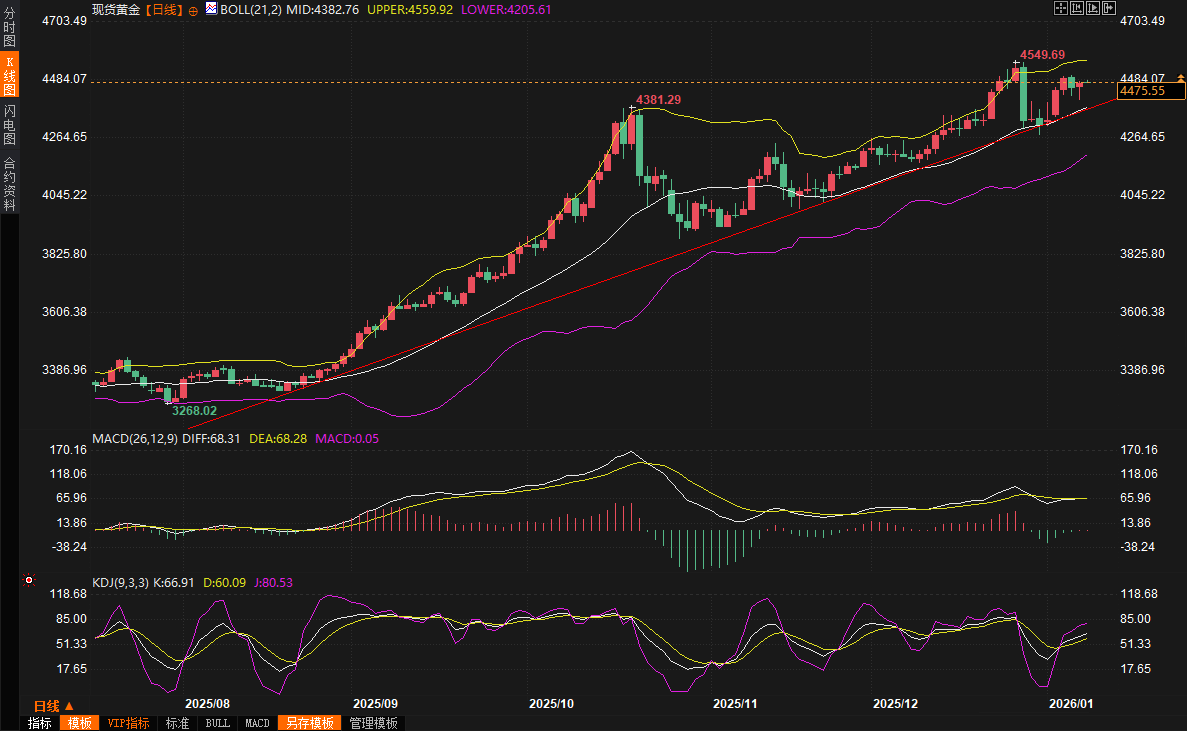
(Spot gold daily chart, source: FX678)
At 07:49 Beijing time, spot gold was trading at $4473.43 per ounce.
US employment data becomes the focus: signs of a weak labor market emerge.
Investors' attention has turned to the upcoming US December non-farm payrolls report, due on Friday, January 9th. This data is considered a key indicator of the Federal Reserve's monetary policy direction. Surveys show economists expect only 60,000 new jobs to be added in December, far below the 64,000 in the previous month, and the unemployment rate is expected to fall slightly from 4.6% to 4.5%. If the data meets or falls short of expectations, it will further strengthen market expectations for two Fed rate cuts this year.
A series of leading indicators have recently suggested that the U.S. labor market is cooling. Initial jobless claims rose modestly to 208,000 last week, which was lower than some extreme forecasts, but continuing jobless claims surged to 1.914 million, indicating that structural weakness is emerging.
November job openings fell more than expected, and private sector job growth also lagged behind expectations. Meanwhile, the number of companies announcing layoffs in 2025 surged 58%, reaching a five-year high, primarily concentrated in the federal government and the technology sector, linked to AI integration and cost-cutting measures.
On the other hand, labor productivity growth hit a two-year high in the third quarter, with companies achieving more output by improving the efficiency of existing employees. This is considered a typical characteristic of a "jobless economic expansion." This situation forces the Federal Reserve to balance weak employment and still slightly high inflation. Further significant interest rate cuts in the short term are unlikely, but expectations for medium- to long-term easing remain.
As a non-yielding asset, gold naturally has an advantage in a low-interest-rate environment. If the non-farm payroll data is weak, reinforcing expectations of interest rate cuts, gold prices are likely to receive strong support; conversely, if the data is stronger than expected, it may trigger a short-term pullback.
Federal Reserve Policy Outlook: Rate Cut Path Becoming Clearer, Long-Term Positive for Gold
The market currently widely expects the Federal Reserve to cut interest rates twice in 2026, contrasting with some internal divisions within the Fed. At its December meeting, the Fed hinted at only one rate cut this year, but traders believe labor market signals will drive further easing. The January meeting is expected to keep rates unchanged, but the probability of a rate cut in March is about 40%. Fed Chairman Powell's term ends in May, and changes in leadership add uncertainty, but overall, the downward trend in the central level of interest rates is beneficial to gold.
In addition, the US dollar index rose slightly to 98.922, a near one-month high, which partially offset the gains in gold. However, if employment data weakens, the dollar is expected to come under pressure and fall, further boosting gold prices. The rise in US Treasury yields and the steepening of the two-year and ten-year yield curve also reflect the market's complex expectations for the economic outlook.
Geopolitical and macroeconomic factors combined: Gold's medium-term target is $5,000.
Beyond economic data, geopolitical tensions continue to support safe-haven demand for gold. US actions in Venezuela and Greenland, as well as potential tariff policy changes by the Trump administration, could amplify market uncertainty. While a significant narrowing of the trade deficit and a surge in productivity demonstrate economic resilience, rising fiscal debt and the potential risk of tariff refunds also encourage investors to allocate gold as a hedging tool.
HSBC's latest forecast is the most optimistic: driven by geopolitical risks and fiscal debt, gold will rise to $5,000 per ounce in the first half of 2026. This contrasts sharply with the current high-level consolidation, suggesting that once the pressure from the index correction eases, long-term investors will have an excellent entry opportunity. Strategists emphasize that after the index correction settles next week, gold prices are expected to resume their upward trend.
Conclusion: Short-term fluctuations do not change the bullish trend; investment opportunities in gold remain.
Looking at the current global gold market, gold prices are fluctuating steadily within the $4400-$4500 range. Short-term factors include commodity index adjustments and uncertainty surrounding non-farm payroll data, but fundamental support remains strong. A weak labor market reinforces expectations of interest rate cuts, while geopolitical risks and debt concerns amplify safe-haven demand, solidifying gold's position as a core asset allocation. For investors, short-term volatility is a normal digestion process, and the medium- to long-term bullish logic remains clear. If the non-farm payroll data is weaker than expected, a break above $4500 and even a push towards $5000 is not out of the question. The gold bull market of 2026 is still underway; patiently holding or adding to positions at opportune times may be a wise choice. However, if the non-farm payroll data is strong, a deep correction in gold prices should be anticipated.
(Spot gold daily chart, source: FX678)
At 07:49 Beijing time, spot gold was trading at $4473.43 per ounce.
- Risk Warning and Disclaimer
- The market involves risk, and trading may not be suitable for all investors. This article is for reference only and does not constitute personal investment advice, nor does it take into account certain users’ specific investment objectives, financial situation, or other needs. Any investment decisions made based on this information are at your own risk.