Crude oil trading alert: Geopolitical uncertainties fuel supply-side concerns, causing oil prices to rebound again.
2026-01-12 09:24:01
The international crude oil market continued its rebound, with crude oil futures rising for the third consecutive week, marking the longest weekly winning streak since June. During Monday's Asian trading session, WTI crude oil traded around $59 per barrel, with a cumulative increase of over 5% in the last two trading days, indicating a significant rise in short-term bullish sentiment.
In terms of price performance, both WTI and Brent crude oil strengthened in tandem, with the price increase driven more by risk premiums than by substantial improvements in fundamentals. Against the backdrop of heightened geopolitical uncertainty, the market's sensitivity to potential supply shocks has significantly increased.
 The increased risk is particularly evident in the derivatives market. Data shows that the skewness of call options relative to put options on U.S. crude oil futures has risen to its highest level since July, indicating that traders are actively betting on further increases in oil prices through the options market to hedge against conflict-related geopolitical risks.
This shift reflects a significant increase in market pricing in upward volatility. The market's current focus is primarily on the situation in Iran, which has somewhat diverted attention from the previous concerns about Venezuela.
Trump stated that the second round of military action against Venezuela had been canceled due to improved cooperation from the Venezuelan side. This news briefly caused oil prices to fall slightly during trading on Friday, but the impact was short-lived.
In addition, Trump said during a meeting with oil company executives at the White House last Friday that the United States would decide which companies could enter the Venezuelan market, and that “giant” oil companies planned to invest approximately $100 billion of their own capital.
These statements have a greater impact on medium- to long-term supply expectations and have not changed the current short-term trading logic dominated by geopolitical risks.
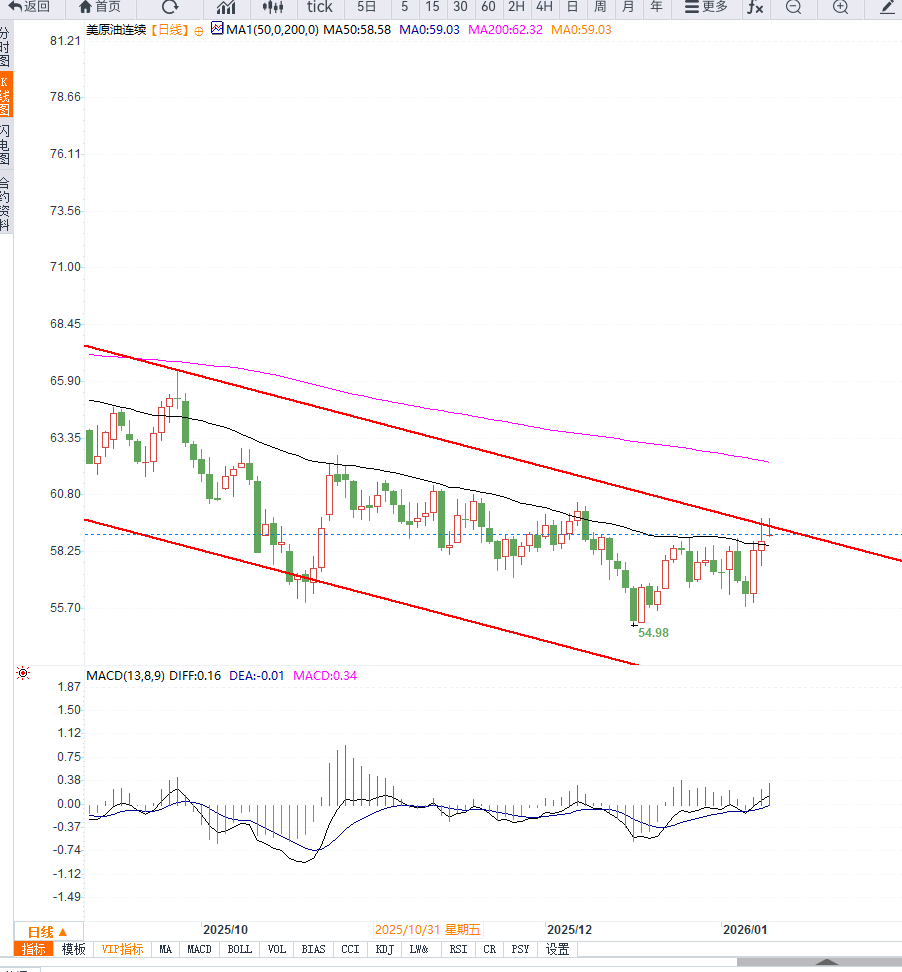
From a daily chart perspective, WTI crude oil has effectively broken through the upper edge of the previous trading range, and the price has regained its position above multiple short- and medium-term moving averages. The moving average system is showing signs of turning upwards, indicating that the trend has shifted from weak to strong.
Momentum indicators are improving in tandem, with bulls in control in the short term. The area around $59 has become a key support zone. If prices can hold firmly above this level, WTI could potentially test the $61-$63 range. However, if geopolitical risks ease or fundamental pressures regain dominance, a pullback to the $57 level is possible.
Despite crude oil futures rising for the third consecutive week, the market generally expects that the global crude oil market will still face a significant oversupply this year, which may put systemic downward pressure on oil prices in the coming months.
Goldman Sachs points out that its clients are currently at their most bearish on crude oil in the past 10 years. "Crude oil remains caught in a complex game, with rising geopolitical risks on one hand and continuously increasing inventories on the other."
Robert Rennie, head of commodities research at Westpac, further noted that oil prices are likely to trade more around $50 a barrel in the first quarter, as Venezuelan crude oil supplies increase and production rises in other regions.
Editor's Note:
Overall, crude oil prices rose for the third consecutive week, which seems more like a phase of recovery driven by geopolitical risks. The bullish structure in the options market indicates that risk premiums are still rising in the short term, but from a supply and demand perspective, the medium-term pressure from inventory accumulation and supply growth has not disappeared.
In the near future, oil prices may fluctuate between "geopolitical support" and "fundamental suppression," and high volatility will remain the main characteristic of the crude oil market.
In terms of price performance, both WTI and Brent crude oil strengthened in tandem, with the price increase driven more by risk premiums than by substantial improvements in fundamentals. Against the backdrop of heightened geopolitical uncertainty, the market's sensitivity to potential supply shocks has significantly increased.
The increased risk is particularly evident in the derivatives market. Data shows that the skewness of call options relative to put options on U.S. crude oil futures has risen to its highest level since July, indicating that traders are actively betting on further increases in oil prices through the options market to hedge against conflict-related geopolitical risks.This shift reflects a significant increase in market pricing in upward volatility. The market's current focus is primarily on the situation in Iran, which has somewhat diverted attention from the previous concerns about Venezuela.
Trump stated that the second round of military action against Venezuela had been canceled due to improved cooperation from the Venezuelan side. This news briefly caused oil prices to fall slightly during trading on Friday, but the impact was short-lived.
In addition, Trump said during a meeting with oil company executives at the White House last Friday that the United States would decide which companies could enter the Venezuelan market, and that “giant” oil companies planned to invest approximately $100 billion of their own capital.
These statements have a greater impact on medium- to long-term supply expectations and have not changed the current short-term trading logic dominated by geopolitical risks.
From a daily chart perspective, WTI crude oil has effectively broken through the upper edge of the previous trading range, and the price has regained its position above multiple short- and medium-term moving averages. The moving average system is showing signs of turning upwards, indicating that the trend has shifted from weak to strong.
Momentum indicators are improving in tandem, with bulls in control in the short term. The area around $59 has become a key support zone. If prices can hold firmly above this level, WTI could potentially test the $61-$63 range. However, if geopolitical risks ease or fundamental pressures regain dominance, a pullback to the $57 level is possible.
Despite crude oil futures rising for the third consecutive week, the market generally expects that the global crude oil market will still face a significant oversupply this year, which may put systemic downward pressure on oil prices in the coming months.
Goldman Sachs points out that its clients are currently at their most bearish on crude oil in the past 10 years. "Crude oil remains caught in a complex game, with rising geopolitical risks on one hand and continuously increasing inventories on the other."
Robert Rennie, head of commodities research at Westpac, further noted that oil prices are likely to trade more around $50 a barrel in the first quarter, as Venezuelan crude oil supplies increase and production rises in other regions.
Editor's Note:
Overall, crude oil prices rose for the third consecutive week, which seems more like a phase of recovery driven by geopolitical risks. The bullish structure in the options market indicates that risk premiums are still rising in the short term, but from a supply and demand perspective, the medium-term pressure from inventory accumulation and supply growth has not disappeared.
In the near future, oil prices may fluctuate between "geopolitical support" and "fundamental suppression," and high volatility will remain the main characteristic of the crude oil market.
- Risk Warning and Disclaimer
- The market involves risk, and trading may not be suitable for all investors. This article is for reference only and does not constitute personal investment advice, nor does it take into account certain users’ specific investment objectives, financial situation, or other needs. Any investment decisions made based on this information are at your own risk.