The euro suddenly surged! Was it the Federal Reserve Chairman who caused the trouble?
2026-01-12 17:34:26
On Monday (January 12), the euro rebounded against the US dollar around 1.1620 in Asian trading, and approached the 1.17 level in European trading. This rebound was not due to strong euro fundamentals, but rather because the US dollar itself was embroiled in a rare political storm. Reports indicate that a US Senate committee is considering launching a criminal investigation into Federal Reserve Chairman Jerome Powell's testimony regarding a renovation project for a Federal Reserve building. The news caused a market uproar. Powell quickly responded, calling the move "unprecedented" and stating bluntly that it was an attempt to use political means to pressure the central bank and force it to cut interest rates.

This event directly shook market confidence in the Federal Reserve's independence. For a long time, the Fed has been seen as a "technocratic bastion" free from political interference, but now its decision-making space appears to be eroded by external forces. When monetary policy may no longer be purely based on economic data but rather mixed with political considerations, the dollar's interest rate advantage is called into question. Traders began to reassess the risk-reward ratio of holding dollar assets, with some funds flowing into relatively stable euro assets, driving a short-term strengthening of the euro.
More notably, against the backdrop of tensions in the Middle East and declining global risk appetite, the US dollar, traditionally seen as a "safe haven," has not received significant support. This indicates a shift in the market's risk-averse logic—when the dollar itself faces policy uncertainty, its "safe asset" aura is fading. Funds are no longer solely chasing the dollar, but rather tend to diversify among various non-US currencies and safe-haven assets, providing the euro with breathing room and even room for a rebound.
Despite the euro's short-term strength, the underlying economic fundamentals are insufficient to support a sustained rise. Latest data shows that the Eurozone's seasonally adjusted unemployment rate in November was 6.3%, slightly lower than the previous month's 6.4%, but higher than the 6.2% of the same period last year; the EU's overall unemployment rate remained at 6.0%, unchanged from the previous month, and still higher than the 5.8% projected for the same period in 2024. While the job market remains stable, the momentum of improvement is showing signs of fatigue.
Economic indicators also showed signs of slowing. The final reading of the Eurozone's composite Purchasing Managers' Index (PMI) for December came in at 51.5, down from 52.8 in November; the services output index was 52.4, also declining from 53.6, both hitting three-month lows. Although still in expansion territory, growth momentum has clearly weakened. Meanwhile, Germany's preliminary harmonized consumer price index (CPI) for December rose 2% year-on-year, lower than the expected 2.2% and the previous reading of 2.6%; month-on-month, it rose only 0.2%, just half of market expectations. The Eurozone's overall CPI also rose 2% year-on-year, in line with expectations, but the month-on-month figure turned positive, indicating that inflationary pressures have eased somewhat but are not out of control.
Given this combination of declining inflation and slowing growth, the European Central Bank (ECB) is clearly reluctant to take any rash actions. Vice President Louis de Guindos explicitly stated that the current interest rate level is appropriate, while emphasizing that "uncertainty remains high." This statement reveals a strong wait-and-see attitude: neither in a hurry to cut rates nor intending to raise them. German retail sales fell 0.6% month-on-month in November, while industrial output rose 0.8%, further confirming that supply and demand have not aligned. Weak demand and relatively stable supply mean that the euro lacks an inherent unilateral driving force and is more passively adjusting to the fluctuations of the US dollar.
In contrast, recent economic data in the United States has shown a divergent pattern: a strong service sector and a weak manufacturing sector. The manufacturing PMI fell to 47.9 in December, remaining in contraction territory for several consecutive months and below both the previous reading and expectations. The employment index rose slightly to 44.9, while the prices paid index remained high at 58.5, indicating continued cost pressures. Conversely, the services PMI surged to 54.4, far exceeding the previous reading of 52.6, with the employment sub-index also rising to 52, demonstrating the resilience of the services sector. However, the prices paid index fell to 64.3, a slight decrease from the previous 65.4, suggesting a slight easing of inflationary pressures.
In terms of foreign trade, the trade deficit narrowed to $59.1 billion in October, significantly lower than the previous month's $78.3 billion, mainly due to increased exports and decreased imports. This data is a short-term positive for the US dollar, but it is unlikely to reverse the overall trend. The job market showed characteristics of "resilience with a cooling trend": private sector employment increased by 41,000 in December, slightly lower than expected but much better than the revised previous month's -29,000; job vacancies fell from 7.449 million in October to 7.146 million, indicating a marginal weakening of labor demand. More noteworthy is that the number of layoffs announced in December was only 35,553, a significant 50% decrease from 71,321 in November, the lowest level since July 2024.
Non-farm payroll data showed that December added 50,000 jobs, lower than the expected 60,000; however, the unemployment rate unexpectedly fell to 4.4%, better than the expected 4.5%. November's data was also revised down to 56,000. This contradictory combination reinforced the market's judgment that "further tightening is unnecessary"—the economy has not collapsed, but growth momentum is weakening. Coupled with the Federal Reserve's expected 25 basis point rate cut in December and its hints at a possible further rate cut in 2026, the market widely expects at least two rate cuts. Furthermore, with Powell's term expiring in May, the uncertainty surrounding personnel changes has further amplified speculation about the future policy path.
The next two days will be crucial in determining the short-term direction of exchange rates. Tuesday will see the release of the US December Consumer Price Index (CPI), while Wednesday will bring the October and November Producer Price Index (PPI) and November retail sales data. These indicators will directly impact market pricing in the number and pace of future Federal Reserve rate cuts. If inflation continues to cool, especially if core CPI falls short of expectations, it could further fuel bets on rate cuts, putting downward pressure on the dollar; conversely, it could cause the market to return to a range-bound pattern.
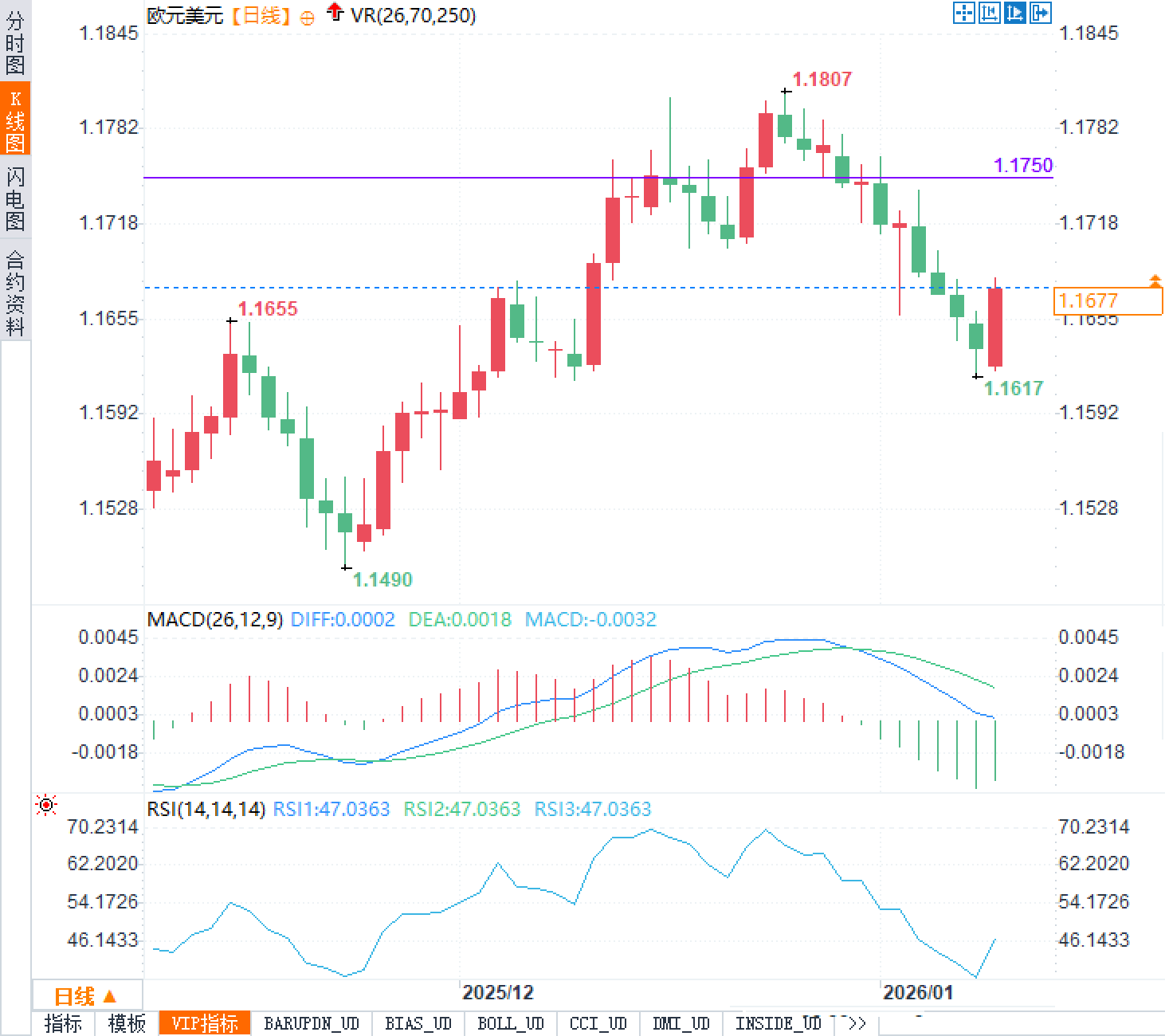
From a technical perspective, the euro/dollar pair retreated after reaching a high of 1.1807 on the daily chart, hitting a low of 1.1617 before rebounding. Strong resistance lies at 1.1750; a hold above this level could lead to a retest of previous highs. Support is seen at 1.1617; a break below this level could result in a return to lower levels. The MACD indicator shows a DIFF of 0.0002, a DEA of 0.0018, and a histogram of -0.0032, indicating that downward momentum has not completely subsided. The RSI is approximately 47.0363, in a slightly bearish zone, suggesting a higher probability of range-bound trading in the short term.
This event directly shook market confidence in the Federal Reserve's independence. For a long time, the Fed has been seen as a "technocratic bastion" free from political interference, but now its decision-making space appears to be eroded by external forces. When monetary policy may no longer be purely based on economic data but rather mixed with political considerations, the dollar's interest rate advantage is called into question. Traders began to reassess the risk-reward ratio of holding dollar assets, with some funds flowing into relatively stable euro assets, driving a short-term strengthening of the euro.
More notably, against the backdrop of tensions in the Middle East and declining global risk appetite, the US dollar, traditionally seen as a "safe haven," has not received significant support. This indicates a shift in the market's risk-averse logic—when the dollar itself faces policy uncertainty, its "safe asset" aura is fading. Funds are no longer solely chasing the dollar, but rather tend to diversify among various non-US currencies and safe-haven assets, providing the euro with breathing room and even room for a rebound.
The Eurozone economy is "lukewarm" and lacks unilateral drivers.
Despite the euro's short-term strength, the underlying economic fundamentals are insufficient to support a sustained rise. Latest data shows that the Eurozone's seasonally adjusted unemployment rate in November was 6.3%, slightly lower than the previous month's 6.4%, but higher than the 6.2% of the same period last year; the EU's overall unemployment rate remained at 6.0%, unchanged from the previous month, and still higher than the 5.8% projected for the same period in 2024. While the job market remains stable, the momentum of improvement is showing signs of fatigue.
Economic indicators also showed signs of slowing. The final reading of the Eurozone's composite Purchasing Managers' Index (PMI) for December came in at 51.5, down from 52.8 in November; the services output index was 52.4, also declining from 53.6, both hitting three-month lows. Although still in expansion territory, growth momentum has clearly weakened. Meanwhile, Germany's preliminary harmonized consumer price index (CPI) for December rose 2% year-on-year, lower than the expected 2.2% and the previous reading of 2.6%; month-on-month, it rose only 0.2%, just half of market expectations. The Eurozone's overall CPI also rose 2% year-on-year, in line with expectations, but the month-on-month figure turned positive, indicating that inflationary pressures have eased somewhat but are not out of control.
Given this combination of declining inflation and slowing growth, the European Central Bank (ECB) is clearly reluctant to take any rash actions. Vice President Louis de Guindos explicitly stated that the current interest rate level is appropriate, while emphasizing that "uncertainty remains high." This statement reveals a strong wait-and-see attitude: neither in a hurry to cut rates nor intending to raise them. German retail sales fell 0.6% month-on-month in November, while industrial output rose 0.8%, further confirming that supply and demand have not aligned. Weak demand and relatively stable supply mean that the euro lacks an inherent unilateral driving force and is more passively adjusting to the fluctuations of the US dollar.
US data presents a mixed picture, quietly fueling expectations of an interest rate cut.
In contrast, recent economic data in the United States has shown a divergent pattern: a strong service sector and a weak manufacturing sector. The manufacturing PMI fell to 47.9 in December, remaining in contraction territory for several consecutive months and below both the previous reading and expectations. The employment index rose slightly to 44.9, while the prices paid index remained high at 58.5, indicating continued cost pressures. Conversely, the services PMI surged to 54.4, far exceeding the previous reading of 52.6, with the employment sub-index also rising to 52, demonstrating the resilience of the services sector. However, the prices paid index fell to 64.3, a slight decrease from the previous 65.4, suggesting a slight easing of inflationary pressures.
In terms of foreign trade, the trade deficit narrowed to $59.1 billion in October, significantly lower than the previous month's $78.3 billion, mainly due to increased exports and decreased imports. This data is a short-term positive for the US dollar, but it is unlikely to reverse the overall trend. The job market showed characteristics of "resilience with a cooling trend": private sector employment increased by 41,000 in December, slightly lower than expected but much better than the revised previous month's -29,000; job vacancies fell from 7.449 million in October to 7.146 million, indicating a marginal weakening of labor demand. More noteworthy is that the number of layoffs announced in December was only 35,553, a significant 50% decrease from 71,321 in November, the lowest level since July 2024.
Non-farm payroll data showed that December added 50,000 jobs, lower than the expected 60,000; however, the unemployment rate unexpectedly fell to 4.4%, better than the expected 4.5%. November's data was also revised down to 56,000. This contradictory combination reinforced the market's judgment that "further tightening is unnecessary"—the economy has not collapsed, but growth momentum is weakening. Coupled with the Federal Reserve's expected 25 basis point rate cut in December and its hints at a possible further rate cut in 2026, the market widely expects at least two rate cuts. Furthermore, with Powell's term expiring in May, the uncertainty surrounding personnel changes has further amplified speculation about the future policy path.
Key data is coming soon; the market has entered the "final round."
The next two days will be crucial in determining the short-term direction of exchange rates. Tuesday will see the release of the US December Consumer Price Index (CPI), while Wednesday will bring the October and November Producer Price Index (PPI) and November retail sales data. These indicators will directly impact market pricing in the number and pace of future Federal Reserve rate cuts. If inflation continues to cool, especially if core CPI falls short of expectations, it could further fuel bets on rate cuts, putting downward pressure on the dollar; conversely, it could cause the market to return to a range-bound pattern.
From a technical perspective, the euro/dollar pair retreated after reaching a high of 1.1807 on the daily chart, hitting a low of 1.1617 before rebounding. Strong resistance lies at 1.1750; a hold above this level could lead to a retest of previous highs. Support is seen at 1.1617; a break below this level could result in a return to lower levels. The MACD indicator shows a DIFF of 0.0002, a DEA of 0.0018, and a histogram of -0.0032, indicating that downward momentum has not completely subsided. The RSI is approximately 47.0363, in a slightly bearish zone, suggesting a higher probability of range-bound trading in the short term.
- Risk Warning and Disclaimer
- The market involves risk, and trading may not be suitable for all investors. This article is for reference only and does not constitute personal investment advice, nor does it take into account certain users’ specific investment objectives, financial situation, or other needs. Any investment decisions made based on this information are at your own risk.