The Federal Reserve's independence crisis, coupled with tensions in the Middle East, has pushed gold prices close to a high of $4,600.
2026-01-13 10:06:55
Gold prices remained near record highs amid escalating risk aversion. During Tuesday's Asian session, gold (XAU/USD) rose to around $4,600, extending its previous strong upward trend.
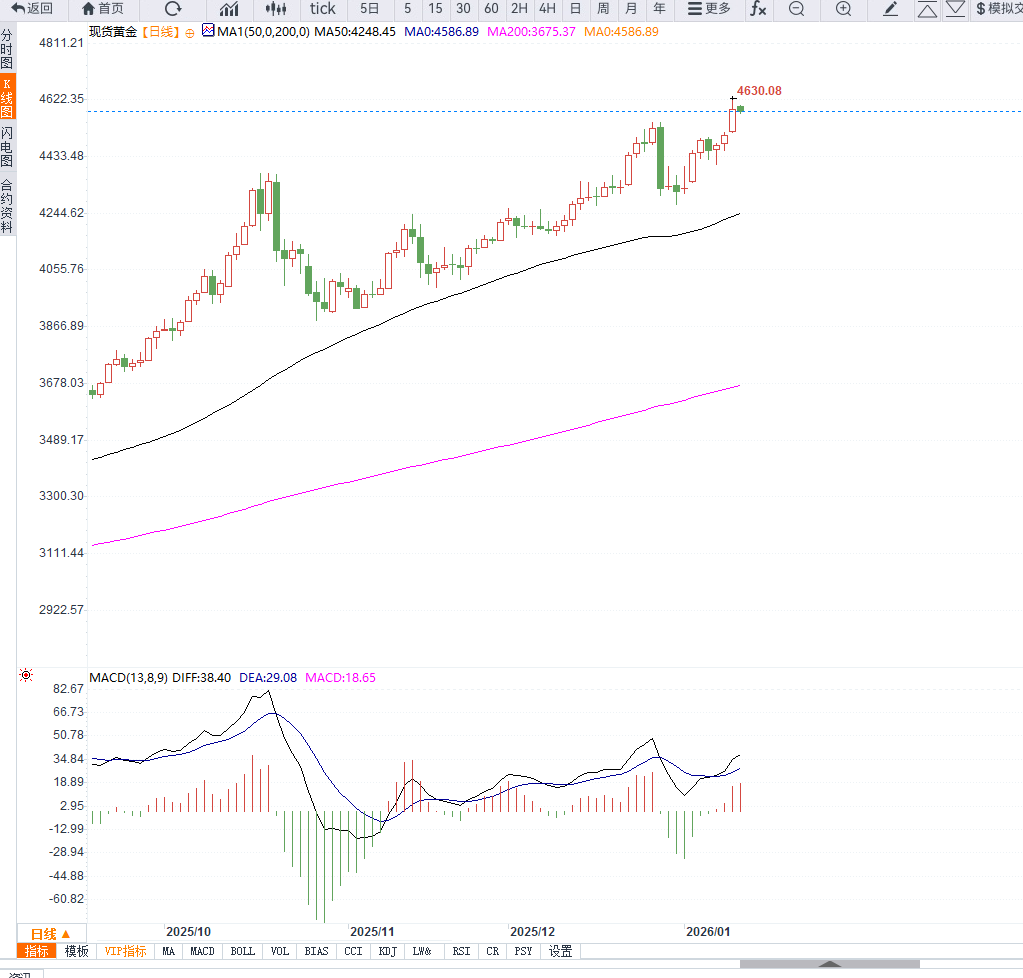
Although gold prices retreated from a record high of $4,630 in the previous trading day, the pullback was limited, indicating that market demand for safe-haven assets remains strong.
Federal Reserve Chairman Jerome Powell stated that he is currently under criminal investigation by the U.S. Department of Justice, a statement that quickly sparked market concerns about the central bank's independence.

The investigation covers the Federal Reserve's Washington headquarters renovation project and related testimony given at a Senate hearing. Powell noted that these moves are seen as attempts to pressure the Fed and influence the direction of monetary policy.
These statements led to a significant decline in risk appetite in global financial markets, with funds flowing more rapidly into traditional safe-haven assets such as gold. The market generally believes that once central bank independence is questioned and policy credibility declines, financial market volatility will increase significantly.
Meanwhile, geopolitical uncertainty is also providing additional support for gold prices. Tensions between the United States and Iran continue to escalate, with the US warning Iran against targeting civilians, while Iran has responded strongly to any external interference.
Furthermore, the United States announced that it would impose higher tariffs on countries that do business with Iran, a move that further exacerbated market concerns about an escalation of regional conflict.
Against this backdrop, gold continues to attract attention as an important tool for hedging systemic risks. Market focus is now shifting to the upcoming release of the US December Consumer Price Index (CPI) data. Both overall and core inflation are expected to be 2.7% year-on-year.
If inflation data is higher than expected, the US dollar may strengthen in the short term, thus putting short-term pressure on gold prices denominated in US dollars; conversely, if inflation is moderate, it will help consolidate the medium-term strong trend of gold.
From the daily chart, gold remains in a clear upward trend. After a rapid rise and a new historical high, the price experienced a technical pullback, but it has consistently traded above the major moving averages, with the moving average system maintaining a bullish alignment, indicating that the trend has not fundamentally changed.
The $4,600 level has become a key short-term support/resistance level. If the price can stabilize, there is still a possibility of challenging new highs again. On the downside, we need to pay attention to the support level of $4,500. If it is breached, the gold price may enter a period of high-level consolidation, but the medium-term upward structure remains intact.
Editor's Note:
Overall, the current strong performance of gold is the result of a confluence of multiple risk factors, rather than being driven by a single event. Gold prices may remain volatile at high levels before the release of inflation data, but as long as macroeconomic and geopolitical uncertainties do not ease significantly, gold's safe-haven value will remain supported.
However, given that prices are already at historically high levels, the risk of short-term pullbacks and increased volatility should also be noted.
Although gold prices retreated from a record high of $4,630 in the previous trading day, the pullback was limited, indicating that market demand for safe-haven assets remains strong.
Federal Reserve Chairman Jerome Powell stated that he is currently under criminal investigation by the U.S. Department of Justice, a statement that quickly sparked market concerns about the central bank's independence.
The investigation covers the Federal Reserve's Washington headquarters renovation project and related testimony given at a Senate hearing. Powell noted that these moves are seen as attempts to pressure the Fed and influence the direction of monetary policy.
These statements led to a significant decline in risk appetite in global financial markets, with funds flowing more rapidly into traditional safe-haven assets such as gold. The market generally believes that once central bank independence is questioned and policy credibility declines, financial market volatility will increase significantly.
Meanwhile, geopolitical uncertainty is also providing additional support for gold prices. Tensions between the United States and Iran continue to escalate, with the US warning Iran against targeting civilians, while Iran has responded strongly to any external interference.
Furthermore, the United States announced that it would impose higher tariffs on countries that do business with Iran, a move that further exacerbated market concerns about an escalation of regional conflict.
Against this backdrop, gold continues to attract attention as an important tool for hedging systemic risks. Market focus is now shifting to the upcoming release of the US December Consumer Price Index (CPI) data. Both overall and core inflation are expected to be 2.7% year-on-year.
If inflation data is higher than expected, the US dollar may strengthen in the short term, thus putting short-term pressure on gold prices denominated in US dollars; conversely, if inflation is moderate, it will help consolidate the medium-term strong trend of gold.
From the daily chart, gold remains in a clear upward trend. After a rapid rise and a new historical high, the price experienced a technical pullback, but it has consistently traded above the major moving averages, with the moving average system maintaining a bullish alignment, indicating that the trend has not fundamentally changed.
The $4,600 level has become a key short-term support/resistance level. If the price can stabilize, there is still a possibility of challenging new highs again. On the downside, we need to pay attention to the support level of $4,500. If it is breached, the gold price may enter a period of high-level consolidation, but the medium-term upward structure remains intact.
Editor's Note:
Overall, the current strong performance of gold is the result of a confluence of multiple risk factors, rather than being driven by a single event. Gold prices may remain volatile at high levels before the release of inflation data, but as long as macroeconomic and geopolitical uncertainties do not ease significantly, gold's safe-haven value will remain supported.
However, given that prices are already at historically high levels, the risk of short-term pullbacks and increased volatility should also be noted.
- Risk Warning and Disclaimer
- The market involves risk, and trading may not be suitable for all investors. This article is for reference only and does not constitute personal investment advice, nor does it take into account certain users’ specific investment objectives, financial situation, or other needs. Any investment decisions made based on this information are at your own risk.