WTI hits three-month high; is tension with Iran about to erupt?
2026-01-15 01:47:14
In the current environment, traders often struggle to accurately identify the main factors driving the market each day. Beyond long-term trends surrounding economic growth, inflation, AI infrastructure development, and sovereign debt burdens, new geopolitical hotspots seem to emerge daily.
While the situation in Venezuela (and perhaps soon Greenland) is still brewing in the background, the country that needs the most attention right now is Iran.
Recent nationwide protests in Iran have raised concerns about the stability of the world's leading oil producer. The protests, sparked by economic hardship and a sharp currency devaluation, have led to large-scale demonstrations and a strong government crackdown. While the protests have not yet disrupted oil production, markets are gradually pricing in a geopolitical risk premium.
It is important to note that Iran remains a key player in the global energy market, producing approximately 2 to 3 million barrels per day, and controls the Strait of Hormuz—a strategic chokepoint through which nearly 20 million barrels of oil pass daily. Any disruption to export or shipping routes could have a significant impact on global supply and prices.
Against this backdrop, oil prices are surging, with WTI approaching $62 and Brent crude rising to around $66. These gains highlight that the market remains sensitive to geopolitical developments, even in the absence of actual supply disruptions.
However, upside risks are capped by overall fundamentals. Global inventories remain high, while additional supply from other oil-producing countries, including Venezuela, helps offset concerns about severe shortages.
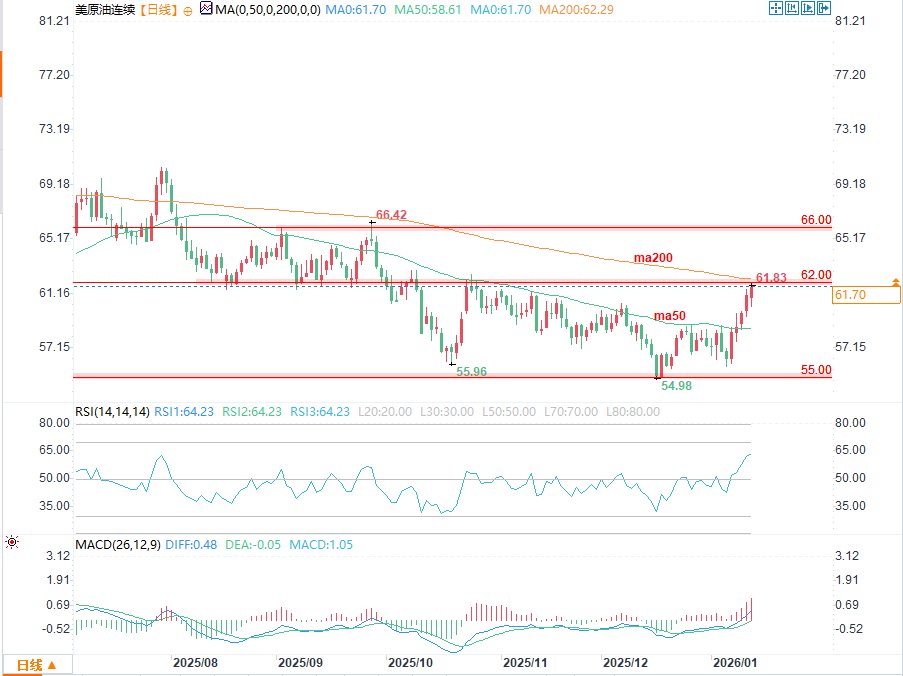
(WTI crude oil daily chart source: FX678)
Looking ahead, oil price movements will depend on whether the protests escalate into disruptions to production or export infrastructure. While the current impact is primarily driven by sentiment, any move toward regional instability or disruption of the Strait of Hormuz could trigger a more significant and sustained price surge, especially following US President Trump's recent tweet that "aid is on the way."
From a technical perspective, WTI crude oil rose for the fifth consecutive day, pushing the benchmark price from the bottom of the three-month range of $55 to $62 to the top. From a chart perspective, the current level is a key dividing line: a break above the $62 resistance level (including the 200-day moving average) could pave the way for further gains towards the six-month high near $66, which is close to the long-term downtrend line resistance from the highs of the second half of 2023.
On the other hand, if there are signs that the protests are slowing down and the country is stabilizing, some of the geopolitical risk premium in oil prices could be wiped out. In this scenario, oil prices could reverse and fall back below $60. Either way, oil traders should pay close attention to Iranian headlines in the coming days.
While the situation in Venezuela (and perhaps soon Greenland) is still brewing in the background, the country that needs the most attention right now is Iran.
Recent nationwide protests in Iran have raised concerns about the stability of the world's leading oil producer. The protests, sparked by economic hardship and a sharp currency devaluation, have led to large-scale demonstrations and a strong government crackdown. While the protests have not yet disrupted oil production, markets are gradually pricing in a geopolitical risk premium.
It is important to note that Iran remains a key player in the global energy market, producing approximately 2 to 3 million barrels per day, and controls the Strait of Hormuz—a strategic chokepoint through which nearly 20 million barrels of oil pass daily. Any disruption to export or shipping routes could have a significant impact on global supply and prices.
Against this backdrop, oil prices are surging, with WTI approaching $62 and Brent crude rising to around $66. These gains highlight that the market remains sensitive to geopolitical developments, even in the absence of actual supply disruptions.
However, upside risks are capped by overall fundamentals. Global inventories remain high, while additional supply from other oil-producing countries, including Venezuela, helps offset concerns about severe shortages.
(WTI crude oil daily chart source: FX678)
Looking ahead, oil price movements will depend on whether the protests escalate into disruptions to production or export infrastructure. While the current impact is primarily driven by sentiment, any move toward regional instability or disruption of the Strait of Hormuz could trigger a more significant and sustained price surge, especially following US President Trump's recent tweet that "aid is on the way."
From a technical perspective, WTI crude oil rose for the fifth consecutive day, pushing the benchmark price from the bottom of the three-month range of $55 to $62 to the top. From a chart perspective, the current level is a key dividing line: a break above the $62 resistance level (including the 200-day moving average) could pave the way for further gains towards the six-month high near $66, which is close to the long-term downtrend line resistance from the highs of the second half of 2023.
On the other hand, if there are signs that the protests are slowing down and the country is stabilizing, some of the geopolitical risk premium in oil prices could be wiped out. In this scenario, oil prices could reverse and fall back below $60. Either way, oil traders should pay close attention to Iranian headlines in the coming days.
- Risk Warning and Disclaimer
- The market involves risk, and trading may not be suitable for all investors. This article is for reference only and does not constitute personal investment advice, nor does it take into account certain users’ specific investment objectives, financial situation, or other needs. Any investment decisions made based on this information are at your own risk.