The data is explosive! GDP exceeded expectations by three times, but the pound dared not rise?
2026-01-15 15:59:09
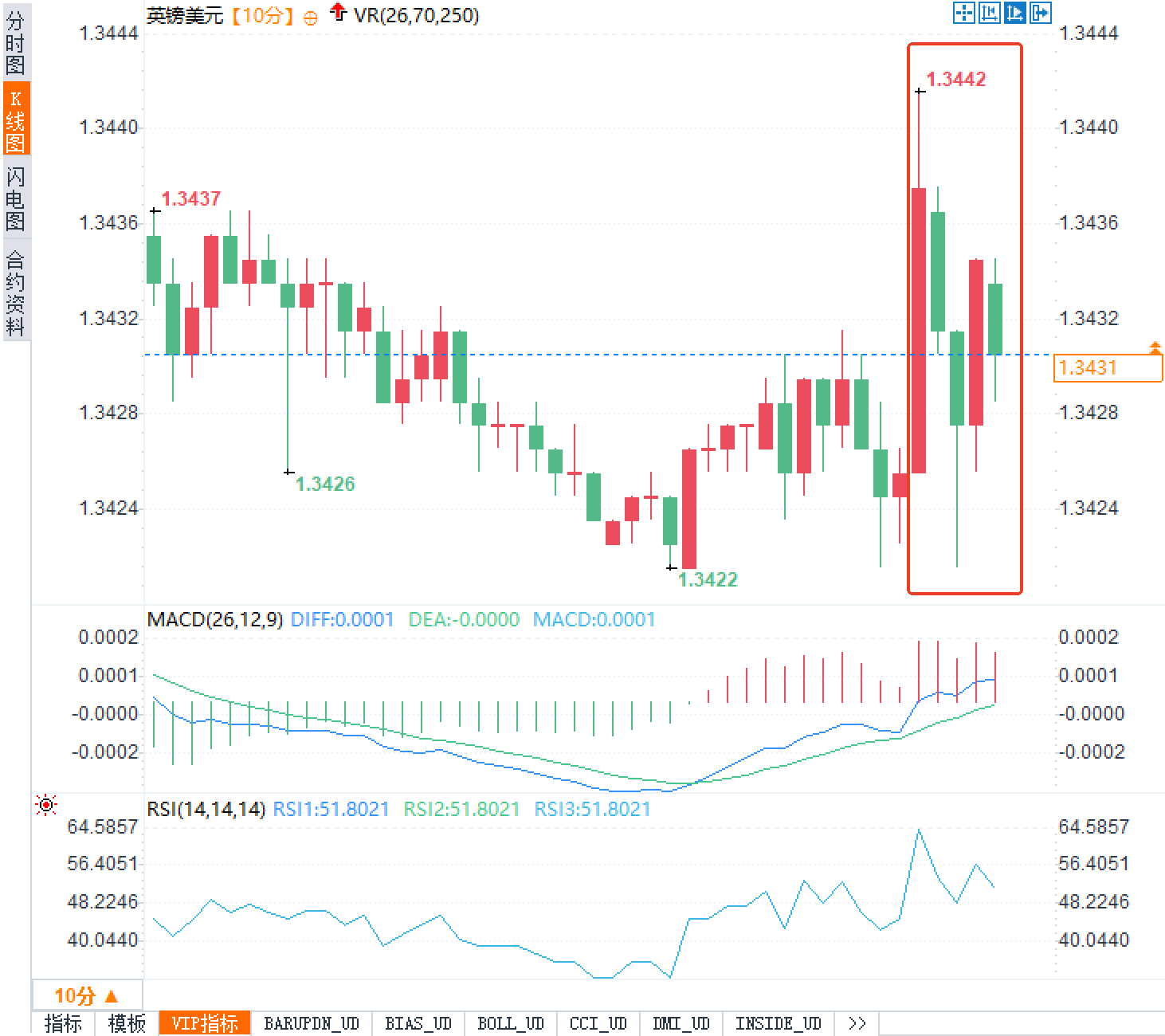
On Thursday (January 15), the British pound traded around 1.3430 against the US dollar during the European session, exhibiting a typical "rapid rise and fall" pattern. The price had previously dipped to 1.3422, hitting a temporary low, before quickly rebounding to 1.3442, completing a rapid rebound and partial retracement within minutes, indicating exceptionally fierce competition at key levels. This volatility pattern is common in the repricing process after major data releases: ample liquidity but divergent trader willingness to chase prices leads to sharp price fluctuations that fail to establish a sustained trend.
Looking at the 10-minute candlestick chart, the longer bodies during the upward phase indicate concentrated and decisive buying power; while the pullback phase is characterized by dense clusters of small bodies or doji candlesticks, reflecting a mix of profit-taking and wait-and-see sentiment. Currently, the RSI indicator is around 51.8, in the neutral zone, neither overbought nor oversold; the MACD is running close to the zero line, indicating weak overall direction, but volatility has clearly increased. In summary, the market is currently in a state of "uncertain direction and increased volatility," technically leaning towards range-bound trading rather than a one-sided breakout.
Analysts believe the core driver of this round of volatility comes from the latest economic data released by the UK. In particular, November's GDP grew by 0.3% month-on-month, not only reversing the 0.1% decline in October but also significantly exceeding market expectations of 0.1%. Year-on-year growth also reached 1.4%, exceeding the expected 1.1%. This means the UK economy did not stagnate at the end of the year but instead demonstrated a certain resilience; at least at the monthly level, both supply and demand performed better than previously feared.
A breakdown of the GDP structure reveals that this growth was not a random rebound, but rather the result of simultaneous improvements in several key sectors. The most noteworthy is the service sector, which grew by 0.3% month-on-month in November, reversing the previous month's 0.3% decline and far exceeding market expectations of 0.1%. As a pillar industry of the UK economy, the service sector accounts for over 70% of GDP, and its recovery directly boosts employment, household income expectations, and consumer confidence.
Within the sub-sectors, professional, scientific and technological activities rose by 1.7%, information and communication industries grew by 1.5%, and wholesale and retail trade also recorded a 0.6% increase. These sectors share a common characteristic: they are highly dependent on business spending and business sentiment. Their expansion is more easily interpreted by the market as a "proactive recovery" rather than a passive rebound, indicating that business confidence is recovering and economic momentum is strengthening.
The production side also saw positive developments. Industrial output rose 1.1% month-on-month in November, continuing the growth momentum of the previous month; manufacturing output surged even more significantly, increasing by 2.1%, far exceeding market expectations of 0.5%. Particularly noteworthy was the 10.7% month-on-month jump in transportation equipment manufacturing, with motor vehicles, trailers, and semi-trailers production surging by 25.5%. This is seen as a reflection of production returning to normal after previous supply chain disruptions subsided. For the foreign exchange market, improved output typically reduces pricing pressure on an economic recession, thus supporting the valuation of the local currency. The pound sterling thus received some fundamental support.
However, not all the data is positive. Construction activity fell 1.3% month-on-month in November, weaker than the market expectation of flat growth and even more so than the 1.2% decline in October. The weakening of the construction industry is often associated with high financing costs, cooling housing demand, and more cautious corporate capital expenditure. If this trend continues, it could undermine the narrative of a "full recovery," leading the market to view the current growth as a temporary stabilization rather than a trend reversal.
Despite strong UK economic data, the pound has failed to sustain its upward trend against the dollar, primarily due to the continued strength of the US dollar. Recent US Producer Price Index (PPI) and retail sales data both exceeded expectations, while the unemployment rate remained low, further reinforcing market expectations that the Federal Reserve will maintain interest rates unchanged for an extended period in the coming months. Against this backdrop, the dollar continues to be supported by its interest rate differential and safe-haven appeal.
This means that even if the UK releases positive news, for the pound to achieve a genuine breakout, one of two conditions must be met: either the US dollar weakens, or subsequent UK data further shifts monetary policy expectations towards a hawkish stance. Otherwise, without a fundamental change in the US-UK interest rate differential, the pound will find it difficult to escape its range-bound trading pattern.
Current monetary policy logic is also influencing exchange rate trends. The Bank of England's core focus remains on the path of inflation and the stability of its expectations. While GDP data eased concerns about a "demand collapse," this is not enough to prompt the central bank to immediately adjust its policy stance. In other words, the 0.3% monthly growth rate provides policymakers with an "observation window," allowing them to confirm whether inflation is continuing to decline while avoiding a premature shift to easing. However, if inflation remains sticky, policy may remain tight or even extend the wait-and-see period.
In contrast, the Federal Reserve, while having paused interest rate hikes due to the solid fundamentals of the US economy, continues to postpone expectations of rate cuts, which keeps dollar assets attractive. This combination of factors has created a situation where "the UK is improving, and the US is not weak," causing the pound to trade against the dollar with more of a "data-driven surge followed by a pullback and consolidation" pattern, rather than entering a clear one-sided trend.
From the current technical perspective, 1.3422 to 1.3442 has become the core range for short-term bullish and bearish battles. The price fell back to 1.3430 after touching 1.3442, indicating selling pressure or short-term profit-taking. If the price can stabilize above 1.3430 and gradually raise the lows, there is still a possibility of challenging 1.3440 again. Conversely, if it breaks below 1.3430 and fails to recover quickly, the price may return to the previous high-volume trading area, at which point the effectiveness of the 1.3422 support level should be closely monitored.
The key to future price movements still hinges on two main themes: first, whether subsequent UK inflation and wage data can continue to support the central bank's prudent stance; and second, whether US employment and inflation data continue to reinforce expectations of "higher and longer" interest rates. Only when the UK demonstrates sustained resilience while US data shows a marginal slowdown will the pound/dollar exchange rate truly have the foundation for an upward breakout. Until then, the exchange rate will likely continue to fluctuate within this range, using time to consolidate before awaiting the next decisive signal.
Looking at the 10-minute candlestick chart, the longer bodies during the upward phase indicate concentrated and decisive buying power; while the pullback phase is characterized by dense clusters of small bodies or doji candlesticks, reflecting a mix of profit-taking and wait-and-see sentiment. Currently, the RSI indicator is around 51.8, in the neutral zone, neither overbought nor oversold; the MACD is running close to the zero line, indicating weak overall direction, but volatility has clearly increased. In summary, the market is currently in a state of "uncertain direction and increased volatility," technically leaning towards range-bound trading rather than a one-sided breakout.
Analysts believe the core driver of this round of volatility comes from the latest economic data released by the UK. In particular, November's GDP grew by 0.3% month-on-month, not only reversing the 0.1% decline in October but also significantly exceeding market expectations of 0.1%. Year-on-year growth also reached 1.4%, exceeding the expected 1.1%. This means the UK economy did not stagnate at the end of the year but instead demonstrated a certain resilience; at least at the monthly level, both supply and demand performed better than previously feared.
With both the service and manufacturing sectors showing strength, initial signs of economic recovery are emerging.
A breakdown of the GDP structure reveals that this growth was not a random rebound, but rather the result of simultaneous improvements in several key sectors. The most noteworthy is the service sector, which grew by 0.3% month-on-month in November, reversing the previous month's 0.3% decline and far exceeding market expectations of 0.1%. As a pillar industry of the UK economy, the service sector accounts for over 70% of GDP, and its recovery directly boosts employment, household income expectations, and consumer confidence.
Within the sub-sectors, professional, scientific and technological activities rose by 1.7%, information and communication industries grew by 1.5%, and wholesale and retail trade also recorded a 0.6% increase. These sectors share a common characteristic: they are highly dependent on business spending and business sentiment. Their expansion is more easily interpreted by the market as a "proactive recovery" rather than a passive rebound, indicating that business confidence is recovering and economic momentum is strengthening.
The production side also saw positive developments. Industrial output rose 1.1% month-on-month in November, continuing the growth momentum of the previous month; manufacturing output surged even more significantly, increasing by 2.1%, far exceeding market expectations of 0.5%. Particularly noteworthy was the 10.7% month-on-month jump in transportation equipment manufacturing, with motor vehicles, trailers, and semi-trailers production surging by 25.5%. This is seen as a reflection of production returning to normal after previous supply chain disruptions subsided. For the foreign exchange market, improved output typically reduces pricing pressure on an economic recession, thus supporting the valuation of the local currency. The pound sterling thus received some fundamental support.
However, not all the data is positive. Construction activity fell 1.3% month-on-month in November, weaker than the market expectation of flat growth and even more so than the 1.2% decline in October. The weakening of the construction industry is often associated with high financing costs, cooling housing demand, and more cautious corporate capital expenditure. If this trend continues, it could undermine the narrative of a "full recovery," leading the market to view the current growth as a temporary stabilization rather than a trend reversal.
A strong US dollar is putting downward pressure on the British pound, making one-sided market movements unlikely.
Despite strong UK economic data, the pound has failed to sustain its upward trend against the dollar, primarily due to the continued strength of the US dollar. Recent US Producer Price Index (PPI) and retail sales data both exceeded expectations, while the unemployment rate remained low, further reinforcing market expectations that the Federal Reserve will maintain interest rates unchanged for an extended period in the coming months. Against this backdrop, the dollar continues to be supported by its interest rate differential and safe-haven appeal.
This means that even if the UK releases positive news, for the pound to achieve a genuine breakout, one of two conditions must be met: either the US dollar weakens, or subsequent UK data further shifts monetary policy expectations towards a hawkish stance. Otherwise, without a fundamental change in the US-UK interest rate differential, the pound will find it difficult to escape its range-bound trading pattern.
Current monetary policy logic is also influencing exchange rate trends. The Bank of England's core focus remains on the path of inflation and the stability of its expectations. While GDP data eased concerns about a "demand collapse," this is not enough to prompt the central bank to immediately adjust its policy stance. In other words, the 0.3% monthly growth rate provides policymakers with an "observation window," allowing them to confirm whether inflation is continuing to decline while avoiding a premature shift to easing. However, if inflation remains sticky, policy may remain tight or even extend the wait-and-see period.
In contrast, the Federal Reserve, while having paused interest rate hikes due to the solid fundamentals of the US economy, continues to postpone expectations of rate cuts, which keeps dollar assets attractive. This combination of factors has created a situation where "the UK is improving, and the US is not weak," causing the pound to trade against the dollar with more of a "data-driven surge followed by a pullback and consolidation" pattern, rather than entering a clear one-sided trend.
In short-term trading, the key is to manage the timing and risk.
From the current technical perspective, 1.3422 to 1.3442 has become the core range for short-term bullish and bearish battles. The price fell back to 1.3430 after touching 1.3442, indicating selling pressure or short-term profit-taking. If the price can stabilize above 1.3430 and gradually raise the lows, there is still a possibility of challenging 1.3440 again. Conversely, if it breaks below 1.3430 and fails to recover quickly, the price may return to the previous high-volume trading area, at which point the effectiveness of the 1.3422 support level should be closely monitored.
The key to future price movements still hinges on two main themes: first, whether subsequent UK inflation and wage data can continue to support the central bank's prudent stance; and second, whether US employment and inflation data continue to reinforce expectations of "higher and longer" interest rates. Only when the UK demonstrates sustained resilience while US data shows a marginal slowdown will the pound/dollar exchange rate truly have the foundation for an upward breakout. Until then, the exchange rate will likely continue to fluctuate within this range, using time to consolidate before awaiting the next decisive signal.
- Risk Warning and Disclaimer
- The market involves risk, and trading may not be suitable for all investors. This article is for reference only and does not constitute personal investment advice, nor does it take into account certain users’ specific investment objectives, financial situation, or other needs. Any investment decisions made based on this information are at your own risk.