Yen bulls are making moves! The central bank has spoken again…
2026-01-15 18:03:12
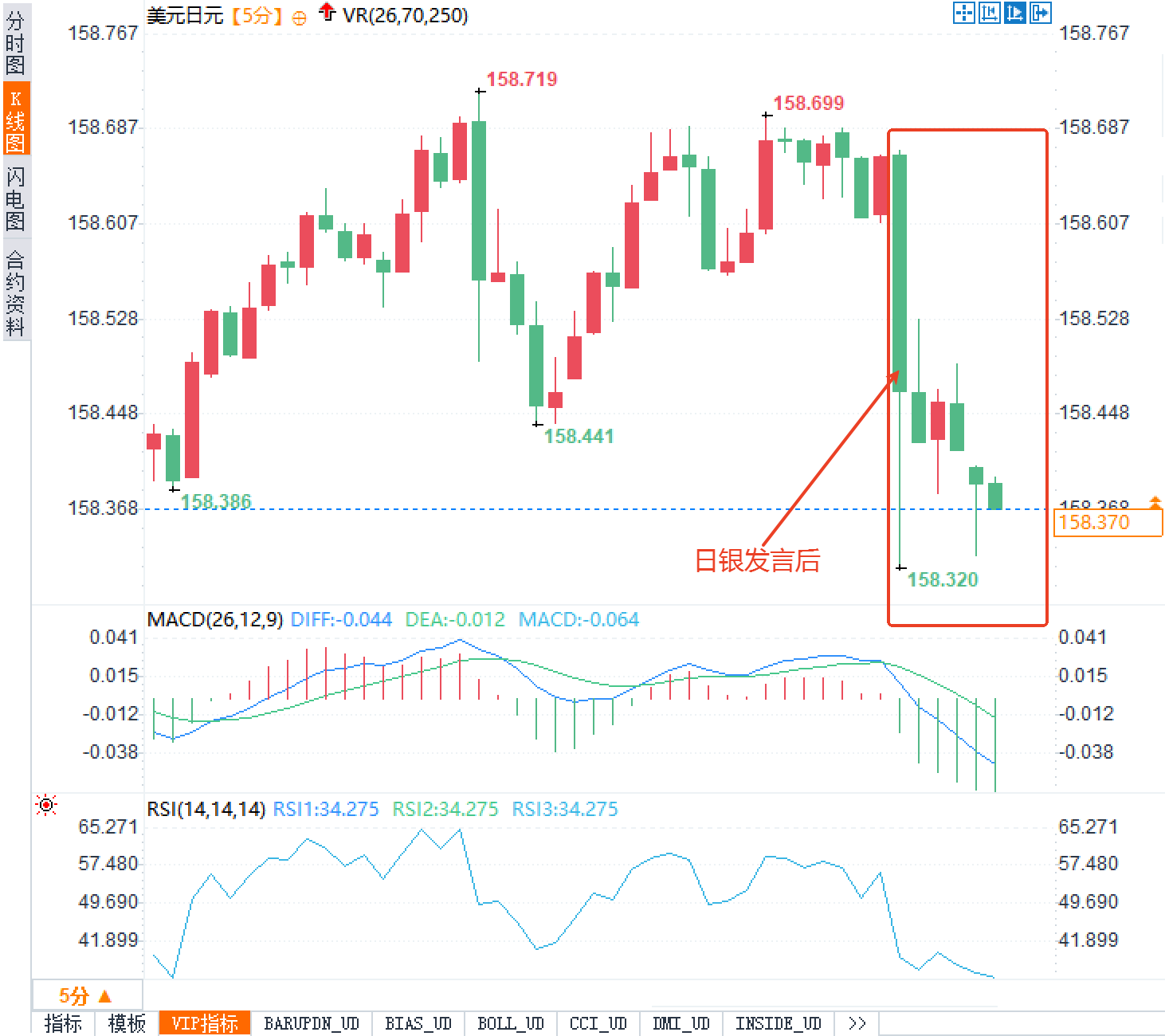
The USD/JPY pair has recently experienced a rollercoaster ride, with market sentiment extremely tense. On Thursday (January 15), the pair traded around 158.370 during the European session, briefly rising to 158.699 before plunging 35 points to a low of 158.32 following comments from Bank of Japan officials. This dramatic fluctuation clearly reflects the current market fragility—any slight change from official sources can trigger significant short-term volatility.
Currently, bulls and bears are locked in a fierce battle. On one hand, while the US dollar faces pressure from weak core inflation, it has received safe-haven support due to geopolitical risks such as the situation in Iran, rising instead of falling after the release of the Consumer Price Index, demonstrating the complex logic behind capital flows. However, as geopolitical news continues to fluctuate, the market has given back all its previous gains and returned to a wait-and-see mode. Traders generally expect the Federal Reserve to cut interest rates by about 54 basis points this year, but because inflation has not yet stabilized and reached its target, policymakers are maintaining a cautious "data-dependent" stance, resulting in a neutral to slightly bearish short-term outlook for the US dollar.
Meanwhile, the yen continues to face pressure, and its depreciation trend is unlikely to reverse. Although Japanese officials have recently issued frequent warnings and attempted to curb the unilateral decline in the exchange rate through "verbal intervention," the effects have been limited. While these statements may boost confidence in the yen in the short term and help it recover some lost ground, they are insufficient to reverse the structural disadvantages in its fundamentals. The market is increasingly worried that if officials remain only at the level of rhetoric, they may ultimately miss the best opportunity for intervention.
The weakness of the yen is not accidental, but rather the result of a combination of unfavorable factors. The most fundamental problem lies in its lack of attractive yields. The Bank of Japan's slow normalization of monetary policy and the prolonged negative real interest rates have dampened international capital's interest in holding yen assets. In contrast, major economies such as the United States maintain relatively high interest rates, creating a strong interest rate differential and further exacerbating the selling pressure on the yen.
To make matters worse, the Japanese government is pursuing an expansionary fiscal policy, and the market widely expects the upcoming budget to include a large-scale spending plan aimed at stimulating economic growth. While this combination of loose fiscal policy and low interest rates may help boost the economy in the short term, it also amplifies the risk of currency depreciation. Analysts point out that such a policy environment will make it harder for the yen to find support, instead encouraging carry trades.
Political factors have also added uncertainty to the market. Japanese Prime Minister Sanae Takaichi has confirmed that she will dissolve parliament and hold a general election in February, meaning that the policy focus in the coming months will lean towards short-term economic stimulus rather than structural reforms. To win public support, the government is likely to continue introducing measures to boost consumption and investment, thus maintaining an easing stance. In this context, even if some central bank officials believe that the excessive depreciation of the yen has negatively impacted people's livelihoods, it will be difficult to push for a rapid policy shift.
It's worth noting that the Bank of Japan is increasingly focused on the exchange rate. Sources familiar with the matter revealed that some policymakers are aware of the imported inflation and rising cost of living resulting from a weaker yen. However, the central bank still considers wage growth a key indicator for policy adjustments; therefore, the outcome of the upcoming spring labor-management negotiations will be a crucial window into whether policy will shift. Currently, the market is pricing in a possible tightening of approximately 40 basis points by the Bank of Japan this year, but whether this expectation will materialize remains uncertain.
As the yen continues to weaken, market expectations for actual foreign exchange intervention by Japanese authorities have risen sharply. TD Securities analysts point out that if the exchange rate continues to climb and approaches or reaches the potential intervention range of 161 to 163, intervention on Monday cannot be ruled out. It is particularly noteworthy that this day coincides with the US market being closed, resulting in lower market liquidity—a timing historically favored by Japanese authorities.
Intervention in a low-liquidity environment allows for leveraging relatively small amounts of capital to trigger larger market reactions, controlling costs while effectively sending signals. Therefore, analysts generally believe that the period around the holidays would be an ideal window if Tokyo were to intervene. This has led many traders to closely monitor every upward momentum after the psychological level of 160, fearing they might miss the calm before the storm.
From a technical perspective, the current MACD indicator for USD/JPY shows a DIFF of -0.044, a DEA of -0.012, and a MACD value of -0.064, indicating an overall bearish signal. The RSI reading is 34.275, relatively low, suggesting that selling pressure on the yen has eased in the short term. However, this does not signify a trend reversal. Without fundamental improvement in the economic outlook, the upside potential for a technical rebound is limited and should be viewed more as a respite within the downtrend.
The performance during the European trading session also confirmed this: although the yen struggled to hold onto its early gains, supported by buying driven by intervention concerns, its overall outlook remained gloomy. The market clearly understands that unless there are substantial policy adjustments or large-scale intervention, the yen will find it difficult to escape its passive position.
Looking ahead, the USD/JPY pair is likely to enter a period of wide-range fluctuations. Upside resistance is limited by the escalating risk of intervention, especially as the exchange rate approaches the 161-163 range, at which point market alert levels will increase significantly. Downside support comes from the USD/JPY interest rate differential and safe-haven demand, making a substantial decline unlikely. This "upper limit, lower limit" pattern is likely to dominate short-term price action.
For the US dollar, its trajectory will continue to be dominated by the Federal Reserve's policy path. Although inflation has eased somewhat, geopolitical risks remain a significant variable. If tensions rise again in the Middle East and elsewhere, safe-haven funds may flow into dollar assets, providing temporary support. Conversely, if signs of peace strengthen, the dollar may come under renewed pressure.
For the Japanese yen, a true turnaround can only come from a fundamental shift in policy. Only when the Bank of Japan clearly signals an acceleration of interest rate hikes, or when real interest rates successfully turn positive, will it be possible to attract long-term capital inflows. Until then, traders are highly vigilant about the risk of intervention, especially near key time windows and sensitive price levels.
Overall, the game surrounding the USD/JPY exchange rate is far from over. Verbal warnings, technical corrections, geopolitical instability, holiday liquidity... any of these factors could be the trigger for a market meltdown.
Currently, bulls and bears are locked in a fierce battle. On one hand, while the US dollar faces pressure from weak core inflation, it has received safe-haven support due to geopolitical risks such as the situation in Iran, rising instead of falling after the release of the Consumer Price Index, demonstrating the complex logic behind capital flows. However, as geopolitical news continues to fluctuate, the market has given back all its previous gains and returned to a wait-and-see mode. Traders generally expect the Federal Reserve to cut interest rates by about 54 basis points this year, but because inflation has not yet stabilized and reached its target, policymakers are maintaining a cautious "data-dependent" stance, resulting in a neutral to slightly bearish short-term outlook for the US dollar.
Meanwhile, the yen continues to face pressure, and its depreciation trend is unlikely to reverse. Although Japanese officials have recently issued frequent warnings and attempted to curb the unilateral decline in the exchange rate through "verbal intervention," the effects have been limited. While these statements may boost confidence in the yen in the short term and help it recover some lost ground, they are insufficient to reverse the structural disadvantages in its fundamentals. The market is increasingly worried that if officials remain only at the level of rhetoric, they may ultimately miss the best opportunity for intervention.
The yen is facing a deep predicament, hampered by both policy and election constraints.
The weakness of the yen is not accidental, but rather the result of a combination of unfavorable factors. The most fundamental problem lies in its lack of attractive yields. The Bank of Japan's slow normalization of monetary policy and the prolonged negative real interest rates have dampened international capital's interest in holding yen assets. In contrast, major economies such as the United States maintain relatively high interest rates, creating a strong interest rate differential and further exacerbating the selling pressure on the yen.
To make matters worse, the Japanese government is pursuing an expansionary fiscal policy, and the market widely expects the upcoming budget to include a large-scale spending plan aimed at stimulating economic growth. While this combination of loose fiscal policy and low interest rates may help boost the economy in the short term, it also amplifies the risk of currency depreciation. Analysts point out that such a policy environment will make it harder for the yen to find support, instead encouraging carry trades.
Political factors have also added uncertainty to the market. Japanese Prime Minister Sanae Takaichi has confirmed that she will dissolve parliament and hold a general election in February, meaning that the policy focus in the coming months will lean towards short-term economic stimulus rather than structural reforms. To win public support, the government is likely to continue introducing measures to boost consumption and investment, thus maintaining an easing stance. In this context, even if some central bank officials believe that the excessive depreciation of the yen has negatively impacted people's livelihoods, it will be difficult to push for a rapid policy shift.
It's worth noting that the Bank of Japan is increasingly focused on the exchange rate. Sources familiar with the matter revealed that some policymakers are aware of the imported inflation and rising cost of living resulting from a weaker yen. However, the central bank still considers wage growth a key indicator for policy adjustments; therefore, the outcome of the upcoming spring labor-management negotiations will be a crucial window into whether policy will shift. Currently, the market is pricing in a possible tightening of approximately 40 basis points by the Bank of Japan this year, but whether this expectation will materialize remains uncertain.
Intervention looms large; 162 may be the last line of defense.
As the yen continues to weaken, market expectations for actual foreign exchange intervention by Japanese authorities have risen sharply. TD Securities analysts point out that if the exchange rate continues to climb and approaches or reaches the potential intervention range of 161 to 163, intervention on Monday cannot be ruled out. It is particularly noteworthy that this day coincides with the US market being closed, resulting in lower market liquidity—a timing historically favored by Japanese authorities.
Intervention in a low-liquidity environment allows for leveraging relatively small amounts of capital to trigger larger market reactions, controlling costs while effectively sending signals. Therefore, analysts generally believe that the period around the holidays would be an ideal window if Tokyo were to intervene. This has led many traders to closely monitor every upward momentum after the psychological level of 160, fearing they might miss the calm before the storm.
From a technical perspective, the current MACD indicator for USD/JPY shows a DIFF of -0.044, a DEA of -0.012, and a MACD value of -0.064, indicating an overall bearish signal. The RSI reading is 34.275, relatively low, suggesting that selling pressure on the yen has eased in the short term. However, this does not signify a trend reversal. Without fundamental improvement in the economic outlook, the upside potential for a technical rebound is limited and should be viewed more as a respite within the downtrend.
The performance during the European trading session also confirmed this: although the yen struggled to hold onto its early gains, supported by buying driven by intervention concerns, its overall outlook remained gloomy. The market clearly understands that unless there are substantial policy adjustments or large-scale intervention, the yen will find it difficult to escape its passive position.
Where will the future lead? Volatility may become the dominant theme.
Looking ahead, the USD/JPY pair is likely to enter a period of wide-range fluctuations. Upside resistance is limited by the escalating risk of intervention, especially as the exchange rate approaches the 161-163 range, at which point market alert levels will increase significantly. Downside support comes from the USD/JPY interest rate differential and safe-haven demand, making a substantial decline unlikely. This "upper limit, lower limit" pattern is likely to dominate short-term price action.
For the US dollar, its trajectory will continue to be dominated by the Federal Reserve's policy path. Although inflation has eased somewhat, geopolitical risks remain a significant variable. If tensions rise again in the Middle East and elsewhere, safe-haven funds may flow into dollar assets, providing temporary support. Conversely, if signs of peace strengthen, the dollar may come under renewed pressure.
For the Japanese yen, a true turnaround can only come from a fundamental shift in policy. Only when the Bank of Japan clearly signals an acceleration of interest rate hikes, or when real interest rates successfully turn positive, will it be possible to attract long-term capital inflows. Until then, traders are highly vigilant about the risk of intervention, especially near key time windows and sensitive price levels.
Overall, the game surrounding the USD/JPY exchange rate is far from over. Verbal warnings, technical corrections, geopolitical instability, holiday liquidity... any of these factors could be the trigger for a market meltdown.
- Risk Warning and Disclaimer
- The market involves risk, and trading may not be suitable for all investors. This article is for reference only and does not constitute personal investment advice, nor does it take into account certain users’ specific investment objectives, financial situation, or other needs. Any investment decisions made based on this information are at your own risk.