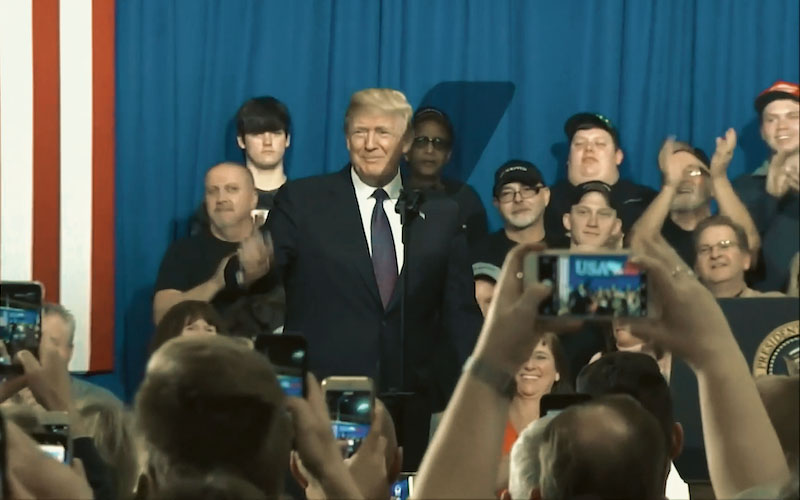
Powell is reportedly considering staying on, and the dollar is awaiting the outcome of a central bank defense battle.
2026-01-16 20:04:40
On Friday (January 16), the US dollar index traded around 99.20, down slightly by 0.14% on the day, continuing its recent narrow range trading pattern. Market focus has shifted dramatically from purely economic data to the political maneuvering that could reshape the Federal Reserve's power structure and policy independence. With current Chairman Powell's term nearing its end, concerns surrounding his future, legal pressure, and the Trump administration's attempts to influence the central bank are becoming potential decisive forces shaping the dollar's medium-term trajectory. Prices are hovering within a key technical range, awaiting a fundamental breakout signal.

The most crucial variable in the current market is not inflation or employment data, but the future of the Federal Reserve as an institution itself. According to reports from well-known institutions, although Powell's term as Fed Chair will end this May, his term as a Fed Governor can continue for up to two years. This presents him with a critical choice: whether to retire completely or remain on the board, potentially playing a key swing vote role internally to counterbalance any executive forces that might undermine the Fed's independence.
This possibility is rising sharply. Over the past week, the U.S. Department of Justice threatened criminal charges, which Powell denounced as a "pretext" to try and influence monetary policy. In response, Powell released a direct video statement, addressing the ongoing pressure head-on, a move seen as a significant shift. Although Trump recently stated in an interview that there are no plans to fire Powell, the existence of the judicial investigation and the attempt to fire another governor, Cook, have shaken market expectations of the Fed's traditionally solid independence.
Former Cleveland Fed President Loretta Mester pointed out that the subpoena "escalated all the issues that have surfaced over the past eight months," and even if the Fed continues to withstand the pressure, "the fact is, it even raised questions, and that's a cost." This "cost" is reflected in market concerns about potential changes to monetary policy rules. Mark Spindle, chief investment officer at investment firm Potomac River Capital, believes that if Trump gains more power to appoint governors, it could drive "various restructurings and reforms" within the Fed, not just lowering interest rates.
Meanwhile, institutional views on the interest rate path have diverged significantly. Analysts at Nordea Bank, in a report, presented a view contrary to market consensus: the Federal Reserve may remain on hold throughout 2026, keeping interest rates unchanged. Their reasoning is based on a continued strong labor market, with last week's non-farm payroll data and ISM services survey both showing improvement, thus "it's difficult to see any weak case in the labor market that would justify a series of rate cuts." This view contrasts sharply with the two rate cuts currently almost fully priced in by the market, and the rate cut foreshadowed by the Fed's December dot plot. Nordea Bank acknowledges that the threat to the Fed's independence is the biggest risk to its forecast, but the outcome and impact of the judicial investigation remain highly uncertain.
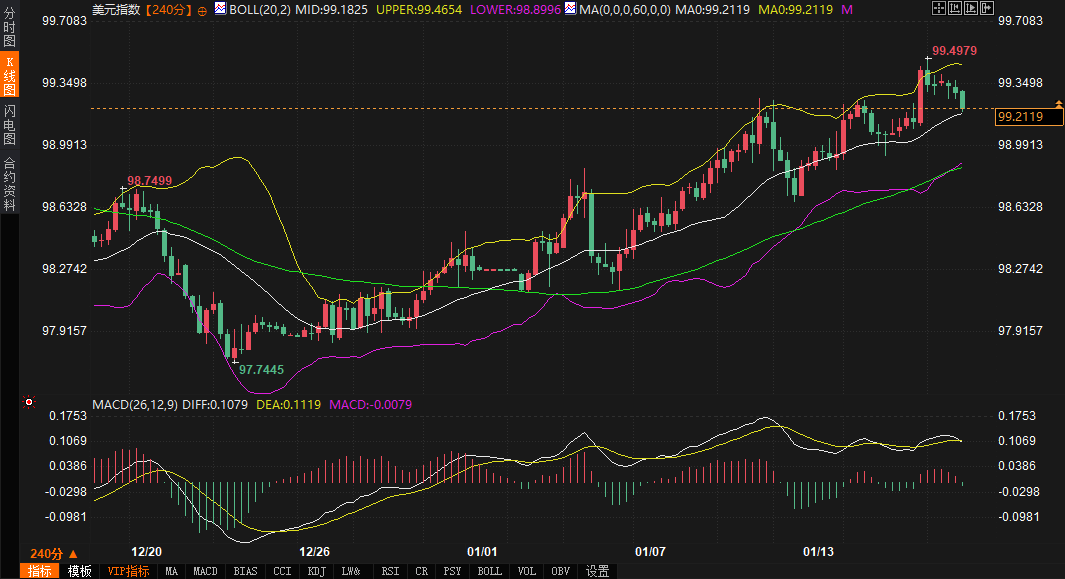
240-Minute Chart Analysis: Battle for the Midline and Stagnant Momentum <br/> Observing the 240-minute chart, the US Dollar Index is currently in a typical consolidation structure. The price is currently oscillating around the middle Bollinger Band (parameter 20,2) at 99.1824, with upper resistance at 99.4653 and lower support at 98.8994. This channel clearly defines the recent balance of power between bulls and bears.
More noteworthy is the state of the momentum indicators. The MACD (parameters 26,12,9) shows that the DIF and DEA values are extremely close, at 0.1074 and 0.1118 respectively, almost overlapping, while the MACD histogram shows only a slight negative value of -0.0084. This pattern indicates that the short-term momentum direction of the market is extremely unclear, with neither the bulls nor the bears showing a clear overwhelming advantage. The price's failure to break through or fall below the middle band after multiple tests reflects the market's hesitation before major fundamental events (Powell's future, the legal process) become clear.
Taking both fundamental and technical factors into account, the US dollar index is currently in a sensitive phase dominated by news-driven factors. The stalemate on the technical charts directly reflects the significant uncertainty surrounding the Federal Reserve's future.
In the coming weeks, the core driving forces of the market will focus on the following points:
1. A clear signal regarding Powell's future : Whether he will ultimately use his governorship to remain in office will be key to assessing the balance of power and resilience within the Federal Reserve. If he remains, it may initially be seen as support for traditional independence, but in the long run, it will exacerbate uncertainty regarding internal policy disagreements.
2. Progress of the judicial and political game : Whether the investigation into the Federal Reserve will be withdrawn or escalated, and the Senate's confirmation process for Trump's nominee for new chairman, will continue to disturb market nerves.
3. The interplay between economic data and interest rate expectations : Nordea Bank's aggressive view of "no rate cuts throughout the year" clashes with mainstream market expectations, meaning that the release of every key economic data point (especially employment and inflation) could lead to a reassessment of interest rate expectations, thereby triggering fluctuations in the US dollar.
Looking at the market outlook, it's difficult to establish a clear trend for the US dollar index until it breaks through the upper Bollinger Band at 99.46 on the 240-minute chart or falls below the lower band at 98.90. The market is awaiting a sufficiently strong catalyst to break the current dull technical equilibrium, and this catalyst will most likely come from Washington, rather than simply an economic statistics report.
Fundamental Analysis: A Crossroads in Fed Independence
The most crucial variable in the current market is not inflation or employment data, but the future of the Federal Reserve as an institution itself. According to reports from well-known institutions, although Powell's term as Fed Chair will end this May, his term as a Fed Governor can continue for up to two years. This presents him with a critical choice: whether to retire completely or remain on the board, potentially playing a key swing vote role internally to counterbalance any executive forces that might undermine the Fed's independence.
This possibility is rising sharply. Over the past week, the U.S. Department of Justice threatened criminal charges, which Powell denounced as a "pretext" to try and influence monetary policy. In response, Powell released a direct video statement, addressing the ongoing pressure head-on, a move seen as a significant shift. Although Trump recently stated in an interview that there are no plans to fire Powell, the existence of the judicial investigation and the attempt to fire another governor, Cook, have shaken market expectations of the Fed's traditionally solid independence.
Former Cleveland Fed President Loretta Mester pointed out that the subpoena "escalated all the issues that have surfaced over the past eight months," and even if the Fed continues to withstand the pressure, "the fact is, it even raised questions, and that's a cost." This "cost" is reflected in market concerns about potential changes to monetary policy rules. Mark Spindle, chief investment officer at investment firm Potomac River Capital, believes that if Trump gains more power to appoint governors, it could drive "various restructurings and reforms" within the Fed, not just lowering interest rates.
Meanwhile, institutional views on the interest rate path have diverged significantly. Analysts at Nordea Bank, in a report, presented a view contrary to market consensus: the Federal Reserve may remain on hold throughout 2026, keeping interest rates unchanged. Their reasoning is based on a continued strong labor market, with last week's non-farm payroll data and ISM services survey both showing improvement, thus "it's difficult to see any weak case in the labor market that would justify a series of rate cuts." This view contrasts sharply with the two rate cuts currently almost fully priced in by the market, and the rate cut foreshadowed by the Fed's December dot plot. Nordea Bank acknowledges that the threat to the Fed's independence is the biggest risk to its forecast, but the outcome and impact of the judicial investigation remain highly uncertain.
Technical Analysis: Bulls and bears are locked in a tug-of-war within a key range.
240-Minute Chart Analysis: Battle for the Midline and Stagnant Momentum <br/> Observing the 240-minute chart, the US Dollar Index is currently in a typical consolidation structure. The price is currently oscillating around the middle Bollinger Band (parameter 20,2) at 99.1824, with upper resistance at 99.4653 and lower support at 98.8994. This channel clearly defines the recent balance of power between bulls and bears.
More noteworthy is the state of the momentum indicators. The MACD (parameters 26,12,9) shows that the DIF and DEA values are extremely close, at 0.1074 and 0.1118 respectively, almost overlapping, while the MACD histogram shows only a slight negative value of -0.0084. This pattern indicates that the short-term momentum direction of the market is extremely unclear, with neither the bulls nor the bears showing a clear overwhelming advantage. The price's failure to break through or fall below the middle band after multiple tests reflects the market's hesitation before major fundamental events (Powell's future, the legal process) become clear.
Future Trend Outlook
Taking both fundamental and technical factors into account, the US dollar index is currently in a sensitive phase dominated by news-driven factors. The stalemate on the technical charts directly reflects the significant uncertainty surrounding the Federal Reserve's future.
In the coming weeks, the core driving forces of the market will focus on the following points:
1. A clear signal regarding Powell's future : Whether he will ultimately use his governorship to remain in office will be key to assessing the balance of power and resilience within the Federal Reserve. If he remains, it may initially be seen as support for traditional independence, but in the long run, it will exacerbate uncertainty regarding internal policy disagreements.
2. Progress of the judicial and political game : Whether the investigation into the Federal Reserve will be withdrawn or escalated, and the Senate's confirmation process for Trump's nominee for new chairman, will continue to disturb market nerves.
3. The interplay between economic data and interest rate expectations : Nordea Bank's aggressive view of "no rate cuts throughout the year" clashes with mainstream market expectations, meaning that the release of every key economic data point (especially employment and inflation) could lead to a reassessment of interest rate expectations, thereby triggering fluctuations in the US dollar.
Looking at the market outlook, it's difficult to establish a clear trend for the US dollar index until it breaks through the upper Bollinger Band at 99.46 on the 240-minute chart or falls below the lower band at 98.90. The market is awaiting a sufficiently strong catalyst to break the current dull technical equilibrium, and this catalyst will most likely come from Washington, rather than simply an economic statistics report.
- Risk Warning and Disclaimer
- The market involves risk, and trading may not be suitable for all investors. This article is for reference only and does not constitute personal investment advice, nor does it take into account certain users’ specific investment objectives, financial situation, or other needs. Any investment decisions made based on this information are at your own risk.