As the US dollar approaches the 100 mark, why has it quietly climbed to a high level?
2026-01-16 21:14:29
On Friday (January 16), the US dollar index traded around 99.20 in pre-market trading, exhibiting a rare pattern of "low-volatility upward movement + high-level consolidation" in recent years. Unlike past sharp rises triggered by sudden events, this round of gains appears to be slowly pushed up by an unseen force. There was no panic in the market, nor was there widespread chasing of the rally, yet the dollar steadily climbed. The driving force behind this is not a single factor, but rather the result of the combined effects of macroeconomic fundamentals and capital flows.
Recent US economic data, including retail sales and initial jobless claims, have been generally strong. In particular, initial jobless claims for the week ending January 10th fell to 198,000, far below the expected 215,000, indicating the continued resilience of the US labor market. Meanwhile, the Federal Reserve's Beige Book also indicated that the economy is in a phase of moderate expansion, with no significant risks to employment. This information has led to a slight adjustment in market expectations regarding the pace of interest rate cuts—the terminal interest rate expectation was raised by 5 basis points this week. Although the increase is small, it represents a cumulative correction of 32 basis points since the low point in October last year. This marginal upward revision of interest rate expectations is one of the core logics supporting the slow strengthening of the US dollar.
Rising interest rate expectations will affect the US dollar through two paths: first, widening the interest rate spread between US Treasuries and bonds of other countries, attracting international capital inflows; second, changing the discount rate for carry trades and global asset allocation, prompting some funds to flow back into dollar-denominated assets. Because the adjustment process is gradual and volatility is low, the US dollar has not experienced a sudden surge, but rather exhibits a "grinding" characteristic, which explains why its recent trend, though seemingly flat, has continued to rise.
Behind the US dollar lies not only interest rate expectations but also capital inflows. According to the November TIC data released by the US Treasury Department, overseas investors continued to increase their holdings of various US assets. Although monthly data fluctuates, the rolling 12-month average shows that net overseas purchases of US assets in November were approximately $100 billion per month, significantly higher than the approximately $25 billion per month level in the summer of 2024. This indicates that external demand for dollar assets has not weakened but rather strengthened.
However, the reality is more complex. If overseas investors increase their hedging ratios, it could actually weaken the effectiveness of dollar buying in the spot market. This is because hedging itself creates reverse pressure in the forward and swap markets. Therefore, while capital inflows are beneficial to the dollar, they do not necessarily mean a sustained one-sided rise. The true direction still depends on the interplay between interest rate trends and hedging behavior. Currently, the former is dominant, while the latter has not yet formed a systemic reversal force; therefore, the dollar can maintain its strong consolidation pattern.
Despite solid fundamental support, potential sources of disturbance remain beneath the market's calm. First, there's the risk premium stemming from geopolitics. The dollar's rebound this year is partly attributed to escalating global tensions and widespread market expectations that the Federal Reserve will remain on the sidelines at the next few FOMC meetings. In this environment, the dollar's role as a safe-haven asset has become more prominent.
However, if geopolitical tensions show signs of easing, the risk premium could quickly recede, putting temporary pressure on the dollar. This is especially true on trading days with relatively light economic data, as markets are more likely to adjust positions based on unexpected news, leading to discontinuous fluctuations in the dollar's direction. Furthermore, another significant risk is "intervention." Analysts have noted that if the dollar/yen exchange rate approaches 160, Japan might intervene by selling dollars. Interestingly, the market interprets the US Treasury's stance on such actions as "tacit approval or even support," meaning that any intervention that occurs would have a considerable impact.
While intervention is generally unlikely to reverse medium-term trends, it is sufficient to disrupt short-term rhythms. A rapid pullback in the dollar could trigger algorithmic trading and stop-loss orders, amplifying intraday volatility. This would disrupt the current pricing logic of "low volatility upwards," forcing the market to reassess the dollar's operating pattern.
From a technical chart perspective, the US dollar index rose to 99.4979 on the 240-minute chart before retreating and is currently fluctuating narrowly around 99.20. Key resistance lies in the 99.50 area; a successful break above this level could lead to a steady advance towards the 100 mark. Conversely, a breach of the important psychological level of 99 could trigger a short-term correction, testing the previous low of 98.6687, with further support at 98.1567.
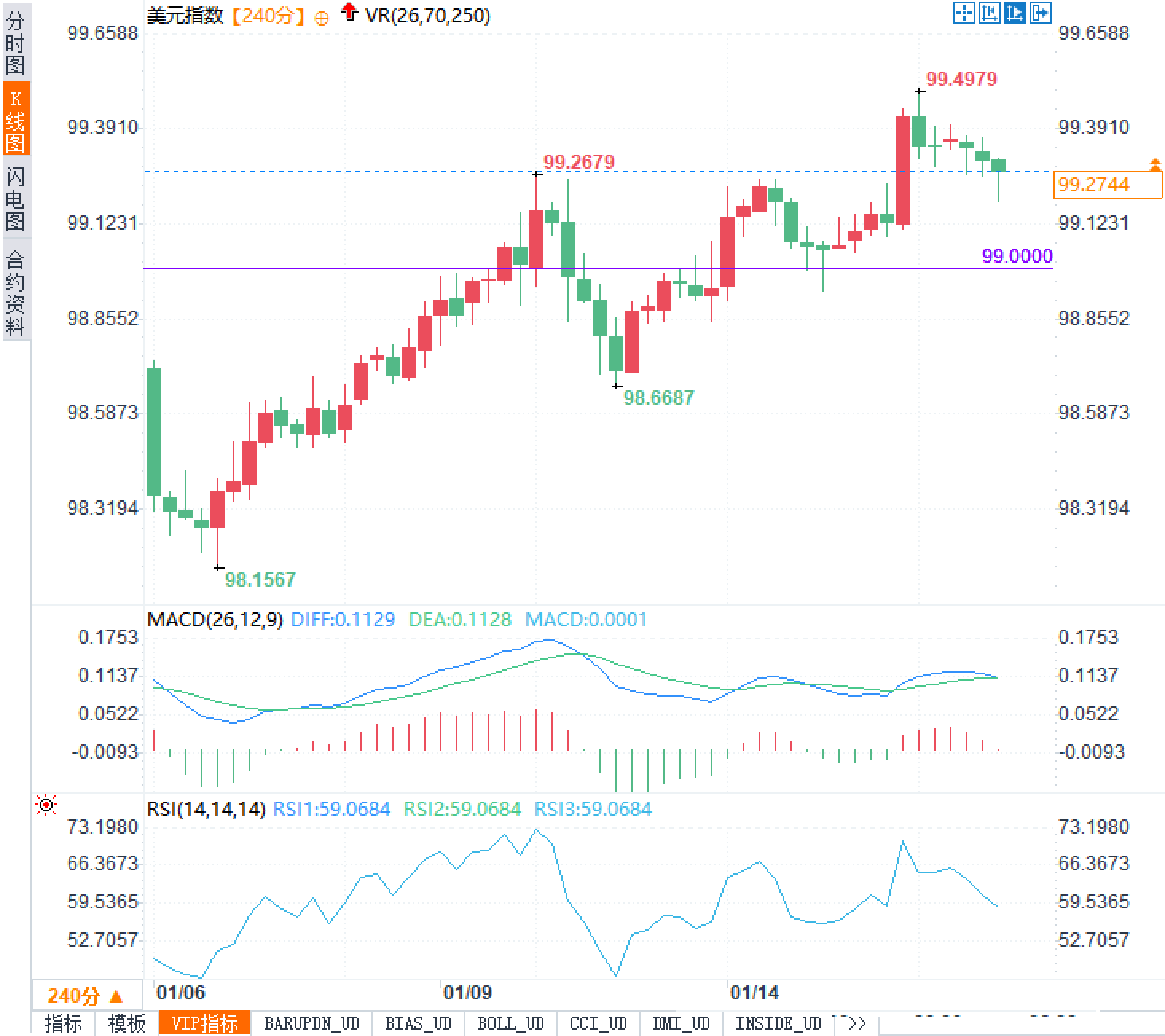
In terms of indicators, the MACD histogram is only 0.0001, and the DIFF and DEA are almost stuck between 0.1128 and 0.1129, indicating that the trend momentum is extremely mild, which is a typical strong consolidation pattern rather than an acceleration signal. The RSI (14) reading is about 59.0684, which is in the neutral to strong range, indicating that the bulls still have the upper hand, but it has not entered the overbought zone, leaving room for further upward movement, while also having the elasticity for a pullback.
In summary, whether the US dollar can continue its upward trend in the short term depends on two key factors: first, whether interest rate expectations continue to be revised slightly upward or at least not significantly downward, which is the foundation for maintaining its strength; and second, whether overseas capital inflows and risk appetite can be sustained, while also paying attention to whether the hedging ratio increases, thereby weakening the marginal support for the dollar. In the absence of new major catalysts, the dollar is more likely to consolidate at high levels, digesting previous gains and awaiting the next round of macroeconomic and news-driven repricing.
Recent US economic data, including retail sales and initial jobless claims, have been generally strong. In particular, initial jobless claims for the week ending January 10th fell to 198,000, far below the expected 215,000, indicating the continued resilience of the US labor market. Meanwhile, the Federal Reserve's Beige Book also indicated that the economy is in a phase of moderate expansion, with no significant risks to employment. This information has led to a slight adjustment in market expectations regarding the pace of interest rate cuts—the terminal interest rate expectation was raised by 5 basis points this week. Although the increase is small, it represents a cumulative correction of 32 basis points since the low point in October last year. This marginal upward revision of interest rate expectations is one of the core logics supporting the slow strengthening of the US dollar.
Rising interest rate expectations will affect the US dollar through two paths: first, widening the interest rate spread between US Treasuries and bonds of other countries, attracting international capital inflows; second, changing the discount rate for carry trades and global asset allocation, prompting some funds to flow back into dollar-denominated assets. Because the adjustment process is gradual and volatility is low, the US dollar has not experienced a sudden surge, but rather exhibits a "grinding" characteristic, which explains why its recent trend, though seemingly flat, has continued to rise.
Are funds still "buying the dip" in US assets?
Behind the US dollar lies not only interest rate expectations but also capital inflows. According to the November TIC data released by the US Treasury Department, overseas investors continued to increase their holdings of various US assets. Although monthly data fluctuates, the rolling 12-month average shows that net overseas purchases of US assets in November were approximately $100 billion per month, significantly higher than the approximately $25 billion per month level in the summer of 2024. This indicates that external demand for dollar assets has not weakened but rather strengthened.
However, the reality is more complex. If overseas investors increase their hedging ratios, it could actually weaken the effectiveness of dollar buying in the spot market. This is because hedging itself creates reverse pressure in the forward and swap markets. Therefore, while capital inflows are beneficial to the dollar, they do not necessarily mean a sustained one-sided rise. The true direction still depends on the interplay between interest rate trends and hedging behavior. Currently, the former is dominant, while the latter has not yet formed a systemic reversal force; therefore, the dollar can maintain its strong consolidation pattern.
Geopolitical undercurrents and policy interventions are brewing variables.
Despite solid fundamental support, potential sources of disturbance remain beneath the market's calm. First, there's the risk premium stemming from geopolitics. The dollar's rebound this year is partly attributed to escalating global tensions and widespread market expectations that the Federal Reserve will remain on the sidelines at the next few FOMC meetings. In this environment, the dollar's role as a safe-haven asset has become more prominent.
However, if geopolitical tensions show signs of easing, the risk premium could quickly recede, putting temporary pressure on the dollar. This is especially true on trading days with relatively light economic data, as markets are more likely to adjust positions based on unexpected news, leading to discontinuous fluctuations in the dollar's direction. Furthermore, another significant risk is "intervention." Analysts have noted that if the dollar/yen exchange rate approaches 160, Japan might intervene by selling dollars. Interestingly, the market interprets the US Treasury's stance on such actions as "tacit approval or even support," meaning that any intervention that occurs would have a considerable impact.
While intervention is generally unlikely to reverse medium-term trends, it is sufficient to disrupt short-term rhythms. A rapid pullback in the dollar could trigger algorithmic trading and stop-loss orders, amplifying intraday volatility. This would disrupt the current pricing logic of "low volatility upwards," forcing the market to reassess the dollar's operating pattern.
Technical Analysis Reveals: A Tug-of-War Between Bulls and Bears is Imminent
From a technical chart perspective, the US dollar index rose to 99.4979 on the 240-minute chart before retreating and is currently fluctuating narrowly around 99.20. Key resistance lies in the 99.50 area; a successful break above this level could lead to a steady advance towards the 100 mark. Conversely, a breach of the important psychological level of 99 could trigger a short-term correction, testing the previous low of 98.6687, with further support at 98.1567.
In terms of indicators, the MACD histogram is only 0.0001, and the DIFF and DEA are almost stuck between 0.1128 and 0.1129, indicating that the trend momentum is extremely mild, which is a typical strong consolidation pattern rather than an acceleration signal. The RSI (14) reading is about 59.0684, which is in the neutral to strong range, indicating that the bulls still have the upper hand, but it has not entered the overbought zone, leaving room for further upward movement, while also having the elasticity for a pullback.
In summary, whether the US dollar can continue its upward trend in the short term depends on two key factors: first, whether interest rate expectations continue to be revised slightly upward or at least not significantly downward, which is the foundation for maintaining its strength; and second, whether overseas capital inflows and risk appetite can be sustained, while also paying attention to whether the hedging ratio increases, thereby weakening the marginal support for the dollar. In the absence of new major catalysts, the dollar is more likely to consolidate at high levels, digesting previous gains and awaiting the next round of macroeconomic and news-driven repricing.
- Risk Warning and Disclaimer
- The market involves risk, and trading may not be suitable for all investors. This article is for reference only and does not constitute personal investment advice, nor does it take into account certain users’ specific investment objectives, financial situation, or other needs. Any investment decisions made based on this information are at your own risk.