Behind the 70-point plunge in the US dollar lies a truth no one dares to speak of.
2026-01-20 20:13:05
On Tuesday (January 20), the US dollar index traded around 98.4260 during the European session, down about 70 points on the day. Against the backdrop of deteriorating global risk sentiment and increased stock market volatility, the dollar did not rise as it had in the past; instead, it weakened against major currencies such as the euro. This raises the question: has the old rule of "buying the dollar as a safe haven" become ineffective?
In fact, it's not that the rules have changed, but rather that the underlying logic driving the market is shifting. In the past, people believed that whenever the market was turbulent, funds would flow into the US dollar and US Treasuries as safe havens. But now analysts are finding the situation to be more complex. Recent remarks by Bank of England Governor Andrew Bailey highlight the key point—if the Federal Reserve's independence is questioned, then the dollar's "safe-haven asset" label may be under scrutiny.
Independence refers to a central bank's ability to formulate monetary policy independently, based on economic data and free from political interference. Once this credibility is compromised, the market demands higher risk compensation. In other words, investors will question whether the Federal Reserve will continue to distort interest rate decisions for electoral or political purposes. This concern won't immediately trigger a sell-off, but it will quietly push up the yield on US Treasury bonds, the "benchmark interest rate" for global financing. As a result, not only will borrowing become more expensive in the US, but financing costs for businesses and individuals in Europe, Japan, and other regions will also rise. This impact spreads like ripples, known as the "global spillover effect."
Bailey has explicitly stated that he does not believe the Bank of England faces a similar threat and has also praised Federal Reserve Chairman Powell's professional competence. However, this statement precisely indicates that the market has begun to be wary of this potential risk. Once a consensus is reached, even a change in expectations could lead to a repricing of dollar assets.
The market often hears talk of "de-dollarization," as if countries are frantically selling off dollar assets. But this is not the case. Data shows that in the 12 months ending in November, overseas investors cumulatively increased their holdings of US long-term securities by $1.569 trillion, a record high. These purchases included US Treasury bonds, corporate bonds, stocks, and government agency bonds. If it were truly a large-scale withdrawal, how could there be a net inflow?
What's actually happening is a different kind of behavior: increased hedging demand. Many foreign investors holding dollar assets, such as European pension funds, choose to increase their foreign exchange hedging ratios when risks rise. In other words, they want the returns from US assets but don't want to bear the risk of exchange rate fluctuations. So they sell dollars and buy their own currency through derivatives, thus creating actual selling pressure on the dollar. This explains why the dollar weakens during periods of market turmoil.
The main driver determining the dollar's trajectory remains the Federal Reserve's policy path. Over the past few months, the market has repeatedly revised its expectations regarding the pace of interest rate cuts: initially, bets on rapid rate cuts caused the dollar to fall; subsequently, a rebound in inflation and a rise in hawkish sentiment led to a slight recovery in the dollar. Behind this back-and-forth fluctuation lies a dual game of interest rate expectations and trading positions.
Of particular note is the fact that the US dollar had previously accumulated a large number of long positions, a classic example of "crowded trading." When market sentiment reversed, these leveraged funds often rushed to liquidate their positions, causing price drops to far exceed the magnitude of fundamental changes. This is why the US dollar sometimes experiences sharp declines: because too many people want to exit at the same time.
From a technical chart perspective, the US dollar index is currently in a critical range. The 99.0000 level has become short-term resistance; after rebounding to 99.4940, it encountered strong selling pressure, with a long bearish candle breaking below this level, indicating a significant weakening of bullish momentum. Support is concentrated around 98.1500; a break below this level could lead to a further test of the previous low of 97.7479.
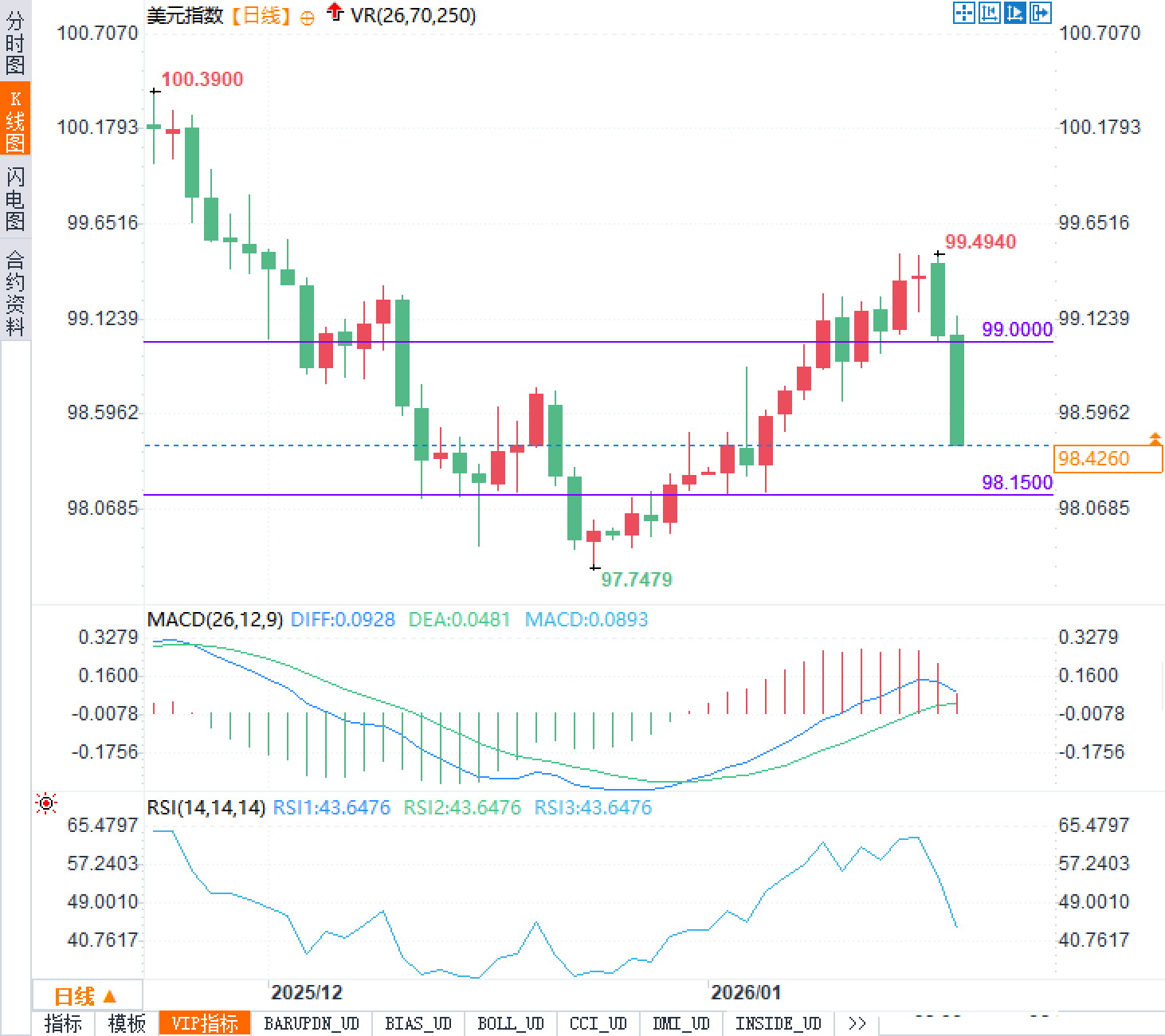
Momentum indicators are also issuing warning signals: the RSI is around 43.6476, in the neutral-to-weak zone, not yet oversold but lacking upward momentum; as for the MACD, the DIFF is 0.0928, the DEA is 0.0481, and although the histogram is still positive, it has begun to converge. Whether the US dollar can hold above 98.1500 in the coming days will be a key indicator of whether it is a "consolidation and correction" or the start of a new round of decline.
In the medium to long term, the challenges facing the US dollar are not only the cyclical narrowing of interest rate differentials, but also structural erosion of confidence. There is a growing speculation about trade policy instability, geopolitical security concerns, and political interference in the independence of the Federal Reserve. These factors will not immediately destroy the dollar's status, but will gradually increase its "risk premium" as a reserve currency.
Like an old building, it may appear sturdy on the outside, but the process of steel corrosion is invisible to the naked eye. Once the market widely believes that "the dollar is no longer so safe," its financing costs will rise permanently, thus affecting the price of capital in the global economy. This change is slow, but once it becomes a trend, it is extremely difficult to reverse.
The current situation is more like a transitional period: in the short term, the US dollar is still fluctuating within the 98-99 range, as most major central banks are nearing the end of their interest rate cuts, while the Federal Reserve still has room to cut rates, and the interest rate differential advantage no longer unilaterally supports the US dollar; in the medium term, if the issue of institutional credibility continues to ferment, volatility may be systematically amplified, and central banks around the world will be forced to deal with the "extreme volatility" of their currencies.
Ultimately, the market is shifting its focus from "whether the next rate hike or cut will be" to "whether this system is still reliable." Within this new framework, simply discussing "whether to buy the dollar as a safe haven" is insufficient. Traders need to closely monitor the correlation between interest rate expectations, hedging flows, and key technical levels to discern the true direction of this silent shift.
In fact, it's not that the rules have changed, but rather that the underlying logic driving the market is shifting. In the past, people believed that whenever the market was turbulent, funds would flow into the US dollar and US Treasuries as safe havens. But now analysts are finding the situation to be more complex. Recent remarks by Bank of England Governor Andrew Bailey highlight the key point—if the Federal Reserve's independence is questioned, then the dollar's "safe-haven asset" label may be under scrutiny.
Independence refers to a central bank's ability to formulate monetary policy independently, based on economic data and free from political interference. Once this credibility is compromised, the market demands higher risk compensation. In other words, investors will question whether the Federal Reserve will continue to distort interest rate decisions for electoral or political purposes. This concern won't immediately trigger a sell-off, but it will quietly push up the yield on US Treasury bonds, the "benchmark interest rate" for global financing. As a result, not only will borrowing become more expensive in the US, but financing costs for businesses and individuals in Europe, Japan, and other regions will also rise. This impact spreads like ripples, known as the "global spillover effect."
Bailey has explicitly stated that he does not believe the Bank of England faces a similar threat and has also praised Federal Reserve Chairman Powell's professional competence. However, this statement precisely indicates that the market has begun to be wary of this potential risk. Once a consensus is reached, even a change in expectations could lead to a repricing of dollar assets.
"De-dollarization" has not yet begun, but a wave of hedging has already quietly emerged.
The market often hears talk of "de-dollarization," as if countries are frantically selling off dollar assets. But this is not the case. Data shows that in the 12 months ending in November, overseas investors cumulatively increased their holdings of US long-term securities by $1.569 trillion, a record high. These purchases included US Treasury bonds, corporate bonds, stocks, and government agency bonds. If it were truly a large-scale withdrawal, how could there be a net inflow?
What's actually happening is a different kind of behavior: increased hedging demand. Many foreign investors holding dollar assets, such as European pension funds, choose to increase their foreign exchange hedging ratios when risks rise. In other words, they want the returns from US assets but don't want to bear the risk of exchange rate fluctuations. So they sell dollars and buy their own currency through derivatives, thus creating actual selling pressure on the dollar. This explains why the dollar weakens during periods of market turmoil.
Interest Rate Expectations and Technical Analysis:
The main driver determining the dollar's trajectory remains the Federal Reserve's policy path. Over the past few months, the market has repeatedly revised its expectations regarding the pace of interest rate cuts: initially, bets on rapid rate cuts caused the dollar to fall; subsequently, a rebound in inflation and a rise in hawkish sentiment led to a slight recovery in the dollar. Behind this back-and-forth fluctuation lies a dual game of interest rate expectations and trading positions.
Of particular note is the fact that the US dollar had previously accumulated a large number of long positions, a classic example of "crowded trading." When market sentiment reversed, these leveraged funds often rushed to liquidate their positions, causing price drops to far exceed the magnitude of fundamental changes. This is why the US dollar sometimes experiences sharp declines: because too many people want to exit at the same time.
From a technical chart perspective, the US dollar index is currently in a critical range. The 99.0000 level has become short-term resistance; after rebounding to 99.4940, it encountered strong selling pressure, with a long bearish candle breaking below this level, indicating a significant weakening of bullish momentum. Support is concentrated around 98.1500; a break below this level could lead to a further test of the previous low of 97.7479.
Momentum indicators are also issuing warning signals: the RSI is around 43.6476, in the neutral-to-weak zone, not yet oversold but lacking upward momentum; as for the MACD, the DIFF is 0.0928, the DEA is 0.0481, and although the histogram is still positive, it has begun to converge. Whether the US dollar can hold above 98.1500 in the coming days will be a key indicator of whether it is a "consolidation and correction" or the start of a new round of decline.
The real danger lies not today, but in tomorrow's crisis of trust.
In the medium to long term, the challenges facing the US dollar are not only the cyclical narrowing of interest rate differentials, but also structural erosion of confidence. There is a growing speculation about trade policy instability, geopolitical security concerns, and political interference in the independence of the Federal Reserve. These factors will not immediately destroy the dollar's status, but will gradually increase its "risk premium" as a reserve currency.
Like an old building, it may appear sturdy on the outside, but the process of steel corrosion is invisible to the naked eye. Once the market widely believes that "the dollar is no longer so safe," its financing costs will rise permanently, thus affecting the price of capital in the global economy. This change is slow, but once it becomes a trend, it is extremely difficult to reverse.
The current situation is more like a transitional period: in the short term, the US dollar is still fluctuating within the 98-99 range, as most major central banks are nearing the end of their interest rate cuts, while the Federal Reserve still has room to cut rates, and the interest rate differential advantage no longer unilaterally supports the US dollar; in the medium term, if the issue of institutional credibility continues to ferment, volatility may be systematically amplified, and central banks around the world will be forced to deal with the "extreme volatility" of their currencies.
Ultimately, the market is shifting its focus from "whether the next rate hike or cut will be" to "whether this system is still reliable." Within this new framework, simply discussing "whether to buy the dollar as a safe haven" is insufficient. Traders need to closely monitor the correlation between interest rate expectations, hedging flows, and key technical levels to discern the true direction of this silent shift.
- Risk Warning and Disclaimer
- The market involves risk, and trading may not be suitable for all investors. This article is for reference only and does not constitute personal investment advice, nor does it take into account certain users’ specific investment objectives, financial situation, or other needs. Any investment decisions made based on this information are at your own risk.