If the sell-off of Japanese bonds triggers action from the central bank, what will be the most important signal for the yen going forward?
2026-01-23 19:01:17
On Friday (January 23), the USD/JPY pair traded in a range-bound pattern during Asian and European sessions, hovering around the 158.00 level. The core logic driving the current USD/JPY exchange rate fluctuations has shifted from simple expectations of the USD/JPY interest rate differential to a deeper interplay between the health of Japan's domestic fiscal situation and the central bank's policy responses.
The core logic driving the current fluctuations in the USD/JPY exchange rate has shifted from simple expectations of the USD/JPY interest rate differential to a deeper interplay between the health of Japan's domestic fiscal situation and the central bank's policy responses.
Soaring yields and "hawkish noise" from the policy committee
The Japanese government bond market is experiencing significant volatility. The benchmark 10-year Japanese government bond yield surged to a 27-year high, a rapid increase that has raised serious concerns at the Bank of Japan. Governor Kazuo Ueda stated at a press conference following the policy meeting that the central bank will "closely communicate and play its respective roles in response to the bond market situation," and reiterated its readiness to increase bond purchases to ensure market stability in "exceptional circumstances." This provides the market with a potential soft floor for "yield curve control."
However, the divisions within the policy committee cannot be ignored. At this meeting, hawkish member Hajime Takada proposed raising the policy rate to approximately 1%, citing concerns about upside risks to prices. Although the proposal was rejected by a vote of 8 to 1, it sent a clear signal: against the backdrop of persistent inflationary pressures, calls for further monetary tightening are growing within the central bank. Market participants generally interpret this as another hawkish member, Naoki Tamura, potentially voting against the move at the next meeting in March, strengthening market expectations that the Bank of Japan could raise interest rates as early as April. Based on overnight index swap pricing, the market currently expects a near 70% probability of a 25 basis point rate hike in April and a 97.5% probability of a rate hike in June.
Fiscal Concerns Escalate, Central Bank Independence Faces Test <br />The underlying reason for the sell-off in Japanese bonds lies in the market's serious concerns about Japan's fiscal discipline. Since taking office last October, Prime Minister Sanae Takaichi has implemented an expansionary fiscal spending policy. Recently, in preparation for the upcoming February 8th general election, various political parties have made campaign promises such as suspending the food consumption tax, further exacerbating market doubts about Japan's medium- to long-term fiscal consolidation path. As Kazuo Ueda emphasized, "For the government, ensuring market confidence in its medium- to long-term fiscal consolidation is crucial." The potential contradiction between fiscal expansion and monetary tightening is squeezing the Bank of Japan's policy maneuvering space.
Combining fundamentals and technical charts, the USD/JPY pair is at a sensitive crossroads.
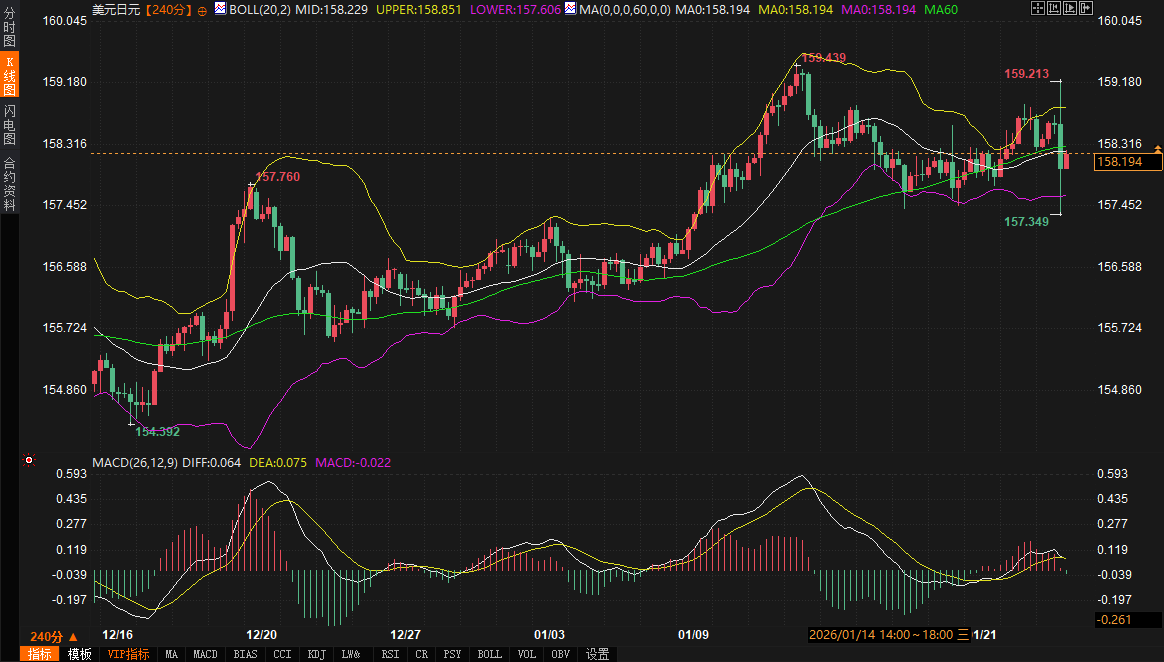
Support and Resistance Range Analysis <br/>Core resistance range: 158.50–158.85. 158.50 is the area where the recent high and psychological level coincide, while 158.85 is the upper Bollinger Band. The exchange rate needs sustained volume to break through this range to confirm a resumption of the upward trend, and may challenge 159.00 or even higher. The core driving force for the upward movement will mainly come from stronger-than-expected US economic data, or the Bank of Japan showing greater determination to curb rising yields, thereby delaying its rate hike pace.
Key support range: 157.60–157.20. The first support level is near the lower Bollinger Band at 157.60, which is also the lower edge of the recent trading range. Stronger support lies at 157.20, a level where multiple previous pullback lows converge, making it technically significant. A break below this support range could indicate that structural buying of the yen, triggered by soaring Japanese bond yields, is gaining momentum, and the market may be pricing in Japanese fiscal risk more than the USD/JPY interest rate differential.
Key points to watch during trading hours
1. Changes in the Japanese government bond yield curve: Pay close attention to the divergence between short-term (2-year, 5-year) and ultra-long-term (30-year, 40-year) yields. If short-term bonds continue to be sold off due to expectations of interest rate hikes (yields rise), while long-term bonds are supported by potential central bank bond-buying commitments (yields fall or rise less), leading to a further flattening of the yield curve, this situation may curb a significant appreciation of the yen in the short term, but in the medium to long term, it will exacerbate pressure on the financial system and bring non-linear risks to the yen.
2. The correlation between USD/JPY and risk sentiment: If global markets experience risk aversion due to US tariff rhetoric or geopolitical events (such as the Russia-Ukraine situation), the yen's appeal as a traditional safe-haven currency will increase, potentially accelerating the exchange rate's downward test of support levels.
3. The effectiveness of official verbal intervention: Closely monitor any follow-up statements from officials of the Japanese Ministry of Finance and the Bank of Japan. Ueda's statement that the exchange rate is "more likely to affect prices than in the past" has placed the yen exchange rate in a more central position of monitoring. Any remarks suggesting displeasure with "excessive" exchange rate fluctuations could trigger sharp short-term fluctuations in the exchange rate.
Looking ahead, the USD/JPY exchange rate will depend on the outcome of the struggle between three forces:
1. The Bank of Japan's policy dilemma: The central bank needs to strike a delicate balance between curbing excessive yen depreciation to alleviate imported inflation, responding to sharp fluctuations in the domestic bond market, and not stifling the nascent signs of inflation. Any confusion in policy signals could trigger significant market volatility.
2. Credibility of Japan's fiscal policy: Whether the new government's fiscal path after the election is clear and whether it can regain market trust will be the fundamental factors determining whether Japanese bond yields can stabilize and thus affect the stability of the yen's value.
3. External Factors: US economic data and the Federal Reserve's policy expectations remain important backdrops. If the US economy shows signs of weakness, leading to a decline in US Treasury yields, it will provide a window for the yen to rebound.
In summary, the USD/JPY pair is likely to remain within a wide trading range (157.20-158.85) at high levels in the short term. The market is awaiting clearer signals: will Japanese fiscal concerns and hawkish pressure within the central bank ultimately force a faster policy shift, thus boosting the yen; or will the global macroeconomic environment and interest rate advantages continue to support the dollar, allowing the exchange rate to consolidate at high levels before breaking upwards? Traders should closely monitor every fluctuation in the Japanese domestic bond market and the next set of signals from policymakers, as these will be the key to breaking the current deadlock.
Core Fundamental Drivers: Volatility in the Japanese Bond Market and the Central Bank's Dilemma
The core logic driving the current fluctuations in the USD/JPY exchange rate has shifted from simple expectations of the USD/JPY interest rate differential to a deeper interplay between the health of Japan's domestic fiscal situation and the central bank's policy responses.
Soaring yields and "hawkish noise" from the policy committee
The Japanese government bond market is experiencing significant volatility. The benchmark 10-year Japanese government bond yield surged to a 27-year high, a rapid increase that has raised serious concerns at the Bank of Japan. Governor Kazuo Ueda stated at a press conference following the policy meeting that the central bank will "closely communicate and play its respective roles in response to the bond market situation," and reiterated its readiness to increase bond purchases to ensure market stability in "exceptional circumstances." This provides the market with a potential soft floor for "yield curve control."
However, the divisions within the policy committee cannot be ignored. At this meeting, hawkish member Hajime Takada proposed raising the policy rate to approximately 1%, citing concerns about upside risks to prices. Although the proposal was rejected by a vote of 8 to 1, it sent a clear signal: against the backdrop of persistent inflationary pressures, calls for further monetary tightening are growing within the central bank. Market participants generally interpret this as another hawkish member, Naoki Tamura, potentially voting against the move at the next meeting in March, strengthening market expectations that the Bank of Japan could raise interest rates as early as April. Based on overnight index swap pricing, the market currently expects a near 70% probability of a 25 basis point rate hike in April and a 97.5% probability of a rate hike in June.
Fiscal Concerns Escalate, Central Bank Independence Faces Test <br />The underlying reason for the sell-off in Japanese bonds lies in the market's serious concerns about Japan's fiscal discipline. Since taking office last October, Prime Minister Sanae Takaichi has implemented an expansionary fiscal spending policy. Recently, in preparation for the upcoming February 8th general election, various political parties have made campaign promises such as suspending the food consumption tax, further exacerbating market doubts about Japan's medium- to long-term fiscal consolidation path. As Kazuo Ueda emphasized, "For the government, ensuring market confidence in its medium- to long-term fiscal consolidation is crucial." The potential contradiction between fiscal expansion and monetary tightening is squeezing the Bank of Japan's policy maneuvering space.
Technical Analysis and Key Range Outlook
Combining fundamentals and technical charts, the USD/JPY pair is at a sensitive crossroads.
Support and Resistance Range Analysis <br/>Core resistance range: 158.50–158.85. 158.50 is the area where the recent high and psychological level coincide, while 158.85 is the upper Bollinger Band. The exchange rate needs sustained volume to break through this range to confirm a resumption of the upward trend, and may challenge 159.00 or even higher. The core driving force for the upward movement will mainly come from stronger-than-expected US economic data, or the Bank of Japan showing greater determination to curb rising yields, thereby delaying its rate hike pace.
Key support range: 157.60–157.20. The first support level is near the lower Bollinger Band at 157.60, which is also the lower edge of the recent trading range. Stronger support lies at 157.20, a level where multiple previous pullback lows converge, making it technically significant. A break below this support range could indicate that structural buying of the yen, triggered by soaring Japanese bond yields, is gaining momentum, and the market may be pricing in Japanese fiscal risk more than the USD/JPY interest rate differential.
Key points to watch during trading hours
1. Changes in the Japanese government bond yield curve: Pay close attention to the divergence between short-term (2-year, 5-year) and ultra-long-term (30-year, 40-year) yields. If short-term bonds continue to be sold off due to expectations of interest rate hikes (yields rise), while long-term bonds are supported by potential central bank bond-buying commitments (yields fall or rise less), leading to a further flattening of the yield curve, this situation may curb a significant appreciation of the yen in the short term, but in the medium to long term, it will exacerbate pressure on the financial system and bring non-linear risks to the yen.
2. The correlation between USD/JPY and risk sentiment: If global markets experience risk aversion due to US tariff rhetoric or geopolitical events (such as the Russia-Ukraine situation), the yen's appeal as a traditional safe-haven currency will increase, potentially accelerating the exchange rate's downward test of support levels.
3. The effectiveness of official verbal intervention: Closely monitor any follow-up statements from officials of the Japanese Ministry of Finance and the Bank of Japan. Ueda's statement that the exchange rate is "more likely to affect prices than in the past" has placed the yen exchange rate in a more central position of monitoring. Any remarks suggesting displeasure with "excessive" exchange rate fluctuations could trigger sharp short-term fluctuations in the exchange rate.
Future Trend Outlook
Looking ahead, the USD/JPY exchange rate will depend on the outcome of the struggle between three forces:
1. The Bank of Japan's policy dilemma: The central bank needs to strike a delicate balance between curbing excessive yen depreciation to alleviate imported inflation, responding to sharp fluctuations in the domestic bond market, and not stifling the nascent signs of inflation. Any confusion in policy signals could trigger significant market volatility.
2. Credibility of Japan's fiscal policy: Whether the new government's fiscal path after the election is clear and whether it can regain market trust will be the fundamental factors determining whether Japanese bond yields can stabilize and thus affect the stability of the yen's value.
3. External Factors: US economic data and the Federal Reserve's policy expectations remain important backdrops. If the US economy shows signs of weakness, leading to a decline in US Treasury yields, it will provide a window for the yen to rebound.
In summary, the USD/JPY pair is likely to remain within a wide trading range (157.20-158.85) at high levels in the short term. The market is awaiting clearer signals: will Japanese fiscal concerns and hawkish pressure within the central bank ultimately force a faster policy shift, thus boosting the yen; or will the global macroeconomic environment and interest rate advantages continue to support the dollar, allowing the exchange rate to consolidate at high levels before breaking upwards? Traders should closely monitor every fluctuation in the Japanese domestic bond market and the next set of signals from policymakers, as these will be the key to breaking the current deadlock.
- Risk Warning and Disclaimer
- The market involves risk, and trading may not be suitable for all investors. This article is for reference only and does not constitute personal investment advice, nor does it take into account certain users’ specific investment objectives, financial situation, or other needs. Any investment decisions made based on this information are at your own risk.