Of the three current consensus narratives surrounding gold, which one will break down first?
2026-01-28 18:42:21
On Wednesday (January 28), the spot gold market witnessed a near-frenzied rally during Asian and European trading sessions. After breaking through the $5,200 mark, gold prices showed no signs of slowing down, reaching an all-time high of $5,311.29, a single-day increase of nearly 1.8%. This rally, which began at the start of the year, has accumulated a gain of over 20% in less than a month, exhibiting clear characteristics of a "short squeeze." Market sentiment is euphoric, but extreme price movements inevitably bring extreme vulnerability. The three core narratives currently driving the market—central bank gold purchases, the Fed's dovish shift, and anxieties about the dollar's credibility—have collectively built a stronghold of confidence for the bulls. However, examining the $5,300 level, which narrative is the most solid, and which is likely to crack first, will determine the subsequent path and magnitude of market fluctuations.

Undeniably, the continued increase in gold reserves held by central banks worldwide, particularly those in emerging markets, has been the most fundamental and solid structural support for the gold bull market of the past two years. This action represents a strategic rebalancing of the US dollar as a single reserve asset by official authorities. Its long decision-making cycle and minimal susceptibility to short-term price fluctuations have provided a long-term buying foundation for the market. The recent approval of a large-scale gold purchase program by the Polish central bank and the People's Bank of China's 14 consecutive months of increased holdings further reinforce this narrative.
However, the blind spot of this narrative is that it acts more as a "stabilizer" of trends than a "amplifier" of short-term prices. Central bank gold purchases are a dispersed and gradual process, and their pace is not closely correlated with the surge in open market prices. Attributing the current daily fluctuations of nearly $100 entirely to central bank actions is a classic logical mismatch. Traders need to be aware that while this narrative is difficult to disprove and provides a buffer during downturns, it is not the primary engine of the current sharp rise. Its risk of collapse is minimal, but its direct impact on short-term prices should not be overestimated.
The core trading logic in the current market undoubtedly revolves around the Federal Reserve. It comprises two sub-narratives: first, aggressive bets on a rate-cutting path; and second, deep concerns about the Fed's political independence. These two factors have created a resonance of emotions. On the one hand, weak economic data and Trump's comments that "interest rates will fall" have reinforced market expectations of an easing cycle; on the other hand, the political maneuvering surrounding the Fed chair and the investigations into its institutions have shaken market confidence in the central bank's independence, giving rise to the so-called "uncertainty premium."
This narrative is powerful, but also extremely fragile. It rests on expectations that have not yet occurred and are potentially subject to revision. Any event could shake its foundations: First, if the Fed's policy statement or the chairman's press conference, which concludes later today, reveals concern about inflation or a cautious stance on rate cuts, it could severely impact current expectations of easing; second, if the final Fed chairman is not the "pragmatic easing" candidate currently speculated by the market, the panic surrounding "political compliance" could quickly subside, and the associated premium would be squeezed out; finally, the fluctuations in key economic data, especially employment and inflation data, will continuously revise the interest rate path. Therefore, this narrative is most likely to experience volatility first; it is both the "rocket fuel" driving gold prices up and the "ignition point" triggering profit-taking.
The third narrative is the most expansive: the dollar's credit system faces long-term challenges, highlighting gold's ultimate safe-haven status as a non-sovereign credit asset. The dollar index falling to a four-year low, along with rhetoric regarding international trade frictions, is seen as evidence of this narrative. This drives capital to seek traditional safe havens.
However, the contradiction lies in this: when an asset surges 20% in a month, its volatility has already increased significantly. Can it still be purely defined as a "safe-haven asset"? A noteworthy statistic is that the S&P 500/gold ratio is currently approaching a historical high of 1.54, somewhat resembling the market turning point before the Great Depression of 1929. This suggests that gold's "valuation" relative to risk assets has been extremely stretched. Some market analysts are beginning to question how much of the current influx of funds into gold is driven by genuine safe-haven demand, and how much is simply momentum trading. If market risk appetite temporarily shifts due to certain factors (such as strong tech stock earnings), this "hot money" could withdraw exceptionally quickly. This blurred narrative boundary gives gold's rise a "story," but it also causes its role to drift from a "safe haven" to a "high-risk momentum asset," thus increasing its sensitivity to corrections.
From a purely technical perspective, almost all indicators on the daily chart point to extreme overbought conditions. The RSI has risen to the extreme zone above 88, and the price is far from the major moving averages, indicating that the market is operating under pure bullish momentum and sentiment. This technical structure itself is the biggest source of risk. It means that the market has accumulated a large amount of short-term unrealized gains, and any slight disturbance could trigger a technical sell-off.
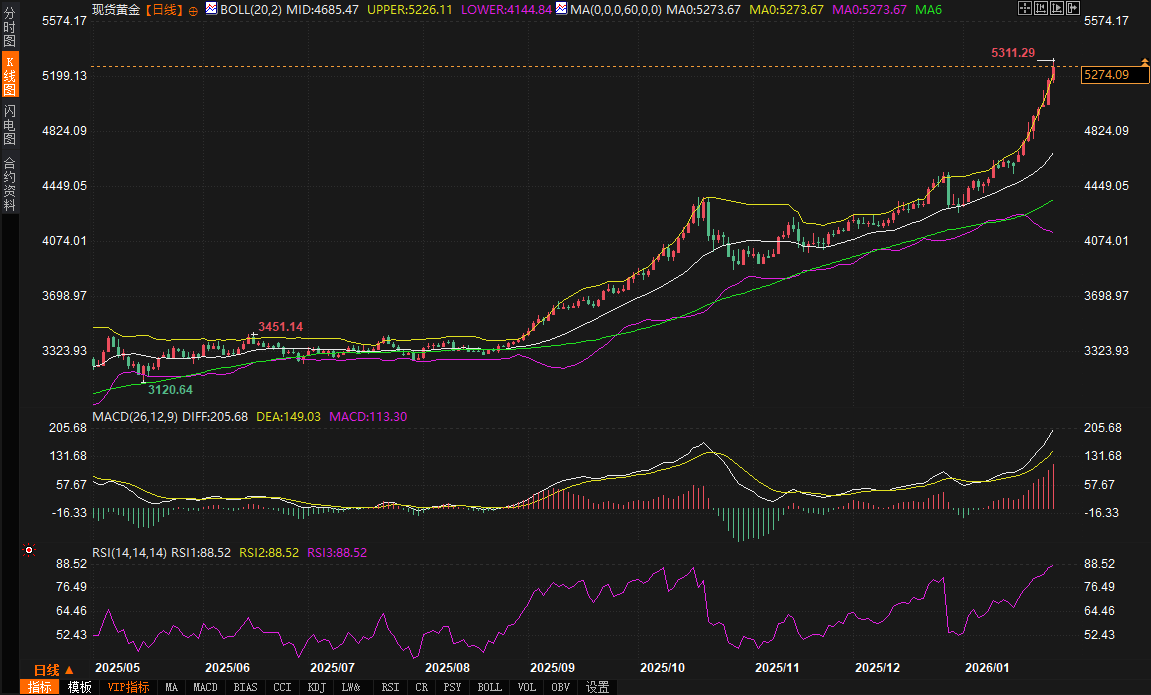
Support and Resistance Range Forecast <br/>Key Psychological and Trend Support: The $5,000 level has transformed from resistance into a core dividing line between bullish and bearish sentiment and a lifeline for the trend. This position is not only an important psychological level but also the starting point for the current upward momentum, and is expected to attract trend-following buying.
Recent dynamic support zone: The $5180-$5200 area is both the area where yesterday's opening and closing prices were concentrated and the first pullback confirmation level after the breakout, which can be used as a point to observe the short-term strength or weakness.
Resistance and Targets: The intraday high of $5311 is a natural resistance level. If this level is broken, the market, driven by sentiment, may test the $5400 level or even higher psychological barriers, but this would enter a purely speculative trading zone.
Key points to watch during trading: Closely monitor the price's reaction to the previous high of $5311. If multiple attempts to break through fail and a rapid pullback occurs, accompanied by increased trading volume, a short-term double top may form or trigger a deeper correction, with the initial support level around $5200.
In summary, among the three narratives currently driving gold prices, the interplay between the anticipated dovish shift in Federal Reserve policy and concerns about its independence is the most crucial and also the most volatile, likely becoming the primary source of market volatility in the next week or two. Meanwhile, amidst the soaring prices, gold's asset attributes are undergoing subtle changes, increasingly exhibiting characteristics of a "high-risk momentum asset," and its volatility will become a major risk that traders must manage.
Looking ahead, the long-term bull market foundation for gold (Narrative 1) remains intact, but short-term price movements have entered a sensitive phase driven by sentiment and capital flows. The market is at a critical juncture: will it rely on strong momentum to continue digesting overbought conditions and expand upwards, or will it wait for clear signals from the fundamental narrative (especially those related to the Federal Reserve) to initiate a healthy correction to digest the gains?
Narrative 1: Global central banks' continued gold purchases – the strongest long-term support, but not a short-term driver.
Undeniably, the continued increase in gold reserves held by central banks worldwide, particularly those in emerging markets, has been the most fundamental and solid structural support for the gold bull market of the past two years. This action represents a strategic rebalancing of the US dollar as a single reserve asset by official authorities. Its long decision-making cycle and minimal susceptibility to short-term price fluctuations have provided a long-term buying foundation for the market. The recent approval of a large-scale gold purchase program by the Polish central bank and the People's Bank of China's 14 consecutive months of increased holdings further reinforce this narrative.
However, the blind spot of this narrative is that it acts more as a "stabilizer" of trends than a "amplifier" of short-term prices. Central bank gold purchases are a dispersed and gradual process, and their pace is not closely correlated with the surge in open market prices. Attributing the current daily fluctuations of nearly $100 entirely to central bank actions is a classic logical mismatch. Traders need to be aware that while this narrative is difficult to disprove and provides a buffer during downturns, it is not the primary engine of the current sharp rise. Its risk of collapse is minimal, but its direct impact on short-term prices should not be overestimated.
Narrative Two: The Fed's Dovish Policy Shift and Concerns about Independence—The Most Critical Game of Expectations
The core trading logic in the current market undoubtedly revolves around the Federal Reserve. It comprises two sub-narratives: first, aggressive bets on a rate-cutting path; and second, deep concerns about the Fed's political independence. These two factors have created a resonance of emotions. On the one hand, weak economic data and Trump's comments that "interest rates will fall" have reinforced market expectations of an easing cycle; on the other hand, the political maneuvering surrounding the Fed chair and the investigations into its institutions have shaken market confidence in the central bank's independence, giving rise to the so-called "uncertainty premium."
This narrative is powerful, but also extremely fragile. It rests on expectations that have not yet occurred and are potentially subject to revision. Any event could shake its foundations: First, if the Fed's policy statement or the chairman's press conference, which concludes later today, reveals concern about inflation or a cautious stance on rate cuts, it could severely impact current expectations of easing; second, if the final Fed chairman is not the "pragmatic easing" candidate currently speculated by the market, the panic surrounding "political compliance" could quickly subside, and the associated premium would be squeezed out; finally, the fluctuations in key economic data, especially employment and inflation data, will continuously revise the interest rate path. Therefore, this narrative is most likely to experience volatility first; it is both the "rocket fuel" driving gold prices up and the "ignition point" triggering profit-taking.
Narrative Three: The Loosening of the Dollar's Credit Anchor and the Demand for Safe-Haven Investment—The Grandest Story, the Blurred Boundaries
The third narrative is the most expansive: the dollar's credit system faces long-term challenges, highlighting gold's ultimate safe-haven status as a non-sovereign credit asset. The dollar index falling to a four-year low, along with rhetoric regarding international trade frictions, is seen as evidence of this narrative. This drives capital to seek traditional safe havens.
However, the contradiction lies in this: when an asset surges 20% in a month, its volatility has already increased significantly. Can it still be purely defined as a "safe-haven asset"? A noteworthy statistic is that the S&P 500/gold ratio is currently approaching a historical high of 1.54, somewhat resembling the market turning point before the Great Depression of 1929. This suggests that gold's "valuation" relative to risk assets has been extremely stretched. Some market analysts are beginning to question how much of the current influx of funds into gold is driven by genuine safe-haven demand, and how much is simply momentum trading. If market risk appetite temporarily shifts due to certain factors (such as strong tech stock earnings), this "hot money" could withdraw exceptionally quickly. This blurred narrative boundary gives gold's rise a "story," but it also causes its role to drift from a "safe haven" to a "high-risk momentum asset," thus increasing its sensitivity to corrections.
Technical Overbuying and Role Transformation: Gold Itself Has Become a Source of Volatility
From a purely technical perspective, almost all indicators on the daily chart point to extreme overbought conditions. The RSI has risen to the extreme zone above 88, and the price is far from the major moving averages, indicating that the market is operating under pure bullish momentum and sentiment. This technical structure itself is the biggest source of risk. It means that the market has accumulated a large amount of short-term unrealized gains, and any slight disturbance could trigger a technical sell-off.
Support and Resistance Range Forecast <br/>Key Psychological and Trend Support: The $5,000 level has transformed from resistance into a core dividing line between bullish and bearish sentiment and a lifeline for the trend. This position is not only an important psychological level but also the starting point for the current upward momentum, and is expected to attract trend-following buying.
Recent dynamic support zone: The $5180-$5200 area is both the area where yesterday's opening and closing prices were concentrated and the first pullback confirmation level after the breakout, which can be used as a point to observe the short-term strength or weakness.
Resistance and Targets: The intraday high of $5311 is a natural resistance level. If this level is broken, the market, driven by sentiment, may test the $5400 level or even higher psychological barriers, but this would enter a purely speculative trading zone.
Key points to watch during trading: Closely monitor the price's reaction to the previous high of $5311. If multiple attempts to break through fail and a rapid pullback occurs, accompanied by increased trading volume, a short-term double top may form or trigger a deeper correction, with the initial support level around $5200.
In summary, among the three narratives currently driving gold prices, the interplay between the anticipated dovish shift in Federal Reserve policy and concerns about its independence is the most crucial and also the most volatile, likely becoming the primary source of market volatility in the next week or two. Meanwhile, amidst the soaring prices, gold's asset attributes are undergoing subtle changes, increasingly exhibiting characteristics of a "high-risk momentum asset," and its volatility will become a major risk that traders must manage.
Looking ahead, the long-term bull market foundation for gold (Narrative 1) remains intact, but short-term price movements have entered a sensitive phase driven by sentiment and capital flows. The market is at a critical juncture: will it rely on strong momentum to continue digesting overbought conditions and expand upwards, or will it wait for clear signals from the fundamental narrative (especially those related to the Federal Reserve) to initiate a healthy correction to digest the gains?
- Risk Warning and Disclaimer
- The market involves risk, and trading may not be suitable for all investors. This article is for reference only and does not constitute personal investment advice, nor does it take into account certain users’ specific investment objectives, financial situation, or other needs. Any investment decisions made based on this information are at your own risk.