The gold market has experienced a sharp correction, putting pressure on short-term confidence, and the risk of a reversal cannot be ignored.
2026-02-02 18:40:09
The gold market has recently experienced an unusually rapid correction. Since reaching a record high of approximately $5626.8 per ounce at the end of January, prices have fallen by more than 15-20% in just a few days, hovering between $4600 and $4700 as of February 2nd. The intraday low touched $4401.58, marking the largest single-day drop since 1983. This precipitous decline stemmed not only from the combined effects of leveraged fund liquidation, profit-taking, and market panic, but also from a significant blow to bullish confidence. Those who chased the rally at high levels are now trapped, and active long positions have been significantly reduced, making it difficult for market confidence to recover in the short term.

Most institutions still characterize this as a "healthy correction within a structural bull market," emphasizing that short-term pressure does not change the long-term trend. However, from the perspective of the market's core driving logic, potential turning points beneath the surface adjustment are gradually emerging, and their impact on the market's medium- to long-term trend warrants attention.
Bullish confidence severely damaged: recovery will be significantly difficult.
This correction has significantly impacted bullish sentiment. Leveraged funds that chased the price higher at higher levels faced margin calls, and active long positions were forced to reduce their holdings and exit the market, leading to a significant decline in market risk appetite. Historically, after gold price corrections, bulls have typically been able to quickly rally and drive a rebound, but this sharp drop has broken that pattern. On one hand, the weakening of core support logic has eroded the confidence of long positions; on the other hand, the record-breaking single-day drop has created a strong psychological impact, with investor caution dominating.
Even if market sentiment recovers slightly, it may only maintain a range-bound pattern and struggle to generate effective counter-offensive momentum. The lack of bullish confidence in the short term will continue to limit the upside potential of gold prices and could become a key factor driving a trend reversal.
Central bank gold purchases: Support weakens marginally
Global central banks' long-term accumulation of gold reserves has been one of the core supports for the gold bull market. However, recent data indicates that this support is gradually weakening. According to data from the World Gold Council (WGC), global central bank net gold purchases in 2025 are projected at 863 tons, a decrease of approximately 21% year-on-year. With gold prices high, central banks are becoming significantly more cautious in their gold purchases, weakening the marginal support for the market.
Central bank gold purchases are projected to reach approximately 800 tons in 2026, maintaining a high level, but the support level is no longer comparable to that of previous gold-buying booms. It's worth noting that after the gold price plunge, central bank intervention has not yet materialized, and the actual market response to gold purchase support may be lower than expected. If the gold price rebound falters, the possibility of the central bank further slowing down its gold purchase pace increases, and what was originally a core support level may transform into a neutral factor, or even become a driving force for a market trend reversal.
Macroeconomic risk environment: shrinking safe-haven premium
Gold's safe-haven appeal is its core value proposition. However, the current global risk appetite recovery is showing signs of being temporary and irreversible, leading to a continued contraction in the safe-haven premium and becoming a key factor suppressing gold prices. Recently, US Treasury yields have seen reduced volatility, major stock indices and the corporate bond market have gradually stabilized, and the VIX fear index, after a short-term surge, has fallen rapidly, indicating a significant decline in market risk pricing.
While this sharp drop was accompanied by short-term panic, it essentially reflects a value reassessment following the marginal decline in safe-haven demand, rather than a simple stampede of funds. Geopolitical tensions and global debt risks remain, but have not triggered large-scale safe-haven demand in the short term. If the global risk environment continues to improve, the contraction in safe-haven demand may become a long-term trend. Gold will lose its safe-haven support, and coupled with the difficulty in quickly restoring bullish confidence, its valuation center is likely to shift downwards, laying the foundation for a trend reversal.
Easing Expectations Dynamics: Policy Shift Becomes Clear
Gold prices are highly sensitive to monetary policy expectations. The Federal Reserve's policy path has recently shown a hawkish shift. On January 29th, the Fed paused its three-pronged rate cut, maintaining the interest rate range at 3.50%-3.75%, and its statement showed a more optimistic assessment of the economy and the job market. Powell pointed out that risks to inflation and employment "have both diminished," releasing a hawkish signal.
Furthermore, Kevin Warsh's nomination as the next Federal Reserve Chairman further strengthens the certainty of a policy shift. As a representative of the hawkish camp, he emphasizes balance sheet reduction and inflation control, and is expected to continue the tightening trend, potentially accelerating policy tightening. The easing expectations that had previously supported gold prices have been impacted, leading to a rapid clearing of crowded long positions. If inflation continues to rise, the possibility of further policy tightening exists, reducing the attractiveness of gold as a non-yielding asset and potentially reversing the market's bullish logic.
Analyst Opinions and Market Risks
JPMorgan Chase, UBS, Goldman Sachs, and other institutions maintain a long-term bullish stance, viewing the pullback as a "healthy correction" or "position clearing." However, these judgments are largely based on historical experience and do not fully consider the core changes such as the slowdown in central bank gold purchases, the contraction in safe-haven demand, and the policy shift, thus having limitations.
A few institutions, such as Zacks, have warned of bubble risks, sounding an alarm for the market. From a technical perspective, spot gold has fallen more than 20% from its high (reaching a low of $4401.58), below the $4501.44 bull-bear dividing line. This level is determined by a common technical analysis standard: a 20% drop from the recent historical high ($5626.8) corresponds to $4501.44 (5626.8 x 0.8 = $4501.44). A substantial break below this level would formally establish a technical bear market, further exacerbating the collapse of bullish sentiment. Simultaneously, a rebound in the US dollar index could also trigger the end of the gold bull market. The current market divergence lies in differing perceptions of the changing driving logic. The three major turning points continue to unfold, coupled with the difficulty in restoring short-term confidence, which may gradually validate the limitations of most institutions' bullish assessments.
Core logic: The three supporting pillars weaken simultaneously.
The core supporting logic of the gold bull market, including central bank gold purchases, safe-haven demand, and expectations of easing policies, has recently undergone substantial changes. First, the growth rate of central bank gold purchases has continued to slow, significantly weakening its marginal support and making it difficult to provide the solid price support it once did. Second, the contraction in safe-haven demand has led to an irreversible decline in the safe-haven premium, reducing the market's ability to price gold as a safe-haven asset despite improved risk sentiment. Third, the logic of policy easing is faltering; the Federal Reserve's hawkish shift is clear, and the market's previous reliance on expectations of monetary easing is crumbling.
The simultaneous weakening of three major factors constitutes the core driving force behind the shift in the gold market trend, rather than a simple phase of adjustment. This price adjustment may only be a preliminary pricing signal from the market regarding these shifting factors. If central bank gold purchases further contract, risk appetite continues to improve, and expectations of policy tightening strengthen, the gold market may gradually shift from a bull market cycle to a medium- to long-term adjustment phase.
Investment Strategy and Risk Warning
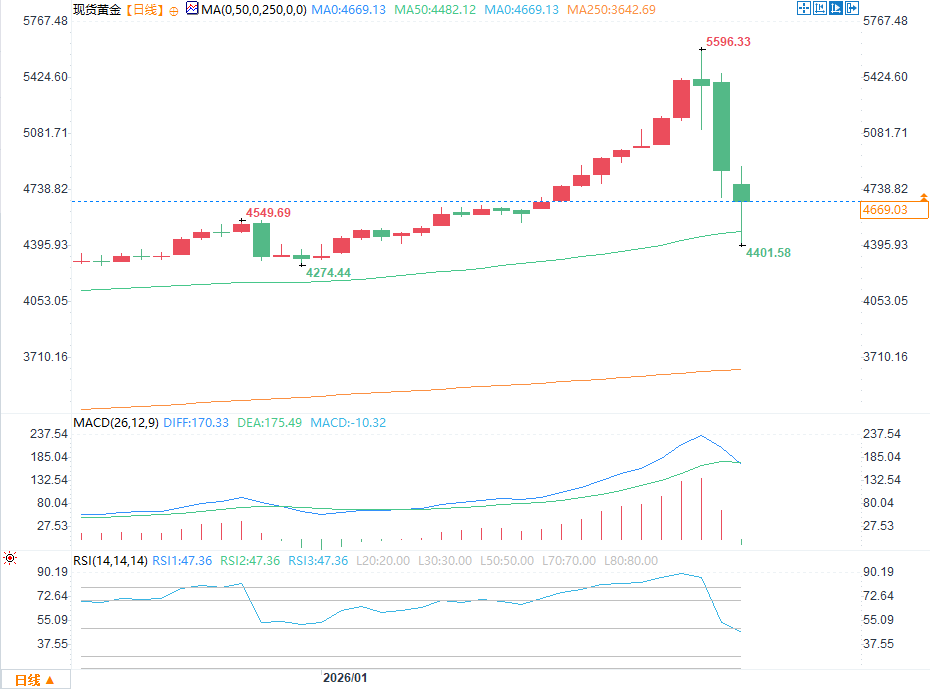
(Spot gold daily chart source: FX678)
The current market environment has shifted from a "faith-driven" phase to a "risk-identification-driven" phase. Investors should focus on three key indicators: the $4501.44 level (the bull-bear dividing line), the trend of the US dollar index, and the Federal Reserve's policies and the actual actions of central banks in purchasing gold.
Short-term rebounds should not be seen as a continuation of the trend; the weakening of the core logic remains. The most prudent investment strategy at present is to rationally address the restructuring of the core driving logic and adjust positions promptly to guard against medium- to long-term downside risks.
Most institutions still characterize this as a "healthy correction within a structural bull market," emphasizing that short-term pressure does not change the long-term trend. However, from the perspective of the market's core driving logic, potential turning points beneath the surface adjustment are gradually emerging, and their impact on the market's medium- to long-term trend warrants attention.
Bullish confidence severely damaged: recovery will be significantly difficult.
This correction has significantly impacted bullish sentiment. Leveraged funds that chased the price higher at higher levels faced margin calls, and active long positions were forced to reduce their holdings and exit the market, leading to a significant decline in market risk appetite. Historically, after gold price corrections, bulls have typically been able to quickly rally and drive a rebound, but this sharp drop has broken that pattern. On one hand, the weakening of core support logic has eroded the confidence of long positions; on the other hand, the record-breaking single-day drop has created a strong psychological impact, with investor caution dominating.
Even if market sentiment recovers slightly, it may only maintain a range-bound pattern and struggle to generate effective counter-offensive momentum. The lack of bullish confidence in the short term will continue to limit the upside potential of gold prices and could become a key factor driving a trend reversal.
Central bank gold purchases: Support weakens marginally
Global central banks' long-term accumulation of gold reserves has been one of the core supports for the gold bull market. However, recent data indicates that this support is gradually weakening. According to data from the World Gold Council (WGC), global central bank net gold purchases in 2025 are projected at 863 tons, a decrease of approximately 21% year-on-year. With gold prices high, central banks are becoming significantly more cautious in their gold purchases, weakening the marginal support for the market.
Central bank gold purchases are projected to reach approximately 800 tons in 2026, maintaining a high level, but the support level is no longer comparable to that of previous gold-buying booms. It's worth noting that after the gold price plunge, central bank intervention has not yet materialized, and the actual market response to gold purchase support may be lower than expected. If the gold price rebound falters, the possibility of the central bank further slowing down its gold purchase pace increases, and what was originally a core support level may transform into a neutral factor, or even become a driving force for a market trend reversal.
Macroeconomic risk environment: shrinking safe-haven premium
Gold's safe-haven appeal is its core value proposition. However, the current global risk appetite recovery is showing signs of being temporary and irreversible, leading to a continued contraction in the safe-haven premium and becoming a key factor suppressing gold prices. Recently, US Treasury yields have seen reduced volatility, major stock indices and the corporate bond market have gradually stabilized, and the VIX fear index, after a short-term surge, has fallen rapidly, indicating a significant decline in market risk pricing.
While this sharp drop was accompanied by short-term panic, it essentially reflects a value reassessment following the marginal decline in safe-haven demand, rather than a simple stampede of funds. Geopolitical tensions and global debt risks remain, but have not triggered large-scale safe-haven demand in the short term. If the global risk environment continues to improve, the contraction in safe-haven demand may become a long-term trend. Gold will lose its safe-haven support, and coupled with the difficulty in quickly restoring bullish confidence, its valuation center is likely to shift downwards, laying the foundation for a trend reversal.
Easing Expectations Dynamics: Policy Shift Becomes Clear
Gold prices are highly sensitive to monetary policy expectations. The Federal Reserve's policy path has recently shown a hawkish shift. On January 29th, the Fed paused its three-pronged rate cut, maintaining the interest rate range at 3.50%-3.75%, and its statement showed a more optimistic assessment of the economy and the job market. Powell pointed out that risks to inflation and employment "have both diminished," releasing a hawkish signal.
Furthermore, Kevin Warsh's nomination as the next Federal Reserve Chairman further strengthens the certainty of a policy shift. As a representative of the hawkish camp, he emphasizes balance sheet reduction and inflation control, and is expected to continue the tightening trend, potentially accelerating policy tightening. The easing expectations that had previously supported gold prices have been impacted, leading to a rapid clearing of crowded long positions. If inflation continues to rise, the possibility of further policy tightening exists, reducing the attractiveness of gold as a non-yielding asset and potentially reversing the market's bullish logic.
Analyst Opinions and Market Risks
JPMorgan Chase, UBS, Goldman Sachs, and other institutions maintain a long-term bullish stance, viewing the pullback as a "healthy correction" or "position clearing." However, these judgments are largely based on historical experience and do not fully consider the core changes such as the slowdown in central bank gold purchases, the contraction in safe-haven demand, and the policy shift, thus having limitations.
A few institutions, such as Zacks, have warned of bubble risks, sounding an alarm for the market. From a technical perspective, spot gold has fallen more than 20% from its high (reaching a low of $4401.58), below the $4501.44 bull-bear dividing line. This level is determined by a common technical analysis standard: a 20% drop from the recent historical high ($5626.8) corresponds to $4501.44 (5626.8 x 0.8 = $4501.44). A substantial break below this level would formally establish a technical bear market, further exacerbating the collapse of bullish sentiment. Simultaneously, a rebound in the US dollar index could also trigger the end of the gold bull market. The current market divergence lies in differing perceptions of the changing driving logic. The three major turning points continue to unfold, coupled with the difficulty in restoring short-term confidence, which may gradually validate the limitations of most institutions' bullish assessments.
Core logic: The three supporting pillars weaken simultaneously.
The core supporting logic of the gold bull market, including central bank gold purchases, safe-haven demand, and expectations of easing policies, has recently undergone substantial changes. First, the growth rate of central bank gold purchases has continued to slow, significantly weakening its marginal support and making it difficult to provide the solid price support it once did. Second, the contraction in safe-haven demand has led to an irreversible decline in the safe-haven premium, reducing the market's ability to price gold as a safe-haven asset despite improved risk sentiment. Third, the logic of policy easing is faltering; the Federal Reserve's hawkish shift is clear, and the market's previous reliance on expectations of monetary easing is crumbling.
The simultaneous weakening of three major factors constitutes the core driving force behind the shift in the gold market trend, rather than a simple phase of adjustment. This price adjustment may only be a preliminary pricing signal from the market regarding these shifting factors. If central bank gold purchases further contract, risk appetite continues to improve, and expectations of policy tightening strengthen, the gold market may gradually shift from a bull market cycle to a medium- to long-term adjustment phase.
Investment Strategy and Risk Warning
(Spot gold daily chart source: FX678)
The current market environment has shifted from a "faith-driven" phase to a "risk-identification-driven" phase. Investors should focus on three key indicators: the $4501.44 level (the bull-bear dividing line), the trend of the US dollar index, and the Federal Reserve's policies and the actual actions of central banks in purchasing gold.
Short-term rebounds should not be seen as a continuation of the trend; the weakening of the core logic remains. The most prudent investment strategy at present is to rationally address the restructuring of the core driving logic and adjust positions promptly to guard against medium- to long-term downside risks.
- Risk Warning and Disclaimer
- The market involves risk, and trading may not be suitable for all investors. This article is for reference only and does not constitute personal investment advice, nor does it take into account certain users’ specific investment objectives, financial situation, or other needs. Any investment decisions made based on this information are at your own risk.