Can silver prices rebound in the $74-$64 range and start a new bull market?
2026-02-02 19:03:55
On Monday (February 2), during the European session, spot silver prices fell 4.60%, down $3.887 from the previous price.

Analysis of the spot silver market reveals a common price movement pattern emerging in commodities and all markets reliant on supply and demand. This pattern also confirms a market characteristic: the higher the price increase, the greater the volatility. In a bull market, the clearer the market trend, the higher the cost of entering the market.
Silver hit a record high of $121.67, highlighting the behavioral characteristics of three types of traders in the market: those who accumulated positions at the bottom, those who chased the upward momentum, and value traders who are currently taking a wait-and-see approach.
Buy-low-accumulate traders: Slow and patient accumulation yields substantial profits.
From April to June 2025, silver prices gradually rose along the 52-week moving average. At that time, this level was seen by traders as a point of entry with manageable risk and relatively low cost. Silver reaching $50 and setting a new historical high was still within market expectations. As the market's upward signals became clearer, silver prices began to move away from the 52-week moving average, a "safety net," and the bullish trend became self-reinforcing. Traders, however, had a clear understanding of the market risks at this stage.
Silver didn't reach a high of $54.49 until early October 2025, before falling back to a low of $45.55. This period of fluctuation between highs and lows built momentum for the subsequent upward breakout, ultimately propelling silver prices to a record high of $121.67 last week. The weekly chart clearly shows that as the upward trend was established, the trading range of silver's weekly candlesticks continued to widen, meaning that the cost of entering the market later increased significantly.
Momentum traders who chase rising trends: follow the breakout and then exit the market to observe.
The bottom support for silver was not formed overnight, but rather gradually built up by traders who accumulated positions at lower prices. These traders firmly believed in the long-term value of silver and were willing to patiently wait for the upward trend to arrive. Some market commentators have mentioned that seasoned investors who entered the silver market in the 1980s waited 46 years to recoup their costs, a phenomenon that also reflects the characteristics of the long-term bottom formation in silver.
In early December 2025, silver broke through its previous high and began a new round of gains. This rally attracted a large number of momentum traders, driving silver prices in a rapid, parabolic upward trend until they reached historical highs. This process also confirms the differences in the market participant structure. In addition to long-term accumulation and momentum-driven traders, there is another key participant—value traders. The current market trend is being determined by the behavior of these traders. Value traders are also optimistic about the long-term trend of silver, but they insist on entering the market based on their own price judgments.
Value traders: becoming the key force determining the next round of silver price increases
At the end of 2025, when silver prices were trading between $28.31 and $54.49, value traders did not enter the market. Even after silver prices reached a historical high of $121.67, these traders chose to remain on the sidelines, believing that prices had been overvalued. Their core trading logic was to wait for silver prices to retrace to the 50%-61.8% Fibonacci retracement level of the main upward wave, a range they considered a valuable entry point.
The future trend of silver will depend on the reaction of value traders to the pullback of silver prices to the target range: long-term accumulation traders have completed their positions, and the $50 drop in silver prices from a week ago has given these traders an opportunity to further increase their positions; while momentum traders who chase the rise have basically completed their exit and turned to other market opportunities.
Key support zone: $74.99-$63.97. Bulls need to exert their strength in this area.
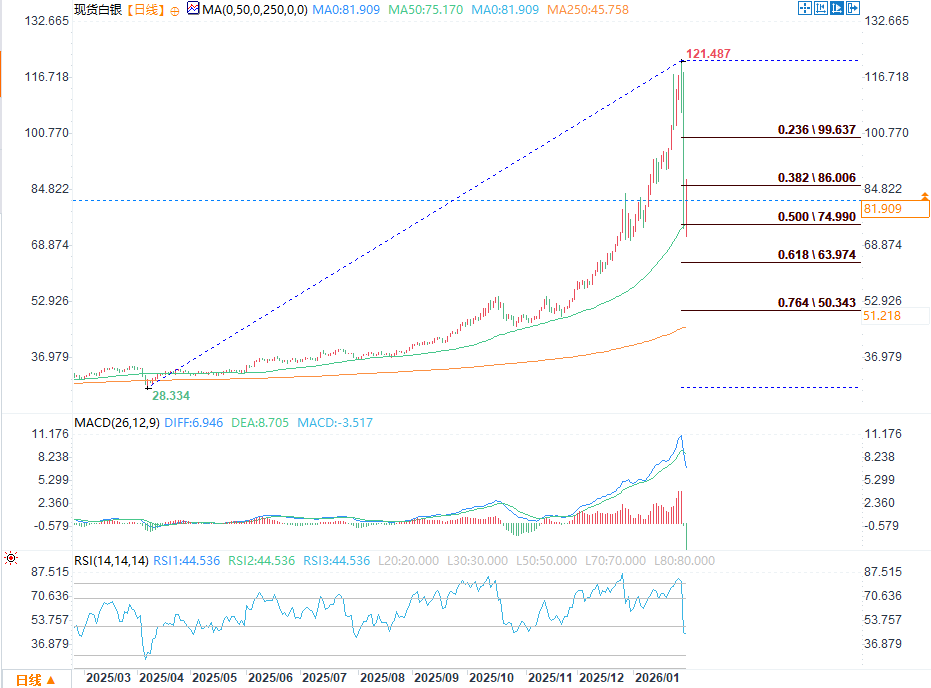
(Spot silver daily chart source: EasyTrade)
Value traders should currently focus on the 50%-61.8% retracement level of the main upward wave in silver from $28.31 to $121.67, which corresponds to $74.99-$63.97. Another important range to watch is the 50%-61.8% retracement level of the upward segment from $45.55 to $121.67, which corresponds to $83.61-$74.63.
Combining the two retracement ranges, the key support area for silver has expanded to $83.61-$63.97. After further precise screening, the narrow range of $74.99-$74.63 has become the "golden support level" on the chart, which is expected to attract new buying.
A 46-year long-term bottom has laid the foundation for an upward trend; $121.67 is by no means the final high.
A classic trading rule summarized by seasoned traders is worth noting: the longer the consolidation, the higher the subsequent rise. Silver's long-term bottoming pattern, formed over 46 years, suggests that the historical high of $121.67 is unlikely to be a long-term top. While specific calculations for silver's subsequent highs are not yet available, it's certain that a new round of upward movement in silver will only begin once value traders enter the market and start building new support levels. This consolidation process may extend throughout February 2026, or even longer.
In an ideal consolidation phase, if the 52-week moving average that has been driving silver prices higher since 2025 gradually converges with the aforementioned support level and resonates with it, it will boost market confidence and attract more traders to invest in silver.
Analysis of the spot silver market reveals a common price movement pattern emerging in commodities and all markets reliant on supply and demand. This pattern also confirms a market characteristic: the higher the price increase, the greater the volatility. In a bull market, the clearer the market trend, the higher the cost of entering the market.
Silver hit a record high of $121.67, highlighting the behavioral characteristics of three types of traders in the market: those who accumulated positions at the bottom, those who chased the upward momentum, and value traders who are currently taking a wait-and-see approach.
Buy-low-accumulate traders: Slow and patient accumulation yields substantial profits.
From April to June 2025, silver prices gradually rose along the 52-week moving average. At that time, this level was seen by traders as a point of entry with manageable risk and relatively low cost. Silver reaching $50 and setting a new historical high was still within market expectations. As the market's upward signals became clearer, silver prices began to move away from the 52-week moving average, a "safety net," and the bullish trend became self-reinforcing. Traders, however, had a clear understanding of the market risks at this stage.
Silver didn't reach a high of $54.49 until early October 2025, before falling back to a low of $45.55. This period of fluctuation between highs and lows built momentum for the subsequent upward breakout, ultimately propelling silver prices to a record high of $121.67 last week. The weekly chart clearly shows that as the upward trend was established, the trading range of silver's weekly candlesticks continued to widen, meaning that the cost of entering the market later increased significantly.
Momentum traders who chase rising trends: follow the breakout and then exit the market to observe.
The bottom support for silver was not formed overnight, but rather gradually built up by traders who accumulated positions at lower prices. These traders firmly believed in the long-term value of silver and were willing to patiently wait for the upward trend to arrive. Some market commentators have mentioned that seasoned investors who entered the silver market in the 1980s waited 46 years to recoup their costs, a phenomenon that also reflects the characteristics of the long-term bottom formation in silver.
In early December 2025, silver broke through its previous high and began a new round of gains. This rally attracted a large number of momentum traders, driving silver prices in a rapid, parabolic upward trend until they reached historical highs. This process also confirms the differences in the market participant structure. In addition to long-term accumulation and momentum-driven traders, there is another key participant—value traders. The current market trend is being determined by the behavior of these traders. Value traders are also optimistic about the long-term trend of silver, but they insist on entering the market based on their own price judgments.
Value traders: becoming the key force determining the next round of silver price increases
At the end of 2025, when silver prices were trading between $28.31 and $54.49, value traders did not enter the market. Even after silver prices reached a historical high of $121.67, these traders chose to remain on the sidelines, believing that prices had been overvalued. Their core trading logic was to wait for silver prices to retrace to the 50%-61.8% Fibonacci retracement level of the main upward wave, a range they considered a valuable entry point.
The future trend of silver will depend on the reaction of value traders to the pullback of silver prices to the target range: long-term accumulation traders have completed their positions, and the $50 drop in silver prices from a week ago has given these traders an opportunity to further increase their positions; while momentum traders who chase the rise have basically completed their exit and turned to other market opportunities.
Key support zone: $74.99-$63.97. Bulls need to exert their strength in this area.
(Spot silver daily chart source: EasyTrade)
Value traders should currently focus on the 50%-61.8% retracement level of the main upward wave in silver from $28.31 to $121.67, which corresponds to $74.99-$63.97. Another important range to watch is the 50%-61.8% retracement level of the upward segment from $45.55 to $121.67, which corresponds to $83.61-$74.63.
Combining the two retracement ranges, the key support area for silver has expanded to $83.61-$63.97. After further precise screening, the narrow range of $74.99-$74.63 has become the "golden support level" on the chart, which is expected to attract new buying.
A 46-year long-term bottom has laid the foundation for an upward trend; $121.67 is by no means the final high.
A classic trading rule summarized by seasoned traders is worth noting: the longer the consolidation, the higher the subsequent rise. Silver's long-term bottoming pattern, formed over 46 years, suggests that the historical high of $121.67 is unlikely to be a long-term top. While specific calculations for silver's subsequent highs are not yet available, it's certain that a new round of upward movement in silver will only begin once value traders enter the market and start building new support levels. This consolidation process may extend throughout February 2026, or even longer.
In an ideal consolidation phase, if the 52-week moving average that has been driving silver prices higher since 2025 gradually converges with the aforementioned support level and resonates with it, it will boost market confidence and attract more traders to invest in silver.
- Risk Warning and Disclaimer
- The market involves risk, and trading may not be suitable for all investors. This article is for reference only and does not constitute personal investment advice, nor does it take into account certain users’ specific investment objectives, financial situation, or other needs. Any investment decisions made based on this information are at your own risk.