The US dollar index underwent a brief correction, and the rebound of the US dollar against the Japanese yen was hampered, awaiting a pullback.
2026-02-03 13:28:12
The yen strengthened slightly against the dollar during Tuesday's Asian trading session, briefly recovering from weakness after falling to a one-week low. Although the rebound was limited, this change reflects market caution regarding further yen weakness at key levels.
Expectations of intervention have re-emerged in the market's view, becoming a significant factor supporting the yen. Japan's Finance Minister stated that the country will continue to maintain close communication with the United States as needed and will take appropriate action in accordance with the previous joint statement between the two sides.
This statement, while not directly implying immediate intervention, was sufficient to psychologically constrain the market and curb expectations of a one-sided depreciation of the yen. At the same time, the Bank of Japan's signal of a tightening policy stance also provided support for the yen.

The latest minutes of the central bank's meeting show that some policymakers are beginning to pay more attention to the imported inflationary pressures brought about by the weak yen, reflecting a change in the internal discussion on maintaining an ultra-loose monetary policy stance.
This signal has kept the market wary of the future path of Japan's monetary policy. However, domestic political and fiscal uncertainties have limited the yen's rebound. With Japan approaching a snap election, policy uncertainty has increased significantly.
The prime minister's proposed stimulus fiscal policies have raised concerns in the market about fiscal sustainability, which has to some extent weakened the yen's appeal as a safe-haven currency.
From an external perspective, a generally positive global risk sentiment is also unfavorable for a sustained strengthening of the yen. Positive signals from the US on trade and a slight easing of tensions in the Middle East have boosted market risk appetite.
Against this backdrop, demand for traditional safe-haven assets has relatively decreased, suppressing the yen's defensive attributes. Furthermore, the US dollar's fundamentals remain supportive. Strong US economic data, coupled with a cautiously hawkish market expectation of the Federal Reserve's future policy stance, has enabled the dollar to demonstrate considerable resilience during its pullback.
This also limits the downside potential of the USD/JPY pair. Overall, while the yen currently enjoys multiple short-term supports, it lacks a decisive factor to drive a trend reversal.
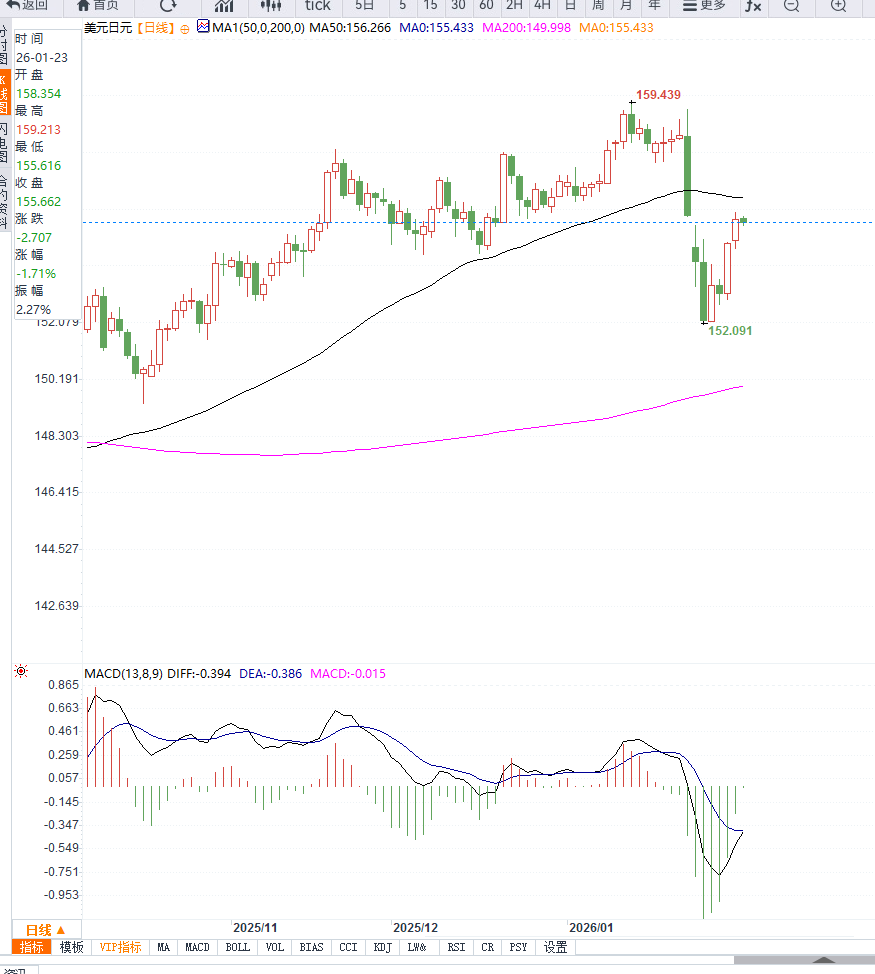
From an overall perspective, the USD/JPY pair has seen a significant pullback from its previous highs, constituting a complete correction. Recently, the exchange rate has attempted a rebound from its lows, but it remains in a recovery phase after the decline and has not yet broken free of its bearish bias.
Prices tested key retracement levels multiple times during the rebound but failed to break through effectively, indicating continued selling pressure above. The current price action better reflects the characteristics of a rebound encountering resistance and a still cautious trend.
Although short-term momentum indicators remain in the neutral-to-strong range, the pace of momentum expansion has slowed, reflecting continued weak buying confidence. From a structural perspective, the USD/JPY pair is trading below key medium-term moving averages, making the rebound more of a technical correction than a trend reversal.
If the exchange rate fails to stabilize above the key resistance area of 156.3, there is still a possibility of a retest of the lower support level. Overall, the current trend shows a consolidation pattern after the decline: there is some support at 154.50, but the resistance above is clear, and a directional breakout still requires new fundamental drivers.
Editor's Note:
The current rebound in the yen is more attributable to policy and intervention-level expectation management than to a substantial reversal in fundamentals. While the Bank of Japan's tightening stance has indeed provided room for medium-term growth in the yen, political uncertainty and fiscal concerns have diminished this positive effect.
Structurally, given that global risk sentiment has not weakened significantly and the US dollar's fundamentals remain supportive, the USD/JPY pair is more likely to maintain range-bound trading rather than experience a one-sided downward trend. In the short term, yen bulls need to see clearer policy signals or risk events to establish a more sustainable rebound trend.
Expectations of intervention have re-emerged in the market's view, becoming a significant factor supporting the yen. Japan's Finance Minister stated that the country will continue to maintain close communication with the United States as needed and will take appropriate action in accordance with the previous joint statement between the two sides.
This statement, while not directly implying immediate intervention, was sufficient to psychologically constrain the market and curb expectations of a one-sided depreciation of the yen. At the same time, the Bank of Japan's signal of a tightening policy stance also provided support for the yen.
The latest minutes of the central bank's meeting show that some policymakers are beginning to pay more attention to the imported inflationary pressures brought about by the weak yen, reflecting a change in the internal discussion on maintaining an ultra-loose monetary policy stance.
This signal has kept the market wary of the future path of Japan's monetary policy. However, domestic political and fiscal uncertainties have limited the yen's rebound. With Japan approaching a snap election, policy uncertainty has increased significantly.
The prime minister's proposed stimulus fiscal policies have raised concerns in the market about fiscal sustainability, which has to some extent weakened the yen's appeal as a safe-haven currency.
From an external perspective, a generally positive global risk sentiment is also unfavorable for a sustained strengthening of the yen. Positive signals from the US on trade and a slight easing of tensions in the Middle East have boosted market risk appetite.
Against this backdrop, demand for traditional safe-haven assets has relatively decreased, suppressing the yen's defensive attributes. Furthermore, the US dollar's fundamentals remain supportive. Strong US economic data, coupled with a cautiously hawkish market expectation of the Federal Reserve's future policy stance, has enabled the dollar to demonstrate considerable resilience during its pullback.
This also limits the downside potential of the USD/JPY pair. Overall, while the yen currently enjoys multiple short-term supports, it lacks a decisive factor to drive a trend reversal.
From an overall perspective, the USD/JPY pair has seen a significant pullback from its previous highs, constituting a complete correction. Recently, the exchange rate has attempted a rebound from its lows, but it remains in a recovery phase after the decline and has not yet broken free of its bearish bias.
Prices tested key retracement levels multiple times during the rebound but failed to break through effectively, indicating continued selling pressure above. The current price action better reflects the characteristics of a rebound encountering resistance and a still cautious trend.
Although short-term momentum indicators remain in the neutral-to-strong range, the pace of momentum expansion has slowed, reflecting continued weak buying confidence. From a structural perspective, the USD/JPY pair is trading below key medium-term moving averages, making the rebound more of a technical correction than a trend reversal.
If the exchange rate fails to stabilize above the key resistance area of 156.3, there is still a possibility of a retest of the lower support level. Overall, the current trend shows a consolidation pattern after the decline: there is some support at 154.50, but the resistance above is clear, and a directional breakout still requires new fundamental drivers.
Editor's Note:
The current rebound in the yen is more attributable to policy and intervention-level expectation management than to a substantial reversal in fundamentals. While the Bank of Japan's tightening stance has indeed provided room for medium-term growth in the yen, political uncertainty and fiscal concerns have diminished this positive effect.
Structurally, given that global risk sentiment has not weakened significantly and the US dollar's fundamentals remain supportive, the USD/JPY pair is more likely to maintain range-bound trading rather than experience a one-sided downward trend. In the short term, yen bulls need to see clearer policy signals or risk events to establish a more sustainable rebound trend.
- Risk Warning and Disclaimer
- The market involves risk, and trading may not be suitable for all investors. This article is for reference only and does not constitute personal investment advice, nor does it take into account certain users’ specific investment objectives, financial situation, or other needs. Any investment decisions made based on this information are at your own risk.