The Reserve Bank of Australia raised interest rates by 25 basis points to 3.85%, firing the first shot in its fight against inflation, causing the Australian dollar to surge by over 1%.
2026-02-03 15:13:35
On Tuesday (February 3), the Reserve Bank of Australia (RBA) raised its policy rate by 25 basis points to 3.85%, restarting its monetary tightening policy. This is the RBA's first rate hike since November 2023, indicating that it is resuming its efforts to combat inflation, which has proven more stubborn than expected. This move marks a significant shift, coming just six months after the last rate cut in August 2025, reflecting growing evidence that the Australian economy is heating up more than anticipated.
The Reserve Bank of Australia's decision was driven by a series of economic data indicating continued economic strength and rising price pressures. Prior to the meeting, the market had already raised the probability of a February rate hike to 78%.
Key factors behind the policy shift include:
Persistent inflation : Consumer price growth has exceeded expectations for two consecutive quarters. The Reserve Bank of Australia's preferred indicator – underlying inflation – reached an annual rate of 3.4% in the fourth quarter, well above the RBA's target range of 2% to 3%.
Strong labor market : The unemployment rate unexpectedly fell to a seven-month low of 4.1% in December, indicating that labor market conditions remain tight.
Strong demand : In its policy statement, the Reserve Bank of Australia noted that "private demand grew faster than expected" and that "capacity pressures were greater than previously assessed."
Loose financial conditions : Strong consumer spending, record high home prices, and readily available credit for households and businesses all suggest that financial conditions are not sufficient to curb an overheated economy.
Although inflation has fallen significantly since its peak in 2022, it is expected to pick up considerably in the second half of 2025. The Committee has been closely monitoring the economy and judges that some of the rise in inflation reflects greater capacity pressures. Therefore, the Committee considers that inflation is likely to remain above its target level for some time.
Capacity pressures partly reflect the increased demand momentum in recent months. Private demand growth has far exceeded expectations, driven by both household spending and investment. Housing market activity and prices continue to recover. Financial conditions are expected to ease in 2025, though it remains uncertain whether they will remain restrictive. Credit is readily available to households and businesses, and the effects of earlier interest rate cuts have not yet fully translated into aggregate demand, prices, and wages. Recently, exchange rates, money market rates, and government bond yields have all risen as market expectations for the cash rate have increased.
The Committee will rely on data and evolving prospects and risk assessments to guide its decision-making. To this end, the Committee will closely monitor developments in the global economy and financial markets, trends in domestic demand, and the outlook for inflation and the labor market. The Committee remains focused on its mandate to maintain price stability and achieve full employment and will take the measures it deems necessary to achieve this objective.
Today’s (February 3) policy decision was adopted unanimously. The committee will closely monitor the data and the evolving assessment of the outlook and risks to guide its decision-making.
The Reserve Bank of Australia (RBA) governor signaled a cautiously hawkish policy stance: while acknowledging a positive economic fundamentals, he prioritized combating inflation and explicitly rejected following market expectations for rapid and significant interest rate hikes. The core of his statement was seeking a difficult balance between curbing inflation and maintaining employment, emphasizing that policy will be entirely data-driven and will not pre-determine a path.
Resolutely control inflation, but be wary of inflation becoming entrenched . Block stated, "Inflation is too strong; we absolutely cannot allow it to spiral out of control. There are concerns that high inflation may persist for a long time." This sets a hawkish tone. The Fed Chairman explicitly considers inflation the biggest threat, implying extremely low tolerance, and preventing inflation expectations from becoming unanchored is the top priority of current policy.
Extremely cautious, data-dependent, and independent of the market . Block stated: "The Committee will approach interest rate policy with caution," "A 50-basis-point rate hike was not discussed," "Policy will not be market-driven," and "No forward guidance will be provided; the focus will be on data."
Assessment of the Economy and Employment: Optimistic but Acknowledging Constraints . Chairman Block stated, "The economic situation is actually good, but supply is constrained," and "We are striving to reduce inflation while maintaining near-full employment." "Maintaining near-full employment" is the boundary of tightening policy, implying that interest rate hikes will be contingent on not severely damaging the labor market.
Assessment of the financial environment: The Fed acknowledges that the monetary channel is already functioning . Governor Block stated, "The Australian dollar's performance indicates a tightening of financial conditions." He pointed out that factors such as the appreciation of the Australian dollar have automatically tightened financial conditions, which may prompt the Fed to consider the magnitude of interest rate hikes, meaning that it does not need to rely solely on interest rates to achieve a tightening effect.
The Reserve Bank of Australia (RBA) leadership has actively refuted market expectations for a near-term interest rate cut. Following the decision on December 9, Bullock stated that a rate cut would not be considered in the foreseeable future.
This view was echoed earlier in 2026 by Vice Chairman Andrew Hauser, who noted that the likelihood of interest rate cuts was "likely very low" due to persistent inflation.
When asked about the possibility of further interest rate hikes, Block explained that the bank will continue to assess economic data on a meeting-by-meeting basis.
She said, "If inflation remains high and does not appear to fall back to the Committee's target level... the Committee may need to consider whether it is appropriate to maintain the current interest rate level, or whether a rate hike will be necessary at some point."
With this rate hike, the Reserve Bank of Australia (RBA) finds itself in a small circle. Alongside the Bank of Japan, the RBA is one of the few central banks in the developed world still tightening monetary policy.
This contrasts sharply with the outlook for other major economies. Markets expect interest rate cuts in the US, UK, and Canada, while the European Central Bank is expected to keep rates unchanged for an extended period.
The Reserve Bank of Australia's hawkish shift immediately impacted financial markets. Following the RBA's interest rate decision announcement around 11:30 AM, the Australian dollar surged significantly. During Tuesday's European session, the Australian dollar traded around 0.7020 against the US dollar, with a daily gain of approximately 1.1%.
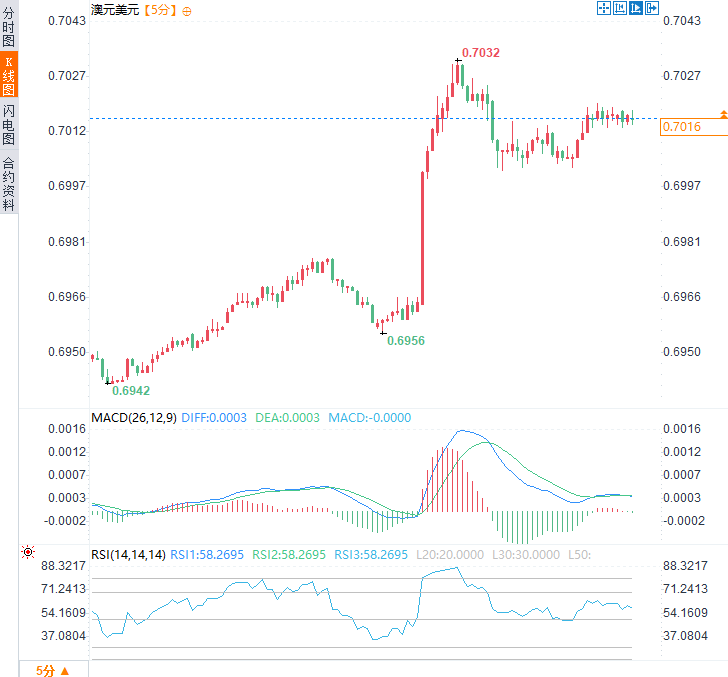
(AUD/USD 5-minute chart, source: FX678)
Investors are now betting that this is not a one-off adjustment. Market pricing suggests an 80% probability of a rate hike in May, with a cumulative tightening of 40 basis points expected by 2026.
Harry Murphy-Cruise, head of economic research at the Reserve Bank of Australia, noted: "With the RBA now expecting inflation to slow more gradually... the risks clearly lean towards a series of rate hikes rather than a one-off increase."
The Reserve Bank of Australia (RBA) adopted a more aggressive stance after a period prioritizing preserving labor market gains, resulting in smaller rate hikes than its global counterparts. However, following three rate cuts in 2025, inflation accelerated again, forcing the bank to adopt a more hawkish position.
In another economic report, the Reserve Bank of Australia expressed uncertainty about whether financial conditions were truly restrictive, acknowledging that some indicators suggest they may still be accommodative. The bank currently believes that even with more than two rate hikes in 2026, inflation could remain high.
"Overall, it is clear that the Reserve Bank of Australia believes the path to cooling inflation will be long and winding," said Abhijit Suria, senior Asia-Pacific economist.
Suria predicted another rate hike in May, but warned that more hikes might be needed . Because the Reserve Bank of Australia "expects underlying inflation to remain below the midpoint of its 2-3% target range by early 2028," it is "very likely to feel the need to raise interest rates further."
At 15:12 Beijing time, the Australian dollar was trading at 0.7021/22 against the US dollar.
Background and Macroeconomic Environment of the Reserve Bank of Australia's Actions
The Reserve Bank of Australia's decision was driven by a series of economic data indicating continued economic strength and rising price pressures. Prior to the meeting, the market had already raised the probability of a February rate hike to 78%.
Key factors behind the policy shift include:
Persistent inflation : Consumer price growth has exceeded expectations for two consecutive quarters. The Reserve Bank of Australia's preferred indicator – underlying inflation – reached an annual rate of 3.4% in the fourth quarter, well above the RBA's target range of 2% to 3%.
Strong labor market : The unemployment rate unexpectedly fell to a seven-month low of 4.1% in December, indicating that labor market conditions remain tight.
Strong demand : In its policy statement, the Reserve Bank of Australia noted that "private demand grew faster than expected" and that "capacity pressures were greater than previously assessed."
Loose financial conditions : Strong consumer spending, record high home prices, and readily available credit for households and businesses all suggest that financial conditions are not sufficient to curb an overheated economy.
Summary of other views from the Reserve Bank of Australia's Policy Committee
Although inflation has fallen significantly since its peak in 2022, it is expected to pick up considerably in the second half of 2025. The Committee has been closely monitoring the economy and judges that some of the rise in inflation reflects greater capacity pressures. Therefore, the Committee considers that inflation is likely to remain above its target level for some time.
Capacity pressures partly reflect the increased demand momentum in recent months. Private demand growth has far exceeded expectations, driven by both household spending and investment. Housing market activity and prices continue to recover. Financial conditions are expected to ease in 2025, though it remains uncertain whether they will remain restrictive. Credit is readily available to households and businesses, and the effects of earlier interest rate cuts have not yet fully translated into aggregate demand, prices, and wages. Recently, exchange rates, money market rates, and government bond yields have all risen as market expectations for the cash rate have increased.
The Committee will rely on data and evolving prospects and risk assessments to guide its decision-making. To this end, the Committee will closely monitor developments in the global economy and financial markets, trends in domestic demand, and the outlook for inflation and the labor market. The Committee remains focused on its mandate to maintain price stability and achieve full employment and will take the measures it deems necessary to achieve this objective.
Today’s (February 3) policy decision was adopted unanimously. The committee will closely monitor the data and the evolving assessment of the outlook and risks to guide its decision-making.
Speech and Analysis by the Governor of the Reserve Bank of Australia
The Reserve Bank of Australia (RBA) governor signaled a cautiously hawkish policy stance: while acknowledging a positive economic fundamentals, he prioritized combating inflation and explicitly rejected following market expectations for rapid and significant interest rate hikes. The core of his statement was seeking a difficult balance between curbing inflation and maintaining employment, emphasizing that policy will be entirely data-driven and will not pre-determine a path.
Resolutely control inflation, but be wary of inflation becoming entrenched . Block stated, "Inflation is too strong; we absolutely cannot allow it to spiral out of control. There are concerns that high inflation may persist for a long time." This sets a hawkish tone. The Fed Chairman explicitly considers inflation the biggest threat, implying extremely low tolerance, and preventing inflation expectations from becoming unanchored is the top priority of current policy.
Extremely cautious, data-dependent, and independent of the market . Block stated: "The Committee will approach interest rate policy with caution," "A 50-basis-point rate hike was not discussed," "Policy will not be market-driven," and "No forward guidance will be provided; the focus will be on data."
Assessment of the Economy and Employment: Optimistic but Acknowledging Constraints . Chairman Block stated, "The economic situation is actually good, but supply is constrained," and "We are striving to reduce inflation while maintaining near-full employment." "Maintaining near-full employment" is the boundary of tightening policy, implying that interest rate hikes will be contingent on not severely damaging the labor market.
Assessment of the financial environment: The Fed acknowledges that the monetary channel is already functioning . Governor Block stated, "The Australian dollar's performance indicates a tightening of financial conditions." He pointed out that factors such as the appreciation of the Australian dollar have automatically tightened financial conditions, which may prompt the Fed to consider the magnitude of interest rate hikes, meaning that it does not need to rely solely on interest rates to achieve a tightening effect.
Officials hint at no possibility of interest rate cut in the near future
The Reserve Bank of Australia (RBA) leadership has actively refuted market expectations for a near-term interest rate cut. Following the decision on December 9, Bullock stated that a rate cut would not be considered in the foreseeable future.
This view was echoed earlier in 2026 by Vice Chairman Andrew Hauser, who noted that the likelihood of interest rate cuts was "likely very low" due to persistent inflation.
When asked about the possibility of further interest rate hikes, Block explained that the bank will continue to assess economic data on a meeting-by-meeting basis.
She said, "If inflation remains high and does not appear to fall back to the Committee's target level... the Committee may need to consider whether it is appropriate to maintain the current interest rate level, or whether a rate hike will be necessary at some point."
The Reserve Bank of Australia becomes a policy outlier
With this rate hike, the Reserve Bank of Australia (RBA) finds itself in a small circle. Alongside the Bank of Japan, the RBA is one of the few central banks in the developed world still tightening monetary policy.
This contrasts sharply with the outlook for other major economies. Markets expect interest rate cuts in the US, UK, and Canada, while the European Central Bank is expected to keep rates unchanged for an extended period.
The market is reacting and pricing in further interest rate hikes.
The Reserve Bank of Australia's hawkish shift immediately impacted financial markets. Following the RBA's interest rate decision announcement around 11:30 AM, the Australian dollar surged significantly. During Tuesday's European session, the Australian dollar traded around 0.7020 against the US dollar, with a daily gain of approximately 1.1%.
(AUD/USD 5-minute chart, source: FX678)
Investors are now betting that this is not a one-off adjustment. Market pricing suggests an 80% probability of a rate hike in May, with a cumulative tightening of 40 basis points expected by 2026.
Harry Murphy-Cruise, head of economic research at the Reserve Bank of Australia, noted: "With the RBA now expecting inflation to slow more gradually... the risks clearly lean towards a series of rate hikes rather than a one-off increase."
The long road to curbing inflation and future market expectations
The Reserve Bank of Australia (RBA) adopted a more aggressive stance after a period prioritizing preserving labor market gains, resulting in smaller rate hikes than its global counterparts. However, following three rate cuts in 2025, inflation accelerated again, forcing the bank to adopt a more hawkish position.
In another economic report, the Reserve Bank of Australia expressed uncertainty about whether financial conditions were truly restrictive, acknowledging that some indicators suggest they may still be accommodative. The bank currently believes that even with more than two rate hikes in 2026, inflation could remain high.
"Overall, it is clear that the Reserve Bank of Australia believes the path to cooling inflation will be long and winding," said Abhijit Suria, senior Asia-Pacific economist.
Suria predicted another rate hike in May, but warned that more hikes might be needed . Because the Reserve Bank of Australia "expects underlying inflation to remain below the midpoint of its 2-3% target range by early 2028," it is "very likely to feel the need to raise interest rates further."
At 15:12 Beijing time, the Australian dollar was trading at 0.7021/22 against the US dollar.
- Risk Warning and Disclaimer
- The market involves risk, and trading may not be suitable for all investors. This article is for reference only and does not constitute personal investment advice, nor does it take into account certain users’ specific investment objectives, financial situation, or other needs. Any investment decisions made based on this information are at your own risk.