Easing geopolitical tensions and a stronger US dollar put downward pressure on international crude oil prices.
2026-02-03 18:16:03
On Tuesday (February 3), during the early European trading session, the price of West Texas Intermediate (WTI) crude oil, the US benchmark, fell to $61.72 per barrel, continuing the sharp decline of the previous trading day. The immediate trigger for this round of price drops was the news that the US and Iran were about to resume nuclear negotiations—officials from both countries were scheduled to meet in Turkey this Friday. This significantly reduced market concerns about a short-term military conflict, and the risk premium previously attached to oil prices due to geopolitical risks is rapidly receding.

Geopolitical situation dominates short-term market trends: from easing panic to renewed competition.
As OPEC's fourth-largest oil producer, Iran's evolving relationship with the United States has been a key variable in the crude oil market. Recent reports indicate that U.S. Special Envoy Steve Witkov will meet with Iranian Foreign Minister Abbas Araqchi in Turkey to attempt to restart diplomatic negotiations on the nuclear issue in an effort to alleviate regional war concerns.
Senior market analyst Kelvin Wong pointed out, "The sharp fluctuations in oil prices over the past four weeks stemmed from geopolitical risks arising from the expansion of the US government's foreign policy, particularly the 'erratic' military threats against Iran." With the resumption of diplomatic negotiations, market panic regarding regional conflicts has significantly subsided, directly driving the pullback in oil prices.
However, the market is still closely watching the progress of subsequent negotiations. If the talks break down, geopolitical risks may escalate again, potentially leading to a rapid rebound in oil prices. Latest news indicates that traders are preparing for potential volatility in the outcome of the negotiations, with some funds already positioning themselves in options to hedge against the risk of a sudden price jump.
It is worth noting that even if negotiations proceed smoothly, the pace of Iranian crude oil's return to the global market remains uncertain. Industry insiders say that if Iran is to lift sanctions and resume crude oil exports, it could take as long as 3-6 months. This means that the actual increase in supply in the short term will be limited, and the downside potential for oil prices may be partially restricted.
The Dual Impact of a Stronger Dollar and Trade Policy: Both Suppression and Support Coexist
Besides geopolitical factors, the recent strength of the US dollar has also put downward pressure on crude oil prices, which are denominated in US dollars. Driven by the hawkish leanings of Federal Reserve Chairman nominee Kevin Warsh and better-than-expected US ISM manufacturing data, the US dollar index has rebounded from a recent four-year low to around 97.60, further increasing downward pressure on crude oil prices.
Historical data shows that the negative correlation between the US dollar index and crude oil prices reached 0.78 in the past month. This means that for every 1% increase in the US dollar, crude oil prices fall by an average of 0.78%. The current rebound of the US dollar is continuously weakening the attractiveness of crude oil.
Meanwhile, trade policy adjustments between the US and India have provided potential support for oil prices. Reports indicate that US President Trump announced a reduction in tariffs on Indian oil from 25% to 18% in exchange for India ceasing its purchases of Russian crude. As the world's third-largest crude oil importer, India's shift in purchasing could potentially reshape the global oil demand landscape in the medium to long term, thereby supporting oil prices.
This agreement could prompt India to increase its imports of US crude oil, indirectly boosting demand expectations for WTI crude oil. Some institutions estimate that if India shifts its purchases of 1.2 million barrels per day of crude oil from Russia to the US, it could push WTI crude oil prices up by $2-3 per barrel over the next 6-12 months.
Furthermore, OPEC+'s production cut policy remains a significant support for oil prices. Recent news indicates that OPEC+ members have recently begun to exceed their production cut agreement, with overall production cuts reaching 1.8 million barrels per day in January, exceeding the original target by 300,000 barrels per day. This supply contraction is providing a floor for oil prices.
The Interplay Between Macroeconomics and Financial Markets: The Underlying Logic Amidst Multidimensional Disturbances
Beyond direct geopolitical and trade factors, the current crude oil market is also facing deeper pressure from the interconnected macroeconomic and financial markets. Recent surveys show that market expectations for global economic growth in 2026 have been revised down from 3.2% at the beginning of the year to 2.8%. This change in expectations has directly dragged down expectations for crude oil demand growth, particularly in emerging markets, the main consumers of global crude oil, where slower demand growth is weakening upward momentum for oil prices. Meanwhile, the relative strength of the US economy has exacerbated this divergence: the US ISM Manufacturing PMI rose to 52.4 in January, exceeding market expectations. While supporting the US dollar, this has further weakened crude oil's safe-haven appeal as a commodity.
According to official CFTC (Committee on Occupations) data for the week ending January 27 (to be released January 31, 2026), hedge funds and other non-commercial institutions increased their net long positions in WTI crude oil futures by 9,586 contracts to 28,937 contracts, ending the previous two weeks of slight fluctuations. This reflects speculative funds covering their long positions during a period of fluctuating US-Iran geopolitical risks, indicating intensified competition among speculative funds amid geopolitical turmoil. From a micro-market perspective, according to ICE (Intercontinental Exchange) data released simultaneously on January 31, as of the week ending January 27, fund management institutions increased their net long positions in Brent crude oil by 19,409 contracts to 377,371 contracts, a nearly 10-month high since early April last year, echoing the covering of long positions in the WTI market. ICE's official non-commercial net long positions also increased by 29,947 contracts to 246,917 contracts, while the commercial sector remained net short for nine consecutive weeks, indicating a significant divergence between the industry and speculative sectors. However, some quantitative funds are still adjusting their crude oil exposure based on the judgment of a stronger dollar and weak demand expectations. Coupled with the sharp drop in oil prices triggered by the US-Iran dialogue on February 2, the market's divergence on whether oil prices can hold the $62 support level has increased significantly, and the battle between bulls and bears has further intensified short-term volatility.
In the longer term, the global energy transition is reshaping the underlying logic of the crude oil market. The EU plans to increase the share of renewable energy to 42.5% by 2030, and the US is expanding subsidies for electric vehicles. These policies will gradually weaken the core position of crude oil in the energy mix. In the short term, the resilience of US shale oil production cannot be ignored. US shale oil producers are taking advantage of current oil price levels to expand drilling activities, and US crude oil production is expected to exceed 14.5 million barrels per day in 2026, setting a new record. This increase in supply will continue to put downward pressure on oil prices.
Technical Analysis: Key support levels are being tested, and the battle between bulls and bears is intensifying.
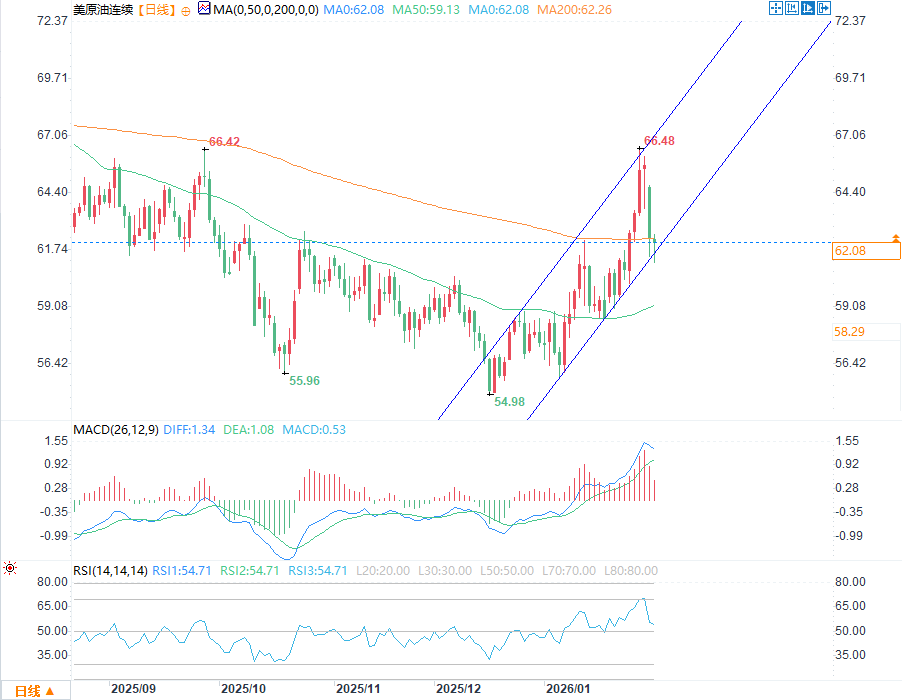
(WTI crude oil daily chart source: FX678)
From a technical analysis perspective, after breaking through the previous downward channel, oil prices encountered resistance and fell back at the $66.48 level, and are currently testing support at the 200-day moving average (approximately $62.25). The weakening bullish momentum of the MACD indicator also confirms the short-term downward pressure.
If the bears break through the 200-day moving average support, oil prices could fall to the $60 level, or even further test the 50-day moving average (around $59.00). A break below this level could completely reverse the recent upward trend.
Conversely, if the 200-day moving average provides effective support, bulls may push oil prices to rebound above $65; if it breaks through the previous high of $66.50, it could open up room for a move towards the $70 mark.
The current RSI indicator has fallen back to 54.75, which has not yet entered the oversold zone. This means that there is still room for downward momentum to be released in the short term, but it also leaves room for a subsequent rebound.
Market Outlook: Four Key Variables to Guide the Market Direction
In summary, the crude oil market is at a critical juncture where bullish and bearish forces are intertwined. Going forward, four key variables need to be monitored: the progress of US-Iran negotiations will directly affect the rise and fall of geopolitical risk premiums; the trend of the US dollar index is closely related to the Fed's policy expectations; the OPEC+'s ability to implement production cuts is the core support on the supply side; and the pace of global economic recovery will become an important observation point on the demand side.
Geopolitical situation dominates short-term market trends: from easing panic to renewed competition.
As OPEC's fourth-largest oil producer, Iran's evolving relationship with the United States has been a key variable in the crude oil market. Recent reports indicate that U.S. Special Envoy Steve Witkov will meet with Iranian Foreign Minister Abbas Araqchi in Turkey to attempt to restart diplomatic negotiations on the nuclear issue in an effort to alleviate regional war concerns.
Senior market analyst Kelvin Wong pointed out, "The sharp fluctuations in oil prices over the past four weeks stemmed from geopolitical risks arising from the expansion of the US government's foreign policy, particularly the 'erratic' military threats against Iran." With the resumption of diplomatic negotiations, market panic regarding regional conflicts has significantly subsided, directly driving the pullback in oil prices.
However, the market is still closely watching the progress of subsequent negotiations. If the talks break down, geopolitical risks may escalate again, potentially leading to a rapid rebound in oil prices. Latest news indicates that traders are preparing for potential volatility in the outcome of the negotiations, with some funds already positioning themselves in options to hedge against the risk of a sudden price jump.
It is worth noting that even if negotiations proceed smoothly, the pace of Iranian crude oil's return to the global market remains uncertain. Industry insiders say that if Iran is to lift sanctions and resume crude oil exports, it could take as long as 3-6 months. This means that the actual increase in supply in the short term will be limited, and the downside potential for oil prices may be partially restricted.
The Dual Impact of a Stronger Dollar and Trade Policy: Both Suppression and Support Coexist
Besides geopolitical factors, the recent strength of the US dollar has also put downward pressure on crude oil prices, which are denominated in US dollars. Driven by the hawkish leanings of Federal Reserve Chairman nominee Kevin Warsh and better-than-expected US ISM manufacturing data, the US dollar index has rebounded from a recent four-year low to around 97.60, further increasing downward pressure on crude oil prices.
Historical data shows that the negative correlation between the US dollar index and crude oil prices reached 0.78 in the past month. This means that for every 1% increase in the US dollar, crude oil prices fall by an average of 0.78%. The current rebound of the US dollar is continuously weakening the attractiveness of crude oil.
Meanwhile, trade policy adjustments between the US and India have provided potential support for oil prices. Reports indicate that US President Trump announced a reduction in tariffs on Indian oil from 25% to 18% in exchange for India ceasing its purchases of Russian crude. As the world's third-largest crude oil importer, India's shift in purchasing could potentially reshape the global oil demand landscape in the medium to long term, thereby supporting oil prices.
This agreement could prompt India to increase its imports of US crude oil, indirectly boosting demand expectations for WTI crude oil. Some institutions estimate that if India shifts its purchases of 1.2 million barrels per day of crude oil from Russia to the US, it could push WTI crude oil prices up by $2-3 per barrel over the next 6-12 months.
Furthermore, OPEC+'s production cut policy remains a significant support for oil prices. Recent news indicates that OPEC+ members have recently begun to exceed their production cut agreement, with overall production cuts reaching 1.8 million barrels per day in January, exceeding the original target by 300,000 barrels per day. This supply contraction is providing a floor for oil prices.
The Interplay Between Macroeconomics and Financial Markets: The Underlying Logic Amidst Multidimensional Disturbances
Beyond direct geopolitical and trade factors, the current crude oil market is also facing deeper pressure from the interconnected macroeconomic and financial markets. Recent surveys show that market expectations for global economic growth in 2026 have been revised down from 3.2% at the beginning of the year to 2.8%. This change in expectations has directly dragged down expectations for crude oil demand growth, particularly in emerging markets, the main consumers of global crude oil, where slower demand growth is weakening upward momentum for oil prices. Meanwhile, the relative strength of the US economy has exacerbated this divergence: the US ISM Manufacturing PMI rose to 52.4 in January, exceeding market expectations. While supporting the US dollar, this has further weakened crude oil's safe-haven appeal as a commodity.
According to official CFTC (Committee on Occupations) data for the week ending January 27 (to be released January 31, 2026), hedge funds and other non-commercial institutions increased their net long positions in WTI crude oil futures by 9,586 contracts to 28,937 contracts, ending the previous two weeks of slight fluctuations. This reflects speculative funds covering their long positions during a period of fluctuating US-Iran geopolitical risks, indicating intensified competition among speculative funds amid geopolitical turmoil. From a micro-market perspective, according to ICE (Intercontinental Exchange) data released simultaneously on January 31, as of the week ending January 27, fund management institutions increased their net long positions in Brent crude oil by 19,409 contracts to 377,371 contracts, a nearly 10-month high since early April last year, echoing the covering of long positions in the WTI market. ICE's official non-commercial net long positions also increased by 29,947 contracts to 246,917 contracts, while the commercial sector remained net short for nine consecutive weeks, indicating a significant divergence between the industry and speculative sectors. However, some quantitative funds are still adjusting their crude oil exposure based on the judgment of a stronger dollar and weak demand expectations. Coupled with the sharp drop in oil prices triggered by the US-Iran dialogue on February 2, the market's divergence on whether oil prices can hold the $62 support level has increased significantly, and the battle between bulls and bears has further intensified short-term volatility.
In the longer term, the global energy transition is reshaping the underlying logic of the crude oil market. The EU plans to increase the share of renewable energy to 42.5% by 2030, and the US is expanding subsidies for electric vehicles. These policies will gradually weaken the core position of crude oil in the energy mix. In the short term, the resilience of US shale oil production cannot be ignored. US shale oil producers are taking advantage of current oil price levels to expand drilling activities, and US crude oil production is expected to exceed 14.5 million barrels per day in 2026, setting a new record. This increase in supply will continue to put downward pressure on oil prices.
Technical Analysis: Key support levels are being tested, and the battle between bulls and bears is intensifying.
(WTI crude oil daily chart source: FX678)
From a technical analysis perspective, after breaking through the previous downward channel, oil prices encountered resistance and fell back at the $66.48 level, and are currently testing support at the 200-day moving average (approximately $62.25). The weakening bullish momentum of the MACD indicator also confirms the short-term downward pressure.
If the bears break through the 200-day moving average support, oil prices could fall to the $60 level, or even further test the 50-day moving average (around $59.00). A break below this level could completely reverse the recent upward trend.
Conversely, if the 200-day moving average provides effective support, bulls may push oil prices to rebound above $65; if it breaks through the previous high of $66.50, it could open up room for a move towards the $70 mark.
The current RSI indicator has fallen back to 54.75, which has not yet entered the oversold zone. This means that there is still room for downward momentum to be released in the short term, but it also leaves room for a subsequent rebound.
Market Outlook: Four Key Variables to Guide the Market Direction
In summary, the crude oil market is at a critical juncture where bullish and bearish forces are intertwined. Going forward, four key variables need to be monitored: the progress of US-Iran negotiations will directly affect the rise and fall of geopolitical risk premiums; the trend of the US dollar index is closely related to the Fed's policy expectations; the OPEC+'s ability to implement production cuts is the core support on the supply side; and the pace of global economic recovery will become an important observation point on the demand side.
- Risk Warning and Disclaimer
- The market involves risk, and trading may not be suitable for all investors. This article is for reference only and does not constitute personal investment advice, nor does it take into account certain users’ specific investment objectives, financial situation, or other needs. Any investment decisions made based on this information are at your own risk.