What happened to international oil prices in just three days?
2026-02-03 19:58:06
Brent crude oil traded around $66.30 during the European session on Tuesday, February 3rd, its recent price action remaining range-bound. Prices initially fell significantly after the opening, primarily due to a temporary easing of the risk premium associated with the Middle East situation. News over the weekend indicated that senior Iranian officials were outlining a framework for negotiations with the US, and Trump subsequently stated publicly that Iran was seriously communicating with the US. These signals significantly alleviated market concerns about an escalation of the conflict.
Furthermore, Iranian officials explicitly denied media reports of military exercises to be held in the Strait of Hormuz, directly eliminating the possibility of short-term supply disruptions. As one of the world's most important oil transportation routes, any obstruction of the Strait of Hormuz would have a severe impact on the global oil market. Now, this "landmine" appears to have been temporarily defused, causing the geopolitical premium previously accumulated on oil prices to be quickly reversed, dragging oil prices down.
The next key juncture is the US-Iran summit in Istanbul this Friday. If the talks make substantial progress, geopolitical risks will be further reduced, and upside potential for oil prices will continue to be suppressed. Currently, the market is in a wait-and-see period regarding this event, and any slight disturbance could trigger sharp short-term fluctuations.
Despite the pressure from easing geopolitical tensions, oil prices have not lost support in the longer term. On the supply side, OPEC+ maintained its existing production policy as expected at its recent meeting. This means that despite the gradual improvement in global demand, new supply has not been released in tandem, leaving room for speculation about a rebalancing process in the market.
Analysts point out that in this environment of "recovering demand but no increase in supply," even a slight sign of demand recovery can be amplified by the market as a bullish factor. Therefore, the recent pullback in oil prices is more of a correction in risk premiums than a fundamental reversal of the supply-demand logic. As long as OPEC+ does not suddenly announce an increase in production, the current supply constraints will continue to support prices.
Meanwhile, positive signals are emerging from the demand side. The latest US ISM Manufacturing PMI significantly exceeded expectations, with the new orders sub-index jumping to its highest level since 2022. A recovery in manufacturing activity often indicates increased inventory replenishment and production activity, leading to higher expected demand for fuels and chemical raw materials. If this trend continues, even if geopolitical premiums continue to diminish, oil prices are still expected to regain their footing based on fundamentals.
From a technical perspective, Brent crude oil is currently in a phase of intense competition between bulls and bears. On the 30-minute chart, recent highs occurred around 66.58, 66.56, and 66.45, forming a dense resistance zone. This means that if the bulls want to break through to the upside, they must effectively digest the selling pressure in this area; otherwise, they will continue to face repeated fluctuations.
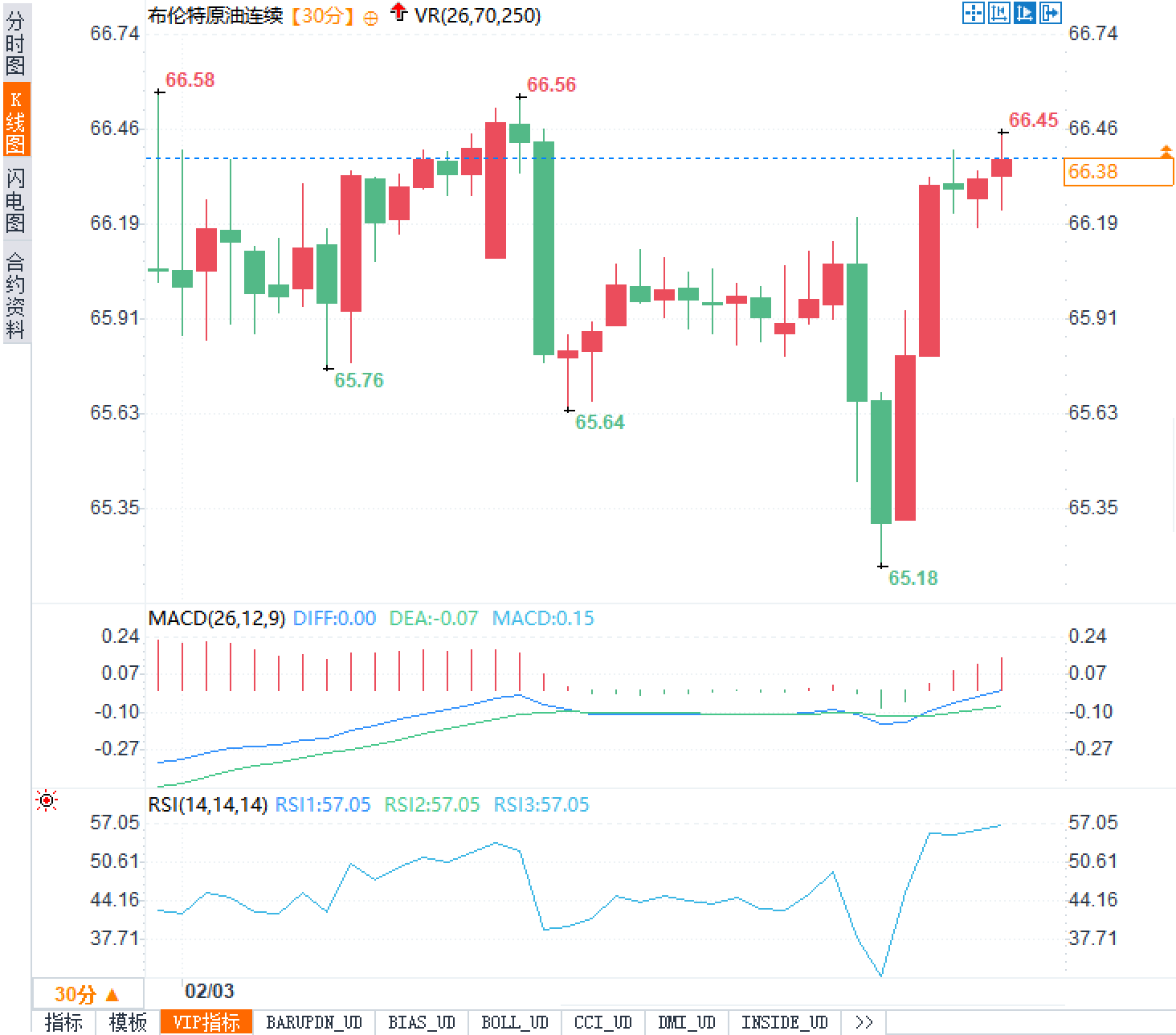
There are several support levels to watch below: 65.76 and 65.64 are key lows during the previous pullback, which have strong psychological and technical significance; while a deeper support level is at 65.18. Once the price retests this level, the market will reassess whether geopolitical risks have truly been resolved and whether the recovery in demand can offset the impact of weakening sentiment.
In terms of technical indicators, the current MACD DIFF value is 0.00, DEA is -0.07, and the MACD histogram is 0.15, indicating that short-term momentum is recovering from a weak state to a neutral-to-strong state, but a one-sided trend has not yet formed. The RSI is 57.05, which is in the neutral-to-strong range, indicating that bullish sentiment has warmed up, but is far from overheated. Overall, the current market is more like a recovery and repricing process after a sharp drop, with prices fluctuating around $66, waiting for a new catalyst to break the balance.
Looking ahead, there are three main variables influencing Brent crude oil prices. First is the progress of the Istanbul talks. If the negotiations release more conciliatory signals, the geopolitical risk premium is expected to further compress, limiting the upside potential of oil prices; conversely, if the negotiations break down or unexpected news emerges, the market may quickly reassess supply security risks, triggering a rebound.
Secondly, there's the issue of OPEC+'s future production decisions. Currently, its stance of maintaining production cuts provides implicit support to the market. However, if additional production increases are implemented later due to a rise in oil prices, especially given that demand has not yet fully recovered, it could disrupt the current fragile supply-demand balance and create downward pressure.
Thirdly, there are changes in expectations regarding macroeconomic monetary policy. If the market begins to bet on the Federal Reserve adopting a tighter interest rate path, tighter financial conditions will suppress sentiment towards risk assets and indirectly drag down oil demand by suppressing economic growth expectations. This dual pressure from "sentiment + fundamentals" cannot be ignored.
Furthermore, Iranian officials explicitly denied media reports of military exercises to be held in the Strait of Hormuz, directly eliminating the possibility of short-term supply disruptions. As one of the world's most important oil transportation routes, any obstruction of the Strait of Hormuz would have a severe impact on the global oil market. Now, this "landmine" appears to have been temporarily defused, causing the geopolitical premium previously accumulated on oil prices to be quickly reversed, dragging oil prices down.
The next key juncture is the US-Iran summit in Istanbul this Friday. If the talks make substantial progress, geopolitical risks will be further reduced, and upside potential for oil prices will continue to be suppressed. Currently, the market is in a wait-and-see period regarding this event, and any slight disturbance could trigger sharp short-term fluctuations.
Supply and demand fundamentals still provide bottom support.
Despite the pressure from easing geopolitical tensions, oil prices have not lost support in the longer term. On the supply side, OPEC+ maintained its existing production policy as expected at its recent meeting. This means that despite the gradual improvement in global demand, new supply has not been released in tandem, leaving room for speculation about a rebalancing process in the market.
Analysts point out that in this environment of "recovering demand but no increase in supply," even a slight sign of demand recovery can be amplified by the market as a bullish factor. Therefore, the recent pullback in oil prices is more of a correction in risk premiums than a fundamental reversal of the supply-demand logic. As long as OPEC+ does not suddenly announce an increase in production, the current supply constraints will continue to support prices.
Meanwhile, positive signals are emerging from the demand side. The latest US ISM Manufacturing PMI significantly exceeded expectations, with the new orders sub-index jumping to its highest level since 2022. A recovery in manufacturing activity often indicates increased inventory replenishment and production activity, leading to higher expected demand for fuels and chemical raw materials. If this trend continues, even if geopolitical premiums continue to diminish, oil prices are still expected to regain their footing based on fundamentals.
The market is in a tug-of-war between bulls and bears, and the technical picture is entering a critical observation period.
From a technical perspective, Brent crude oil is currently in a phase of intense competition between bulls and bears. On the 30-minute chart, recent highs occurred around 66.58, 66.56, and 66.45, forming a dense resistance zone. This means that if the bulls want to break through to the upside, they must effectively digest the selling pressure in this area; otherwise, they will continue to face repeated fluctuations.
There are several support levels to watch below: 65.76 and 65.64 are key lows during the previous pullback, which have strong psychological and technical significance; while a deeper support level is at 65.18. Once the price retests this level, the market will reassess whether geopolitical risks have truly been resolved and whether the recovery in demand can offset the impact of weakening sentiment.
In terms of technical indicators, the current MACD DIFF value is 0.00, DEA is -0.07, and the MACD histogram is 0.15, indicating that short-term momentum is recovering from a weak state to a neutral-to-strong state, but a one-sided trend has not yet formed. The RSI is 57.05, which is in the neutral-to-strong range, indicating that bullish sentiment has warmed up, but is far from overheated. Overall, the current market is more like a recovery and repricing process after a sharp drop, with prices fluctuating around $66, waiting for a new catalyst to break the balance.
Three key factors will determine the future direction of oil prices.
Looking ahead, there are three main variables influencing Brent crude oil prices. First is the progress of the Istanbul talks. If the negotiations release more conciliatory signals, the geopolitical risk premium is expected to further compress, limiting the upside potential of oil prices; conversely, if the negotiations break down or unexpected news emerges, the market may quickly reassess supply security risks, triggering a rebound.
Secondly, there's the issue of OPEC+'s future production decisions. Currently, its stance of maintaining production cuts provides implicit support to the market. However, if additional production increases are implemented later due to a rise in oil prices, especially given that demand has not yet fully recovered, it could disrupt the current fragile supply-demand balance and create downward pressure.
Thirdly, there are changes in expectations regarding macroeconomic monetary policy. If the market begins to bet on the Federal Reserve adopting a tighter interest rate path, tighter financial conditions will suppress sentiment towards risk assets and indirectly drag down oil demand by suppressing economic growth expectations. This dual pressure from "sentiment + fundamentals" cannot be ignored.
- Risk Warning and Disclaimer
- The market involves risk, and trading may not be suitable for all investors. This article is for reference only and does not constitute personal investment advice, nor does it take into account certain users’ specific investment objectives, financial situation, or other needs. Any investment decisions made based on this information are at your own risk.