













Gold rebounded strongly, approaching 5100, but may enter a period of consolidation in the short term.
2026-02-04 20:05:58
On Wednesday (February 4th) during the early European trading session, spot gold (XAU/USD) continued its strong rebound, climbing to near a new high for the week and approaching the key $5100 level. Since its rapid rebound from last week's low of around $4400, gold prices have recovered more than 15%, demonstrating significant resilience after a sharp correction. However, before breaking through key resistance, market divergence has increased, and the short-term trend is gradually transitioning from a "sentiment-driven rebound" to a phase of "high-level consolidation."

Risk aversion has intensified again, with geopolitical events becoming a key short-term catalyst.
A key driver of this rebound is the renewed escalation of geopolitical risks in the Middle East. Recent news indicates that the US Navy shot down an Iranian drone in the Arabian Sea, which the US described as having made an "aggressive approach" to the USS Abraham Lincoln aircraft carrier. This incident quickly ignited risk aversion in the market, driving funds back into traditional safe-haven assets such as gold.
Despite the White House's emphasis that diplomatic channels remain open and its confirmation that US-Iran negotiations will continue this Friday, this sudden military clash has already significantly impacted market risk appetite. Many institutions view it as a "direct trigger for a new round of safe-haven buying," rather than an isolated event. Combined with previous recurring risks related to Iran, geopolitical uncertainty has become one of the core drivers of short-term gold price volatility, rather than merely a technical correction of the previous sharp decline.
US data becomes a key variable, and the importance of leading indicators increases significantly.
On the fundamental front, the impact of US macroeconomic data on the US dollar and gold has increased significantly this week. The ADP private sector employment report, due on Wednesday, is expected to show approximately 48,000 new jobs added in January, a slight increase from the previous month, but still within a moderate growth range, unlikely to provide strong support for the US dollar.
If the actual data falls short of expectations, it will further strengthen market pricing in at least two rate cuts by the Federal Reserve this year, thereby lowering real interest rates and providing support for gold, a non-yielding asset. A weak ISM Services PMI released on the same day could also weaken demand for the US dollar, creating conditions for gold prices to break through upper resistance levels.
It is worth noting that due to the partial government shutdown, the non-farm payroll data was postponed to Friday. This significantly amplified the market influence of leading indicators such as ADP and ISM, which may directly determine whether gold prices can effectively hold above $5,100 in the short term.
After a strong rebound, momentum has slowed, and the market may enter a "digestion period" in the short term.
From an overall structural perspective, gold previously plummeted from a high of around $5,600 to around $4,400, a drop of nearly 20%, which is a typical example of leveraged liquidation and panic selling. The current rebound has essentially recovered about half of the losses, indicating that the bullish foundation remains intact, but it also means that the short-term recovery momentum is weakening.
In the absence of new strong catalysts (such as a clearer policy shift or escalation of geopolitical conflicts), profit-taking, position adjustments, and fluctuating sentiment could all amplify price volatility, making it difficult for gold prices to break through the $5100-$5200 resistance zone in one go. A more realistic scenario is that it will enter a period of high-level consolidation, allowing time to digest the previous overheated sentiment.
Technical Structure: Consolidation above $5000
From a technical perspective, on the daily chart, the gold price is currently above the 9-day moving average (approximately 4966.61), which is an important reference level for the short-term bullish trend.
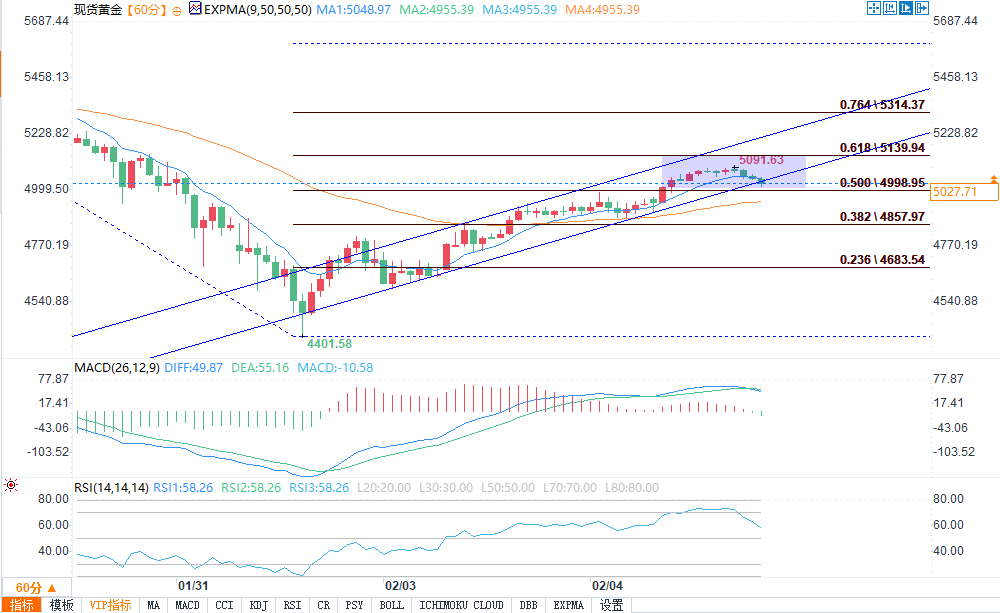
(Spot gold 1-hour chart source: EasyForex)
On the hourly chart, although the price broke below the 9-period EXPMA, indicating a weakening of short-term bullish momentum, a clear breakout has not yet occurred. The market is currently testing the $5000 psychological level, which coincides significantly with the 0.500 Fibonacci retracement level (approximately 4998.95), making it a crucial psychological and technical support level for the bulls. Considering the previous stabilization performance within this range, the price is expected to consolidate above $5000, awaiting new momentum guidance.
Until the direction becomes clearer, prices will mainly trade within the Fibonacci 0.500 (4998.95) to 0.618 (5139.94) range. The $5000 level is not only a psychological barrier but also forms a potential support level with the 50-hour moving average (around 4955.17), providing double protection for the bulls. As long as prices remain above $5000, the short-term bullish trend remains intact, and there is still a possibility of testing the 0.618 resistance level (5139.94).
If the price stabilizes above $5,000, pay attention to the momentum recovery of indicators. Once indicators such as RSI and MACD show bullish divergence or a golden cross, it can be considered a signal of a rebound starting. Even if there is a brief dip, as long as it does not effectively break below $5,000, there is no need to be overly bearish; only when this support level is completely breached should we further look at the support level of the 0.382 Fibonacci retracement (4857.97).
Conclusion: The medium- to long-term logic remains unchanged; a range-bound trading strategy should be adopted in the short term.
Overall, the long-term bullish logic for gold remains intact. Continued central bank gold purchases, the trend towards de-dollarization, and expectations of a downward shift in the central level of real interest rates continue to provide solid underlying support for gold prices. Institutions such as JP Morgan and Deutsche Bank maintain a structurally bullish view, with long-term targets pointing to $6,000 or even higher.
However, in the short term, after a strong rebound, gold prices are more likely to enter a period of high-level consolidation rather than a linear upward trend. Unless geopolitical risks escalate further and US data reveals a significant "dovish surprise," the market needs time to digest previous volatility and leverage adjustments.
Risk aversion has intensified again, with geopolitical events becoming a key short-term catalyst.
A key driver of this rebound is the renewed escalation of geopolitical risks in the Middle East. Recent news indicates that the US Navy shot down an Iranian drone in the Arabian Sea, which the US described as having made an "aggressive approach" to the USS Abraham Lincoln aircraft carrier. This incident quickly ignited risk aversion in the market, driving funds back into traditional safe-haven assets such as gold.
Despite the White House's emphasis that diplomatic channels remain open and its confirmation that US-Iran negotiations will continue this Friday, this sudden military clash has already significantly impacted market risk appetite. Many institutions view it as a "direct trigger for a new round of safe-haven buying," rather than an isolated event. Combined with previous recurring risks related to Iran, geopolitical uncertainty has become one of the core drivers of short-term gold price volatility, rather than merely a technical correction of the previous sharp decline.
US data becomes a key variable, and the importance of leading indicators increases significantly.
On the fundamental front, the impact of US macroeconomic data on the US dollar and gold has increased significantly this week. The ADP private sector employment report, due on Wednesday, is expected to show approximately 48,000 new jobs added in January, a slight increase from the previous month, but still within a moderate growth range, unlikely to provide strong support for the US dollar.
If the actual data falls short of expectations, it will further strengthen market pricing in at least two rate cuts by the Federal Reserve this year, thereby lowering real interest rates and providing support for gold, a non-yielding asset. A weak ISM Services PMI released on the same day could also weaken demand for the US dollar, creating conditions for gold prices to break through upper resistance levels.
It is worth noting that due to the partial government shutdown, the non-farm payroll data was postponed to Friday. This significantly amplified the market influence of leading indicators such as ADP and ISM, which may directly determine whether gold prices can effectively hold above $5,100 in the short term.
After a strong rebound, momentum has slowed, and the market may enter a "digestion period" in the short term.
From an overall structural perspective, gold previously plummeted from a high of around $5,600 to around $4,400, a drop of nearly 20%, which is a typical example of leveraged liquidation and panic selling. The current rebound has essentially recovered about half of the losses, indicating that the bullish foundation remains intact, but it also means that the short-term recovery momentum is weakening.
In the absence of new strong catalysts (such as a clearer policy shift or escalation of geopolitical conflicts), profit-taking, position adjustments, and fluctuating sentiment could all amplify price volatility, making it difficult for gold prices to break through the $5100-$5200 resistance zone in one go. A more realistic scenario is that it will enter a period of high-level consolidation, allowing time to digest the previous overheated sentiment.
Technical Structure: Consolidation above $5000
From a technical perspective, on the daily chart, the gold price is currently above the 9-day moving average (approximately 4966.61), which is an important reference level for the short-term bullish trend.
(Spot gold 1-hour chart source: EasyForex)
On the hourly chart, although the price broke below the 9-period EXPMA, indicating a weakening of short-term bullish momentum, a clear breakout has not yet occurred. The market is currently testing the $5000 psychological level, which coincides significantly with the 0.500 Fibonacci retracement level (approximately 4998.95), making it a crucial psychological and technical support level for the bulls. Considering the previous stabilization performance within this range, the price is expected to consolidate above $5000, awaiting new momentum guidance.
Until the direction becomes clearer, prices will mainly trade within the Fibonacci 0.500 (4998.95) to 0.618 (5139.94) range. The $5000 level is not only a psychological barrier but also forms a potential support level with the 50-hour moving average (around 4955.17), providing double protection for the bulls. As long as prices remain above $5000, the short-term bullish trend remains intact, and there is still a possibility of testing the 0.618 resistance level (5139.94).
If the price stabilizes above $5,000, pay attention to the momentum recovery of indicators. Once indicators such as RSI and MACD show bullish divergence or a golden cross, it can be considered a signal of a rebound starting. Even if there is a brief dip, as long as it does not effectively break below $5,000, there is no need to be overly bearish; only when this support level is completely breached should we further look at the support level of the 0.382 Fibonacci retracement (4857.97).
Conclusion: The medium- to long-term logic remains unchanged; a range-bound trading strategy should be adopted in the short term.
Overall, the long-term bullish logic for gold remains intact. Continued central bank gold purchases, the trend towards de-dollarization, and expectations of a downward shift in the central level of real interest rates continue to provide solid underlying support for gold prices. Institutions such as JP Morgan and Deutsche Bank maintain a structurally bullish view, with long-term targets pointing to $6,000 or even higher.
However, in the short term, after a strong rebound, gold prices are more likely to enter a period of high-level consolidation rather than a linear upward trend. Unless geopolitical risks escalate further and US data reveals a significant "dovish surprise," the market needs time to digest previous volatility and leverage adjustments.
- Risk Warning and Disclaimer
- The market involves risk, and trading may not be suitable for all investors. This article is for reference only and does not constitute personal investment advice, nor does it take into account certain users’ specific investment objectives, financial situation, or other needs. Any investment decisions made based on this information are at your own risk.

