Cooling employment data dampened the dollar's momentum, but the Federal Reserve's cautious stance kept the dollar index fluctuating at high levels.
2026-02-06 13:23:28
The dollar index edged lower in Asian trading on Friday, giving back some of the gains from the previous two days, and is currently trading around 97.90. Market sentiment is cautious as investors await the release of the preliminary University of Michigan consumer sentiment index for February, to assess changes in the U.S. economic outlook and inflation expectations.
Recent U.S. labor market data has been generally weak, putting pressure on the dollar. Data from the U.S. Department of Labor showed that initial jobless claims rose to 231,000 in the week ending January 31, higher than market expectations and the previous week's figure.
Meanwhile, ADP data showed that U.S. private sector employment increased by only 22,000 in January, significantly lower than market expectations. This series of data reinforced market sentiment that the U.S. job market is gradually cooling, and has also prompted investors to further bet on the Federal Reserve starting a rate-cutting cycle this year.
 Based on market pricing, traders generally expect the Federal Reserve to implement two rate cuts this year, with the first possibly starting in June, followed by another adjustment to the policy rate in September.
The CME FedWatch tool shows that the market believes there is nearly an 80% probability that the Federal Reserve will keep interest rates unchanged at its March meeting. However, the downside for the dollar remains limited. Some Fed officials have recently adopted a cautious stance, emphasizing that it is not advisable to ease policy before there are clearer signs of a decline in inflation.
Federal Reserve Governor Lisa Cook pointed out that with the downward trend in inflation not yet fully confirmed, concerns about stagnant inflation outweighed concerns about a weakening labor market, a stance that supported the dollar to some extent.
In addition, the market is also digesting the impact of Kevin Warsh's nomination as the next Federal Reserve Chairman. He is seen as favoring a smaller balance sheet and a relatively restrained path of interest rate cuts, an expectation that has not only eased concerns about the Fed's independence but also provided sentiment support for the dollar.
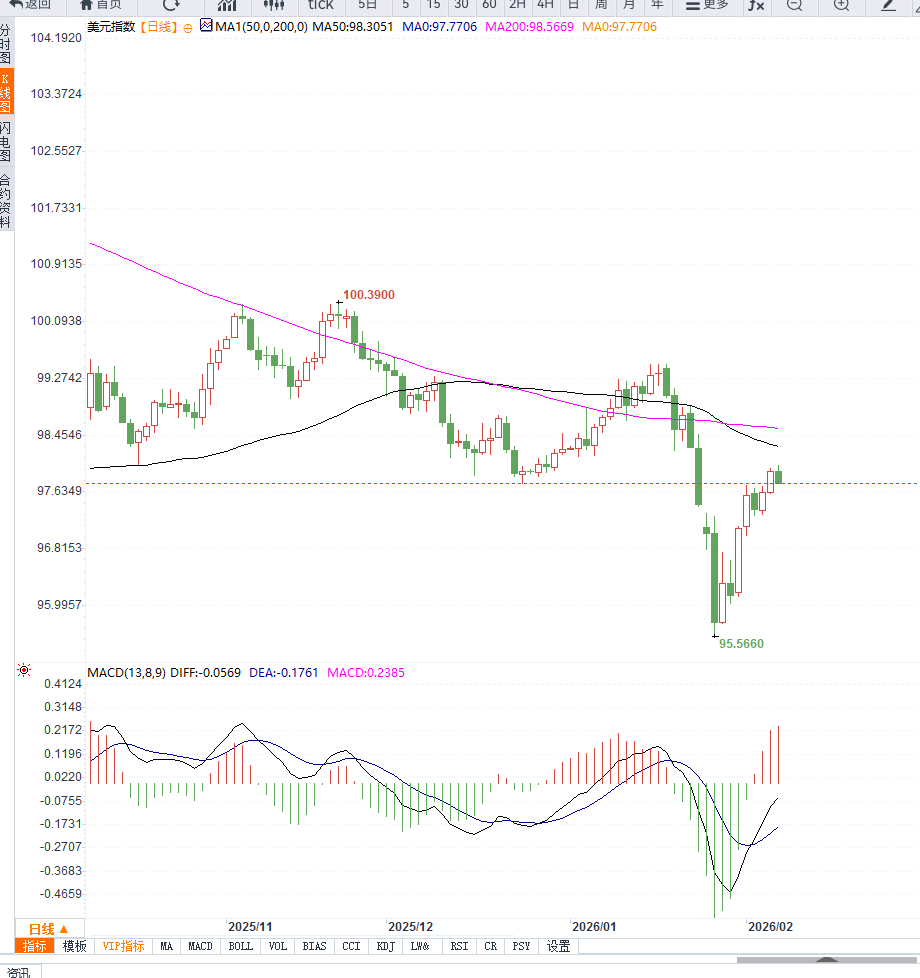
From a daily chart perspective, the US dollar index has entered a consolidation phase at high levels after a continuous rebound, but it remains within a short-term upward channel. Currently, the price is fluctuating around 97.90, with the 98.30-98.50 area forming a significant resistance level. This area corresponds to a dense cluster of previous highs, and if it cannot be effectively broken, the upward momentum of the US dollar index may be limited in the short term.
Looking at the downside, 97.40 forms the first support level. If a more significant pullback occurs, the psychological level of 97.00 will become a key defensive area. Once this level is breached, a retest of the 96.50 level cannot be ruled out. Overall, given the mixed fundamental factors, the US dollar index is more likely to fluctuate within the 97.00-98.50 range in the short term.
Editor's Note:
The current trend of the US dollar index reflects the market's speculation on the "timing of interest rate cuts" rather than the "whether interest rates will be cut." While the cooling employment data has indeed weakened the dollar's upward momentum, the Federal Reserve's cautious stance on inflation and the restoration of confidence in policy independence make a sustained decline in the dollar unlikely.
Before key economic data becomes clearer, the US dollar index is more likely to maintain a relatively strong consolidation pattern, with short-term fluctuations being more driven by changes in data and policy expectations.
Recent U.S. labor market data has been generally weak, putting pressure on the dollar. Data from the U.S. Department of Labor showed that initial jobless claims rose to 231,000 in the week ending January 31, higher than market expectations and the previous week's figure.
Meanwhile, ADP data showed that U.S. private sector employment increased by only 22,000 in January, significantly lower than market expectations. This series of data reinforced market sentiment that the U.S. job market is gradually cooling, and has also prompted investors to further bet on the Federal Reserve starting a rate-cutting cycle this year.
Based on market pricing, traders generally expect the Federal Reserve to implement two rate cuts this year, with the first possibly starting in June, followed by another adjustment to the policy rate in September.The CME FedWatch tool shows that the market believes there is nearly an 80% probability that the Federal Reserve will keep interest rates unchanged at its March meeting. However, the downside for the dollar remains limited. Some Fed officials have recently adopted a cautious stance, emphasizing that it is not advisable to ease policy before there are clearer signs of a decline in inflation.
Federal Reserve Governor Lisa Cook pointed out that with the downward trend in inflation not yet fully confirmed, concerns about stagnant inflation outweighed concerns about a weakening labor market, a stance that supported the dollar to some extent.
In addition, the market is also digesting the impact of Kevin Warsh's nomination as the next Federal Reserve Chairman. He is seen as favoring a smaller balance sheet and a relatively restrained path of interest rate cuts, an expectation that has not only eased concerns about the Fed's independence but also provided sentiment support for the dollar.
From a daily chart perspective, the US dollar index has entered a consolidation phase at high levels after a continuous rebound, but it remains within a short-term upward channel. Currently, the price is fluctuating around 97.90, with the 98.30-98.50 area forming a significant resistance level. This area corresponds to a dense cluster of previous highs, and if it cannot be effectively broken, the upward momentum of the US dollar index may be limited in the short term.
Looking at the downside, 97.40 forms the first support level. If a more significant pullback occurs, the psychological level of 97.00 will become a key defensive area. Once this level is breached, a retest of the 96.50 level cannot be ruled out. Overall, given the mixed fundamental factors, the US dollar index is more likely to fluctuate within the 97.00-98.50 range in the short term.
Editor's Note:
The current trend of the US dollar index reflects the market's speculation on the "timing of interest rate cuts" rather than the "whether interest rates will be cut." While the cooling employment data has indeed weakened the dollar's upward momentum, the Federal Reserve's cautious stance on inflation and the restoration of confidence in policy independence make a sustained decline in the dollar unlikely.
Before key economic data becomes clearer, the US dollar index is more likely to maintain a relatively strong consolidation pattern, with short-term fluctuations being more driven by changes in data and policy expectations.
- Risk Warning and Disclaimer
- The market involves risk, and trading may not be suitable for all investors. This article is for reference only and does not constitute personal investment advice, nor does it take into account certain users’ specific investment objectives, financial situation, or other needs. Any investment decisions made based on this information are at your own risk.