The yen's decline has halted due to a resurgence in risk aversion and hawkish expectations from the Bank of Japan, but the downside for the USD/JPY pair remains limited.
2026-02-06 13:31:47
The yen attracted some bargain hunting during Friday's Asian session, temporarily reversing its previous losing streak. Earlier, the dollar-yen pair had hit a two-week high, but selling pressure on the yen eased as risk sentiment shifted and market attention intensified regarding potential joint US-Japan intervention.
A temporary easing of global risk sentiment has become a significant factor supporting the yen. Overnight, the technology sector continued to be under pressure, and increased market volatility enhanced the yen's appeal as a traditional safe-haven currency.
Meanwhile, market expectations for the Bank of Japan's policy outlook remain hawkish, also providing support for the yen. Latest data shows that Japanese household spending in December 2025 fell by 2.6% year-on-year, a significant decline after a sharp increase in the previous month, highlighting the crowding-out effect of high inflation on consumer activity.

This result reinforced market expectations that the Bank of Japan would accelerate policy normalization and raise interest rates sooner than anticipated. The Bank of Japan's January meeting summary indicated that policymakers had discussed the weak yen's contribution to inflationary pressures and believed that further interest rate hikes were reasonable in terms of timing.
However, the sustainability of the yen's rebound remains limited. Market concerns about Japan's fiscal situation, along with upcoming political events, have made some investors cautious about chasing the yen higher.
With Japan's extraordinary House of Representatives election approaching, the ruling party is expected to gain a significant advantage. Market concerns that more aggressive fiscal stimulus policies could further burden public finances limit the yen's upside potential in the medium term.
Regarding the US dollar, a series of recent weak US employment data have strengthened market expectations for future interest rate cuts by the Federal Reserve, but the dollar's previous rebound from multi-year lows has not yet completely subsided.
The market still expects the Federal Reserve to have room for further interest rate cuts in 2026, which has to some extent curbed the continued rise of the US dollar and also caused the USD/JPY pair to retreat slightly from its high of above 157.00.
Looking ahead, traders will be focused on the upcoming University of Michigan Consumer Sentiment Index and inflation expectations data, while closely monitoring speeches by Federal Reserve officials. However, ahead of major political events in Japan, the market is likely to remain cautious, and the volatility triggered by the data may be relatively limited.
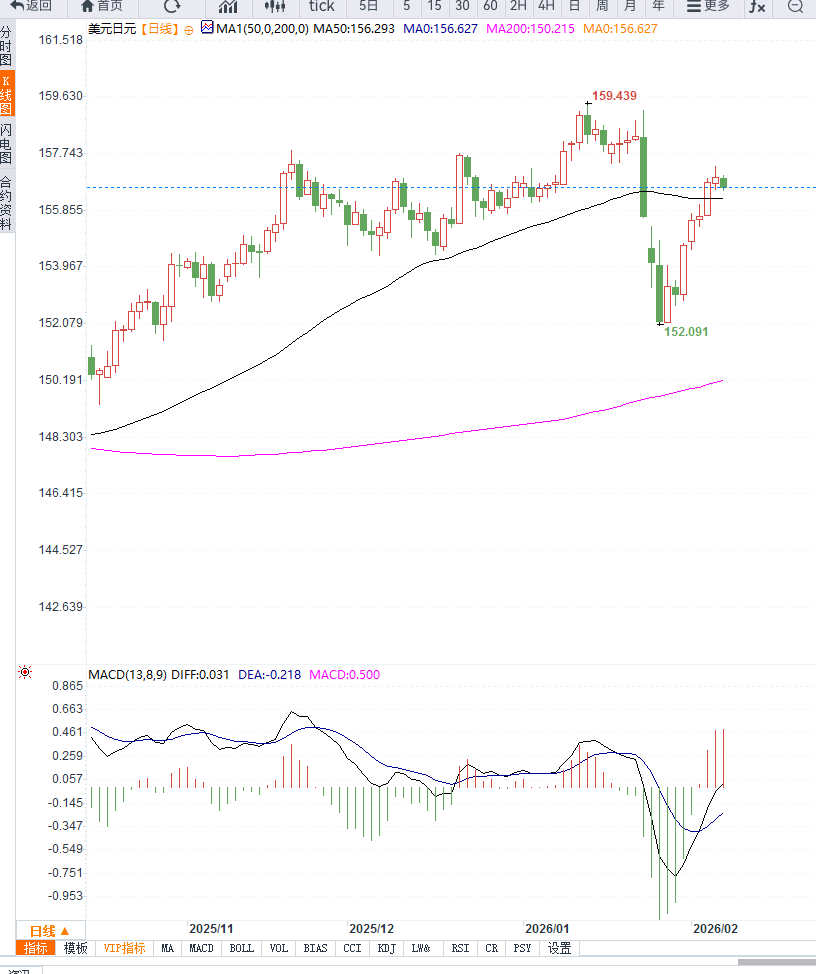
From a technical perspective, the USD/JPY pair previously broke through the 156.50 level and held above the 200-period moving average on the 4-hour chart, confirming a short-term bullish technical structure.
The current moving average continues its slow upward trend, with the price remaining above it, indicating that the overall trend is still bullish, but the upward momentum has slowed somewhat. In terms of momentum indicators, the MACD is showing signs of a death cross near the zero line, and the histogram is gradually turning negative and expanding, suggesting that short-term bullish momentum is weakening.
The RSI has fallen back to around 63, moving away from the previous overbought zone, but remains above 50, indicating that demand has not completely disappeared. If the exchange rate can continue to hold the support level of 156.50, there is still a possibility of retesting 157.00 and the resistance above in the short term.
Conversely, if the price breaks below the 200-period moving average support, the technical structure will shift to a correction, with the pullback target potentially pointing to 155.50 or even lower.
Editor's Note:
The current yen's exchange rate is influenced by a combination of factors. On the one hand, the Bank of Japan's policy stance is gradually shifting towards normalization, coupled with a rebound in safe-haven demand, providing temporary support for the yen;
On the other hand, fiscal and political uncertainties in Japan, coupled with the fact that the US dollar has not yet fully weakened, make it difficult for the yen to stage a trend-based rebound. Until key political events and policy signals become clearer, the USD/JPY pair is more likely to maintain a high-level consolidation pattern, with short-term fluctuations primarily driven by changes in risk sentiment and policy expectations.
A temporary easing of global risk sentiment has become a significant factor supporting the yen. Overnight, the technology sector continued to be under pressure, and increased market volatility enhanced the yen's appeal as a traditional safe-haven currency.
Meanwhile, market expectations for the Bank of Japan's policy outlook remain hawkish, also providing support for the yen. Latest data shows that Japanese household spending in December 2025 fell by 2.6% year-on-year, a significant decline after a sharp increase in the previous month, highlighting the crowding-out effect of high inflation on consumer activity.
This result reinforced market expectations that the Bank of Japan would accelerate policy normalization and raise interest rates sooner than anticipated. The Bank of Japan's January meeting summary indicated that policymakers had discussed the weak yen's contribution to inflationary pressures and believed that further interest rate hikes were reasonable in terms of timing.
However, the sustainability of the yen's rebound remains limited. Market concerns about Japan's fiscal situation, along with upcoming political events, have made some investors cautious about chasing the yen higher.
With Japan's extraordinary House of Representatives election approaching, the ruling party is expected to gain a significant advantage. Market concerns that more aggressive fiscal stimulus policies could further burden public finances limit the yen's upside potential in the medium term.
Regarding the US dollar, a series of recent weak US employment data have strengthened market expectations for future interest rate cuts by the Federal Reserve, but the dollar's previous rebound from multi-year lows has not yet completely subsided.
The market still expects the Federal Reserve to have room for further interest rate cuts in 2026, which has to some extent curbed the continued rise of the US dollar and also caused the USD/JPY pair to retreat slightly from its high of above 157.00.
Looking ahead, traders will be focused on the upcoming University of Michigan Consumer Sentiment Index and inflation expectations data, while closely monitoring speeches by Federal Reserve officials. However, ahead of major political events in Japan, the market is likely to remain cautious, and the volatility triggered by the data may be relatively limited.
From a technical perspective, the USD/JPY pair previously broke through the 156.50 level and held above the 200-period moving average on the 4-hour chart, confirming a short-term bullish technical structure.
The current moving average continues its slow upward trend, with the price remaining above it, indicating that the overall trend is still bullish, but the upward momentum has slowed somewhat. In terms of momentum indicators, the MACD is showing signs of a death cross near the zero line, and the histogram is gradually turning negative and expanding, suggesting that short-term bullish momentum is weakening.
The RSI has fallen back to around 63, moving away from the previous overbought zone, but remains above 50, indicating that demand has not completely disappeared. If the exchange rate can continue to hold the support level of 156.50, there is still a possibility of retesting 157.00 and the resistance above in the short term.
Conversely, if the price breaks below the 200-period moving average support, the technical structure will shift to a correction, with the pullback target potentially pointing to 155.50 or even lower.
Editor's Note:
The current yen's exchange rate is influenced by a combination of factors. On the one hand, the Bank of Japan's policy stance is gradually shifting towards normalization, coupled with a rebound in safe-haven demand, providing temporary support for the yen;
On the other hand, fiscal and political uncertainties in Japan, coupled with the fact that the US dollar has not yet fully weakened, make it difficult for the yen to stage a trend-based rebound. Until key political events and policy signals become clearer, the USD/JPY pair is more likely to maintain a high-level consolidation pattern, with short-term fluctuations primarily driven by changes in risk sentiment and policy expectations.
- Risk Warning and Disclaimer
- The market involves risk, and trading may not be suitable for all investors. This article is for reference only and does not constitute personal investment advice, nor does it take into account certain users’ specific investment objectives, financial situation, or other needs. Any investment decisions made based on this information are at your own risk.