A weaker dollar and central bank demand are supporting gold prices, but US-Iran negotiations may limit short-term upside potential.
2026-02-09 10:11:29
On Monday during Asian trading hours, international gold prices continued their rebound, with spot gold (XAU/USD) rising to around $5035 before falling back. A generally weaker US dollar coupled with continued central bank gold purchases provided support for precious metal prices, pushing gold prices to further recover from previous lows.
A significant reason for the pressure on the US dollar is the growing market concern about the independence of the Federal Reserve. US Treasury Secretary Scott Bessant recently stated that he would not rule out the possibility of launching a criminal investigation into the selection of the Federal Reserve Chair under certain circumstances. This statement has fueled market concerns about the independence of monetary policy, continuously dragging down the dollar's performance.
Against the backdrop of a weakening dollar, gold priced in dollars received passive support, attracting some capital inflows. Meanwhile, central bank demand remains a crucial pillar of the medium-term gold price trend.

Data shows that central banks in major Asian countries increased their gold reserves for the 15th consecutive month in January, with holdings rising slightly to 74.19 million ounces. As one of the world's largest gold consumers, this continued increase in gold holdings is seen by the market as an affirmation of its long-term value and strengthens investors' confidence in the medium- to long-term investment value of gold.
On the macroeconomic front, the market is focused on the US January jobs report, to be released later this week. Due to the delayed release of this data, investors are remaining cautious before its release, preferring to adjust positions rather than make large directional bets in the short term. This has resulted in gold prices exhibiting a volatile pattern during the rebound.
In terms of geopolitical factors, the latest developments in US-Iran relations have added new variables to the market. The Iranian president stated that the talks with the United States on the nuclear issue were "a step forward," while the Iranian foreign minister emphasized that dialogue must be conducted without threats.
The US has confirmed a new round of meetings early this week, but has also issued a tough stance. This combination of dialogue and pressure has led to divergent market opinions on the situation in the Middle East.
For gold, if the US-Iran negotiations continue to send positive signals, the geopolitical risk premium may further narrow, thereby weakening gold's safe-haven appeal; conversely, if the negotiations are stalled, gold's defensive attributes may be reactivated. In the short term, gold prices are in a balanced phase with intertwined bullish and bearish factors.
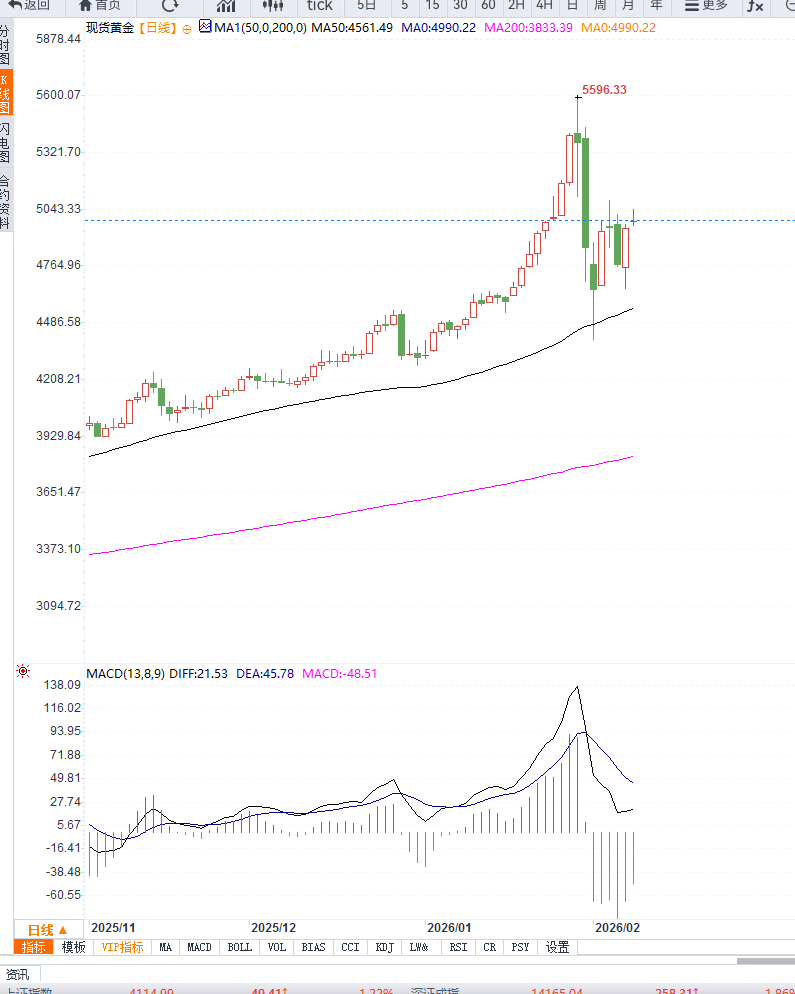
From a daily chart perspective, gold prices have gradually stabilized after falling from historical highs and have begun a technical rebound, currently trading above $5,000, indicating that buying pressure remains strong. On the downside, the first support level to watch is the psychological level of $5,000.
This level combines psychological resistance with a recent area of concentrated lows; holding above this level would help continue the current recovery trend. The second support level is located in the $4950-$4970 range; a decisive break below this area could indicate a prolonged correction and a further pullback in gold prices.
On the upside, the first resistance level is located in the $5050-$5070 range, near the previous rebound high, where short-term selling pressure is concentrated. If gold prices effectively break through and hold above this range, the next resistance level will be around $5150, corresponding to the previous historical high, where a breakthrough will be difficult.
In terms of momentum indicators, the daily RSI has fallen from the overbought zone to a neutral level, indicating that the previous overheated sentiment has been somewhat released, but no obvious oversold signal has yet appeared. This means that the current rebound is more of a corrective measure, and in the short term, gold prices may oscillate between $4,950 and $5,150 to digest the divergence between bulls and bears.
Editor's Note:
The current rebound in gold prices is mainly supported by a weaker dollar and continued central bank buying, but marginal changes in safe-haven demand are becoming a key variable influencing short-term trends. Continued progress in US-Iran negotiations could suppress the sentiment premium for gold.
Amidst doubts about the Federal Reserve's policy independence and persistent macroeconomic uncertainties, gold's medium- to long-term investment value remains unshaken. In the short term, gold prices are more likely to maintain a high-level consolidation pattern, awaiting new direction from macroeconomic data and geopolitical signals.
A significant reason for the pressure on the US dollar is the growing market concern about the independence of the Federal Reserve. US Treasury Secretary Scott Bessant recently stated that he would not rule out the possibility of launching a criminal investigation into the selection of the Federal Reserve Chair under certain circumstances. This statement has fueled market concerns about the independence of monetary policy, continuously dragging down the dollar's performance.
Against the backdrop of a weakening dollar, gold priced in dollars received passive support, attracting some capital inflows. Meanwhile, central bank demand remains a crucial pillar of the medium-term gold price trend.
Data shows that central banks in major Asian countries increased their gold reserves for the 15th consecutive month in January, with holdings rising slightly to 74.19 million ounces. As one of the world's largest gold consumers, this continued increase in gold holdings is seen by the market as an affirmation of its long-term value and strengthens investors' confidence in the medium- to long-term investment value of gold.
On the macroeconomic front, the market is focused on the US January jobs report, to be released later this week. Due to the delayed release of this data, investors are remaining cautious before its release, preferring to adjust positions rather than make large directional bets in the short term. This has resulted in gold prices exhibiting a volatile pattern during the rebound.
In terms of geopolitical factors, the latest developments in US-Iran relations have added new variables to the market. The Iranian president stated that the talks with the United States on the nuclear issue were "a step forward," while the Iranian foreign minister emphasized that dialogue must be conducted without threats.
The US has confirmed a new round of meetings early this week, but has also issued a tough stance. This combination of dialogue and pressure has led to divergent market opinions on the situation in the Middle East.
For gold, if the US-Iran negotiations continue to send positive signals, the geopolitical risk premium may further narrow, thereby weakening gold's safe-haven appeal; conversely, if the negotiations are stalled, gold's defensive attributes may be reactivated. In the short term, gold prices are in a balanced phase with intertwined bullish and bearish factors.
From a daily chart perspective, gold prices have gradually stabilized after falling from historical highs and have begun a technical rebound, currently trading above $5,000, indicating that buying pressure remains strong. On the downside, the first support level to watch is the psychological level of $5,000.
This level combines psychological resistance with a recent area of concentrated lows; holding above this level would help continue the current recovery trend. The second support level is located in the $4950-$4970 range; a decisive break below this area could indicate a prolonged correction and a further pullback in gold prices.
On the upside, the first resistance level is located in the $5050-$5070 range, near the previous rebound high, where short-term selling pressure is concentrated. If gold prices effectively break through and hold above this range, the next resistance level will be around $5150, corresponding to the previous historical high, where a breakthrough will be difficult.
In terms of momentum indicators, the daily RSI has fallen from the overbought zone to a neutral level, indicating that the previous overheated sentiment has been somewhat released, but no obvious oversold signal has yet appeared. This means that the current rebound is more of a corrective measure, and in the short term, gold prices may oscillate between $4,950 and $5,150 to digest the divergence between bulls and bears.
Editor's Note:
The current rebound in gold prices is mainly supported by a weaker dollar and continued central bank buying, but marginal changes in safe-haven demand are becoming a key variable influencing short-term trends. Continued progress in US-Iran negotiations could suppress the sentiment premium for gold.
Amidst doubts about the Federal Reserve's policy independence and persistent macroeconomic uncertainties, gold's medium- to long-term investment value remains unshaken. In the short term, gold prices are more likely to maintain a high-level consolidation pattern, awaiting new direction from macroeconomic data and geopolitical signals.
- Risk Warning and Disclaimer
- The market involves risk, and trading may not be suitable for all investors. This article is for reference only and does not constitute personal investment advice, nor does it take into account certain users’ specific investment objectives, financial situation, or other needs. Any investment decisions made based on this information are at your own risk.