Is the British pound quietly positioning itself ahead of the non-farm payrolls report?
2026-02-09 21:30:31
On Monday, February 9th, the British pound traded around 1.3650 against the US dollar during the North American session, having recently experienced a strong rebound. Although the Bank of England's decision last week initially put pressure on the pound, market sentiment quickly recovered, and the exchange rate has largely regained its losses. While this appears to be a technical rebound, it is actually the result of a fierce battle over interest rate expectations. The market's focus is now rapidly shifting to the upcoming US non-farm payroll report.
The US dollar has recently fluctuated, initially strengthening due to market covering of excessively accumulated short positions, but then losing momentum due to weak job openings data and cooling risk sentiment. Currently, the market is pricing in a 54 basis point rate cut by the Federal Reserve this year. This means that strong non-farm payroll data could trigger a "hawkish repricing"—that is, the market lowers its rate cut expectations, pushing up the central interest rate, thereby supporting the dollar. Conversely, weak data could strengthen expectations of easing, even prompting some funds to bet on rate cuts in advance, causing the dollar to weaken again. This uncertainty is the core driver of current exchange rate volatility.
Unlike external variables affecting the US dollar, the pressure on the pound stems more from changes in internal policy direction. Last week, while the Bank of England kept interest rates unchanged, its statement was noticeably dovish. Most notably, the voting results were significant: four members supported a rate cut, far exceeding the market's previous expectation of two. This not only reveals policymakers' concerns about the economic outlook but also sends a strong signal of easing.
More importantly, the central bank changed its forward guidance from "interest rates may adjust along a gradual downward path" to "interest rates may be further reduced," making the tone more direct and explicit. At the same time, inflation forecasts for multiple timeframes were significantly revised downwards, indicating policymakers' acceptance of the downward trend in inflation. Furthermore, the latest institutional surveys show that the average wage growth rate in 2026 is only 3.4%, lower than the expected 3.5%, further weakening the necessity of maintaining high interest rates. As a result, the interest rate market has already priced in approximately a 60% probability of a rate cut at the next meeting.
These changes mean that the pound is facing pressure from narrowing interest rate differentials. Once US data strengthens and the dollar gains support, the pound is likely to fall passively; only when US data is weak and the dollar itself is under pressure can the pound offset internal negative factors, maintain its fluctuations, or even attempt to rise.
From a price structure perspective, the GBP/USD pair is at a crucial observation window. The previous rally reached a high of 1.3867 before quickly retreating to around 1.3508, indicating heavy selling pressure and concentrated profit-taking by short-term investors. Currently, the exchange rate has returned to around 1.3650, precisely at the midpoint of the previous pullback range, where bulls and bears are locked in a tug-of-war, and the direction remains unclear.
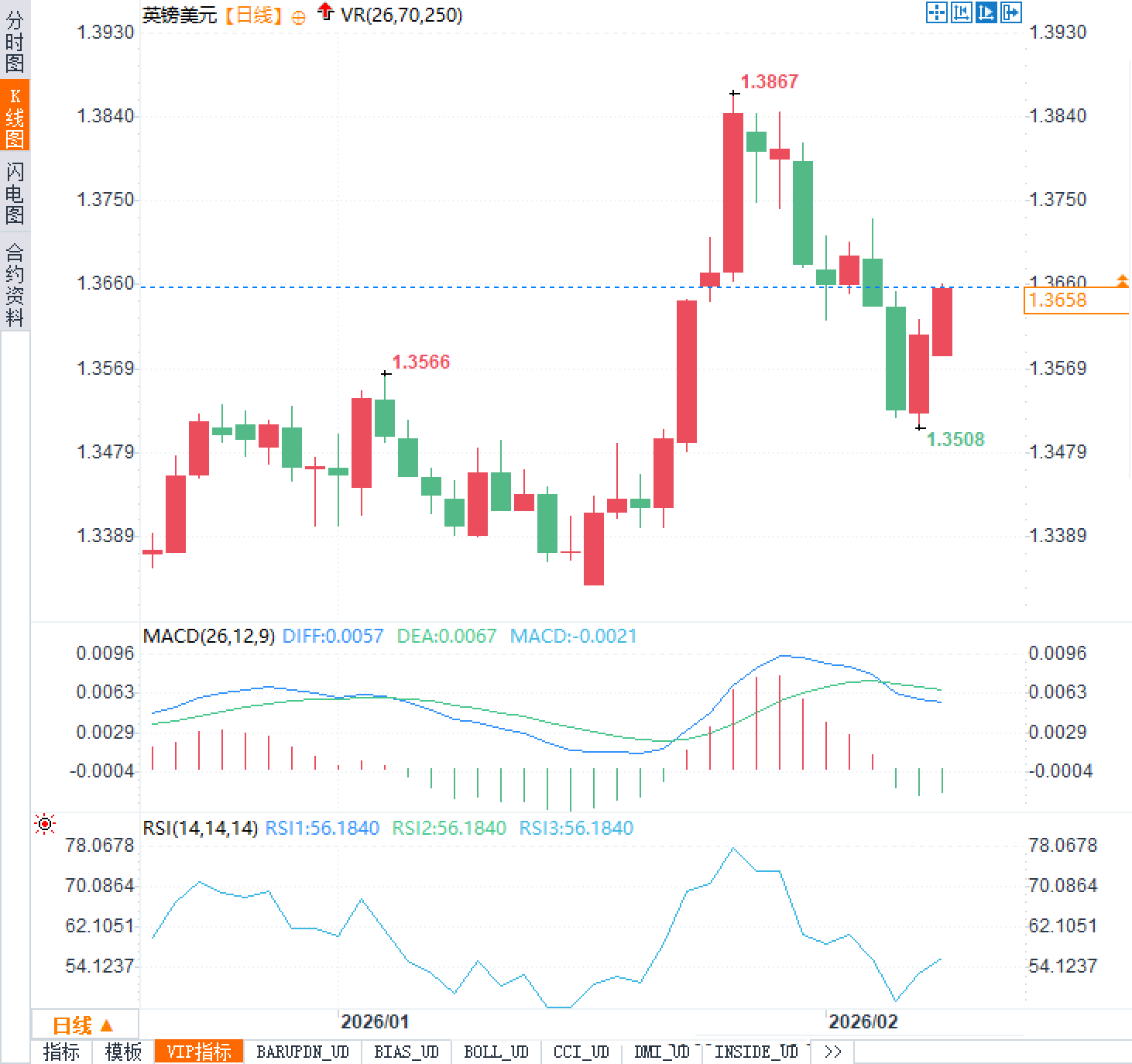
From a range-bound perspective, 1.3508, as a recent significant low, provides some support; while 1.3867 represents a previous high resistance zone, which will be difficult to break through. Unless there is strong fundamental support—such as unexpectedly weak US non-farm payroll data that weakens the dollar across the board—it will be difficult to effectively challenge this area. Technical indicators also confirm the oscillating nature of the market: the MACD shows DIFF at 0.0057, DEA at 0.0067, and the MACD histogram at -0.0021, indicating that momentum has retreated from its highs and is still in a consolidation phase; the RSI is around 56.1840, in a neutral-to-strong range, indicating that buying pressure has not completely disappeared, but it is not overheated either, consistent with the volatile market conditions. The true directional choice will likely only be revealed after the non-farm payroll data is released.
The upcoming trading pace will largely depend on the performance of the non-farm payroll report. If the data is stronger than expected, the market will reassess the Fed's rate-cutting path, potentially reducing bets on rate cuts and raising interest rate expectations, thereby providing broad support for the dollar. In this scenario, even if the pound/dollar pair holds above 1.3650, it may encounter resistance and fall back near the trendline. At that point, it will be crucial to watch whether the previous densely traded area around 1.3560 can provide a buffer, and whether 1.3508 can hold to maintain the overall range framework.
Conversely, weak non-farm payroll data would further exacerbate the Federal Reserve's concerns about the labor market, prompting the market to increase its bets on easing policies, and the dollar could fall accordingly. At this point, the pound could potentially retest the 1.3867 resistance area, and market focus would shift from the Bank of England's dovish stance to a loosening of dollar policy. However, it's important to note that subsequent UK economic data will still influence the Bank of England's actual actions. If inflation and wages continue to cool, market expectations for more aggressive rate cuts may rise, limiting the pound's medium-term rebound potential; conversely, if there are signs of improved data, interest rate expectations may reverse, providing the pound with a chance to recover.
The US dollar has recently fluctuated, initially strengthening due to market covering of excessively accumulated short positions, but then losing momentum due to weak job openings data and cooling risk sentiment. Currently, the market is pricing in a 54 basis point rate cut by the Federal Reserve this year. This means that strong non-farm payroll data could trigger a "hawkish repricing"—that is, the market lowers its rate cut expectations, pushing up the central interest rate, thereby supporting the dollar. Conversely, weak data could strengthen expectations of easing, even prompting some funds to bet on rate cuts in advance, causing the dollar to weaken again. This uncertainty is the core driver of current exchange rate volatility.
The Bank of England has quietly shifted its stance, putting increasing pressure on the pound.
Unlike external variables affecting the US dollar, the pressure on the pound stems more from changes in internal policy direction. Last week, while the Bank of England kept interest rates unchanged, its statement was noticeably dovish. Most notably, the voting results were significant: four members supported a rate cut, far exceeding the market's previous expectation of two. This not only reveals policymakers' concerns about the economic outlook but also sends a strong signal of easing.
More importantly, the central bank changed its forward guidance from "interest rates may adjust along a gradual downward path" to "interest rates may be further reduced," making the tone more direct and explicit. At the same time, inflation forecasts for multiple timeframes were significantly revised downwards, indicating policymakers' acceptance of the downward trend in inflation. Furthermore, the latest institutional surveys show that the average wage growth rate in 2026 is only 3.4%, lower than the expected 3.5%, further weakening the necessity of maintaining high interest rates. As a result, the interest rate market has already priced in approximately a 60% probability of a rate cut at the next meeting.
These changes mean that the pound is facing pressure from narrowing interest rate differentials. Once US data strengthens and the dollar gains support, the pound is likely to fall passively; only when US data is weak and the dollar itself is under pressure can the pound offset internal negative factors, maintain its fluctuations, or even attempt to rise.
Technical analysis shows a tug-of-war, and the range-bound pattern may continue.
From a price structure perspective, the GBP/USD pair is at a crucial observation window. The previous rally reached a high of 1.3867 before quickly retreating to around 1.3508, indicating heavy selling pressure and concentrated profit-taking by short-term investors. Currently, the exchange rate has returned to around 1.3650, precisely at the midpoint of the previous pullback range, where bulls and bears are locked in a tug-of-war, and the direction remains unclear.
From a range-bound perspective, 1.3508, as a recent significant low, provides some support; while 1.3867 represents a previous high resistance zone, which will be difficult to break through. Unless there is strong fundamental support—such as unexpectedly weak US non-farm payroll data that weakens the dollar across the board—it will be difficult to effectively challenge this area. Technical indicators also confirm the oscillating nature of the market: the MACD shows DIFF at 0.0057, DEA at 0.0067, and the MACD histogram at -0.0021, indicating that momentum has retreated from its highs and is still in a consolidation phase; the RSI is around 56.1840, in a neutral-to-strong range, indicating that buying pressure has not completely disappeared, but it is not overheated either, consistent with the volatile market conditions. The true directional choice will likely only be revealed after the non-farm payroll data is released.
With the decisive moment approaching, non-farm payrolls may rewrite the script.
The upcoming trading pace will largely depend on the performance of the non-farm payroll report. If the data is stronger than expected, the market will reassess the Fed's rate-cutting path, potentially reducing bets on rate cuts and raising interest rate expectations, thereby providing broad support for the dollar. In this scenario, even if the pound/dollar pair holds above 1.3650, it may encounter resistance and fall back near the trendline. At that point, it will be crucial to watch whether the previous densely traded area around 1.3560 can provide a buffer, and whether 1.3508 can hold to maintain the overall range framework.
Conversely, weak non-farm payroll data would further exacerbate the Federal Reserve's concerns about the labor market, prompting the market to increase its bets on easing policies, and the dollar could fall accordingly. At this point, the pound could potentially retest the 1.3867 resistance area, and market focus would shift from the Bank of England's dovish stance to a loosening of dollar policy. However, it's important to note that subsequent UK economic data will still influence the Bank of England's actual actions. If inflation and wages continue to cool, market expectations for more aggressive rate cuts may rise, limiting the pound's medium-term rebound potential; conversely, if there are signs of improved data, interest rate expectations may reverse, providing the pound with a chance to recover.
- Risk Warning and Disclaimer
- The market involves risk, and trading may not be suitable for all investors. This article is for reference only and does not constitute personal investment advice, nor does it take into account certain users’ specific investment objectives, financial situation, or other needs. Any investment decisions made based on this information are at your own risk.