Expectations of a Federal Reserve rate cut are rising, putting continuous downward pressure on the dollar index.
2026-02-10 14:36:27
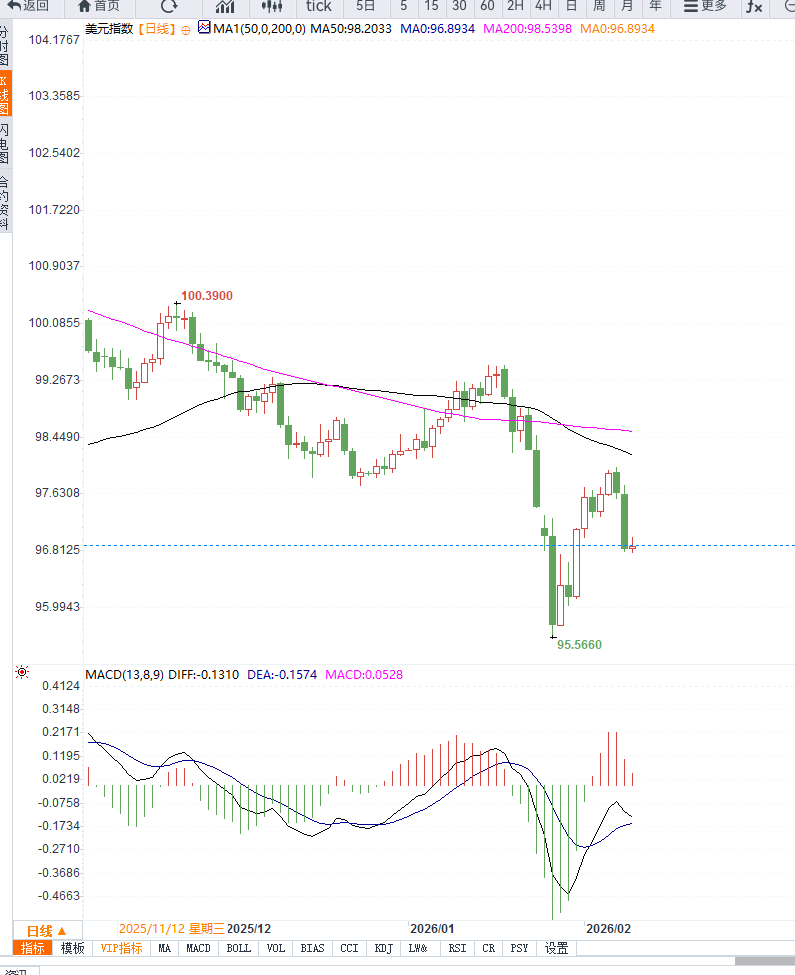
During Tuesday's Asian trading session, the US dollar index (DXY) continued its consolidation at low levels, failing to rebound effectively for the third consecutive trading day, and is currently trading around 96.80.
Market sentiment remains cautious overall, with investors gradually reducing their enthusiasm for short-term dollar allocations while awaiting key US economic data. Recently, concerns about a potential decline in external funds' willingness to allocate to dollar assets have become a significant factor suppressing the dollar.
Market sources indicate that some Asian financial institutions have suggested reducing their concentrated allocation to US Treasuries to diversify risk and address uncertainty surrounding US economic policies. This move has exacerbated market expectations of potentially weakening medium- to long-term demand for the US dollar, putting downward pressure on the currency.
 Meanwhile, global risk appetite has improved, with safe-haven funds temporarily flowing out of dollar assets ahead of a series of key US data releases this week. The market widely expects the Federal Reserve to keep interest rates unchanged at its March meeting, but the policy focus for the year has clearly shifted towards easing.
Current interest rate path expectations suggest that the first rate cut may occur in June, and if the economy cools further, there may be room for another rate cut in September. The decline in inflation expectations further reinforces this assessment.
The latest survey data shows that the US one-year inflation expectation has fallen to 3.1%, a near six-month low, indicating that inflationary pressures are slowly easing. Medium- and long-term inflation expectations remain relatively stable, suggesting that market concerns about runaway inflation have significantly cooled, which has weakened the dollar's interest rate support to some extent.
Regarding policy statements, Federal Reserve officials remained cautious. San Francisco Fed President Daly noted that the U.S. labor market may maintain a state of low hiring and low layoffs, but did not rule out the possibility of more pronounced signs of cooling in the future.
At the same time, Federal Reserve Governor Milan emphasized the importance of central bank independence, although he also acknowledged the limitations of complete independence in reality. These statements indicate that the Federal Reserve maintains a flexible but cautious stance on the issue of policy shift.
The market will now focus on the delayed January jobs report and the upcoming CPI data. These figures will be crucial in determining whether the US economy continues to cool and the pace of the Federal Reserve's interest rate cuts, and may also determine the short-term direction of the US dollar index.
From a technical perspective, the US dollar index remains in a weak consolidation range. The price continues to trade below key medium-term moving averages, reflecting that trend momentum has not yet recovered. Multiple short-term rebounds have been limited, indicating that selling pressure remains.
In terms of momentum indicators, the oscillator is in the low to mid-range, and no obvious oversold signal has yet appeared, meaning that the US dollar still has technical room to fall further. If the index breaks below the lower edge of the current consolidation range, it may trigger a new round of technical decline.
Conversely, if a rebound occurs due to data stimulus, it is more likely to be seen as a corrective rebound rather than a trend reversal. Overall, the technical pattern still supports the judgment of a weak and volatile market, and the direction will be highly dependent on the performance of the upcoming US macroeconomic data.
Editor's Note:
The core pressure on the US dollar index currently does not stem from a single data point, but rather from the combined effect of multiple expectations. Concerns about foreign investment allocation have weakened structural demand for the dollar, while falling inflation and expectations of interest rate cuts have diminished its interest rate advantage.
Ahead of key data releases, the US dollar is more likely to maintain a defensive consolidation pattern. If employment and inflation data further confirm an economic slowdown, the dollar will still face downside risks in the medium term; conversely, if the data is stronger than expected, the dollar may only see a short-term recovery.
Market sentiment remains cautious overall, with investors gradually reducing their enthusiasm for short-term dollar allocations while awaiting key US economic data. Recently, concerns about a potential decline in external funds' willingness to allocate to dollar assets have become a significant factor suppressing the dollar.
Market sources indicate that some Asian financial institutions have suggested reducing their concentrated allocation to US Treasuries to diversify risk and address uncertainty surrounding US economic policies. This move has exacerbated market expectations of potentially weakening medium- to long-term demand for the US dollar, putting downward pressure on the currency.
Meanwhile, global risk appetite has improved, with safe-haven funds temporarily flowing out of dollar assets ahead of a series of key US data releases this week. The market widely expects the Federal Reserve to keep interest rates unchanged at its March meeting, but the policy focus for the year has clearly shifted towards easing.Current interest rate path expectations suggest that the first rate cut may occur in June, and if the economy cools further, there may be room for another rate cut in September. The decline in inflation expectations further reinforces this assessment.
The latest survey data shows that the US one-year inflation expectation has fallen to 3.1%, a near six-month low, indicating that inflationary pressures are slowly easing. Medium- and long-term inflation expectations remain relatively stable, suggesting that market concerns about runaway inflation have significantly cooled, which has weakened the dollar's interest rate support to some extent.
Regarding policy statements, Federal Reserve officials remained cautious. San Francisco Fed President Daly noted that the U.S. labor market may maintain a state of low hiring and low layoffs, but did not rule out the possibility of more pronounced signs of cooling in the future.
At the same time, Federal Reserve Governor Milan emphasized the importance of central bank independence, although he also acknowledged the limitations of complete independence in reality. These statements indicate that the Federal Reserve maintains a flexible but cautious stance on the issue of policy shift.
The market will now focus on the delayed January jobs report and the upcoming CPI data. These figures will be crucial in determining whether the US economy continues to cool and the pace of the Federal Reserve's interest rate cuts, and may also determine the short-term direction of the US dollar index.
From a technical perspective, the US dollar index remains in a weak consolidation range. The price continues to trade below key medium-term moving averages, reflecting that trend momentum has not yet recovered. Multiple short-term rebounds have been limited, indicating that selling pressure remains.
In terms of momentum indicators, the oscillator is in the low to mid-range, and no obvious oversold signal has yet appeared, meaning that the US dollar still has technical room to fall further. If the index breaks below the lower edge of the current consolidation range, it may trigger a new round of technical decline.
Conversely, if a rebound occurs due to data stimulus, it is more likely to be seen as a corrective rebound rather than a trend reversal. Overall, the technical pattern still supports the judgment of a weak and volatile market, and the direction will be highly dependent on the performance of the upcoming US macroeconomic data.
Editor's Note:
The core pressure on the US dollar index currently does not stem from a single data point, but rather from the combined effect of multiple expectations. Concerns about foreign investment allocation have weakened structural demand for the dollar, while falling inflation and expectations of interest rate cuts have diminished its interest rate advantage.
Ahead of key data releases, the US dollar is more likely to maintain a defensive consolidation pattern. If employment and inflation data further confirm an economic slowdown, the dollar will still face downside risks in the medium term; conversely, if the data is stronger than expected, the dollar may only see a short-term recovery.
- Risk Warning and Disclaimer
- The market involves risk, and trading may not be suitable for all investors. This article is for reference only and does not constitute personal investment advice, nor does it take into account certain users’ specific investment objectives, financial situation, or other needs. Any investment decisions made based on this information are at your own risk.