Crude oil trading alert: Geopolitical uncertainty supports oil prices, which are expected to remain range-bound in the short term.
2026-02-11 09:37:41
International crude oil markets traded in a range-bound pattern at high levels on Wednesday, hovering around $64.30 per barrel. WTI crude oil prices fluctuated throughout the day before closing slightly lower, falling back to around $64 per barrel, ending a two-day winning streak.
The energy sector weakened across the board, indicating overall pressure on risk assets. Meanwhile, natural gas futures retreated due to anticipated lower heating demand as spring approaches in many parts of the US, exacerbating the overall bearish sentiment in the energy market.

The core variable in this round of oil price fluctuations remains the uncertainty surrounding the situation in the Middle East. Oman stated that constructive progress had been made in talks between the US and Iran, a statement that briefly eased market concerns about supply disruptions, causing oil prices to subsequently fall.
However, subsequent reports indicated that the US might consider sending a second carrier strike group to the Middle East if negotiations failed. This news quickly increased risk premiums, and oil prices recovered some of their losses in a short period. Trump stated, "If the negotiations fail, we will consider further military deployments. But I still believe there is a possibility of reaching an agreement."
Meanwhile, US officials confirmed that relevant military plans were indeed being discussed. The parallel approach of diplomacy and military preparations made it difficult for the market to form a clear direction, causing oil prices to fluctuate amidst conflicting information.
Furthermore, the U.S. Energy Information Administration pointed out that disruptions to shipping through the Strait of Hormuz would be a significant uncertainty for global supply this year. As a vital global oil transportation route, a substantial disruption would directly impact the supply chain.
Although no actual disruptions have yet occurred, the risk premium is already partially reflected in the price structure. From a medium-term fundamental perspective, the EIA raised its 2026 oil price forecast in its latest Short-Term Energy Outlook, while slightly lowering its 2027 price forecast.
This structural adjustment reflects an assessment of a temporary supply shortage, but also indicates a cautious stance on long-term demand and the release of new production capacity. Current WTI prices are significantly higher than institutional average price forecasts for the next two years, suggesting that geopolitical risk premiums still play a significant role.
At the macro level, the weakening of risk assets has dampened risk appetite and indirectly put downward pressure on oil prices. In the absence of clear geopolitical signals, market sentiment fluctuations have become the dominant force.
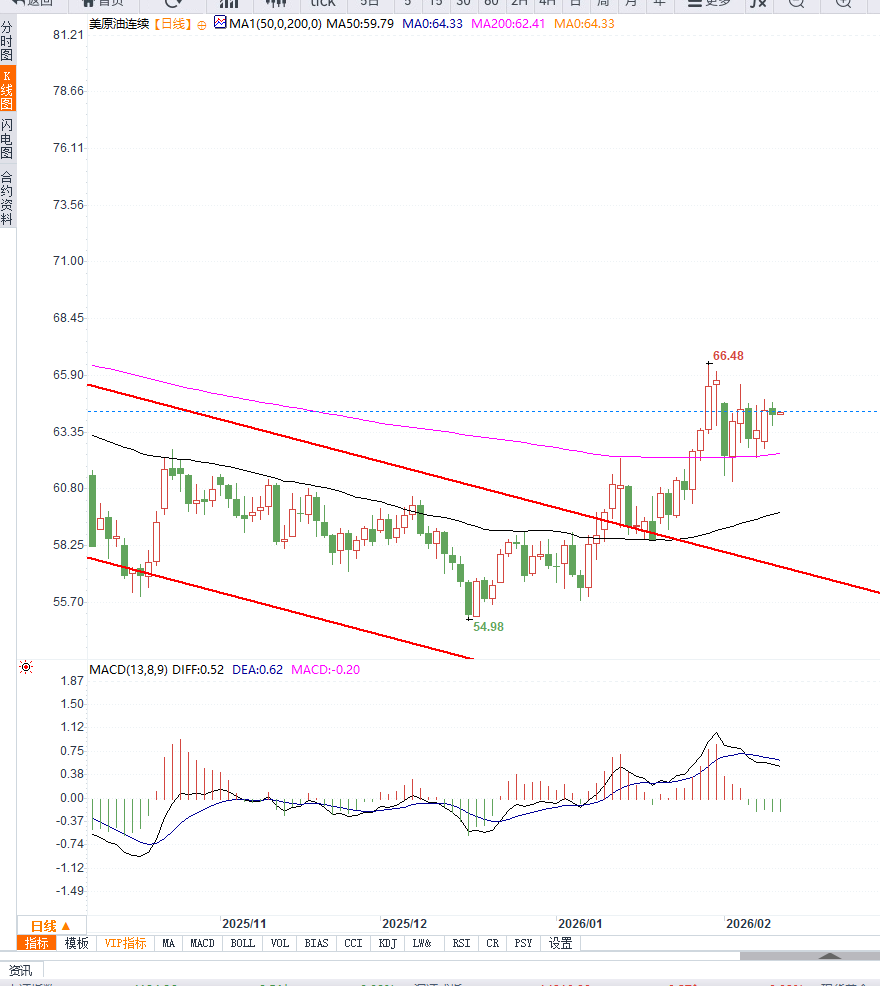
From the daily chart, WTI crude oil is currently in a consolidation phase. After a previous rebound, the price showed clear signs of stalling around $64, and momentum indicators are gradually flattening, indicating that bullish momentum has weakened.
The moving average system is beginning to flatten, and the short-term trend has shifted from a one-sided upward movement to sideways consolidation. Technically, the $66.50 to $67.20 area constitutes a recent zone of dense trading resistance; if the price fails to break through this range effectively, upward momentum will remain limited.
The key resistance level is around $69, which is the previous high area. A break above this level could reopen upside potential. On the downside, $62.80 is a key short-term support level, which coincides with the recent low and the moving average area.
If the price breaks below this level, it may retest the $60 psychological level. $60 is not only a psychological support level but also a significant consolidation platform from the previous period; a breach of this level could trigger a larger correction.
Overall, the current technical structure exhibits characteristics of high-level consolidation, with bullish and bearish forces in a rebalancing phase. Until a directional breakout occurs in fundamental news, prices are likely to continue trading within a range.
Editor's Note:
The current volatility in the oil market stems from the repeated adjustments in risk premiums. Alternating signals of diplomatic optimism and military deployments cause market sentiment to shift rapidly in a short period. Short-term price movements are more driven by news than by substantial changes in supply and demand fundamentals.
In the medium term, whether oil prices can remain above $60 depends on two major variables: first, whether the US-Iran negotiations achieve substantial results; and second, whether the shipping risks in the Strait of Hormuz truly escalate. If the situation eases, the geopolitical premium will gradually decline; if there are signs of escalating conflict, the oil price fluctuation range may shift further upward.
The energy sector weakened across the board, indicating overall pressure on risk assets. Meanwhile, natural gas futures retreated due to anticipated lower heating demand as spring approaches in many parts of the US, exacerbating the overall bearish sentiment in the energy market.
The core variable in this round of oil price fluctuations remains the uncertainty surrounding the situation in the Middle East. Oman stated that constructive progress had been made in talks between the US and Iran, a statement that briefly eased market concerns about supply disruptions, causing oil prices to subsequently fall.
However, subsequent reports indicated that the US might consider sending a second carrier strike group to the Middle East if negotiations failed. This news quickly increased risk premiums, and oil prices recovered some of their losses in a short period. Trump stated, "If the negotiations fail, we will consider further military deployments. But I still believe there is a possibility of reaching an agreement."
Meanwhile, US officials confirmed that relevant military plans were indeed being discussed. The parallel approach of diplomacy and military preparations made it difficult for the market to form a clear direction, causing oil prices to fluctuate amidst conflicting information.
Furthermore, the U.S. Energy Information Administration pointed out that disruptions to shipping through the Strait of Hormuz would be a significant uncertainty for global supply this year. As a vital global oil transportation route, a substantial disruption would directly impact the supply chain.
Although no actual disruptions have yet occurred, the risk premium is already partially reflected in the price structure. From a medium-term fundamental perspective, the EIA raised its 2026 oil price forecast in its latest Short-Term Energy Outlook, while slightly lowering its 2027 price forecast.
This structural adjustment reflects an assessment of a temporary supply shortage, but also indicates a cautious stance on long-term demand and the release of new production capacity. Current WTI prices are significantly higher than institutional average price forecasts for the next two years, suggesting that geopolitical risk premiums still play a significant role.
At the macro level, the weakening of risk assets has dampened risk appetite and indirectly put downward pressure on oil prices. In the absence of clear geopolitical signals, market sentiment fluctuations have become the dominant force.
From the daily chart, WTI crude oil is currently in a consolidation phase. After a previous rebound, the price showed clear signs of stalling around $64, and momentum indicators are gradually flattening, indicating that bullish momentum has weakened.
The moving average system is beginning to flatten, and the short-term trend has shifted from a one-sided upward movement to sideways consolidation. Technically, the $66.50 to $67.20 area constitutes a recent zone of dense trading resistance; if the price fails to break through this range effectively, upward momentum will remain limited.
The key resistance level is around $69, which is the previous high area. A break above this level could reopen upside potential. On the downside, $62.80 is a key short-term support level, which coincides with the recent low and the moving average area.
If the price breaks below this level, it may retest the $60 psychological level. $60 is not only a psychological support level but also a significant consolidation platform from the previous period; a breach of this level could trigger a larger correction.
Overall, the current technical structure exhibits characteristics of high-level consolidation, with bullish and bearish forces in a rebalancing phase. Until a directional breakout occurs in fundamental news, prices are likely to continue trading within a range.
Editor's Note:
The current volatility in the oil market stems from the repeated adjustments in risk premiums. Alternating signals of diplomatic optimism and military deployments cause market sentiment to shift rapidly in a short period. Short-term price movements are more driven by news than by substantial changes in supply and demand fundamentals.
In the medium term, whether oil prices can remain above $60 depends on two major variables: first, whether the US-Iran negotiations achieve substantial results; and second, whether the shipping risks in the Strait of Hormuz truly escalate. If the situation eases, the geopolitical premium will gradually decline; if there are signs of escalating conflict, the oil price fluctuation range may shift further upward.
- Risk Warning and Disclaimer
- The market involves risk, and trading may not be suitable for all investors. This article is for reference only and does not constitute personal investment advice, nor does it take into account certain users’ specific investment objectives, financial situation, or other needs. Any investment decisions made based on this information are at your own risk.