The expectation of a Federal Reserve rate cut, coupled with the hawkish stance of the Bank of Japan, caused USD/JPY to fall below the 154 level.
2026-02-11 10:15:34
On Wednesday during the Asian session, USD/JPY continued to trade under pressure, remaining below 154.00 and extending the significant decline of the past two trading days. Although market trading was cautious, the overall trend remained downward.
Market focus is on the upcoming US January non-farm payrolls report. This data was delayed due to the partial federal government shutdown. The market expects 70,000 new jobs to be added in January, with the unemployment rate remaining at 4.4%.
Meanwhile, average wage data will also serve as an important reference indicator for judging inflationary pressures and policy direction. The results of employment data will directly influence market judgments about the Federal Reserve's policy path.

Strong employment data could weaken expectations of interest rate cuts, thus providing temporary support for the dollar; weaker data could strengthen bets on further interest rate cuts this year, putting continued pressure on the dollar.
The market widely expects the Federal Reserve to implement two more interest rate cuts this year, and coupled with some investors' concerns about the Fed's policy independence, the US dollar index has remained near its lowest level in over a week. This is a significant factor contributing to the recent continued weakness of the USD/JPY pair.
Meanwhile, policy expectations in Japan present a stark contrast. The market believes that Prime Minister Sanae Takaichi's expansionary policies are likely to stimulate economic activity and provide room for the Bank of Japan to maintain a relatively hawkish stance.
Policy divergence expectations supported the yen's performance, giving USD/JPY bears the upper hand. Furthermore, market concerns that Japanese authorities might intervene in the foreign exchange market to support the yen if necessary also limited the upside potential of the USD/JPY pair.
The area around 154 was previously considered a sensitive zone, and a significant depreciation in the exchange rate could reignite the risk of intervention. Overall, the fundamental structure indicates that the US dollar lacks significant upward momentum in the short term, while the Japanese yen remains relatively strong, supported by both policy and intervention expectations, and faces relatively less resistance on its downward path.
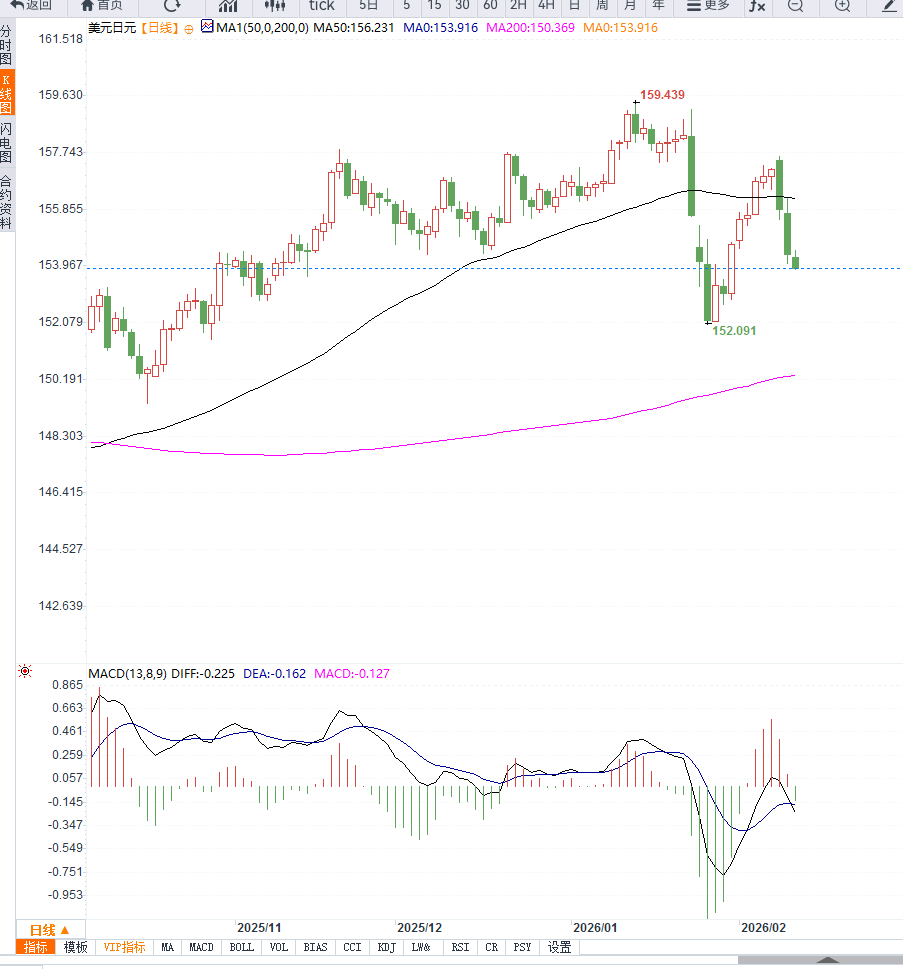
From a daily chart perspective, USD/JPY has declined significantly for two consecutive trading days, indicating a weakening short-term trend. The price has broken below short-term moving average support, and the moving average system has begun to turn downwards, suggesting increasing bearish momentum. The psychological level of 154.00 has become a key dividing line.
If the exchange rate continues to trade below this level and a valid break below it is confirmed, it may further decline towards the 152.80 area, which is the previous consolidation low. Meanwhile, the 152.00 level forms a stronger support level; a break below this level would open up further downside potential.
On the upside, the 154.80-155.00 range is the first short-term resistance area. If the rebound is blocked here, the downtrend will continue. Stronger resistance is located around 156.00, which is a previous high and a dense area of moving averages.
From a momentum perspective, there are no clear signs of divergence in short-term downward momentum, and the trend remains bearish. However, if the non-farm payroll data is unexpectedly strong, a technical rebound is possible. Overall, as long as the exchange rate cannot regain a foothold above 155, the short-term structure will remain dominated by a downward trend.
Editor's Note:
The current USD/JPY exchange rate movement reflects a typical divergence in policy expectations: expectations of a Federal Reserve rate cut are increasing, while the Bank of Japan maintains a hawkish stance, gradually shifting the interest rate advantage towards the yen. In the short term, the non-farm payroll report will be a key variable determining the direction of the US dollar.
Even if a short-term rebound occurs, the upside potential for the exchange rate may remain limited if the Federal Reserve's easing path does not fundamentally change. Until a significant reversal in the fundamental structure occurs, the medium- to short-term risks for USD/JPY remain skewed to the downside. Closely monitor whether the 154 level is effectively broken, and any changes in the Japanese authorities' policy stance regarding exchange rate fluctuations.
Market focus is on the upcoming US January non-farm payrolls report. This data was delayed due to the partial federal government shutdown. The market expects 70,000 new jobs to be added in January, with the unemployment rate remaining at 4.4%.
Meanwhile, average wage data will also serve as an important reference indicator for judging inflationary pressures and policy direction. The results of employment data will directly influence market judgments about the Federal Reserve's policy path.
Strong employment data could weaken expectations of interest rate cuts, thus providing temporary support for the dollar; weaker data could strengthen bets on further interest rate cuts this year, putting continued pressure on the dollar.
The market widely expects the Federal Reserve to implement two more interest rate cuts this year, and coupled with some investors' concerns about the Fed's policy independence, the US dollar index has remained near its lowest level in over a week. This is a significant factor contributing to the recent continued weakness of the USD/JPY pair.
Meanwhile, policy expectations in Japan present a stark contrast. The market believes that Prime Minister Sanae Takaichi's expansionary policies are likely to stimulate economic activity and provide room for the Bank of Japan to maintain a relatively hawkish stance.
Policy divergence expectations supported the yen's performance, giving USD/JPY bears the upper hand. Furthermore, market concerns that Japanese authorities might intervene in the foreign exchange market to support the yen if necessary also limited the upside potential of the USD/JPY pair.
The area around 154 was previously considered a sensitive zone, and a significant depreciation in the exchange rate could reignite the risk of intervention. Overall, the fundamental structure indicates that the US dollar lacks significant upward momentum in the short term, while the Japanese yen remains relatively strong, supported by both policy and intervention expectations, and faces relatively less resistance on its downward path.
From a daily chart perspective, USD/JPY has declined significantly for two consecutive trading days, indicating a weakening short-term trend. The price has broken below short-term moving average support, and the moving average system has begun to turn downwards, suggesting increasing bearish momentum. The psychological level of 154.00 has become a key dividing line.
If the exchange rate continues to trade below this level and a valid break below it is confirmed, it may further decline towards the 152.80 area, which is the previous consolidation low. Meanwhile, the 152.00 level forms a stronger support level; a break below this level would open up further downside potential.
On the upside, the 154.80-155.00 range is the first short-term resistance area. If the rebound is blocked here, the downtrend will continue. Stronger resistance is located around 156.00, which is a previous high and a dense area of moving averages.
From a momentum perspective, there are no clear signs of divergence in short-term downward momentum, and the trend remains bearish. However, if the non-farm payroll data is unexpectedly strong, a technical rebound is possible. Overall, as long as the exchange rate cannot regain a foothold above 155, the short-term structure will remain dominated by a downward trend.
Editor's Note:
The current USD/JPY exchange rate movement reflects a typical divergence in policy expectations: expectations of a Federal Reserve rate cut are increasing, while the Bank of Japan maintains a hawkish stance, gradually shifting the interest rate advantage towards the yen. In the short term, the non-farm payroll report will be a key variable determining the direction of the US dollar.
Even if a short-term rebound occurs, the upside potential for the exchange rate may remain limited if the Federal Reserve's easing path does not fundamentally change. Until a significant reversal in the fundamental structure occurs, the medium- to short-term risks for USD/JPY remain skewed to the downside. Closely monitor whether the 154 level is effectively broken, and any changes in the Japanese authorities' policy stance regarding exchange rate fluctuations.
- Risk Warning and Disclaimer
- The market involves risk, and trading may not be suitable for all investors. This article is for reference only and does not constitute personal investment advice, nor does it take into account certain users’ specific investment objectives, financial situation, or other needs. Any investment decisions made based on this information are at your own risk.