Australian Dollar Outlook: Hawkish comments from the Reserve Bank of Australia coupled with heightened risk appetite have led to a significant strengthening of the Australian dollar.
2026-02-11 18:41:43
On Wednesday (February 11), the Australian dollar rose strongly against the US dollar during the European session, boosted by hawkish comments from the Reserve Bank of Australia and improved risk appetite. It traded at 0.7109/10, up 0.49%. Tonight's US non-farm payroll data will be key to determining whether it can continue its upward trend.
Hawkish comments from the Reserve Bank of Australia's deputy governor, coupled with heightened market risk appetite and a generally weaker US dollar, pushed the Australian dollar to a new multi-year high against the US dollar ahead of key US employment data releases. Technically, the upward trend remains the primary direction, and if market expectations of a significant slowdown in US non-farm payrolls materialize, the Australian dollar could see further upside potential.
Inflation risks remain, and the Reserve Bank of Australia reiterates its hawkish stance.
Speaking at a business luncheon in Sydney, Reserve Bank of Australia Deputy Governor Andrew Hauser reinforced the message sent by last week's rate hike: current inflation levels remain too high and cannot be allowed to continue.
He emphasized the issue of domestic production capacity constraints, which is also the core focus of the market. Consistent with the Reserve Bank of Australia's policy shift in February, the authorities have regarded production capacity constraints as an inflation driver rather than a simple risk. This further confirms that if inflationary pressures do not subside, the Fed is prepared to continue raising interest rates.
Following Hauser's remarks, the yield spread between Australian and US two-year government bonds approached last week's high again, with the Australian dollar's yield advantage reaching its largest level since the end of 2016.
The market expects the Reserve Bank of Australia to raise interest rates at least once more this year, while the Federal Reserve is expected to cut rates at least twice during the same period. This difference in expectations has directly driven the Australian dollar higher.
The Australian dollar rose, driven by both risk appetite and interest rate differentials.
The chart below clearly shows the correlation between the Australian dollar and the US dollar and several market indicators over the past week and month:
The correlation between short-term interest rate differentials and the Australian dollar is as high as 0.75 and 0.87 respectively, indicating a very strong linkage.
Meanwhile, market risk appetite has surged, with the correlation coefficient between the Australian dollar and the US dollar, as well as gold, silver, and Nasdaq 100 futures, ranging from 0.95 to 0.97 over the past week, indicating a high degree of synchronization. The strengthening of other Asian currencies has also provided support for the Australian dollar.
The upcoming US non-farm payrolls report and multiple expectations are causing market volatility.
While the logic supporting the surge in the Australian dollar is clear, the upcoming US January non-farm payroll data (including downward revisions to previous data) will pose the ultimate test to risk sentiment and the weakness of the US dollar.
This week, Kevin Hassett, a senior White House economic official and director of the National Economic Council, warned that job growth might slow, triggering market expectations of weak data.
Hassett argues that the weakening employment data resulting from slower population growth and increased productivity should not be interpreted as a deterioration in the economy's endogenous growth momentum.
Some market participants viewed this statement as pre-data expectation management, which contributed to a weaker dollar and increased market expectations for a Fed rate cut.
Federal Reserve funds futures are currently pricing in a 58-basis-point rate cut in 2026, implying at least two 25-basis-point cuts and a roughly one-third probability of a third cut; just a week ago, the market expected a cut of less than 46 basis points. Hassett's speech, coupled with weak retail sales and wage data, has collectively fueled expectations of a dovish shift in the Fed's stance.
The market generally expects non-farm payrolls to increase by 70,000, but following Hassett's remarks, unofficial estimates suggest an even lower figure. The unemployment rate is projected to remain stable at 4.4%, providing a more accurate reflection of the labor market situation. While downward revisions to the non-farm payroll data for the 12 months ending March 2025 may attract attention, their relevance to the latest trends remains debatable.
If the data is better than expected: the US dollar is likely to rebound slightly.
If the data falls short of expectations: cyclical currencies such as the Australian dollar are likely to rise further.
Extremely weak data could reignite global economic concerns, suppress risk appetite, and consequently drag down the Australian dollar's performance against currencies such as the US dollar, Japanese yen, and euro.
Technical Analysis: The Australian dollar remains bullish against the US dollar in the short term.
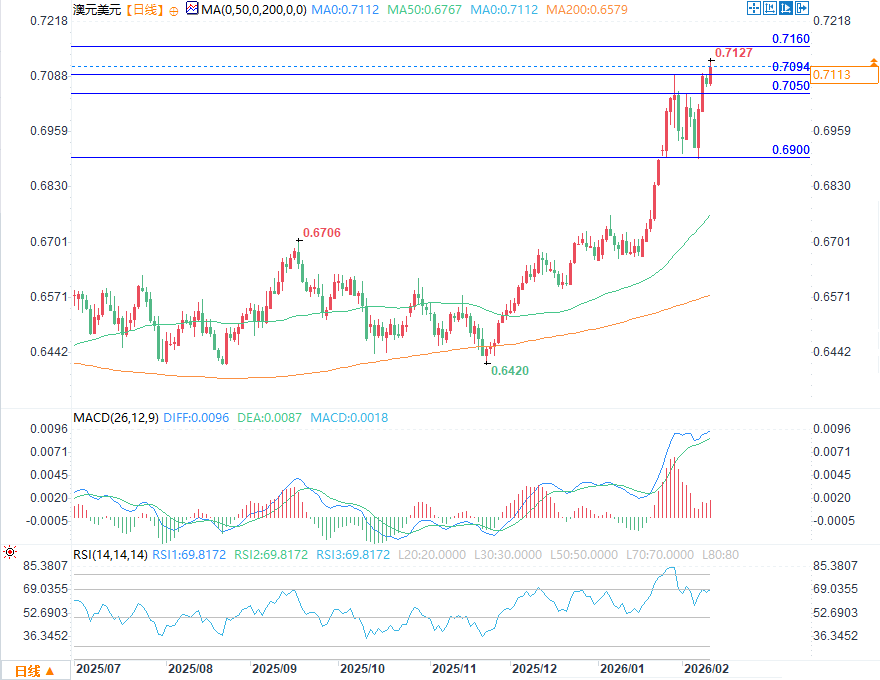
(AUD/USD daily chart source: FX678)
On the daily chart, influenced by Hauser's hawkish remarks and the continued strengthening of the yen, the Australian dollar has effectively broken through the January high of 0.7094 against the US dollar and is now approaching the February 2023 high of 0.7160.
If the price breaks through this level, the next target is the June 2022 high of 0.7282.
The first support level to watch is 0.7094, followed by 0.7050, with stronger support around 0.6900.
While it remains to be seen whether the Relative Strength Index (RSI14) can reach a new high, the overall oscillator is still bullish, and the short-term bias is towards going long rather than short.
Hawkish comments from the Reserve Bank of Australia's deputy governor, coupled with heightened market risk appetite and a generally weaker US dollar, pushed the Australian dollar to a new multi-year high against the US dollar ahead of key US employment data releases. Technically, the upward trend remains the primary direction, and if market expectations of a significant slowdown in US non-farm payrolls materialize, the Australian dollar could see further upside potential.
Inflation risks remain, and the Reserve Bank of Australia reiterates its hawkish stance.
Speaking at a business luncheon in Sydney, Reserve Bank of Australia Deputy Governor Andrew Hauser reinforced the message sent by last week's rate hike: current inflation levels remain too high and cannot be allowed to continue.
He emphasized the issue of domestic production capacity constraints, which is also the core focus of the market. Consistent with the Reserve Bank of Australia's policy shift in February, the authorities have regarded production capacity constraints as an inflation driver rather than a simple risk. This further confirms that if inflationary pressures do not subside, the Fed is prepared to continue raising interest rates.
Following Hauser's remarks, the yield spread between Australian and US two-year government bonds approached last week's high again, with the Australian dollar's yield advantage reaching its largest level since the end of 2016.
The market expects the Reserve Bank of Australia to raise interest rates at least once more this year, while the Federal Reserve is expected to cut rates at least twice during the same period. This difference in expectations has directly driven the Australian dollar higher.
The Australian dollar rose, driven by both risk appetite and interest rate differentials.
The chart below clearly shows the correlation between the Australian dollar and the US dollar and several market indicators over the past week and month:
The correlation between short-term interest rate differentials and the Australian dollar is as high as 0.75 and 0.87 respectively, indicating a very strong linkage.
Meanwhile, market risk appetite has surged, with the correlation coefficient between the Australian dollar and the US dollar, as well as gold, silver, and Nasdaq 100 futures, ranging from 0.95 to 0.97 over the past week, indicating a high degree of synchronization. The strengthening of other Asian currencies has also provided support for the Australian dollar.
The upcoming US non-farm payrolls report and multiple expectations are causing market volatility.
While the logic supporting the surge in the Australian dollar is clear, the upcoming US January non-farm payroll data (including downward revisions to previous data) will pose the ultimate test to risk sentiment and the weakness of the US dollar.
This week, Kevin Hassett, a senior White House economic official and director of the National Economic Council, warned that job growth might slow, triggering market expectations of weak data.
Hassett argues that the weakening employment data resulting from slower population growth and increased productivity should not be interpreted as a deterioration in the economy's endogenous growth momentum.
Some market participants viewed this statement as pre-data expectation management, which contributed to a weaker dollar and increased market expectations for a Fed rate cut.
Federal Reserve funds futures are currently pricing in a 58-basis-point rate cut in 2026, implying at least two 25-basis-point cuts and a roughly one-third probability of a third cut; just a week ago, the market expected a cut of less than 46 basis points. Hassett's speech, coupled with weak retail sales and wage data, has collectively fueled expectations of a dovish shift in the Fed's stance.
The market generally expects non-farm payrolls to increase by 70,000, but following Hassett's remarks, unofficial estimates suggest an even lower figure. The unemployment rate is projected to remain stable at 4.4%, providing a more accurate reflection of the labor market situation. While downward revisions to the non-farm payroll data for the 12 months ending March 2025 may attract attention, their relevance to the latest trends remains debatable.
If the data is better than expected: the US dollar is likely to rebound slightly.
If the data falls short of expectations: cyclical currencies such as the Australian dollar are likely to rise further.
Extremely weak data could reignite global economic concerns, suppress risk appetite, and consequently drag down the Australian dollar's performance against currencies such as the US dollar, Japanese yen, and euro.
Technical Analysis: The Australian dollar remains bullish against the US dollar in the short term.
(AUD/USD daily chart source: FX678)
On the daily chart, influenced by Hauser's hawkish remarks and the continued strengthening of the yen, the Australian dollar has effectively broken through the January high of 0.7094 against the US dollar and is now approaching the February 2023 high of 0.7160.
If the price breaks through this level, the next target is the June 2022 high of 0.7282.
The first support level to watch is 0.7094, followed by 0.7050, with stronger support around 0.6900.
While it remains to be seen whether the Relative Strength Index (RSI14) can reach a new high, the overall oscillator is still bullish, and the short-term bias is towards going long rather than short.
- Risk Warning and Disclaimer
- The market involves risk, and trading may not be suitable for all investors. This article is for reference only and does not constitute personal investment advice, nor does it take into account certain users’ specific investment objectives, financial situation, or other needs. Any investment decisions made based on this information are at your own risk.