Geopolitical nuclear weapons and employment data storm send gold prices slashing through $5100, shocking the market.
2026-02-11 20:32:58
On Wednesday (February 11), spot gold saw a rapid rise during the European session. Gold prices had been consolidating above 5,000 points recently and had just attempted to break through the 5,100 mark, currently trading at $5,107.9 per ounce.
The market is currently pricing in bad news from US data and potential US action against Iran, while awaiting the US non-farm payrolls report.
The recent surge in gold prices is mainly due to the market's pessimistic pricing of US economic data, escalating uncertainty in the US-Iran geopolitical situation, and the market's anticipation of the delayed US non-farm payroll data, which will become a key indicator for the gold market in the short term.
Due to the disruption to data release schedule caused by the federal government shutdown, the U.S. Bureau of Labor Statistics (BLS) will release January hiring data and the baseline revision for employment data in 2025 simultaneously at 8:30 a.m. Eastern Time today.
This rare "double disclosure" model will significantly enhance the data's sensitivity to the market and its volatility transmission effect, becoming a core variable that influences the short-term direction of gold prices. However, since BLS mentioned a downward revision of 900,000 for the whole year last September, and the overall non-farm payroll data is running at a low level, the main focus of observation is still the unemployment rate, and whether the unemployment rate will break through the key threshold of 4.4%.
The US-Iran situation is characterized by a combination of negotiations and military deterrence, continuing to provide safe-haven support for gold.
Military pressure escalates: Trump stated on Tuesday that he is considering sending a second aircraft carrier to the Middle East to strengthen military pressure on Iran; the US military has already deployed a carrier strike group in the Persian Gulf, and there are signs of war preparations at the base in Qatar. Trump warned that he would take "very tough measures" if negotiations fail.
Negotiations have resumed but significant differences remain: Under Oman's mediation, the US and Iran have restarted negotiations. Iran says the talks pave the way for further consultations, but it insists on its core demands, such as lifting sanctions and the right to enrich uranium. The US is trying to include its ballistic missile program in the negotiations, but Iran has explicitly rejected the topic. The two sides have significant differences on key issues such as lifting sanctions and regional security arrangements.
Potential action is limited: The U.S. government has discussed detaining more Iranian oil tankers, but has not yet taken action due to concerns about Iranian retaliation and the impact on the global oil market.
In addition, Israeli Prime Minister Netanyahu plans to meet with Trump on Wednesday in an attempt to push for an agreement to limit Iran's missile program, further complicating the geopolitical situation.
The US bond and currency markets had already reacted before the non-farm payroll data was released: the 10-year US Treasury yield fell 1.2 basis points to 4.132%, and the US dollar index fell 0.19% to 96.67.
The market generally expects that if January's employment data shows weakness again, it will further strengthen expectations of a Federal Reserve rate cut.
Against the backdrop of recent weaker-than-expected retail data, any additional signs of weakness will push the Federal Reserve closer to cutting interest rates.
If inflation data remains moderate this Friday, the market may further advance its pricing of a policy shift, with traders already positioning themselves for potential economic slowdown signals.
Gold prices are currently maintaining a strong trend, primarily due to three key support levels:
Easing expectations provide a floor: The market has priced in the Fed's policy shift in advance. Under the expectation of easing, the dollar and US Treasury yields are under pressure, providing valuation support for non-interest-bearing assets such as gold. Some institutions even believe that there is a chance of an interest rate cut before June.
Central bank gold purchases stabilize prices: Central banks around the world continue to purchase gold, which has become a "ballast" for the long-term rise in gold prices.
Geopolitical risks are a catalyst: Uncertainty persists in the global geopolitical landscape, and various risk events continue to catalyze the safe-haven demand for gold.
In the long run, the trend of global central banks increasing their gold holdings remains unchanged. Coupled with rising market concerns about global debt issues and geopolitical situations, as well as the White House's intervention in the Federal Reserve, it is only a matter of time before gold prices rise further.
Currently, all the news is good for gold, so the price of gold has continued to rebound to the key level of 5100. 5125 is the most critical watershed between bulls and bears in the near term, and it is the point that determines whether this rebound has a chance to reverse.
Currently, gold prices are pricing in the negative impact of the non-farm payroll data release. However, unless the unemployment rate falls below 4.4%, there is a high probability that the negative impact will be fully priced in, and gold will reach a short-term high. However, there are several points in the non-farm payroll data that could exceed expectations. If these unexpected events occur, gold prices will still have significant upward potential before the negative impact is fully priced in.
However, in the medium to long term, geopolitical tensions have not subsided, and the White House's intervention in the Federal Reserve is negative for the dollar. After consolidation, gold prices still have ample reason to rise, and it is still worthwhile to invest in gold.
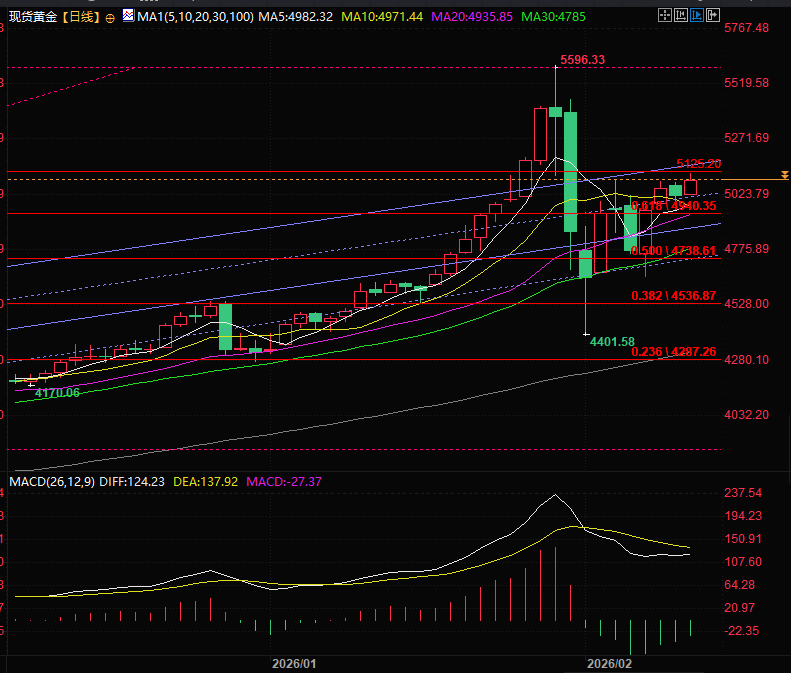
(Spot gold daily chart, source: FX678)
At 20:28 Beijing time, spot gold was trading at $5096.5 per ounce.
The market is currently pricing in bad news from US data and potential US action against Iran, while awaiting the US non-farm payrolls report.
The recent surge in gold prices is mainly due to the market's pessimistic pricing of US economic data, escalating uncertainty in the US-Iran geopolitical situation, and the market's anticipation of the delayed US non-farm payroll data, which will become a key indicator for the gold market in the short term.
Major Event: "Double Disclosure" Non-Farm Payrolls Report May Amplify Short-Term Volatility
Due to the disruption to data release schedule caused by the federal government shutdown, the U.S. Bureau of Labor Statistics (BLS) will release January hiring data and the baseline revision for employment data in 2025 simultaneously at 8:30 a.m. Eastern Time today.
This rare "double disclosure" model will significantly enhance the data's sensitivity to the market and its volatility transmission effect, becoming a core variable that influences the short-term direction of gold prices. However, since BLS mentioned a downward revision of 900,000 for the whole year last September, and the overall non-farm payroll data is running at a low level, the main focus of observation is still the unemployment rate, and whether the unemployment rate will break through the key threshold of 4.4%.
Geopolitical game: US and Iran engage in talks while exerting pressure, leading to a continued rise in safe-haven demand.
The US-Iran situation is characterized by a combination of negotiations and military deterrence, continuing to provide safe-haven support for gold.
Military pressure escalates: Trump stated on Tuesday that he is considering sending a second aircraft carrier to the Middle East to strengthen military pressure on Iran; the US military has already deployed a carrier strike group in the Persian Gulf, and there are signs of war preparations at the base in Qatar. Trump warned that he would take "very tough measures" if negotiations fail.
Negotiations have resumed but significant differences remain: Under Oman's mediation, the US and Iran have restarted negotiations. Iran says the talks pave the way for further consultations, but it insists on its core demands, such as lifting sanctions and the right to enrich uranium. The US is trying to include its ballistic missile program in the negotiations, but Iran has explicitly rejected the topic. The two sides have significant differences on key issues such as lifting sanctions and regional security arrangements.
Potential action is limited: The U.S. government has discussed detaining more Iranian oil tankers, but has not yet taken action due to concerns about Iranian retaliation and the impact on the global oil market.
In addition, Israeli Prime Minister Netanyahu plans to meet with Trump on Wednesday in an attempt to push for an agreement to limit Iran's missile program, further complicating the geopolitical situation.
Market Outlook: A weakening US dollar and weak US Treasury bonds reinforce expectations of further interest rate cuts.
The US bond and currency markets had already reacted before the non-farm payroll data was released: the 10-year US Treasury yield fell 1.2 basis points to 4.132%, and the US dollar index fell 0.19% to 96.67.
The market generally expects that if January's employment data shows weakness again, it will further strengthen expectations of a Federal Reserve rate cut.
Against the backdrop of recent weaker-than-expected retail data, any additional signs of weakness will push the Federal Reserve closer to cutting interest rates.
If inflation data remains moderate this Friday, the market may further advance its pricing of a policy shift, with traders already positioning themselves for potential economic slowdown signals.
Gold Price Core Support: Three Factors Solidify the Bullish Foundation
Gold prices are currently maintaining a strong trend, primarily due to three key support levels:
Easing expectations provide a floor: The market has priced in the Fed's policy shift in advance. Under the expectation of easing, the dollar and US Treasury yields are under pressure, providing valuation support for non-interest-bearing assets such as gold. Some institutions even believe that there is a chance of an interest rate cut before June.
Central bank gold purchases stabilize prices: Central banks around the world continue to purchase gold, which has become a "ballast" for the long-term rise in gold prices.
Geopolitical risks are a catalyst: Uncertainty persists in the global geopolitical landscape, and various risk events continue to catalyze the safe-haven demand for gold.
In the long run, the trend of global central banks increasing their gold holdings remains unchanged. Coupled with rising market concerns about global debt issues and geopolitical situations, as well as the White House's intervention in the Federal Reserve, it is only a matter of time before gold prices rise further.
Summary and Technical Analysis:
Currently, all the news is good for gold, so the price of gold has continued to rebound to the key level of 5100. 5125 is the most critical watershed between bulls and bears in the near term, and it is the point that determines whether this rebound has a chance to reverse.
Currently, gold prices are pricing in the negative impact of the non-farm payroll data release. However, unless the unemployment rate falls below 4.4%, there is a high probability that the negative impact will be fully priced in, and gold will reach a short-term high. However, there are several points in the non-farm payroll data that could exceed expectations. If these unexpected events occur, gold prices will still have significant upward potential before the negative impact is fully priced in.
However, in the medium to long term, geopolitical tensions have not subsided, and the White House's intervention in the Federal Reserve is negative for the dollar. After consolidation, gold prices still have ample reason to rise, and it is still worthwhile to invest in gold.
(Spot gold daily chart, source: FX678)
At 20:28 Beijing time, spot gold was trading at $5096.5 per ounce.
- Risk Warning and Disclaimer
- The market involves risk, and trading may not be suitable for all investors. This article is for reference only and does not constitute personal investment advice, nor does it take into account certain users’ specific investment objectives, financial situation, or other needs. Any investment decisions made based on this information are at your own risk.