Uncertainty surrounding the situation in Iran, coupled with increased demand from India, drove crude oil futures higher.
2026-02-11 19:09:53
On Wednesday (February 11), West Texas Intermediate (WTI) crude oil futures prices rose slightly during the US trading session, primarily supported by two key factors: escalating geopolitical risks in the Middle East and a significant rebound in demand from India, a major Asian oil importer. In particular, the failure of the US and Iran to reach an agreement on their core differences after three days of intensive negotiations resulted in no substantial progress, directly boosting market risk aversion and risk premiums.

At the same time, traders have also reacted positively to signals that the market's oversupply situation may ease, mainly due to strong growth in Indian crude oil demand. Recently, India and the United States formally reached an important trade agreement, the implementation of which has significantly boosted India's domestic industrial production and energy consumption, thereby driving a substantial increase in its crude oil imports and injecting important momentum into global crude oil demand.
At 18:50 Beijing time, the March West Texas Intermediate crude oil futures contract was trading at $64.82 per barrel, up $0.86 from the previous trading day, a gain of 1.34%, showing a clear trend of stabilization and recovery.
The risk premium in the Strait of Hormuz still exists.
Current crude oil prices remain supported by bullish tail risks, primarily because while US-Iran negotiations are progressing, the overall process is extremely fragile, lacking a clear consensus and action framework. Meanwhile, international sanctions pressure against Iran persists, the threat of tariffs related to Iranian trade remains unresolved, and the escalating US military presence in the Middle East, combined with these factors, have allowed the risk premium associated with the Strait of Hormuz to persist, making it difficult for the market to absorb.
Judging from current price trends, global crude oil traders are in a wait-and-see mode, generally awaiting a clear framework agreement between the US and Iran to alleviate market uncertainty. However, as of now, negotiations between the two countries remain at the preliminary consultation stage without any breakthrough progress. This unresolved situation has further exacerbated traders' anxieties and made it difficult for market risk premiums to decline.
According to reports, an Iranian Foreign Ministry spokesperson stated at a regular press conference on Tuesday that the nuclear negotiations with the United States were of positive significance. Through these negotiations, Tehran was able to fully assess Washington's sincerity on the nuclear issue, and the two sides also reached sufficient consensus, laying the foundation for further diplomatic negotiations.
Iran's statement was unexpected. The United States' previous deployment of a naval fleet to waters near Iran was enough to demonstrate its serious attitude on the issue, and in theory, the two sides should have been able to make more progress on the core issues.
Mixed signals, persistently high market uncertainty
It is worth noting that the various signals recently released from the Middle East present a distinctly mixed picture, failing to alleviate market uncertainty and instead further exacerbating investor caution. On the one hand, Oman's Foreign Minister stated in a media interview that the negotiations between the US and Iran have been generally fruitful, with both sides demonstrating a pragmatic negotiating attitude, and a consensus is expected to be reached later. On the other hand, ANZ analysts pointed out that reliable sources indicate the US may soon deploy a second aircraft carrier to the Middle East to further strengthen its military presence in the region and respond to potential contingencies.
These conflicting signals have further increased uncertainty in the global crude oil market, making traders hesitant to build large positions and forcing them to maintain cautious trading strategies. This has limited the extent of oil price increases to some extent, but it has also held up the support level provided by geopolitical risks.
Strong Indian demand offset the negative impact of rising US crude oil inventories.
On the supply and demand front for crude oil, a series of data released late Tuesday presented a complex picture of mixed signals, failing to provide clear market guidance. From the demand side, the overall outlook is positive, with the most crucial positive factor being the gradual return to normalcy in global maritime crude oil shipping activities. Furthermore, India, as one of the world's major crude oil importers, has recently seen a significant increase in its crude oil purchases. This change has provided strong support for the global crude oil demand market and alleviated market concerns about weak demand.
However, from the supply side, the market remains cautious because the latest inventory data released by the American Petroleum Institute (API) shows a significant increase in U.S. crude oil inventories recently, with a month-on-month increase of 13.4 million barrels. This increase far exceeded market expectations and put some downward pressure on oil prices. However, the market generally believes that the negative impact of this API data may be partially offset by the subsequently released EIA data.
At 15:30 GMT today (23:30 Beijing time), the U.S. Energy Information Administration (EIA) will officially release crude oil inventory data for the week ending February 6. According to market consensus, U.S. crude oil inventories are expected to increase by 800,000 barrels this week, a significant narrowing compared to the increase reported by the API. Meanwhile, distillate fuel inventories are expected to decrease by 1.3 million barrels, and gasoline inventories are expected to decrease by 400,000 barrels. The decline in refined product inventories is expected to partially offset the negative impact of the increase in crude oil inventories, providing some support for oil prices.
Technical Analysis: The uptrend remains intact; closely monitor the trendline support at $64.29.
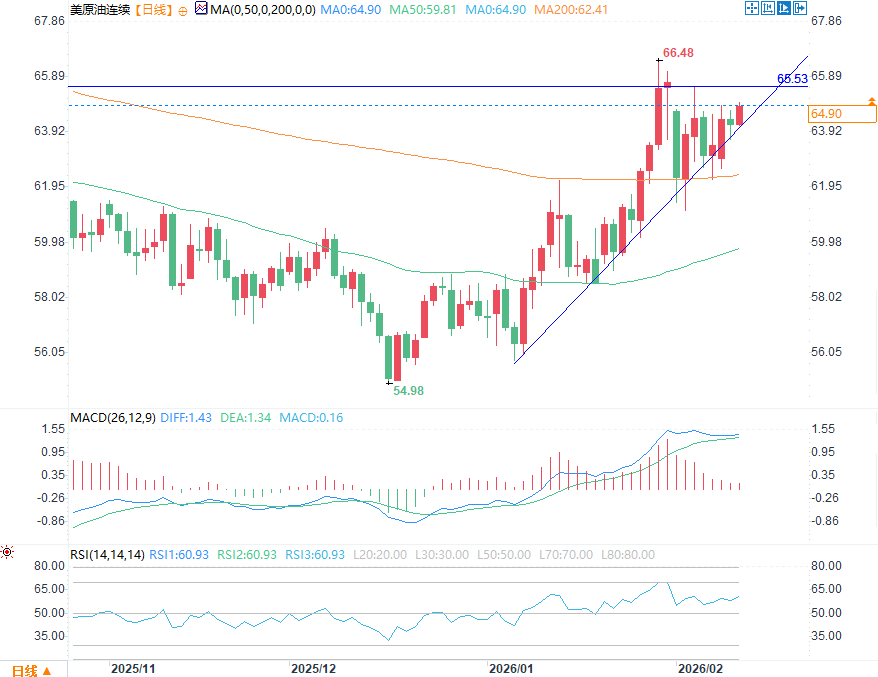
(WTI crude oil daily chart source: FX678)
From a technical perspective, based on a comprehensive assessment of multiple technical indicators such as oscillating charts, trend lines, and moving averages, the main trend of WTI crude oil futures in March is still upward, with a relatively stable overall trend. Although the upward momentum has slowed down, there are no obvious signs of weakening.
Specifically, if oil prices can successfully break through the key resistance level of $65.53 per barrel, it will further activate bullish sentiment in the market and drive the upward trend to strengthen further. The next important target will be the previous high of $66.48 per barrel. If it can successfully break through this high and then stand firmly above the long-term high of $66.48 per barrel, it is expected to trigger a new round of accelerated upward movement, and oil prices may challenge even higher levels.
Regarding support levels, the current trendline support has moved up to $64.29 per barrel, a key level for determining whether the trend will continue. As long as oil prices can hold this support level today and do not break below it, the current upward trend and market momentum will continue, and oil prices still have room to rise further.
From a medium- to long-term support perspective, the 200-day moving average is currently at $62.41 per barrel, and the 50-day moving average is at $59.80 per barrel, providing strong medium- to long-term support for oil prices.
Regarding risk warnings, if oil prices unexpectedly break below the trendline support level of $64.29/barrel, it will be the first clear signal of market weakness, which may trigger some profit-taking. If it further breaks below the short-term pivot point of $63.80/barrel, selling pressure may intensify, and oil prices may fall back to the medium-term support level of $59.80/barrel.
At the same time, traders have also reacted positively to signals that the market's oversupply situation may ease, mainly due to strong growth in Indian crude oil demand. Recently, India and the United States formally reached an important trade agreement, the implementation of which has significantly boosted India's domestic industrial production and energy consumption, thereby driving a substantial increase in its crude oil imports and injecting important momentum into global crude oil demand.
At 18:50 Beijing time, the March West Texas Intermediate crude oil futures contract was trading at $64.82 per barrel, up $0.86 from the previous trading day, a gain of 1.34%, showing a clear trend of stabilization and recovery.
The risk premium in the Strait of Hormuz still exists.
Current crude oil prices remain supported by bullish tail risks, primarily because while US-Iran negotiations are progressing, the overall process is extremely fragile, lacking a clear consensus and action framework. Meanwhile, international sanctions pressure against Iran persists, the threat of tariffs related to Iranian trade remains unresolved, and the escalating US military presence in the Middle East, combined with these factors, have allowed the risk premium associated with the Strait of Hormuz to persist, making it difficult for the market to absorb.
Judging from current price trends, global crude oil traders are in a wait-and-see mode, generally awaiting a clear framework agreement between the US and Iran to alleviate market uncertainty. However, as of now, negotiations between the two countries remain at the preliminary consultation stage without any breakthrough progress. This unresolved situation has further exacerbated traders' anxieties and made it difficult for market risk premiums to decline.
According to reports, an Iranian Foreign Ministry spokesperson stated at a regular press conference on Tuesday that the nuclear negotiations with the United States were of positive significance. Through these negotiations, Tehran was able to fully assess Washington's sincerity on the nuclear issue, and the two sides also reached sufficient consensus, laying the foundation for further diplomatic negotiations.
Iran's statement was unexpected. The United States' previous deployment of a naval fleet to waters near Iran was enough to demonstrate its serious attitude on the issue, and in theory, the two sides should have been able to make more progress on the core issues.
Mixed signals, persistently high market uncertainty
It is worth noting that the various signals recently released from the Middle East present a distinctly mixed picture, failing to alleviate market uncertainty and instead further exacerbating investor caution. On the one hand, Oman's Foreign Minister stated in a media interview that the negotiations between the US and Iran have been generally fruitful, with both sides demonstrating a pragmatic negotiating attitude, and a consensus is expected to be reached later. On the other hand, ANZ analysts pointed out that reliable sources indicate the US may soon deploy a second aircraft carrier to the Middle East to further strengthen its military presence in the region and respond to potential contingencies.
These conflicting signals have further increased uncertainty in the global crude oil market, making traders hesitant to build large positions and forcing them to maintain cautious trading strategies. This has limited the extent of oil price increases to some extent, but it has also held up the support level provided by geopolitical risks.
Strong Indian demand offset the negative impact of rising US crude oil inventories.
On the supply and demand front for crude oil, a series of data released late Tuesday presented a complex picture of mixed signals, failing to provide clear market guidance. From the demand side, the overall outlook is positive, with the most crucial positive factor being the gradual return to normalcy in global maritime crude oil shipping activities. Furthermore, India, as one of the world's major crude oil importers, has recently seen a significant increase in its crude oil purchases. This change has provided strong support for the global crude oil demand market and alleviated market concerns about weak demand.
However, from the supply side, the market remains cautious because the latest inventory data released by the American Petroleum Institute (API) shows a significant increase in U.S. crude oil inventories recently, with a month-on-month increase of 13.4 million barrels. This increase far exceeded market expectations and put some downward pressure on oil prices. However, the market generally believes that the negative impact of this API data may be partially offset by the subsequently released EIA data.
At 15:30 GMT today (23:30 Beijing time), the U.S. Energy Information Administration (EIA) will officially release crude oil inventory data for the week ending February 6. According to market consensus, U.S. crude oil inventories are expected to increase by 800,000 barrels this week, a significant narrowing compared to the increase reported by the API. Meanwhile, distillate fuel inventories are expected to decrease by 1.3 million barrels, and gasoline inventories are expected to decrease by 400,000 barrels. The decline in refined product inventories is expected to partially offset the negative impact of the increase in crude oil inventories, providing some support for oil prices.
Technical Analysis: The uptrend remains intact; closely monitor the trendline support at $64.29.
(WTI crude oil daily chart source: FX678)
From a technical perspective, based on a comprehensive assessment of multiple technical indicators such as oscillating charts, trend lines, and moving averages, the main trend of WTI crude oil futures in March is still upward, with a relatively stable overall trend. Although the upward momentum has slowed down, there are no obvious signs of weakening.
Specifically, if oil prices can successfully break through the key resistance level of $65.53 per barrel, it will further activate bullish sentiment in the market and drive the upward trend to strengthen further. The next important target will be the previous high of $66.48 per barrel. If it can successfully break through this high and then stand firmly above the long-term high of $66.48 per barrel, it is expected to trigger a new round of accelerated upward movement, and oil prices may challenge even higher levels.
Regarding support levels, the current trendline support has moved up to $64.29 per barrel, a key level for determining whether the trend will continue. As long as oil prices can hold this support level today and do not break below it, the current upward trend and market momentum will continue, and oil prices still have room to rise further.
From a medium- to long-term support perspective, the 200-day moving average is currently at $62.41 per barrel, and the 50-day moving average is at $59.80 per barrel, providing strong medium- to long-term support for oil prices.
Regarding risk warnings, if oil prices unexpectedly break below the trendline support level of $64.29/barrel, it will be the first clear signal of market weakness, which may trigger some profit-taking. If it further breaks below the short-term pivot point of $63.80/barrel, selling pressure may intensify, and oil prices may fall back to the medium-term support level of $59.80/barrel.
- Risk Warning and Disclaimer
- The market involves risk, and trading may not be suitable for all investors. This article is for reference only and does not constitute personal investment advice, nor does it take into account certain users’ specific investment objectives, financial situation, or other needs. Any investment decisions made based on this information are at your own risk.