Strong non-farm payrolls data supported the US dollar; short-term volatility will focus on CPI and interest rate expectations.
2026-02-12 10:48:41
The US dollar index (DXY) fluctuated weakly around 96.80 during Thursday's Asian trading session, with limited short-term movement. Key factors recently weighing on the dollar include lower-than-expected December retail sales data and comments from White House economic advisor Kevin Hassett suggesting that future US job growth may slow, primarily due to slower labor force growth and productivity increases.
However, strong US non-farm payroll data for January provided support for the dollar. Data from the US Department of Labor showed that 130,000 jobs were added in January, exceeding market expectations of 70,000 and significantly improving from the revised 48,000 in December.
The unemployment rate fell to 4.3% from 4.4%, better than the market forecast of 4.4%. The strong employment data indicates that the US labor market remains resilient, limiting further declines in the dollar index.
 Statements from Federal Reserve officials also influenced the market. Cleveland Fed President Beth Hammark noted that the January non-farm payroll data indicated that the unemployment rate was stabilizing; Kansas City Fed President Schmid emphasized that maintaining restrictive interest rates remained necessary to curb inflation, and that current economic data did not show any significant signs of slowing down.
These comments have kept the market cautious about the Federal Reserve's policy path. In financial markets, the CME FedWatch tool shows that investors expect the probability of the Fed keeping interest rates unchanged at its next meeting to rise to about 94%, up from 80% the previous day.
Overall, the US dollar index remained relatively stable, supported by strong employment data and policy expectations, with obvious short-term fluctuations.
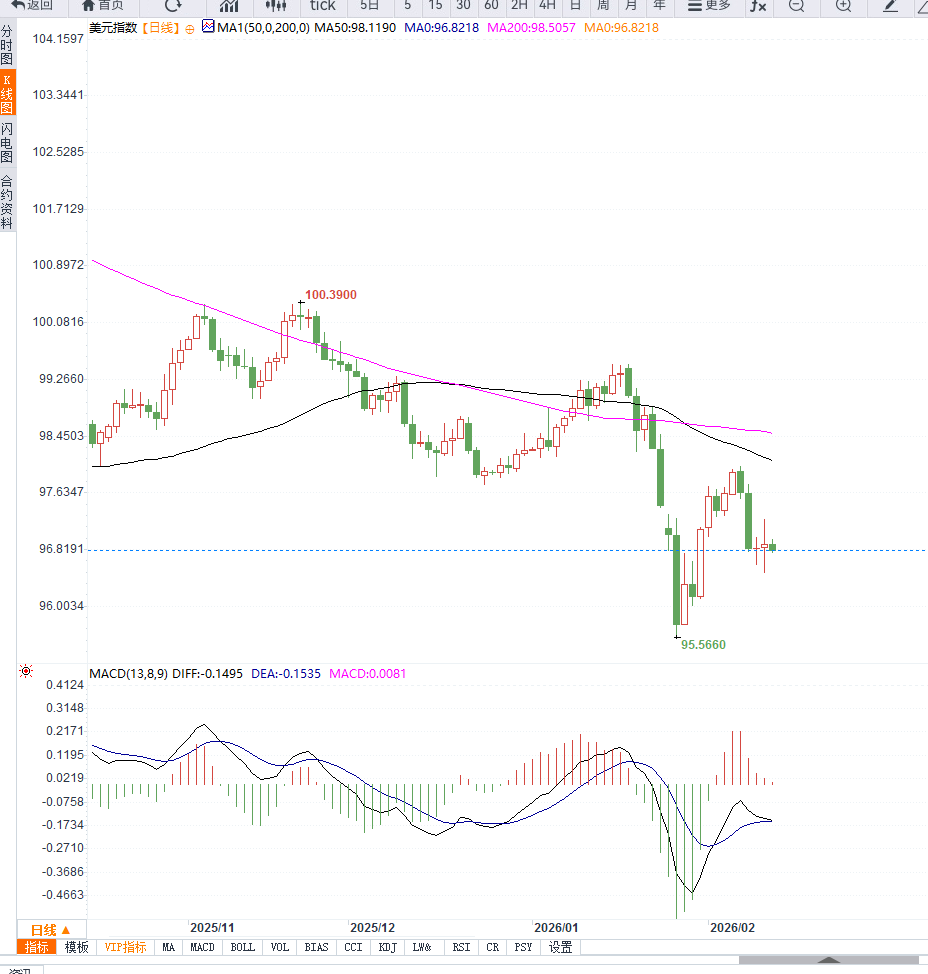
From the daily chart, the DXY recently encountered resistance near 97.00 and fell back to 96.80, forming a small bearish candlestick with an upper shadow, indicating significant short-term pressure on the bulls. However, the 96.50-96.40 area provides support. The 50-day and 100-day moving averages are arranged below the price, providing dynamic support for any potential pullback.
The RSI indicator is around 52, indicating a neutral to bullish bias; the MACD is near the zero line, with the histogram contracting, suggesting a short-term balance between bullish and bearish forces. On the 4-hour chart, the DXY is consolidating in the 96.75-96.85 range, forming a box-shaped oscillation structure. The 96.95-97.00 level represents strong resistance, which has been tested multiple times without a breakthrough.
Support levels to watch are 96.60-96.50; a break below this level could lead to a test of 96.30. Short-term candlestick patterns show alternating small gains and losses, with moderate momentum and no clear trend breakout yet.
In summary, the US dollar index is likely to fluctuate in the short term. Strong non-farm payroll data will limit its downside, while market expectations for CPI and the Fed's interest rate path will determine its next direction.
Editor's Note:
The US Dollar Index (DXY) is currently in a short-term trading range, showing overall stability but significant downward pressure. Strong January non-farm payroll data demonstrated the resilience of the US labor market, limiting the dollar's downside, but also hindering its upward momentum, resulting in a complex interplay of bullish and bearish forces.
From a market sentiment perspective, investors remain divided on the Federal Reserve's interest rate path: the probability of maintaining interest rates unchanged in the short term has increased significantly, but expectations of rate cuts still exist in the medium to long term. This has led to a consolidation-oriented bullish pattern for the US dollar at its high levels, rather than a one-sided trend.
Looking ahead, market focus will shift to Friday's CPI data. If inflation data is lower than expected, it could strengthen expectations of interest rate cuts, putting pressure on the dollar and benefiting non-US currencies and risk assets. Conversely, if inflation remains high, the dollar may find support, putting downward pressure on commodities and emerging market currencies.
However, strong US non-farm payroll data for January provided support for the dollar. Data from the US Department of Labor showed that 130,000 jobs were added in January, exceeding market expectations of 70,000 and significantly improving from the revised 48,000 in December.
The unemployment rate fell to 4.3% from 4.4%, better than the market forecast of 4.4%. The strong employment data indicates that the US labor market remains resilient, limiting further declines in the dollar index.
Statements from Federal Reserve officials also influenced the market. Cleveland Fed President Beth Hammark noted that the January non-farm payroll data indicated that the unemployment rate was stabilizing; Kansas City Fed President Schmid emphasized that maintaining restrictive interest rates remained necessary to curb inflation, and that current economic data did not show any significant signs of slowing down.These comments have kept the market cautious about the Federal Reserve's policy path. In financial markets, the CME FedWatch tool shows that investors expect the probability of the Fed keeping interest rates unchanged at its next meeting to rise to about 94%, up from 80% the previous day.
Overall, the US dollar index remained relatively stable, supported by strong employment data and policy expectations, with obvious short-term fluctuations.
From the daily chart, the DXY recently encountered resistance near 97.00 and fell back to 96.80, forming a small bearish candlestick with an upper shadow, indicating significant short-term pressure on the bulls. However, the 96.50-96.40 area provides support. The 50-day and 100-day moving averages are arranged below the price, providing dynamic support for any potential pullback.
The RSI indicator is around 52, indicating a neutral to bullish bias; the MACD is near the zero line, with the histogram contracting, suggesting a short-term balance between bullish and bearish forces. On the 4-hour chart, the DXY is consolidating in the 96.75-96.85 range, forming a box-shaped oscillation structure. The 96.95-97.00 level represents strong resistance, which has been tested multiple times without a breakthrough.
Support levels to watch are 96.60-96.50; a break below this level could lead to a test of 96.30. Short-term candlestick patterns show alternating small gains and losses, with moderate momentum and no clear trend breakout yet.
In summary, the US dollar index is likely to fluctuate in the short term. Strong non-farm payroll data will limit its downside, while market expectations for CPI and the Fed's interest rate path will determine its next direction.
Editor's Note:
The US Dollar Index (DXY) is currently in a short-term trading range, showing overall stability but significant downward pressure. Strong January non-farm payroll data demonstrated the resilience of the US labor market, limiting the dollar's downside, but also hindering its upward momentum, resulting in a complex interplay of bullish and bearish forces.
From a market sentiment perspective, investors remain divided on the Federal Reserve's interest rate path: the probability of maintaining interest rates unchanged in the short term has increased significantly, but expectations of rate cuts still exist in the medium to long term. This has led to a consolidation-oriented bullish pattern for the US dollar at its high levels, rather than a one-sided trend.
Looking ahead, market focus will shift to Friday's CPI data. If inflation data is lower than expected, it could strengthen expectations of interest rate cuts, putting pressure on the dollar and benefiting non-US currencies and risk assets. Conversely, if inflation remains high, the dollar may find support, putting downward pressure on commodities and emerging market currencies.
- Risk Warning and Disclaimer
- The market involves risk, and trading may not be suitable for all investors. This article is for reference only and does not constitute personal investment advice, nor does it take into account certain users’ specific investment objectives, financial situation, or other needs. Any investment decisions made based on this information are at your own risk.