Strategists remain bullish on gold, but warn that speculative buying could trigger another pullback.
2026-02-12 11:16:58
Gold has successfully maintained its steady gains above $5,000 per ounce, but one market analyst believes there are short-term tactical risks as the market attempts to find some balance after last month's unprecedented sell-off.
In her latest report, BCA Research's chief strategist, Roukaya Ibrahim, stated that she remains bullish on gold but warned investors to prepare for more short-term volatility and another "significant pullback" in gold prices.
Despite the risk of a decline in gold prices in the coming months, she said the BCA is maintaining its longer-term long gold position, which it first recommended in November 2022.
This Montreal-based research firm believes there is further value in going long on gold/short on copper, long on gold/short on global stocks, and long on gold mines/short on global stocks.
In her report, she stated, "We suspect that the January high for gold marks the peak of a structural bull market; however, downside risks remain in the short term. Therefore, gold prices may face resistance in the coming months before resuming their upward trend."
While the biggest sell-off in gold in decades has spooked many investors, Ibrahim says the price action isn't surprising given the gains over the past few months. She adds that the current volatility is consistent with previous cycles.
However, she also pointed out that despite the significant pullback, the overall market fundamentals remain unchanged. Nevertheless, it may take some time for investors to find a solid price base again.
She said, "In past structural bull market corrections, the duration of the sell-off has ranged from 13 days to nearly 6 months. Moreover, it took gold prices a month to nearly a year to return to their previous highs."
Ibrahim explained that speculative momentum remains the biggest near-term risk to gold. She pointed out that gold's near-parabolic rally was driven by inflows into gold ETFs. Meanwhile, a large portion of this demand came from Asian investors. She said, "Given that Asian investors are very momentum-driven and price-sensitive, a correction could trigger position liquidation and cause a significant price drop in the short term. The increased investment demand (likely speculative) from major Asian countries over the past year will cause price volatility in the coming months, and these speculative flows could reverse as suddenly as they surged. "
While gold prices will be sensitive to changes in investor sentiment, she said there is still a solid pillar of strength in the market.
She said, "Private investors may inject volatility into gold prices in the short term. But over a cyclical timeframe, they are likely to remain a positive factor. Meanwhile, continued central bank buying will help support the market ."
Ibrahim stated that with rising geopolitical uncertainty and increasing government debt, central banks are unlikely to stop buying gold, despite a slower pace of purchases compared to the momentum of the past three years.
She said, “Central bank gold purchases are price-sensitive in the short term, with demand slowing as prices surge. However, in the long term, they are price-insensitive as they continue to reduce their exposure to dollar-denominated reserves. Therefore, while these purchases will push prices higher in a structural timeframe, they will not prevent a gold sell-off in the short term.”
She said that, as they have done in the retail investment market, major Asian economies will continue to play a dominant role in the official sector. She noted that while major Asian central banks have significantly increased their official reserves over the past three years, their gold holdings remain relatively low. Ibrahim pointed out that gold accounts for less than 9% of their foreign exchange reserves, a much smaller share compared to other emerging economies in their overall reserves. She said, “If the central bank were to increase that share to the emerging market average of 18%, it would need to purchase approximately another 60 tonnes of gold (assuming gold prices remain constant and the total value of reserves remains unchanged), and these quarterly purchases would be nearly 2.5 times higher than the bank’s average purchases since the beginning of 2023.”
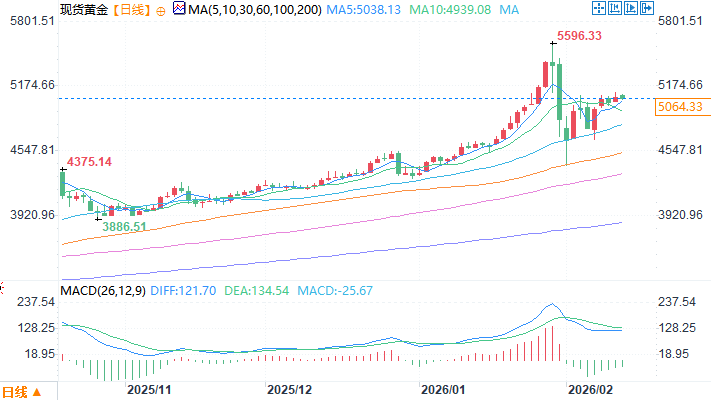
Spot gold daily chart source: EasyForex
At 11:16 AM Beijing time on February 12, spot gold was trading at $5068.33 per ounce.
In her latest report, BCA Research's chief strategist, Roukaya Ibrahim, stated that she remains bullish on gold but warned investors to prepare for more short-term volatility and another "significant pullback" in gold prices.
Despite the risk of a decline in gold prices in the coming months, she said the BCA is maintaining its longer-term long gold position, which it first recommended in November 2022.
This Montreal-based research firm believes there is further value in going long on gold/short on copper, long on gold/short on global stocks, and long on gold mines/short on global stocks.
In her report, she stated, "We suspect that the January high for gold marks the peak of a structural bull market; however, downside risks remain in the short term. Therefore, gold prices may face resistance in the coming months before resuming their upward trend."
While the biggest sell-off in gold in decades has spooked many investors, Ibrahim says the price action isn't surprising given the gains over the past few months. She adds that the current volatility is consistent with previous cycles.
However, she also pointed out that despite the significant pullback, the overall market fundamentals remain unchanged. Nevertheless, it may take some time for investors to find a solid price base again.
She said, "In past structural bull market corrections, the duration of the sell-off has ranged from 13 days to nearly 6 months. Moreover, it took gold prices a month to nearly a year to return to their previous highs."
Ibrahim explained that speculative momentum remains the biggest near-term risk to gold. She pointed out that gold's near-parabolic rally was driven by inflows into gold ETFs. Meanwhile, a large portion of this demand came from Asian investors. She said, "Given that Asian investors are very momentum-driven and price-sensitive, a correction could trigger position liquidation and cause a significant price drop in the short term. The increased investment demand (likely speculative) from major Asian countries over the past year will cause price volatility in the coming months, and these speculative flows could reverse as suddenly as they surged. "
While gold prices will be sensitive to changes in investor sentiment, she said there is still a solid pillar of strength in the market.
She said, "Private investors may inject volatility into gold prices in the short term. But over a cyclical timeframe, they are likely to remain a positive factor. Meanwhile, continued central bank buying will help support the market ."
Ibrahim stated that with rising geopolitical uncertainty and increasing government debt, central banks are unlikely to stop buying gold, despite a slower pace of purchases compared to the momentum of the past three years.
She said, “Central bank gold purchases are price-sensitive in the short term, with demand slowing as prices surge. However, in the long term, they are price-insensitive as they continue to reduce their exposure to dollar-denominated reserves. Therefore, while these purchases will push prices higher in a structural timeframe, they will not prevent a gold sell-off in the short term.”
She said that, as they have done in the retail investment market, major Asian economies will continue to play a dominant role in the official sector. She noted that while major Asian central banks have significantly increased their official reserves over the past three years, their gold holdings remain relatively low. Ibrahim pointed out that gold accounts for less than 9% of their foreign exchange reserves, a much smaller share compared to other emerging economies in their overall reserves. She said, “If the central bank were to increase that share to the emerging market average of 18%, it would need to purchase approximately another 60 tonnes of gold (assuming gold prices remain constant and the total value of reserves remains unchanged), and these quarterly purchases would be nearly 2.5 times higher than the bank’s average purchases since the beginning of 2023.”
Spot gold daily chart source: EasyForex
At 11:16 AM Beijing time on February 12, spot gold was trading at $5068.33 per ounce.
- Risk Warning and Disclaimer
- The market involves risk, and trading may not be suitable for all investors. This article is for reference only and does not constitute personal investment advice, nor does it take into account certain users’ specific investment objectives, financial situation, or other needs. Any investment decisions made based on this information are at your own risk.