The USD/JPY pair has weakened for four consecutive days, hovering near the lower end of its trading range, awaiting a rebound.
2026-02-12 14:23:23
During Thursday's Asian trading session, the USD/JPY pair continued its downward trend, hovering around the 153.00 level, marking its fourth consecutive trading day of pressure. Overall market sentiment clearly favored the Japanese yen.
Policy signals from Japan are becoming a key variable. The Vice Minister of Finance responsible for international affairs stated that the authorities are monitoring exchange rate fluctuations with a high degree of urgency and are maintaining a vigilant stance.
The Finance Minister also reiterated that Japan would respond to unusual volatility in accordance with the joint statement between the US and Japan. Such statements are usually seen as a signal of potential intervention, reinforcing market confidence in the yen.

Meanwhile, Prime Minister Sanae Takaichi's expansionary fiscal policy strengthened market expectations for Japanese economic growth. Analysts believe that the new government's emphasis on fiscal discipline while stimulating the economy, coupled with a relatively stable policy stance, has attracted capital inflows into the Japanese market, providing structural support for the yen.
Regarding the US dollar, the US January non-farm payroll report was strong. Data showed that 130,000 jobs were added in January, exceeding market expectations of 70,000; the unemployment rate fell to 4.3%, lower than the previous 4.4%. The labor market remains resilient, providing some support for the dollar.
However, market opinions remain divided on future policy direction, preventing the dollar from sustaining a rebound. Investors are now focusing on the upcoming US CPI data. Inflation trends will influence market expectations regarding the pace of Federal Reserve policy and could be key to the next direction of the USD/JPY exchange rate.
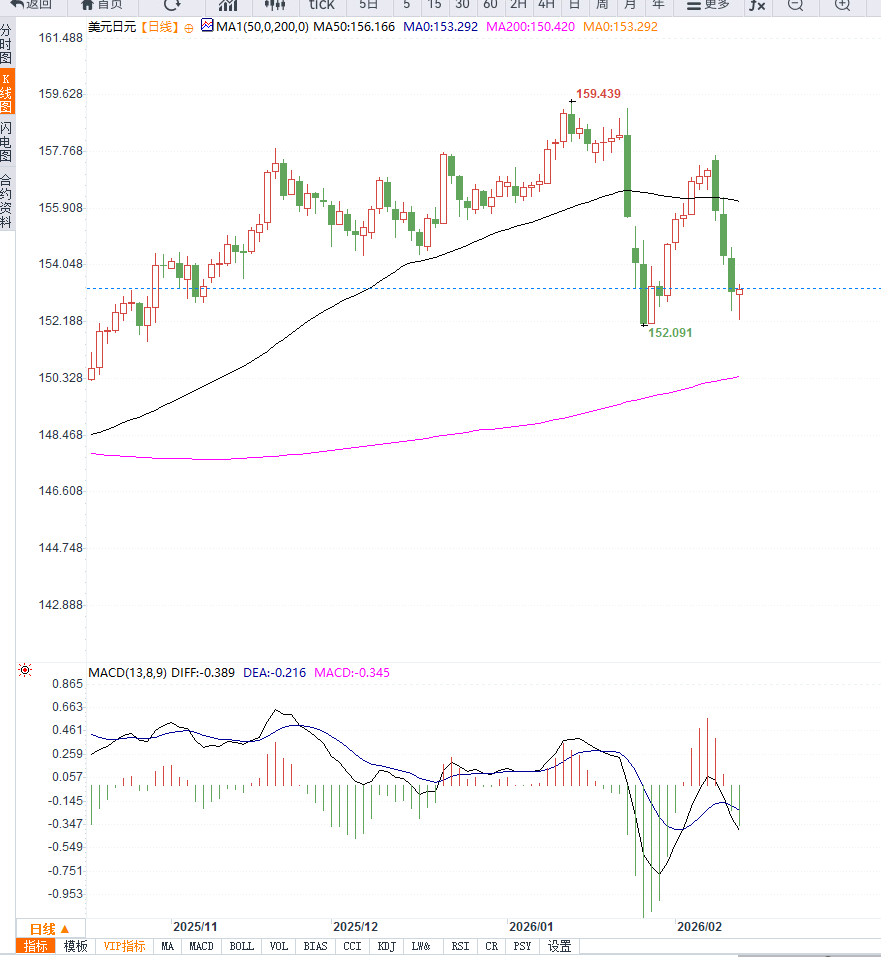
From a daily chart perspective, USD/JPY has closed lower for four consecutive days, with the price center gradually shifting downwards, indicating a clear weakening of the short-term trend. Currently, the exchange rate is trading not far above the 200-day exponential moving average (approximately 152.50), which is still slowly rising. However, the repeated testing of this level by the price suggests that the bulls' defensive strength is gradually weakening.
In the Fibonacci retracement structure, looking at the wave from 140.02 to 159.35, the 38.2% retracement level is located in the 152.00-151.95 area, forming a technical support confluence with the 200-day moving average. A decisive break below this area would signify a deeper correction in the previous medium-term uptrend, potentially targeting the 50% retracement level at 149.68.
In terms of momentum indicators, the MACD has fallen below the zero line, the MACD line is below the signal line, and the negative histogram continues to expand, indicating that the bearish momentum is strengthening. The RSI is running around 36, which is in a bearish range, and there has been no obvious oversold rebound signal yet, indicating that the sellers still have the initiative.
In terms of candlestick pattern, the consecutive bearish candles form a clear downward trend, with limited rebound strength, exhibiting characteristics of "weak consolidation." If a large-volume long bearish candle breaks below the 152 level, the decline may accelerate; if a lower shadow forms support near the 200-day moving average, it may enter a period of consolidation and recovery.
Overall, the daily chart structure has shifted from high-level consolidation to a bearish correction phase, and the outcome of key support areas will determine the medium-term trend.
Editor's Note:
The current USD/JPY exchange rate movement is primarily driven by the divergence in policy expectations. Japan's strengthened exchange rate warnings and fiscal stimulus signals are providing medium-term support for the yen, while the dollar, though boosted by employment data, lacks new driving factors.
Structurally, the exchange rate is approaching a key technical support level, and market sentiment is bearish but not yet extreme. If US inflation data is weak, the dollar may come under further pressure, opening up downside potential for USD/JPY; if inflation remains resilient, the dollar may experience a technical rebound.
Near key support levels, market competition intensifies. Short-term trends may be more data-driven, while the medium-term direction will depend on whether policy expectations undergo a substantial shift.
Policy signals from Japan are becoming a key variable. The Vice Minister of Finance responsible for international affairs stated that the authorities are monitoring exchange rate fluctuations with a high degree of urgency and are maintaining a vigilant stance.
The Finance Minister also reiterated that Japan would respond to unusual volatility in accordance with the joint statement between the US and Japan. Such statements are usually seen as a signal of potential intervention, reinforcing market confidence in the yen.
Meanwhile, Prime Minister Sanae Takaichi's expansionary fiscal policy strengthened market expectations for Japanese economic growth. Analysts believe that the new government's emphasis on fiscal discipline while stimulating the economy, coupled with a relatively stable policy stance, has attracted capital inflows into the Japanese market, providing structural support for the yen.
Regarding the US dollar, the US January non-farm payroll report was strong. Data showed that 130,000 jobs were added in January, exceeding market expectations of 70,000; the unemployment rate fell to 4.3%, lower than the previous 4.4%. The labor market remains resilient, providing some support for the dollar.
However, market opinions remain divided on future policy direction, preventing the dollar from sustaining a rebound. Investors are now focusing on the upcoming US CPI data. Inflation trends will influence market expectations regarding the pace of Federal Reserve policy and could be key to the next direction of the USD/JPY exchange rate.
From a daily chart perspective, USD/JPY has closed lower for four consecutive days, with the price center gradually shifting downwards, indicating a clear weakening of the short-term trend. Currently, the exchange rate is trading not far above the 200-day exponential moving average (approximately 152.50), which is still slowly rising. However, the repeated testing of this level by the price suggests that the bulls' defensive strength is gradually weakening.
In the Fibonacci retracement structure, looking at the wave from 140.02 to 159.35, the 38.2% retracement level is located in the 152.00-151.95 area, forming a technical support confluence with the 200-day moving average. A decisive break below this area would signify a deeper correction in the previous medium-term uptrend, potentially targeting the 50% retracement level at 149.68.
In terms of momentum indicators, the MACD has fallen below the zero line, the MACD line is below the signal line, and the negative histogram continues to expand, indicating that the bearish momentum is strengthening. The RSI is running around 36, which is in a bearish range, and there has been no obvious oversold rebound signal yet, indicating that the sellers still have the initiative.
In terms of candlestick pattern, the consecutive bearish candles form a clear downward trend, with limited rebound strength, exhibiting characteristics of "weak consolidation." If a large-volume long bearish candle breaks below the 152 level, the decline may accelerate; if a lower shadow forms support near the 200-day moving average, it may enter a period of consolidation and recovery.
Overall, the daily chart structure has shifted from high-level consolidation to a bearish correction phase, and the outcome of key support areas will determine the medium-term trend.
Editor's Note:
The current USD/JPY exchange rate movement is primarily driven by the divergence in policy expectations. Japan's strengthened exchange rate warnings and fiscal stimulus signals are providing medium-term support for the yen, while the dollar, though boosted by employment data, lacks new driving factors.
Structurally, the exchange rate is approaching a key technical support level, and market sentiment is bearish but not yet extreme. If US inflation data is weak, the dollar may come under further pressure, opening up downside potential for USD/JPY; if inflation remains resilient, the dollar may experience a technical rebound.
Near key support levels, market competition intensifies. Short-term trends may be more data-driven, while the medium-term direction will depend on whether policy expectations undergo a substantial shift.
- Risk Warning and Disclaimer
- The market involves risk, and trading may not be suitable for all investors. This article is for reference only and does not constitute personal investment advice, nor does it take into account certain users’ specific investment objectives, financial situation, or other needs. Any investment decisions made based on this information are at your own risk.