Despite the ongoing war of words between the US and Iran and the continued oil inventory buildup, prices haven't fallen, leaving bullish investors eager for action.
2026-02-12 14:57:17
On Thursday (February 12), during the Asian and European sessions, US crude oil prices rose for the second consecutive day, currently trading around $64.80 per barrel, with a daily increase of approximately 0.25%. Traders were primarily focused on the US-Iran tensions, a geopolitical risk that overshadowed signs of increased supply. US oil prices have recorded gains almost every week in 2026, with only one exception, and their upward trend has been mainly driven by geopolitical uncertainty.
Following his meeting with Israeli Prime Minister Benjamin Netanyahu, US President Donald Trump stated that his goal remains to reach a nuclear agreement with Iran, emphasizing that "reaching an agreement is my preference." However, he also warned that if negotiations fail, "we'll have to see what happens." Despite Trump's preference for a diplomatic approach, markets remain concerned that potential military action could threaten key shipping lanes such as the Strait of Hormuz and global oil supplies.
Vandana Hari, founder of Vanda Insights, analyzed that against the backdrop of ongoing tensions between the US and Iran, oil prices are likely to remain range-bound. If diplomatic progress is made, the downside for prices will be limited, as any lasting agreement faces significant political obstacles. "Additional confrontational rhetoric or military posture could bring some risk premium, but unless a US strike on Iran is imminent, the gains will be significantly limited."
Despite geopolitical risks providing support, supply-side data indicates easing. The latest report from the U.S. Energy Information Administration (EIA) shows that U.S. crude oil inventories surged by 8.5 million barrels last week, reaching the highest level since June 2025. Several investment banks believe that global crude oil supply is ample. Goldman Sachs points out that a supply glut is emerging, but it is mainly concentrated in regions with less influence on price formation.
The International Energy Agency (IEA) will release its monthly oil market report later Thursday, which is expected to reiterate the oversupply pressures facing the global market.
In addition, Venezuelan crude oil flows have also attracted much attention. U.S. Energy Secretary Chris Wright stated at a media roundtable in Caracas that Venezuela's so-called "oil quarantine" has essentially ended.
Overall, geopolitical risks remain the main driver of the current oil market, but inventory accumulation and potential oversupply are putting some pressure on prices. In the short term, oil prices may continue to fluctuate within a relatively narrow range or rise moderately, awaiting clearer signals from the US-Iran negotiations.
The daily chart shows that oil prices are maintaining an upward trend with fluctuations. The 14-day Relative Strength Index (RSI) is above the midline, and the MACD oscillator is also in positive territory, indicating that the rebound momentum remains. However, the histogram is showing a narrowing trend, suggesting that the upward pace of oil prices is expected to slow down. After consecutive daily gains, prices are approaching the upper edge of the previous high-volume trading zone. The slowing upward slope and lack of significant volume suggest that short-term technical correction pressure should be watched closely.
On the downside, the previous trading day's intraday low of $64.15 is expected to form the first support level. If this level is broken during the day, the short-term trend may turn to bearish dominance, and then the upward trend line and the 20-day moving average (MA, 62.62) are expected to form a combined support.
On the upside, $65.00 is expected to be the first resistance level. If oil prices break through this level, it may strengthen the upward momentum of oil prices and help them move towards $66. After that, the high of $66.48 at the end of January will form a strong resistance level.
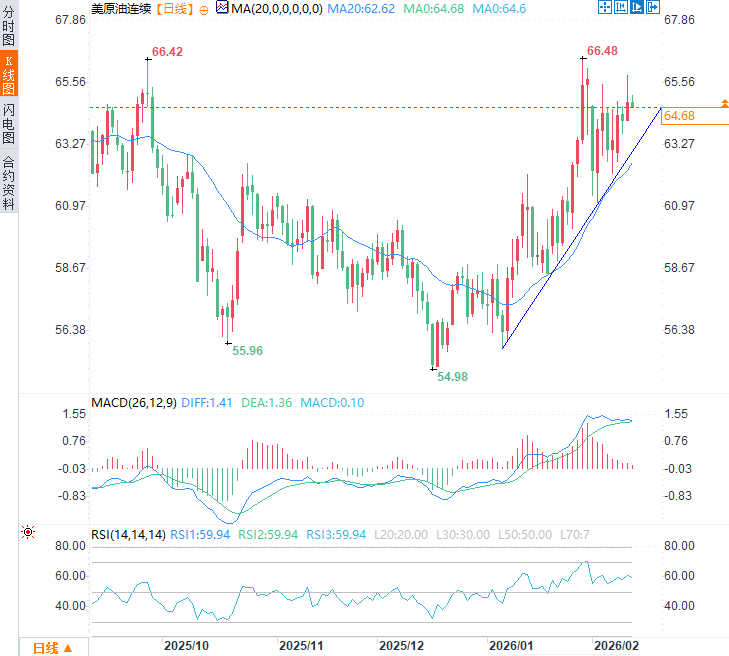
(US crude oil daily chart, source: FX678)
At 14:54 Beijing time, US crude oil futures were trading at $64.80 per barrel.
The US-Iran rivalry is affecting the oil market.
Following his meeting with Israeli Prime Minister Benjamin Netanyahu, US President Donald Trump stated that his goal remains to reach a nuclear agreement with Iran, emphasizing that "reaching an agreement is my preference." However, he also warned that if negotiations fail, "we'll have to see what happens." Despite Trump's preference for a diplomatic approach, markets remain concerned that potential military action could threaten key shipping lanes such as the Strait of Hormuz and global oil supplies.
Vandana Hari, founder of Vanda Insights, analyzed that against the backdrop of ongoing tensions between the US and Iran, oil prices are likely to remain range-bound. If diplomatic progress is made, the downside for prices will be limited, as any lasting agreement faces significant political obstacles. "Additional confrontational rhetoric or military posture could bring some risk premium, but unless a US strike on Iran is imminent, the gains will be significantly limited."
US inventories hit an eight-month high, supply limiting oil price gains.
Despite geopolitical risks providing support, supply-side data indicates easing. The latest report from the U.S. Energy Information Administration (EIA) shows that U.S. crude oil inventories surged by 8.5 million barrels last week, reaching the highest level since June 2025. Several investment banks believe that global crude oil supply is ample. Goldman Sachs points out that a supply glut is emerging, but it is mainly concentrated in regions with less influence on price formation.
The International Energy Agency (IEA) will release its monthly oil market report later Thursday, which is expected to reiterate the oversupply pressures facing the global market.
Venezuelan oil reserves reopened
In addition, Venezuelan crude oil flows have also attracted much attention. U.S. Energy Secretary Chris Wright stated at a media roundtable in Caracas that Venezuela's so-called "oil quarantine" has essentially ended.
Overall, geopolitical risks remain the main driver of the current oil market, but inventory accumulation and potential oversupply are putting some pressure on prices. In the short term, oil prices may continue to fluctuate within a relatively narrow range or rise moderately, awaiting clearer signals from the US-Iran negotiations.
The bullish momentum continues, but the pace of the upward movement is slowing.
The daily chart shows that oil prices are maintaining an upward trend with fluctuations. The 14-day Relative Strength Index (RSI) is above the midline, and the MACD oscillator is also in positive territory, indicating that the rebound momentum remains. However, the histogram is showing a narrowing trend, suggesting that the upward pace of oil prices is expected to slow down. After consecutive daily gains, prices are approaching the upper edge of the previous high-volume trading zone. The slowing upward slope and lack of significant volume suggest that short-term technical correction pressure should be watched closely.
On the downside, the previous trading day's intraday low of $64.15 is expected to form the first support level. If this level is broken during the day, the short-term trend may turn to bearish dominance, and then the upward trend line and the 20-day moving average (MA, 62.62) are expected to form a combined support.
On the upside, $65.00 is expected to be the first resistance level. If oil prices break through this level, it may strengthen the upward momentum of oil prices and help them move towards $66. After that, the high of $66.48 at the end of January will form a strong resistance level.
(US crude oil daily chart, source: FX678)
At 14:54 Beijing time, US crude oil futures were trading at $64.80 per barrel.
- Risk Warning and Disclaimer
- The market involves risk, and trading may not be suitable for all investors. This article is for reference only and does not constitute personal investment advice, nor does it take into account certain users’ specific investment objectives, financial situation, or other needs. Any investment decisions made based on this information are at your own risk.