The economy hasn't collapsed, but it's not doing well either: Is the pound sterling no longer appreciating?
2026-02-12 16:57:26
In the fourth quarter of 2025, the UK's GDP grew by 0.1% quarter-on-quarter, unchanged from the previous quarter and slightly below market expectations of 0.2%. Year-on-year growth was 1.0%, also failing to reach the expected 1.2%. More notably, the year-on-year growth rate for the first three quarters, previously reported as 1.3%, has now been revised to 1.2%, indicating that overall economic momentum is actually weaker than previously thought. Although the numbers show the UK economy is still in expansion territory, this "slow progress" resembles stagnation, lacking genuine upward momentum.
What is truly worrying is that real GDP per capita has declined for two consecutive quarters. This means that even with a slight increase in total national output, the living standards of ordinary people have not improved accordingly. Since economic growth has not translated into tangible benefits for residents, subsequent changes in consumer confidence and the job market become particularly crucial. If wage growth fails to keep pace with price increases, the "pillar" of service consumption may falter, thereby undermining the stability of the entire economy.
A breakdown of the monthly data reveals that GDP grew by 0.1% month-on-month in December 2025, in line with expectations but significantly lower than the previous month's 0.3%. Structural divergence is becoming increasingly apparent: the service sector grew by 0.3% month-on-month, significantly better than the expected 0.1%, remaining the main driver of economic growth; however, industrial output declined by 0.9%, and manufacturing by 0.5%, both significantly weaker than the expected zero growth; the construction sector even declined by 0.5%, far below the expected +0.5%. This data paints a typical picture of "two extremes"—the service sector is still able to maintain its momentum, but the real economy has clearly cooled down.
Looking further at the quarterly level, in the three months of the fourth quarter, the service sector contributed only +0.02% to overall GDP growth, the production sector contributed +0.16%, while the construction sector dragged it down by -0.13%. The end result was a meager +0.1% expansion for the entire quarter. In other words, the current growth is not due to a broad recovery, but rather a result of some sectors barely holding up the economy. If the service sector also begins to slow down in the future, or if unemployment rises, the current seemingly "stable" situation could quickly weaken.
The current situation in the UK is quite delicate: on the one hand, continued lower-than-expected economic growth has reinforced market speculation that the Bank of England will adopt a more accommodative stance; on the other hand, the service sector's resilience has curbed overly pessimistic pricing. Therefore, monetary policy is caught in a tug-of-war, with market focus now on the Bank of England's meeting on March 19th—whether there will be a 25 basis point rate cut depends on whether subsequent inflation and demand data continue to signal a cooling trend.
Currently, if the economy remains in a "low but not collapsing" state, and inflation remains sticky, the Bank of England will likely remain cautious and avoid initiating a significant interest rate cut cycle prematurely. This would limit the downside potential of the pound. Conversely, if manufacturing weakness spreads to the job market and impacts service consumption demand, expectations for interest rate cuts will quickly rise, and the pound may face temporary pressure. In short, the fate of the pound is no longer determined by a single data point, but rather by the dynamic balance between growth, inflation, and employment.
Looking at the GBP/USD exchange rate, it is currently hovering around 1.3630. After a rapid rebound from 1.3340 to form a temporary high of 1.3867, it entered a consolidation phase, with market sentiment shifting from chasing gains to a wait-and-see approach. Technical indicators show that although the MACD fast and slow lines are still above the zero axis, the momentum bars have turned negative (-0.0025), indicating that upward momentum is weakening; the RSI is around 53.47, in the neutral zone, showing neither a strong upward signal nor oversold signs, which is consistent with the characteristics of a range-bound market.
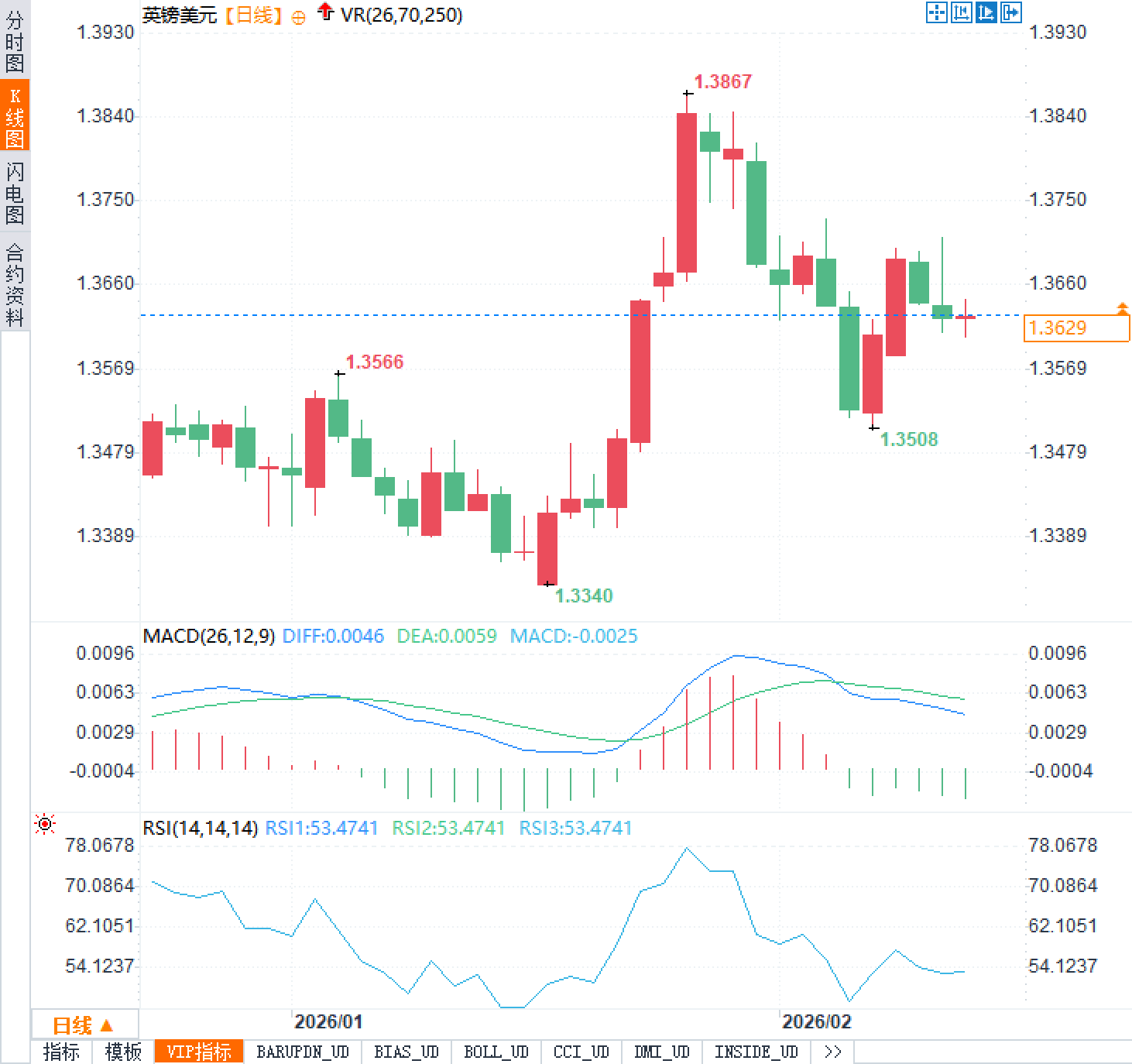
In terms of price structure, the area around 1.3900 forms a strong resistance zone, and without significant fundamental impetus in the short term, a breakout will be difficult. On the downside, the support level to watch is the previous low of 1.3508. A break below this level could trigger technical stop-loss orders, leading to a further price pullback. If the price holds, it will likely fluctuate between 1.35 and 1.39.
In summary, the UK economy is in a sensitive phase characterized by a "weak recovery" and "strong expectations." Repeated data confirms a pattern of "low growth but no stall," making the pace of interest rate cuts unclear and leaving the pound in a dilemma. Short-term movements will likely continue to be data-driven, with the economy consolidating while awaiting the next breakout signal.
What is truly worrying is that real GDP per capita has declined for two consecutive quarters. This means that even with a slight increase in total national output, the living standards of ordinary people have not improved accordingly. Since economic growth has not translated into tangible benefits for residents, subsequent changes in consumer confidence and the job market become particularly crucial. If wage growth fails to keep pace with price increases, the "pillar" of service consumption may falter, thereby undermining the stability of the entire economy.
The service sector alone cannot sustain the economy; the real economy is dragging down across the board.
A breakdown of the monthly data reveals that GDP grew by 0.1% month-on-month in December 2025, in line with expectations but significantly lower than the previous month's 0.3%. Structural divergence is becoming increasingly apparent: the service sector grew by 0.3% month-on-month, significantly better than the expected 0.1%, remaining the main driver of economic growth; however, industrial output declined by 0.9%, and manufacturing by 0.5%, both significantly weaker than the expected zero growth; the construction sector even declined by 0.5%, far below the expected +0.5%. This data paints a typical picture of "two extremes"—the service sector is still able to maintain its momentum, but the real economy has clearly cooled down.
Looking further at the quarterly level, in the three months of the fourth quarter, the service sector contributed only +0.02% to overall GDP growth, the production sector contributed +0.16%, while the construction sector dragged it down by -0.13%. The end result was a meager +0.1% expansion for the entire quarter. In other words, the current growth is not due to a broad recovery, but rather a result of some sectors barely holding up the economy. If the service sector also begins to slow down in the future, or if unemployment rises, the current seemingly "stable" situation could quickly weaken.
The pound is caught in a dilemma, with policy expectations being the biggest variable.
The current situation in the UK is quite delicate: on the one hand, continued lower-than-expected economic growth has reinforced market speculation that the Bank of England will adopt a more accommodative stance; on the other hand, the service sector's resilience has curbed overly pessimistic pricing. Therefore, monetary policy is caught in a tug-of-war, with market focus now on the Bank of England's meeting on March 19th—whether there will be a 25 basis point rate cut depends on whether subsequent inflation and demand data continue to signal a cooling trend.
Currently, if the economy remains in a "low but not collapsing" state, and inflation remains sticky, the Bank of England will likely remain cautious and avoid initiating a significant interest rate cut cycle prematurely. This would limit the downside potential of the pound. Conversely, if manufacturing weakness spreads to the job market and impacts service consumption demand, expectations for interest rate cuts will quickly rise, and the pound may face temporary pressure. In short, the fate of the pound is no longer determined by a single data point, but rather by the dynamic balance between growth, inflation, and employment.
The technical picture has entered a period of consolidation, with range-bound trading becoming the dominant theme.
Looking at the GBP/USD exchange rate, it is currently hovering around 1.3630. After a rapid rebound from 1.3340 to form a temporary high of 1.3867, it entered a consolidation phase, with market sentiment shifting from chasing gains to a wait-and-see approach. Technical indicators show that although the MACD fast and slow lines are still above the zero axis, the momentum bars have turned negative (-0.0025), indicating that upward momentum is weakening; the RSI is around 53.47, in the neutral zone, showing neither a strong upward signal nor oversold signs, which is consistent with the characteristics of a range-bound market.
In terms of price structure, the area around 1.3900 forms a strong resistance zone, and without significant fundamental impetus in the short term, a breakout will be difficult. On the downside, the support level to watch is the previous low of 1.3508. A break below this level could trigger technical stop-loss orders, leading to a further price pullback. If the price holds, it will likely fluctuate between 1.35 and 1.39.
In summary, the UK economy is in a sensitive phase characterized by a "weak recovery" and "strong expectations." Repeated data confirms a pattern of "low growth but no stall," making the pace of interest rate cuts unclear and leaving the pound in a dilemma. Short-term movements will likely continue to be data-driven, with the economy consolidating while awaiting the next breakout signal.
- Risk Warning and Disclaimer
- The market involves risk, and trading may not be suitable for all investors. This article is for reference only and does not constitute personal investment advice, nor does it take into account certain users’ specific investment objectives, financial situation, or other needs. Any investment decisions made based on this information are at your own risk.