Yen Trend: No solution before April, now it's a gamble?
2026-02-12 17:47:36
The USD/JPY pair has recently experienced significant volatility, with a noticeably faster pace. Following the release of a strong US non-farm payrolls report in the previous trading day, the exchange rate initially surged, but this rally was short-lived, quickly erasing all gains and falling back to near the key trendline. On Thursday, February 12th, it traded around 152.85 during the European session, just a step away from a short-term support zone. Market attention is rapidly shifting from the non-farm payrolls data to Friday's upcoming US Consumer Price Index (CPI), which could become a key variable determining short-term price movements.

Despite strong non-farm payroll data that briefly raised market expectations for a Federal Reserve rate cut and boosted the dollar, the rally failed to hold. This "rise then fall" pattern reflects continued caution among investors regarding the trend-following impact of single economic data points. On one hand, the market generally believes the US labor market may weaken further and is unwilling to chase the dollar higher at current levels; on the other hand, with upcoming important inflation data, investors are more inclined to wait and see, awaiting clearer signals before making decisions. While data since the beginning of the year has generally shown improvement, this is insufficient to significantly reduce market bets on rate cuts, thus amplifying the marginal impact of the next CPI report.
The market's future direction will largely depend on the performance of the US CPI. If inflation readings are overheated, the market will find it difficult to digest or mitigate their impact as quickly as it did with non-farm payrolls. Instead, a hawkish repricing could be more pronounced—meaning the market will postpone its expectations for the timing of Fed rate cuts and may even reconsider whether higher interest rates need to be maintained for a longer period. In this scenario, the US dollar is expected to receive stronger support and form a more sustained rebound.
Conversely, if the CPI data is weak, indicating continued easing of inflationary pressures, then the pricing changes in current interest rate expectations may be relatively limited. While this won't trigger a sharp correction, it will further perpetuate the short-term pressure on the US dollar. In this case, the exchange rate will rely more on technical support and changes in market sentiment to maintain stability. It can be said that this CPI data is not only a matter of the data itself, but also a "stress test" of the market's judgment on the future path of monetary policy.
From the perspective of the yen, recent price action resembles a typical "profit-taking" market. The yen buying triggered by certain events quickly turned into large-scale "sell the fact" trading after the news was released, resulting in a weak yen rebound. However, the core factors driving the yen's long-term trend have not fundamentally changed. Domestic macroeconomic data in Japan still lacks the momentum to support a rapid interest rate hike, and the Bank of Japan has not released any new policy guidance.
At its most recent policy meeting, the Bank of Japan, as expected, kept interest rates unchanged while slightly raising its economic growth and inflation forecasts against the backdrop of expansionary fiscal policy. In his speech, Governor Kazuo Ueda emphasized that if the economic outlook materializes as anticipated, the Bank of Japan will continue with a gradual approach to interest rate hikes, specifically noting that April's price performance will be a crucial factor in assessing the next steps. This statement effectively implies that the real policy window may not open until after April, provided that subsequent data provides sufficient support.
This means that in the short term, the yen's exchange rate will remain highly dependent on the external environment, particularly changes in US dollar interest rates and fluctuations in global risk appetite. Domestic policies alone are unlikely to drive a sustained strengthening of the yen; opportunities will likely arise only through short-term fluctuations in expectations. Lacking intrinsic momentum, the yen is unlikely to escape its passive, follow-the-leader role.
From a technical chart perspective, the current price level is at an extremely sensitive position. The exchange rate previously surged to 159.439 before falling sharply, forming a low point around 152.091. Although it rebounded to 157.652, it encountered resistance again and declined, indicating heavy selling pressure above, while the support below is gradually becoming clearer through repeated testing.
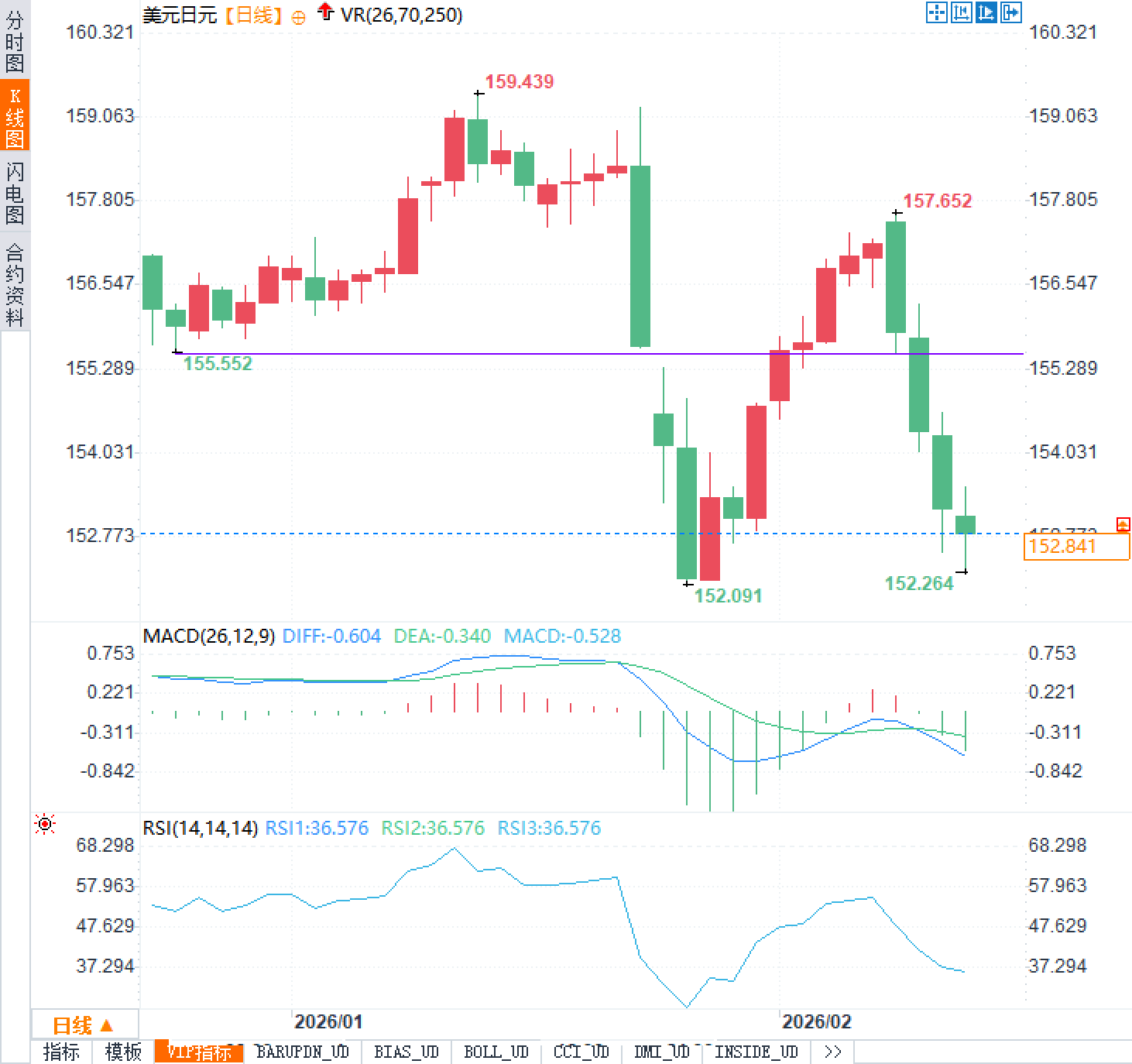
If these two levels are breached, it not only signifies a break in the short-term trendline support but could also trigger technical stop-loss orders, potentially leading to a new round of downward extension. Conversely, if the area can effectively stabilize, and subsequent prices form higher lows or continuously recover important moving averages, the short-term trend may shift to a low-level consolidation pattern, awaiting the release of CPI data before choosing a direction.
In summary, the USD/JPY pair is currently in a sensitive phase, coinciding with a shift in fundamental events and a convergence of key technical levels. In the short term, the focus is on how the upcoming CPI data will affect interest rate expectations, while in the medium term, attention should be paid to whether the Bank of Japan will accelerate its policy pace in response to April's price performance.
Despite strong non-farm payroll data that briefly raised market expectations for a Federal Reserve rate cut and boosted the dollar, the rally failed to hold. This "rise then fall" pattern reflects continued caution among investors regarding the trend-following impact of single economic data points. On one hand, the market generally believes the US labor market may weaken further and is unwilling to chase the dollar higher at current levels; on the other hand, with upcoming important inflation data, investors are more inclined to wait and see, awaiting clearer signals before making decisions. While data since the beginning of the year has generally shown improvement, this is insufficient to significantly reduce market bets on rate cuts, thus amplifying the marginal impact of the next CPI report.
Inflation data may rewrite the slope of interest rate expectations.
The market's future direction will largely depend on the performance of the US CPI. If inflation readings are overheated, the market will find it difficult to digest or mitigate their impact as quickly as it did with non-farm payrolls. Instead, a hawkish repricing could be more pronounced—meaning the market will postpone its expectations for the timing of Fed rate cuts and may even reconsider whether higher interest rates need to be maintained for a longer period. In this scenario, the US dollar is expected to receive stronger support and form a more sustained rebound.
Conversely, if the CPI data is weak, indicating continued easing of inflationary pressures, then the pricing changes in current interest rate expectations may be relatively limited. While this won't trigger a sharp correction, it will further perpetuate the short-term pressure on the US dollar. In this case, the exchange rate will rely more on technical support and changes in market sentiment to maintain stability. It can be said that this CPI data is not only a matter of the data itself, but also a "stress test" of the market's judgment on the future path of monetary policy.
The yen's predicament remains unresolved, and policy expectations lack a breakthrough.
From the perspective of the yen, recent price action resembles a typical "profit-taking" market. The yen buying triggered by certain events quickly turned into large-scale "sell the fact" trading after the news was released, resulting in a weak yen rebound. However, the core factors driving the yen's long-term trend have not fundamentally changed. Domestic macroeconomic data in Japan still lacks the momentum to support a rapid interest rate hike, and the Bank of Japan has not released any new policy guidance.
At its most recent policy meeting, the Bank of Japan, as expected, kept interest rates unchanged while slightly raising its economic growth and inflation forecasts against the backdrop of expansionary fiscal policy. In his speech, Governor Kazuo Ueda emphasized that if the economic outlook materializes as anticipated, the Bank of Japan will continue with a gradual approach to interest rate hikes, specifically noting that April's price performance will be a crucial factor in assessing the next steps. This statement effectively implies that the real policy window may not open until after April, provided that subsequent data provides sufficient support.
This means that in the short term, the yen's exchange rate will remain highly dependent on the external environment, particularly changes in US dollar interest rates and fluctuations in global risk appetite. Domestic policies alone are unlikely to drive a sustained strengthening of the yen; opportunities will likely arise only through short-term fluctuations in expectations. Lacking intrinsic momentum, the yen is unlikely to escape its passive, follow-the-leader role.
Technical warning signs are sounding; support levels become the lifeline for both bulls and bears.
From a technical chart perspective, the current price level is at an extremely sensitive position. The exchange rate previously surged to 159.439 before falling sharply, forming a low point around 152.091. Although it rebounded to 157.652, it encountered resistance again and declined, indicating heavy selling pressure above, while the support below is gradually becoming clearer through repeated testing.
If these two levels are breached, it not only signifies a break in the short-term trendline support but could also trigger technical stop-loss orders, potentially leading to a new round of downward extension. Conversely, if the area can effectively stabilize, and subsequent prices form higher lows or continuously recover important moving averages, the short-term trend may shift to a low-level consolidation pattern, awaiting the release of CPI data before choosing a direction.
In summary, the USD/JPY pair is currently in a sensitive phase, coinciding with a shift in fundamental events and a convergence of key technical levels. In the short term, the focus is on how the upcoming CPI data will affect interest rate expectations, while in the medium term, attention should be paid to whether the Bank of Japan will accelerate its policy pace in response to April's price performance.
- Risk Warning and Disclaimer
- The market involves risk, and trading may not be suitable for all investors. This article is for reference only and does not constitute personal investment advice, nor does it take into account certain users’ specific investment objectives, financial situation, or other needs. Any investment decisions made based on this information are at your own risk.