Amidst a double whammy of a falling US dollar and US Treasury bonds, gold and equity investments present an opportunity.
2026-02-12 20:49:28
On February 12, the stronger-than-expected US non-farm payroll data for January directly triggered sharp fluctuations in the US Treasury market, with short-term bonds under particular pressure. The market significantly adjusted its pricing for a Fed rate cut in 2026. On the same day, the US Treasury auction also showed weak market demand for US Treasuries. For various reasons, the market needs higher yields on US Treasuries, which has made the US government's debt crisis even more mysterious.
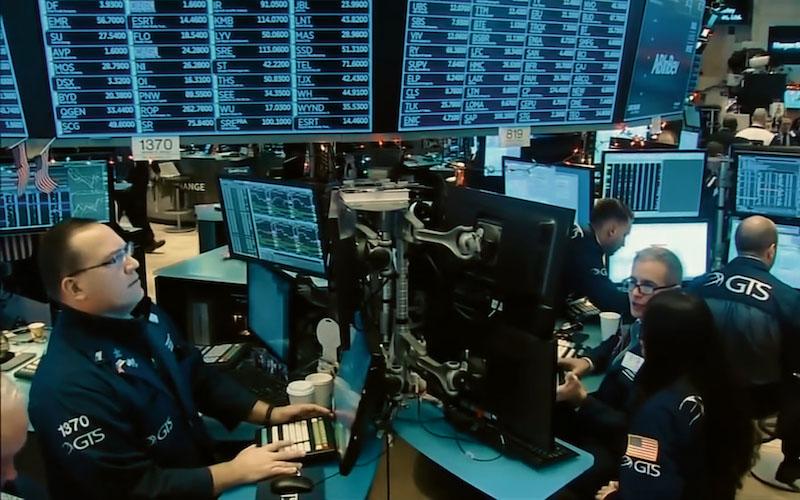
Following the release of the non-farm payroll data, US Treasuries were sold off, with prices falling rapidly. The yield curve rose significantly more at the short end than at the long end, and ultimately the yields on 2-, 5-, and 10-year Treasury bonds stretched by 1-2% before retreating from their highs.
The yield on the two-year U.S. Treasury note rose 6 basis points to 3.51% in a single day, holding steady near the key 3.5% level; the yield on the ten-year U.S. Treasury note rose 3 basis points to 4.17% in the same period, with the spread between long and short yields remaining narrow.
This trend reflects the market's repricing of the Fed's policy rate path—the money market's previous bet on the first rate cut in June has been postponed to July, the probability of a rate cut in March has plummeted to less than 5%, and the cumulative rate cut expectation for the whole year has shrunk from 59 basis points to 52 basis points.
Among other assets linked to US Treasury bonds, the US dollar fluctuated within a range without showing a significant upward trend. Usually, when US Treasury bonds rise so rapidly, the US dollar would actively follow suit. This reveals several critical signals.
First, US Treasury yields are usually a very stable asset. The recent rapid rise suggests that there may be a serious sell-off sentiment in US Treasury bonds. Combined with the weak rebound of the US dollar index, this has created the impression of a dollar credit crisis.
In addition, the market's simultaneous sell-off of the US dollar and short-term US Treasury bonds indicates a shift of funds away from traditional safe-haven assets, suggesting potential opportunities in gold and US stocks.
Judging from the closing performance, the Nasdaq usually experiences a significant valuation-killing effect when the unemployment rate rises, wages increase, and non-farm payrolls increase, resulting in inflation and a tight labor market. This is similar to how rising corporate labor costs combined with a higher valuation discount rate cause the Nasdaq to suffer a double blow and plummet. However, the Nasdaq actually performed very strongly, which confirms the hypothesis of funds shifting from the US dollar and US Treasury bonds.
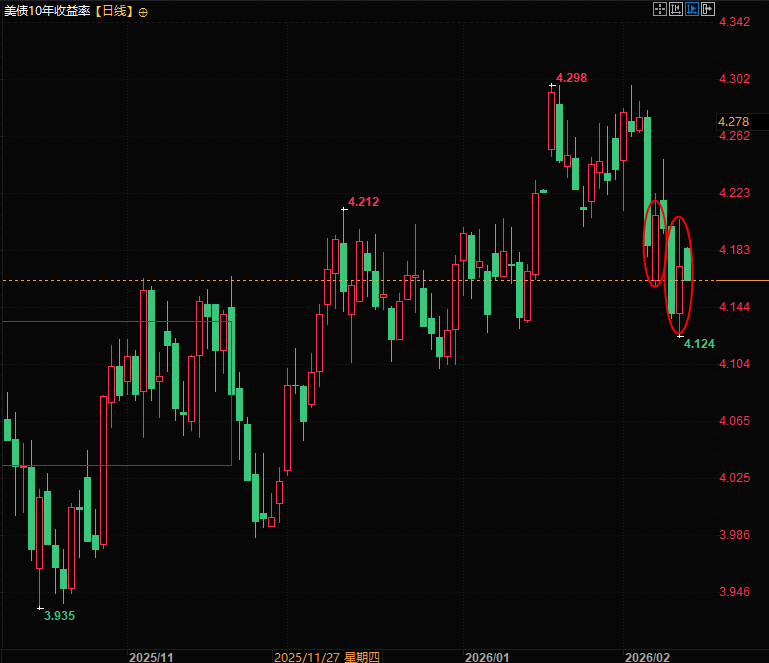
(Daily chart of US 10-year Treasury yield; the overall decline is beneficial to gold and equity assets)
The U.S. added 130,000 non-farm jobs in January, the largest increase in more than a year, and the unemployment rate unexpectedly fell to 4.3%. These two positive factors confirm the continued stabilization of the labor market and directly reduce the need for the Federal Reserve to cut interest rates in the short term.
It is worth noting that last year's employment data was significantly revised downward, with an average monthly increase of only 15,000 jobs, far below the initial estimate of 49,000. However, the strong rebound in January's data still exceeded all economists' expectations, forming a pattern of "lower base but stronger month-on-month growth".
Another key highlight of this non-farm payrolls report is that U.S. manufacturing employment turned positive for the first time since the end of 2024, sending a positive signal that the manufacturing sector is breaking free from its long-term slump.
In a subsequent statement, the White House described this change as a sign that industrial policies were taking effect, and the overall stabilization of the labor market echoed the Federal Reserve's decision to "pause rate cuts" at its last policy meeting, further strengthening market expectations that policies would remain robust.
Alan Zentner of Morgan Stanley Wealth Management pointed out that last week's weak data led the market to predict a weak non-farm payrolls report, but the strong recovery in the actual job market directly broke the previous pessimistic expectations of an economic slowdown, becoming the core driver of the rise in US Treasury yields.
Strong non-farm payroll data provided strong support for the Fed's hawkish stance, and market judgment on the policy path has shifted significantly.
Kansas City Federal Reserve President Jeff Schmidt made it clear that interest rates should be kept in a "restricted range," and that the current high level of inflation still needs to be monitored.
This stance resonated with the market's contraction in expectations for interest rate cuts, driving a sharp rise in short-term US Treasury yields—as the most policy-rate sensitive asset, the two-year US Treasury directly reflects the market's pricing adjustment of the Fed's decision to maintain high interest rates.
Institutional expectations for the magnitude of interest rate cuts have also diverged. TD Securities maintains its forecast of a 75 basis point rate cut in 2026, but emphasizes that the rate cut will be a "policy normalization" after inflation moves closer to the 2% target, rather than an easing forced by a weakening economy;
Krishna Guha of Everton believes that if the strong job market continues in January, it will be difficult for the Fed to cut rates three times throughout the year; Bank of America focuses on the policy orientation of Fed Chair nominee Walsh, maintaining its baseline expectation of "two rate cuts", but warns that if the unemployment rate continues to decline, Walsh may keep interest rates unchanged for the remainder of the year.
Mike Reid of RBC Capital Markets emphasized that the January non-farm payroll data clearly showed a continued improvement in the job market, which confirms the Fed's judgment of a "long-term pause in rate cuts" in 2026. However, he also cautioned against over-interpreting the single-month data and urged continued attention to further confirmation signals.
Regarding subsequent US Treasury transactions, institutions generally believe that the repricing of policy expectations has not yet ended, and yields will exhibit range-bound fluctuations.
From an asset allocation perspective, Angelo Kulcafas of Edward Jones points out that the yield on 10-year US Treasury bonds is expected to return to the middle of the 4%-4.5% range, a judgment that has become an important reference for institutions to deploy medium- and long-term US Treasury bond positions.
The key variable for subsequent trading will be the core CPI data to be released this Friday.
Kay Haig of Goldman Sachs Asset Management said that the job market is showing signs of tightening again, and the better-than-expected economic performance will cause the Federal Reserve to shift its policy focus entirely to inflation. If the CPI exceeds expectations, the Fed's policy may become more hawkish, pushing US Treasury yields to continue to rise.
Morgan Stanley's Michael Gapen also emphasized that the core of interest rate cuts still depends on the pace of inflation decline. Strong non-farm payrolls only reduced the probability of short-term interest rate cuts and did not change the core logic that "inflation dominates the timing of easing."
JPMorgan's trading team's calculations show that if the core CPI meets or falls short of expectations (economists expect a 0.3% month-on-month increase), the rise in risk assets may indirectly suppress the pace of the rise in US Treasury yields.
If the CPI increases by 0.4% or more month-on-month, it may trigger a sharp drop in US stocks, but US Treasury bonds may be supported by safe-haven demand. However, the probability of this scenario is low.
Overall, the January non-farm payroll data has dominated recent US Treasury trading logic by reshaping expectations of Federal Reserve policy.
In the short term, US Treasury yields will fluctuate within a range as the policy path unfolds, with short-term yields remaining most sensitive to changes in expectations of interest rate cuts.
In the medium to long term, inflation data and the sustainability of the labor market will be key factors in determining the trend of US Treasury bonds. Investors need to pay close attention to the resonance or divergence signals between policy expectations and fundamentals, and seize trading opportunities in yield fluctuations.
The weaker-than-expected 10-year US Treasury auction, coupled with rising US Treasury yields and a lack of follow-through from the dollar, suggests concerns about US government debt and doubts about the dollar's credibility. This, combined with Texas's introduction of its own gold-pegged currency, indicates that the wave of selling off US assets is not over. Meanwhile, the secondary market for 10-year US Treasury yields continues to decline, leading to further downward pressure on long-term interest rates, creating opportunities in assets such as gold and US stocks.
US Treasury market activity: Short-term yields lead the gains, yield curve undergoes minor adjustments.
Following the release of the non-farm payroll data, US Treasuries were sold off, with prices falling rapidly. The yield curve rose significantly more at the short end than at the long end, and ultimately the yields on 2-, 5-, and 10-year Treasury bonds stretched by 1-2% before retreating from their highs.
The yield on the two-year U.S. Treasury note rose 6 basis points to 3.51% in a single day, holding steady near the key 3.5% level; the yield on the ten-year U.S. Treasury note rose 3 basis points to 4.17% in the same period, with the spread between long and short yields remaining narrow.
This trend reflects the market's repricing of the Fed's policy rate path—the money market's previous bet on the first rate cut in June has been postponed to July, the probability of a rate cut in March has plummeted to less than 5%, and the cumulative rate cut expectation for the whole year has shrunk from 59 basis points to 52 basis points.
Among other assets linked to US Treasury bonds, the US dollar fluctuated within a range without showing a significant upward trend. Usually, when US Treasury bonds rise so rapidly, the US dollar would actively follow suit. This reveals several critical signals.
First, US Treasury yields are usually a very stable asset. The recent rapid rise suggests that there may be a serious sell-off sentiment in US Treasury bonds. Combined with the weak rebound of the US dollar index, this has created the impression of a dollar credit crisis.
In addition, the market's simultaneous sell-off of the US dollar and short-term US Treasury bonds indicates a shift of funds away from traditional safe-haven assets, suggesting potential opportunities in gold and US stocks.
Judging from the closing performance, the Nasdaq usually experiences a significant valuation-killing effect when the unemployment rate rises, wages increase, and non-farm payrolls increase, resulting in inflation and a tight labor market. This is similar to how rising corporate labor costs combined with a higher valuation discount rate cause the Nasdaq to suffer a double blow and plummet. However, the Nasdaq actually performed very strongly, which confirms the hypothesis of funds shifting from the US dollar and US Treasury bonds.
(Daily chart of US 10-year Treasury yield; the overall decline is beneficial to gold and equity assets)
Key driver: Better-than-expected non-farm payroll data; stabilization of the labor market is crucial.
The U.S. added 130,000 non-farm jobs in January, the largest increase in more than a year, and the unemployment rate unexpectedly fell to 4.3%. These two positive factors confirm the continued stabilization of the labor market and directly reduce the need for the Federal Reserve to cut interest rates in the short term.
It is worth noting that last year's employment data was significantly revised downward, with an average monthly increase of only 15,000 jobs, far below the initial estimate of 49,000. However, the strong rebound in January's data still exceeded all economists' expectations, forming a pattern of "lower base but stronger month-on-month growth".
Another key highlight of this non-farm payrolls report is that U.S. manufacturing employment turned positive for the first time since the end of 2024, sending a positive signal that the manufacturing sector is breaking free from its long-term slump.
In a subsequent statement, the White House described this change as a sign that industrial policies were taking effect, and the overall stabilization of the labor market echoed the Federal Reserve's decision to "pause rate cuts" at its last policy meeting, further strengthening market expectations that policies would remain robust.
Alan Zentner of Morgan Stanley Wealth Management pointed out that last week's weak data led the market to predict a weak non-farm payrolls report, but the strong recovery in the actual job market directly broke the previous pessimistic expectations of an economic slowdown, becoming the core driver of the rise in US Treasury yields.
Policy expectations repricing: Room for interest rate cuts shrinks, hawkish stance supported.
Strong non-farm payroll data provided strong support for the Fed's hawkish stance, and market judgment on the policy path has shifted significantly.
Kansas City Federal Reserve President Jeff Schmidt made it clear that interest rates should be kept in a "restricted range," and that the current high level of inflation still needs to be monitored.
This stance resonated with the market's contraction in expectations for interest rate cuts, driving a sharp rise in short-term US Treasury yields—as the most policy-rate sensitive asset, the two-year US Treasury directly reflects the market's pricing adjustment of the Fed's decision to maintain high interest rates.
Institutional expectations for the magnitude of interest rate cuts have also diverged. TD Securities maintains its forecast of a 75 basis point rate cut in 2026, but emphasizes that the rate cut will be a "policy normalization" after inflation moves closer to the 2% target, rather than an easing forced by a weakening economy;
Krishna Guha of Everton believes that if the strong job market continues in January, it will be difficult for the Fed to cut rates three times throughout the year; Bank of America focuses on the policy orientation of Fed Chair nominee Walsh, maintaining its baseline expectation of "two rate cuts", but warns that if the unemployment rate continues to decline, Walsh may keep interest rates unchanged for the remainder of the year.
Mike Reid of RBC Capital Markets emphasized that the January non-farm payroll data clearly showed a continued improvement in the job market, which confirms the Fed's judgment of a "long-term pause in rate cuts" in 2026. However, he also cautioned against over-interpreting the single-month data and urged continued attention to further confirmation signals.
Institutional Trading Outlook: Focus on Yield Range Fluctuations, CPI Becomes the Next Key Variable
Regarding subsequent US Treasury transactions, institutions generally believe that the repricing of policy expectations has not yet ended, and yields will exhibit range-bound fluctuations.
From an asset allocation perspective, Angelo Kulcafas of Edward Jones points out that the yield on 10-year US Treasury bonds is expected to return to the middle of the 4%-4.5% range, a judgment that has become an important reference for institutions to deploy medium- and long-term US Treasury bond positions.
The key variable for subsequent trading will be the core CPI data to be released this Friday.
Kay Haig of Goldman Sachs Asset Management said that the job market is showing signs of tightening again, and the better-than-expected economic performance will cause the Federal Reserve to shift its policy focus entirely to inflation. If the CPI exceeds expectations, the Fed's policy may become more hawkish, pushing US Treasury yields to continue to rise.
Morgan Stanley's Michael Gapen also emphasized that the core of interest rate cuts still depends on the pace of inflation decline. Strong non-farm payrolls only reduced the probability of short-term interest rate cuts and did not change the core logic that "inflation dominates the timing of easing."
JPMorgan's trading team's calculations show that if the core CPI meets or falls short of expectations (economists expect a 0.3% month-on-month increase), the rise in risk assets may indirectly suppress the pace of the rise in US Treasury yields.
If the CPI increases by 0.4% or more month-on-month, it may trigger a sharp drop in US stocks, but US Treasury bonds may be supported by safe-haven demand. However, the probability of this scenario is low.
Summarize:
Overall, the January non-farm payroll data has dominated recent US Treasury trading logic by reshaping expectations of Federal Reserve policy.
In the short term, US Treasury yields will fluctuate within a range as the policy path unfolds, with short-term yields remaining most sensitive to changes in expectations of interest rate cuts.
In the medium to long term, inflation data and the sustainability of the labor market will be key factors in determining the trend of US Treasury bonds. Investors need to pay close attention to the resonance or divergence signals between policy expectations and fundamentals, and seize trading opportunities in yield fluctuations.
The weaker-than-expected 10-year US Treasury auction, coupled with rising US Treasury yields and a lack of follow-through from the dollar, suggests concerns about US government debt and doubts about the dollar's credibility. This, combined with Texas's introduction of its own gold-pegged currency, indicates that the wave of selling off US assets is not over. Meanwhile, the secondary market for 10-year US Treasury yields continues to decline, leading to further downward pressure on long-term interest rates, creating opportunities in assets such as gold and US stocks.
- Risk Warning and Disclaimer
- The market involves risk, and trading may not be suitable for all investors. This article is for reference only and does not constitute personal investment advice, nor does it take into account certain users’ specific investment objectives, financial situation, or other needs. Any investment decisions made based on this information are at your own risk.