Gold Trading Alert: AI-Driven Stop-Loss Frenzy Leads to Massive Liquidations! Gold Price Falls Below $5000, Experiencing a "Black Thursday"; Focus on US CPI
2026-02-13 08:17:10
On Thursday (February 12), spot gold broke through the $5,000 mark, a psychological barrier it had only recently established, with a massive bearish candlestick of over 3%. At the close of trading in New York, gold settled at $4,920 per ounce, a 3.2% drop on the day. During the session, it had plunged more than 4%, hitting a low of $4,878, its lowest level since February 6. Silver fared even worse, plummeting 10% in a single day, erasing all of the previous day's gains.
All of this happened within just a few hours. It all happened so fast that even seasoned traders were caught off guard, and market analysts were baffled. But this was not an unexpected event without warning; rather, it was a systemic sell-off triggered by a convergence of fundamental, technical, and sentiment factors.
On Friday (February 13) in early Asian trading, spot gold rebounded in a narrow range, currently trading at $4,940 per ounce, up about 0.4%. Market attention is focused on the US CPI data today.

What is the core logic behind this round of gold price increases? One factor is the market's obsession with the Federal Reserve's impending shift to interest rate cuts. However, Wednesday's US January jobs report dealt a heavy blow to this logic.
Data shows that non-farm payrolls increased by 130,000 in January, while December's figure was revised upwards—completely contrary to market expectations of a cooling job market. Even more surprisingly, the unemployment rate fell slightly to 4.3%. While the subsequent weekly initial jobless claims were slightly higher than expected, the figure of 227,000 still demonstrates that the labor market is far from needing intervention from the Federal Reserve.
The impact of this non-farm payroll report lies in its complete shattering of the market's belief in the trading theme of "weak economy - Fed rate cut - gold benefits." With such strong employment data in hand, policymakers have every reason to keep interest rates high for an extended period until they are certain that inflation is fully under control.
Gold's non-yielding nature becomes its fatal flaw at this moment. When the opportunity cost of holding gold remains high, and may even rise further, speculative funds' first reaction is to flee.
If it were merely a negative non-farm payroll report, gold might only experience a mild correction. However, the fragile technical structure amplified the decline several times over.
City Index market analyst Fawad Razaqzada succinctly explained the key: a large number of investors placed stop-loss orders below $5,000. This means that when gold prices broke through this psychological level, it wasn't natural buying pressure that absorbed the selling pressure, but rather a collective triggering of numerous stop-loss orders.
This is a classic example of a "long squeeze" tragedy. Each stop-loss order triggered a new round of selling pressure, further driving down the price and triggering even more stop-losses. The chain reaction was completed within minutes, the $5,000 support level collapsed instantly, and a daily low of $4,878 followed.
This is not rational pricing driven by fundamentals, but rather a self-destructive technical structure. The $5,000 level is so fatal precisely because too many people believe it's an ironclad bottom, placing a dense array of stop-loss orders below it. The market is merciless; it preys on consensus expectations.
If non-farm payrolls and stop-loss orders were the internal factors causing the decline in gold prices, then the sharp fluctuations in external markets acted as an accelerator.
Thursday's U.S. stock market witnessed a bloodbath triggered by artificial intelligence. The Nasdaq plunged 2%, the S&P 500 fell more than 1.5%, and the Dow Jones Industrial Average was also not spared. The trigger was the market's deep anxiety about the disruptive effects of AI: from Cisco's lower-than-expected profit margins to the bloodbath in transportation stocks due to the prospect of AI automation, and Lenovo's warning of memory shortages impacting PC shipments, a series of signals made investors suddenly realize that while AI is creating winners, it is also creating a large number of losers.
This originally had nothing to do with gold. However, under extreme market pressure, safe-haven assets cannot always remain unaffected.
Nicky Shiels, Head of Metals Strategy at MKS PAMP, described a classic scenario: margin calls rained down on investors, forcing those heavily leveraged in the stock market to sell all their liquid assets to meet margin requirements. Even gold, with its safe-haven appeal, became a liquidity tool in that moment.
Even more frightening is the power of algorithmic trading. Bloomberg macro strategist Michael Ball points out that computer-driven players, such as commodity trading advisors, automatically trigger sell orders when prices fall below key thresholds. These algorithmic trades are emotionless, thoughtless, and mechanically executed. They amplify a potentially mild downturn into a systemic stampede.
Ole Hansen, a commodities strategist at Saxo Bank, aptly commented: "A significant portion of trading in gold and silver remains driven by sentiment and momentum. On days like these, they'll struggle." When the market sentiment, dominated by speculative trading, suddenly shifts, the frenzy of the retreat is predictable.
The fact that silver's 10% drop was more severe than gold's is no coincidence.
During its previous rapid rise, silver attracted a large amount of trend-following capital due to its higher volatility and stronger speculative nature. When market sentiment reversed, these funds exited the market much faster and more aggressively than gold. The silver crash serves as a warning for gold: speculative funds are fleeing at any cost, and any asset that has experienced excessive gains in the past will face a severe deleveraging process.
Copper prices on the London Metal Exchange were also affected, falling nearly 3% at one point during the session. This further confirms that the market is experiencing a liquidity squeeze across assets. Investors are not only abandoning precious metals but also withdrawing from industrial metals, with the sole aim of recouping cash and reducing risk.
Interestingly, while gold prices plummeted, the US dollar index did not strengthen, but instead hovered around 96.93; the yield on the 10-year US Treasury note fell sharply by 8.1 basis points, marking its largest single-day drop since October.
This seemingly contradictory combination reveals the true market sentiment: investors are not convinced that the Fed will never cut rates, but rather that their expectations regarding the timing of rate cuts have shifted. The CME FedWatch tool shows that the probability of a rate cut at the June meeting remains close to 50%; the market is simply no longer betting on an earlier move.
Marvin Loh, senior global strategist at State Street, aptly summarized the situation: "The Federal Reserve will remain on the sidelines until issues such as tariff policy, inflation trends, and whether retail data foreshadow a recession become clearer." Analysts at Scotiabank were even more direct, believing the dollar will weaken across the board because the Fed will eventually ease policy, while other central banks may not follow suit.
This means that Thursday's plunge was not the end of the gold bull market, but rather a sharp fluctuation triggered by a correction in expectations. The market has sobered up from the frenzy of "the Fed is about to cut rates" and returned to the reality that "the Fed may cut rates later." This shift is enough to trigger a deep correction in severely overbought gold prices, but not enough to reverse long-term trends such as declining real interest rates, continued central bank gold purchases, and global de-dollarization.
All eyes are on the U.S. January Consumer Price Index report, which will be released on Friday.
If inflation data is as strong as the jobs report, indicating persistent price pressures, the Fed's rate cut timetable will be further postponed, and the gold correction period will be prolonged. If inflation data shows a moderate decline, the market will resume betting on a mid-year rate cut, and gold is expected to find solid support below $5,000.
Jay Hatfield, CEO of Infrastructure Capital Advisors, believes the bond market sell-off following Wednesday's jobs report was an "overreaction." Whether this assessment is correct needs to be verified by inflation data.
Signals from the inflation-protected bond market indicate that the 5-year break-even yield has fallen from 2.502% to 2.466%, while the 10-year break-even yield is at 2.302%. Market expectations for future inflation remain stable and have not been significantly revised upwards despite strong employment data. This is a glimmer of hope for gold.
The gold price crash on February 12, 2026, was a classic lesson in the complexity of the market.
Non-farm payrolls provided the reason for the decline, stop-loss orders below $5,000 determined the manner of the decline, the liquidity squeeze triggered by the stock market crash amplified the magnitude of the decline, and the mechanical selling by algorithmic trading locked in the speed of the decline. These four forces were interlocked and progressively intensified, ultimately resulting in a bloodbath night with a single-day drop of over 3% and intraday volatility exceeding 4%.
For those long positions that placed stop-loss orders below $5,000, this was a brutal night of margin calls; for those waiting on the sidelines, it was a long-awaited opportunity to get on board. The fundamentals of gold have not collapsed; the interest rate cut cycle, though late, has arrived; global central banks' demand for gold remains; and the underlying geopolitical risks have never faded.
The breach of the $5,000 mark is not the scary part; what is truly frightening is losing sight of core principles during a market crash. When the wave of stop-loss orders subsides, algorithmic trading exits the market, and margin calls cease, gold will return to its most fundamental pricing anchor—real interest rates and the credibility of the US dollar.
Despite short-term pressure on gold, its long-term value as an inflation hedge and geopolitical safe haven remains. Investors should closely monitor the Federal Reserve's actions and global economic signals, avoiding blindly chasing momentum. If inflation data is moderate, gold may find a bottom and rebound below $5,000; otherwise, downside risks will intensify.
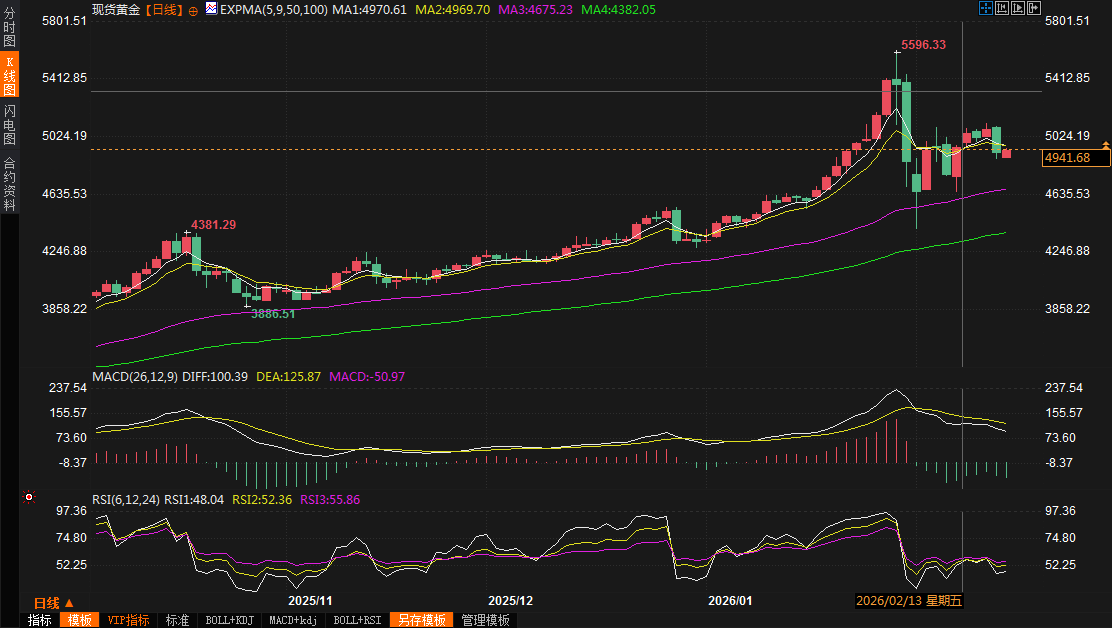
(Spot gold daily chart, source: FX678)
At 08:14 Beijing time, spot gold was trading at $4940.12 per ounce.
All of this happened within just a few hours. It all happened so fast that even seasoned traders were caught off guard, and market analysts were baffled. But this was not an unexpected event without warning; rather, it was a systemic sell-off triggered by a convergence of fundamental, technical, and sentiment factors.
On Friday (February 13) in early Asian trading, spot gold rebounded in a narrow range, currently trading at $4,940 per ounce, up about 0.4%. Market attention is focused on the US CPI data today.
I. Strong non-farm payrolls suppress expectations of interest rate cuts
What is the core logic behind this round of gold price increases? One factor is the market's obsession with the Federal Reserve's impending shift to interest rate cuts. However, Wednesday's US January jobs report dealt a heavy blow to this logic.
Data shows that non-farm payrolls increased by 130,000 in January, while December's figure was revised upwards—completely contrary to market expectations of a cooling job market. Even more surprisingly, the unemployment rate fell slightly to 4.3%. While the subsequent weekly initial jobless claims were slightly higher than expected, the figure of 227,000 still demonstrates that the labor market is far from needing intervention from the Federal Reserve.
The impact of this non-farm payroll report lies in its complete shattering of the market's belief in the trading theme of "weak economy - Fed rate cut - gold benefits." With such strong employment data in hand, policymakers have every reason to keep interest rates high for an extended period until they are certain that inflation is fully under control.
Gold's non-yielding nature becomes its fatal flaw at this moment. When the opportunity cost of holding gold remains high, and may even rise further, speculative funds' first reaction is to flee.
II. The $5,000 Curse: Stop-Loss Orders Trigger a Chain Reaction to a Collapse
If it were merely a negative non-farm payroll report, gold might only experience a mild correction. However, the fragile technical structure amplified the decline several times over.
City Index market analyst Fawad Razaqzada succinctly explained the key: a large number of investors placed stop-loss orders below $5,000. This means that when gold prices broke through this psychological level, it wasn't natural buying pressure that absorbed the selling pressure, but rather a collective triggering of numerous stop-loss orders.
This is a classic example of a "long squeeze" tragedy. Each stop-loss order triggered a new round of selling pressure, further driving down the price and triggering even more stop-losses. The chain reaction was completed within minutes, the $5,000 support level collapsed instantly, and a daily low of $4,878 followed.
This is not rational pricing driven by fundamentals, but rather a self-destructive technical structure. The $5,000 level is so fatal precisely because too many people believe it's an ironclad bottom, placing a dense array of stop-loss orders below it. The market is merciless; it preys on consensus expectations.
III. AI Panic: Stock Market Crash Drains Gold Prices
If non-farm payrolls and stop-loss orders were the internal factors causing the decline in gold prices, then the sharp fluctuations in external markets acted as an accelerator.
Thursday's U.S. stock market witnessed a bloodbath triggered by artificial intelligence. The Nasdaq plunged 2%, the S&P 500 fell more than 1.5%, and the Dow Jones Industrial Average was also not spared. The trigger was the market's deep anxiety about the disruptive effects of AI: from Cisco's lower-than-expected profit margins to the bloodbath in transportation stocks due to the prospect of AI automation, and Lenovo's warning of memory shortages impacting PC shipments, a series of signals made investors suddenly realize that while AI is creating winners, it is also creating a large number of losers.
This originally had nothing to do with gold. However, under extreme market pressure, safe-haven assets cannot always remain unaffected.
Nicky Shiels, Head of Metals Strategy at MKS PAMP, described a classic scenario: margin calls rained down on investors, forcing those heavily leveraged in the stock market to sell all their liquid assets to meet margin requirements. Even gold, with its safe-haven appeal, became a liquidity tool in that moment.
Even more frightening is the power of algorithmic trading. Bloomberg macro strategist Michael Ball points out that computer-driven players, such as commodity trading advisors, automatically trigger sell orders when prices fall below key thresholds. These algorithmic trades are emotionless, thoughtless, and mechanically executed. They amplify a potentially mild downturn into a systemic stampede.
Ole Hansen, a commodities strategist at Saxo Bank, aptly commented: "A significant portion of trading in gold and silver remains driven by sentiment and momentum. On days like these, they'll struggle." When the market sentiment, dominated by speculative trading, suddenly shifts, the frenzy of the retreat is predictable.
IV. Profit-taking and the battle for liquidity: A warning from the silver price crash
The fact that silver's 10% drop was more severe than gold's is no coincidence.
During its previous rapid rise, silver attracted a large amount of trend-following capital due to its higher volatility and stronger speculative nature. When market sentiment reversed, these funds exited the market much faster and more aggressively than gold. The silver crash serves as a warning for gold: speculative funds are fleeing at any cost, and any asset that has experienced excessive gains in the past will face a severe deleveraging process.
Copper prices on the London Metal Exchange were also affected, falling nearly 3% at one point during the session. This further confirms that the market is experiencing a liquidity squeeze across assets. Investors are not only abandoning precious metals but also withdrawing from industrial metals, with the sole aim of recouping cash and reducing risk.
V. The divergence between the US dollar and US Treasury bonds: Why are expectations of interest rate cuts "not dying"?
Interestingly, while gold prices plummeted, the US dollar index did not strengthen, but instead hovered around 96.93; the yield on the 10-year US Treasury note fell sharply by 8.1 basis points, marking its largest single-day drop since October.
This seemingly contradictory combination reveals the true market sentiment: investors are not convinced that the Fed will never cut rates, but rather that their expectations regarding the timing of rate cuts have shifted. The CME FedWatch tool shows that the probability of a rate cut at the June meeting remains close to 50%; the market is simply no longer betting on an earlier move.
Marvin Loh, senior global strategist at State Street, aptly summarized the situation: "The Federal Reserve will remain on the sidelines until issues such as tariff policy, inflation trends, and whether retail data foreshadow a recession become clearer." Analysts at Scotiabank were even more direct, believing the dollar will weaken across the board because the Fed will eventually ease policy, while other central banks may not follow suit.
This means that Thursday's plunge was not the end of the gold bull market, but rather a sharp fluctuation triggered by a correction in expectations. The market has sobered up from the frenzy of "the Fed is about to cut rates" and returned to the reality that "the Fed may cut rates later." This shift is enough to trigger a deep correction in severely overbought gold prices, but not enough to reverse long-term trends such as declining real interest rates, continued central bank gold purchases, and global de-dollarization.
VI. Eye of the Storm: Friday's US CPI Data Will Determine the Fate of the Storm
All eyes are on the U.S. January Consumer Price Index report, which will be released on Friday.
If inflation data is as strong as the jobs report, indicating persistent price pressures, the Fed's rate cut timetable will be further postponed, and the gold correction period will be prolonged. If inflation data shows a moderate decline, the market will resume betting on a mid-year rate cut, and gold is expected to find solid support below $5,000.
Jay Hatfield, CEO of Infrastructure Capital Advisors, believes the bond market sell-off following Wednesday's jobs report was an "overreaction." Whether this assessment is correct needs to be verified by inflation data.
Signals from the inflation-protected bond market indicate that the 5-year break-even yield has fallen from 2.502% to 2.466%, while the 10-year break-even yield is at 2.302%. Market expectations for future inflation remain stable and have not been significantly revised upwards despite strong employment data. This is a glimmer of hope for gold.
Conclusion
The gold price crash on February 12, 2026, was a classic lesson in the complexity of the market.
Non-farm payrolls provided the reason for the decline, stop-loss orders below $5,000 determined the manner of the decline, the liquidity squeeze triggered by the stock market crash amplified the magnitude of the decline, and the mechanical selling by algorithmic trading locked in the speed of the decline. These four forces were interlocked and progressively intensified, ultimately resulting in a bloodbath night with a single-day drop of over 3% and intraday volatility exceeding 4%.
For those long positions that placed stop-loss orders below $5,000, this was a brutal night of margin calls; for those waiting on the sidelines, it was a long-awaited opportunity to get on board. The fundamentals of gold have not collapsed; the interest rate cut cycle, though late, has arrived; global central banks' demand for gold remains; and the underlying geopolitical risks have never faded.
The breach of the $5,000 mark is not the scary part; what is truly frightening is losing sight of core principles during a market crash. When the wave of stop-loss orders subsides, algorithmic trading exits the market, and margin calls cease, gold will return to its most fundamental pricing anchor—real interest rates and the credibility of the US dollar.
Despite short-term pressure on gold, its long-term value as an inflation hedge and geopolitical safe haven remains. Investors should closely monitor the Federal Reserve's actions and global economic signals, avoiding blindly chasing momentum. If inflation data is moderate, gold may find a bottom and rebound below $5,000; otherwise, downside risks will intensify.
(Spot gold daily chart, source: FX678)
At 08:14 Beijing time, spot gold was trading at $4940.12 per ounce.
- Risk Warning and Disclaimer
- The market involves risk, and trading may not be suitable for all investors. This article is for reference only and does not constitute personal investment advice, nor does it take into account certain users’ specific investment objectives, financial situation, or other needs. Any investment decisions made based on this information are at your own risk.