Has the euro bottomed out? A data storm is quietly approaching.
2026-02-13 16:57:32
On Friday, February 13th, in early European trading, the euro continued its weak consolidation against the US dollar around 1.1850. Although the exchange rate closed virtually unchanged on Thursday, the intraday rebound was weak, with insufficient upward momentum, and the technical pattern gradually leaning towards a correction. Market attention is shifting from the previous day's risk sentiment to tonight's upcoming US January inflation data, leading to increased volatility expectations. Traders are generally adopting a wait-and-see approach, awaiting new pricing signals.

The price action during this phase reflects a clear cautious sentiment. From a macroeconomic perspective, the US dollar received support during the US session due to safe-haven demand, but risk appetite did not fully recover. Entering the Asian and European sessions on Friday, US stock index futures fell slightly by about -0.2%, indicating that global funds remain wary of short-term uncertainties. With the US dollar index above 97.00, liquid assets were once again favored. This "pre-data position reduction" behavior made it difficult for the euro to break through key resistance against the dollar, resulting in repeated fluctuations at low levels.
It's worth noting that the current weakness of the euro is not due to a deterioration in its own fundamentals, but rather a result of the combined effects of external pressures and market sentiment. Reports indicate that the US president plans to withdraw some tariffs on steel and aluminum. If this policy is implemented, it could stimulate a rebound in market risk appetite, weakening the safe-haven premium of the US dollar. This means that the downside potential of the euro may be limited, and it is more likely to maintain range-bound trading rather than a one-sided weakening in the short term.
The real focus is on the upcoming January Consumer Price Index (CPI) release from the U.S. Bureau of Labor Statistics. The market widely expects overall inflation to fall from 2.7% year-on-year to 2.5%, seemingly moderate. However, the truly sensitive factor is core inflation – excluding food and energy – which is expected to rise by 0.3% month-on-month, higher than December's 0.2%. Because core inflation better reflects the stickiness of service prices and the resilience of consumer demand, it is closely linked to the Federal Reserve's future policy path, and even slight deviations could trigger significant reactions.
If the actual core inflation figure exceeds 0.3% month-on-month, traders are likely to quickly raise their expectations for short-term interest rates, pushing the dollar higher immediately, while the euro/dollar pair may accelerate its decline to test lower support levels. Conversely, if the data falls short of expectations, the dollar's upward momentum will be suppressed, and the exchange rate is expected to hold its current range and attempt a technical rebound before the weekend. However, even if overall inflation falls to 2.5%, as long as core inflation remains high, market concerns about "inflation stickiness" will not easily dissipate, and the dollar may not continue to weaken; the market is more likely to experience a phase of fluctuation rather than a trend reversal.
Meanwhile, other recent economic data have presented conflicting signals. Initial jobless claims, released on Thursday, fell by 5,000 to 227,000, showing some improvement but still exceeding the expected 222,000; existing home sales in January plummeted 8.4%, further exacerbating concerns about slowing economic growth. This combination of weak growth and incompletely cooled inflation makes the market prone to volatility, with the dollar fluctuating between strength and weakness, and the euro struggling to escape its oscillating pattern.
In the Eurozone, the focus is on the preliminary GDP data for the fourth quarter of 2025. The market expects the economy to grow by 0.3% quarter-on-quarter, maintaining a stable pace, but the annualized growth rate may slow to 1.3%, slightly lower than the previous quarter's 1.4%. If the data meets expectations, it will only provide mild fundamental support for the euro and will not be enough to reverse the dollar-dominated market trend; if the data is unexpectedly weak, the euro will find it more difficult to mount an effective rebound in the face of inflation data; only a better-than-expected performance could amplify its upward potential during a dollar pullback.
From a technical perspective, the euro/dollar pair has been consolidating above 1.18 since its pullback from the previous high of 1.2081. Currently, 1.1900 forms a significant resistance level, having been repeatedly tested but failed to break through effectively, making it a psychological barrier that bulls must overcome. If positive data pushes the price above this level, further upside potential may open up. On the downside, the key short-term support level to watch is 1.1765. A break below this level could trigger a new round of technical selling pressure, forcing the market to reassess the next support zone.
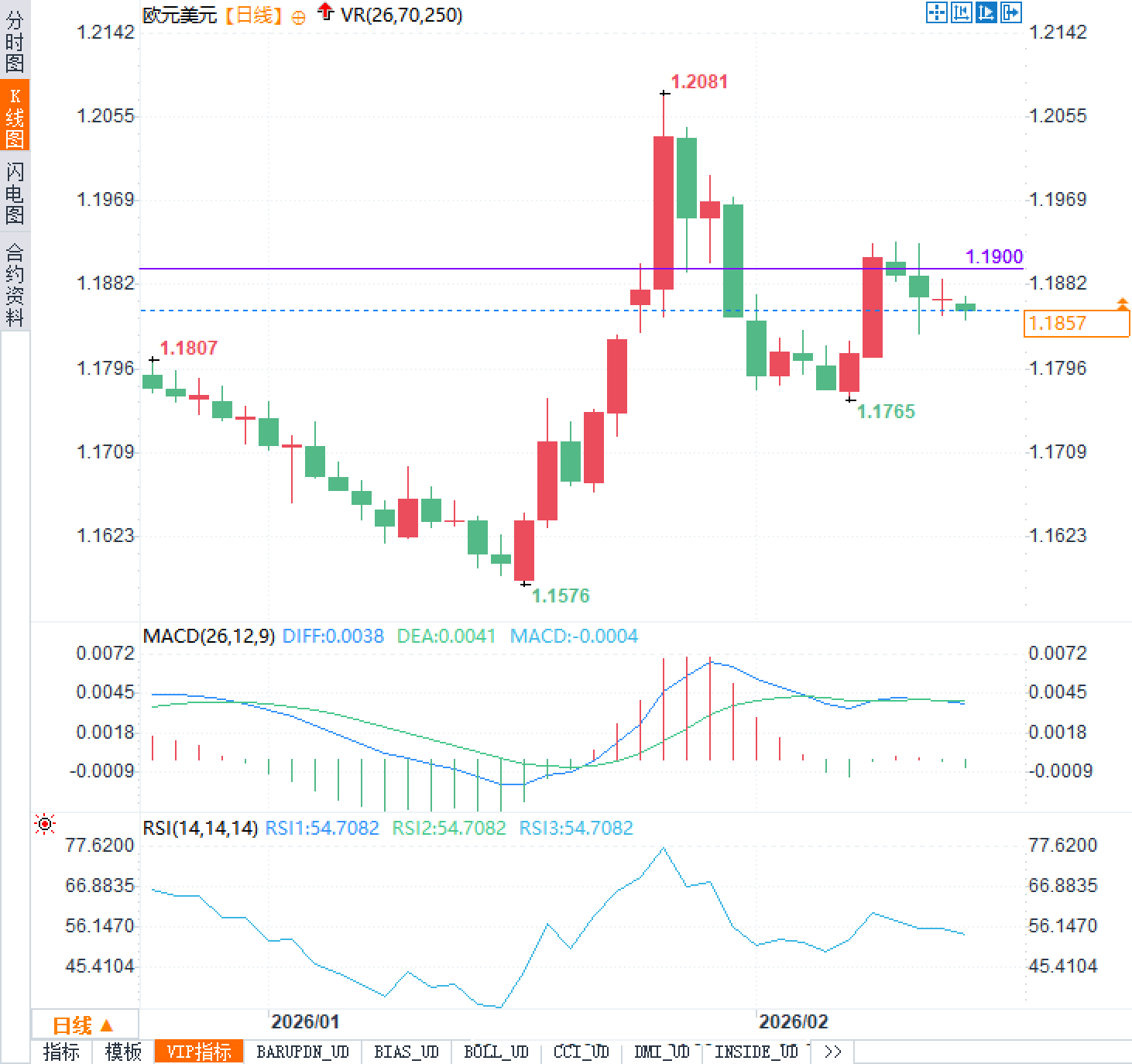
In terms of momentum indicators, commonly used tools such as RSI and MACD have leveled off after falling from high levels, without showing extreme oversold or overbought conditions, confirming that the current market is in a typical consolidation phase. This indicates that the market has not yet formed a clear directional consensus, and the market is still driven by external information flows. Especially before and after the release of important US data, the first wave of price fluctuations is often the most decisive. The true direction will depend on the degree of deviation between the US January core inflation data and the expected 0.3%, as well as the rebalancing of risk sentiment under multiple factors such as tariff news and employment prospects.
The price action during this phase reflects a clear cautious sentiment. From a macroeconomic perspective, the US dollar received support during the US session due to safe-haven demand, but risk appetite did not fully recover. Entering the Asian and European sessions on Friday, US stock index futures fell slightly by about -0.2%, indicating that global funds remain wary of short-term uncertainties. With the US dollar index above 97.00, liquid assets were once again favored. This "pre-data position reduction" behavior made it difficult for the euro to break through key resistance against the dollar, resulting in repeated fluctuations at low levels.
It's worth noting that the current weakness of the euro is not due to a deterioration in its own fundamentals, but rather a result of the combined effects of external pressures and market sentiment. Reports indicate that the US president plans to withdraw some tariffs on steel and aluminum. If this policy is implemented, it could stimulate a rebound in market risk appetite, weakening the safe-haven premium of the US dollar. This means that the downside potential of the euro may be limited, and it is more likely to maintain range-bound trading rather than a one-sided weakening in the short term.
Core inflation becomes the deciding factor, and the fate of the US dollar hangs in the balance.
The real focus is on the upcoming January Consumer Price Index (CPI) release from the U.S. Bureau of Labor Statistics. The market widely expects overall inflation to fall from 2.7% year-on-year to 2.5%, seemingly moderate. However, the truly sensitive factor is core inflation – excluding food and energy – which is expected to rise by 0.3% month-on-month, higher than December's 0.2%. Because core inflation better reflects the stickiness of service prices and the resilience of consumer demand, it is closely linked to the Federal Reserve's future policy path, and even slight deviations could trigger significant reactions.
If the actual core inflation figure exceeds 0.3% month-on-month, traders are likely to quickly raise their expectations for short-term interest rates, pushing the dollar higher immediately, while the euro/dollar pair may accelerate its decline to test lower support levels. Conversely, if the data falls short of expectations, the dollar's upward momentum will be suppressed, and the exchange rate is expected to hold its current range and attempt a technical rebound before the weekend. However, even if overall inflation falls to 2.5%, as long as core inflation remains high, market concerns about "inflation stickiness" will not easily dissipate, and the dollar may not continue to weaken; the market is more likely to experience a phase of fluctuation rather than a trend reversal.
Meanwhile, other recent economic data have presented conflicting signals. Initial jobless claims, released on Thursday, fell by 5,000 to 227,000, showing some improvement but still exceeding the expected 222,000; existing home sales in January plummeted 8.4%, further exacerbating concerns about slowing economic growth. This combination of weak growth and incompletely cooled inflation makes the market prone to volatility, with the dollar fluctuating between strength and weakness, and the euro struggling to escape its oscillating pattern.
Fundamental and technical factors converge, key price levels become battlegrounds between bulls and bears.
In the Eurozone, the focus is on the preliminary GDP data for the fourth quarter of 2025. The market expects the economy to grow by 0.3% quarter-on-quarter, maintaining a stable pace, but the annualized growth rate may slow to 1.3%, slightly lower than the previous quarter's 1.4%. If the data meets expectations, it will only provide mild fundamental support for the euro and will not be enough to reverse the dollar-dominated market trend; if the data is unexpectedly weak, the euro will find it more difficult to mount an effective rebound in the face of inflation data; only a better-than-expected performance could amplify its upward potential during a dollar pullback.
From a technical perspective, the euro/dollar pair has been consolidating above 1.18 since its pullback from the previous high of 1.2081. Currently, 1.1900 forms a significant resistance level, having been repeatedly tested but failed to break through effectively, making it a psychological barrier that bulls must overcome. If positive data pushes the price above this level, further upside potential may open up. On the downside, the key short-term support level to watch is 1.1765. A break below this level could trigger a new round of technical selling pressure, forcing the market to reassess the next support zone.
In terms of momentum indicators, commonly used tools such as RSI and MACD have leveled off after falling from high levels, without showing extreme oversold or overbought conditions, confirming that the current market is in a typical consolidation phase. This indicates that the market has not yet formed a clear directional consensus, and the market is still driven by external information flows. Especially before and after the release of important US data, the first wave of price fluctuations is often the most decisive. The true direction will depend on the degree of deviation between the US January core inflation data and the expected 0.3%, as well as the rebalancing of risk sentiment under multiple factors such as tariff news and employment prospects.
- Risk Warning and Disclaimer
- The market involves risk, and trading may not be suitable for all investors. This article is for reference only and does not constitute personal investment advice, nor does it take into account certain users’ specific investment objectives, financial situation, or other needs. Any investment decisions made based on this information are at your own risk.