February 16th Financial Breakfast: Inflation reignites hopes for a Fed rate cut; gold prices test $5000 support; OPEC+ may resume production increases in April, putting pressure on oil prices.
2026-02-16 07:09:54
On Monday (February 16, Beijing time) in early Asian trading, spot gold was trading around $5,018 per ounce. Lower-than-expected US inflation data for January reignited market hopes for a Federal Reserve rate cut this year, overshadowing the pressure from strong employment data earlier last week. US crude oil was trading around $62.85 per barrel. OPEC+ is leaning towards resuming its production increase plan from April, and US military intelligence is discussing supporting Israeli airstrikes against Iran; geopolitical uncertainty is supporting oil prices.

U.S. stocks closed mixed on Friday, with the S&P 500 rising slightly on positive news of easing inflation, but the Nasdaq fell, dragged down by tech giants. Continued concerns that generative artificial intelligence could disrupt existing business models and squeeze corporate profits weighed on the tech sector, and investor caution ahead of Monday's President's Day holiday caused the market to give back earlier gains driven by inflation data.
Despite weaker-than-expected U.S. consumer price increases in January, slightly increasing market bets on a June rate cut, the three major stock indexes still recorded significant declines last week, marking their biggest weekly drop since November. Large-cap tech stocks underperformed, with Nvidia and Apple being the biggest drags on the S&P 500. Meanwhile, funds flowed into defensive sectors, with utilities and real estate stocks leading the gains, and the healthcare sector also performing well due to better-than-expected earnings from companies like Dexcom and Moderna. Chip equipment supplier Applied Materials saw its share price surge on strong quarterly forecasts, providing the biggest boost to the market.
On the other hand, White House trade advisors denied reports of lowering steel and aluminum tariffs, causing some steel and aluminum stocks to fall. Looking ahead, strategists warn that market volatility may increase as the US midterm elections approach and expectations of a potential change in Federal Reserve leadership persist.
Gold prices rose more than 2% on Friday, closing higher for the week, as weaker-than-expected U.S. inflation data for January rekindled hopes for a Federal Reserve rate cut this year, a factor that outweighed the pressure from strong jobs data earlier in the week. Spot gold settled at $5,022.06 an ounce, up 1.2% for the week.
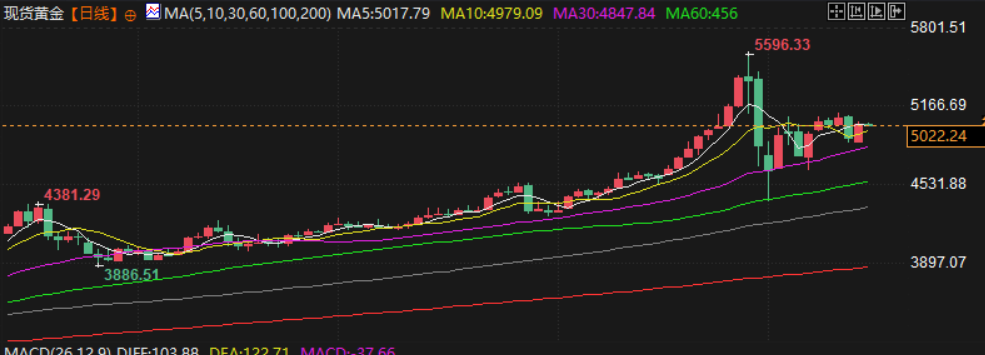
Easing inflation eased previous market jitters, with moderate CPI data providing a relief rally for gold after concerns were raised by Wednesday's strong jobs report. Market participants now expect a cumulative 63 basis point rate cuts this year, with the first cut anticipated in July.
In other precious metals, spot silver rose 3.4% to $77.70 an ounce, after plunging 11% in the previous session and falling slightly last week. Spot platinum and palladium also rose, but both recorded weekly declines.
On the demand side, with the Spring Festival approaching, Chinese gold demand remains strong, while the Indian market has turned to a discount. ANZ Bank has raised its second-quarter gold price forecast to $5,800 per ounce, citing the increased attractiveness of gold as an insurance asset.
International oil prices rose slightly on Friday, as optimism surrounding slowing US inflation offset supply concerns about a potential resumption of production increases by OPEC+. Brent crude futures rose 0.3% to $67.75 a barrel, while US crude futures edged up 0.08% to $62.89. Despite Friday's rebound, both benchmark crudes still recorded weekly declines for the week.
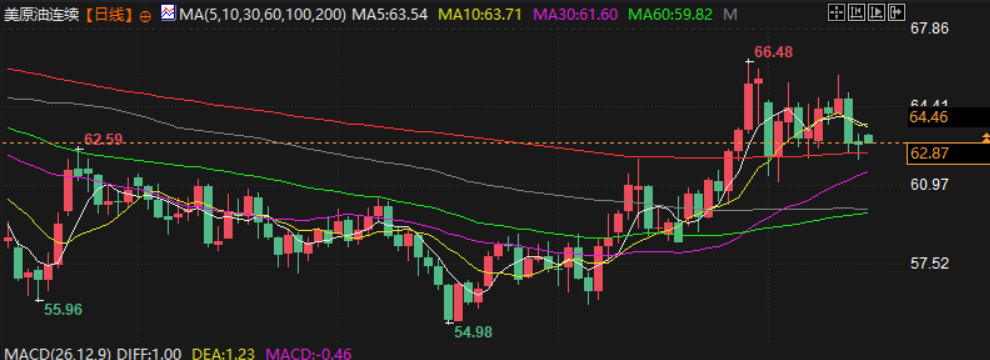
U.S. consumer price increases in January were lower than expected, and signs of stabilizing inflation boosted risk appetite and could push interest rates lower, which would be a positive factor for economic growth and energy demand. However, the market still faces supply-side pressures, with reports indicating that OPEC+ is inclined to resume production increases from April, which would increase market supply ahead of the peak summer fuel demand season. In addition, the number of U.S. oil drilling rigs decreased by three this week, and Russia stated that the next round of peace talks in Ukraine will be held next week.
The dollar was largely unchanged against major currencies on Friday. Earlier data showed that U.S. inflation rose less than expected in January, suggesting the Federal Reserve is likely to keep interest rates unchanged in the near term. Meanwhile, the yen is on track for its strongest weekly gain in about 15 months.
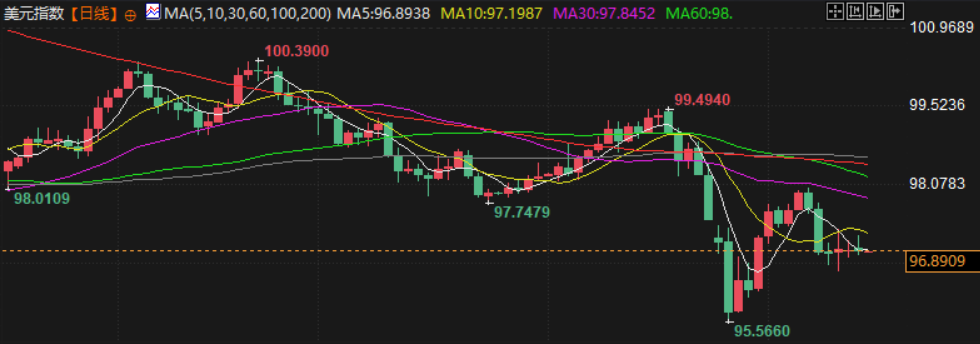
Data released by the U.S. Labor Department last Friday showed that the Consumer Price Index (CPI) rose 0.2% month-over-month last month, lower than the expected 0.3%. The market reacted mildly. Olivier Bellemare, senior derivatives trader at Monex Canada, said the dollar's movement reflected position adjustments as the market awaited signals from central banks regarding interest rate direction.
Data released earlier last week also showed that the U.S. labor market was stabilizing: job growth was strong in January and the unemployment rate fell. Bellemare noted that the market's reaction to this data was equally mild, with most of the movements being tactical.
Among major currency pairs, the euro rose slightly by 0.02% against the dollar to $1.1873, after rising 0.5% last week. The dollar fell 0.22% against the Swiss franc to 0.76785. The dollar index, which measures the dollar's value against six major currencies, slipped 0.07% to 96.85, with a cumulative decline of 0.84% last week. Goldman Sachs analysts noted in an investor report that the dollar's relative weakness stemmed partly from policy volatility in the US in January and the recent sell-off in the software sector, which weakened the outperformance of US stocks.
The yen dominated the foreign exchange market last week. With Prime Minister Sanae Takaichi's historic election victory easing investor concerns about the government's fiscal situation, the yen received strong support. The yen rose nearly 3% against the dollar last week, its biggest weekly gain since November 2024, climbing 0.08% to 152.67 yen on Friday. Against the euro, the yen rose 0.02% to 181.29 yen, accumulating a 2.37% gain for the week, its strongest performance in a year.
Among other currencies, the Australian dollar has recently surged due to the Reserve Bank of Australia's stance, becoming the best-performing major currency so far in 2026. In late New York trading, the Australian dollar fell 0.20% to US$0.70765, but is still up nearly 1% for the week. The Canadian dollar edged up 0.10% to US$1.361, though it still fell 0.45% overall last week.
US media: If US-Iran negotiations fail, Trump supports Israeli airstrikes on Iranian ballistic missile facilities.
US media reported on the 15th that US President Trump told Israeli Prime Minister Netanyahu that he would support Israel in airstrikes against Iranian ballistic missile facilities if the US and Iran could not reach an agreement. According to CBS News, citing two sources familiar with the matter, Trump made this promise during a meeting with Netanyahu at Mar-a-Lago in Florida last December. Two other US officials familiar with the matter said that senior US military and intelligence officials have begun discussing the possibility of supporting Israeli airstrikes, focusing not on whether Israel will act, but on how the US can assist Israeli airstrikes, including refueling Israeli warplanes in mid-air and ensuring relevant countries agree to allow US and Israeli aircraft to fly over their airspace. (Xinhua)
Hungary and Slovakia sent a letter to Croatia requesting assistance in transporting Russian crude oil.
On February 15th local time, Hungarian Foreign Minister Szijjártó posted on his personal social media that, due to Ukraine's continued suspension of transit transport through the "Friendship" oil pipeline, Hungary and Slovakia have sought assistance from Croatia, hoping to transport Russian crude oil via the "Adriatic" pipeline. Szijjártó stated that Hungary and Slovakia had previously secured the right to continue purchasing cheap Russian crude oil through the "Friendship" pipeline, and this waiver also included the option of purchasing Russian crude oil by sea if transit via the pipeline became unfeasible. Szijjártó stated that Ukraine, for political reasons, has still not resumed oil transport through the "Friendship" pipeline. Therefore, he, along with Slovakian Economy Minister Sakova, wrote to Croatian Economy Minister Šushniyar, requesting Croatia to immediately allow the transport of Russian crude oil to Hungary and Slovakia via the "Adriatic" pipeline, in accordance with relevant EU regulations. (CCTV News)
Sources: OPEC+ is currently leaning towards resuming its production increase plan starting in April.
According to three OPEC+ sources, OPEC+ is currently leaning towards resuming its production increase plan starting in April to meet peak summer demand, while heightened tensions between the US and Iran have further pushed up oil prices. The resumption of the production increase plan would allow Saudi Arabia and the UAE to regain market share, as member countries such as Russia, Venezuela, and Iran are currently facing pressure from Western sanctions, while Kazakhstan's production has been constrained by a series of setbacks. OPEC+ will meet on March 1. Two sources said that no decision has been made yet, and consultations will continue in the weeks leading up to the meeting. OPEC, Russia, and Saudi Arabia did not immediately respond to requests for comment.
U.S. Treasury Secretary Bessant: The Senate Banking Committee has agreed to proceed with confirmation hearings for Warsh as the new Federal Reserve Chairman.
U.S. Treasury Secretary Kevin Warsh said last Friday that the Senate Banking Committee has agreed to proceed with confirmation hearings for President Trump's nomination of Kevin Warsh to succeed him as Federal Reserve Chairman, despite reservations from a key senator. Warsh stated, "I think holding hearings is crucial. Chairman Powell's term expires in mid-May, and anyone concerned about the integrity and independence of the Fed wants to see Kevin Warsh ensure continuity."
Iranian Foreign Minister departs for second round of Iran-US talks
On the evening of the 15th local time, Iranian Foreign Minister Araqchi led an Iranian negotiating delegation to Geneva, Switzerland, to participate in the second round of Iran-US talks and other diplomatic activities. It is understood that in addition to participating in the talks on the 17th, Araqchi will also meet with the Swiss Foreign Minister, the Omani Foreign Minister, the Director General of the International Atomic Energy Agency, and other officials. According to previous reports, the new round of US-Iran talks will be held in Geneva, Switzerland on the 17th. Sources say that the US delegation, including US Presidential Special Envoy Witkov and Trump's son-in-law Jared Kushner, will begin negotiations with the Iranian side on the morning of the 17th, while Omani representatives will coordinate the contacts between the two sides. (CCTV News)
Iranian officials: We are prepared with a negotiation plan with the US, but we are not optimistic about the outcome.
On March 15th local time, Ibrahim Rezaei, spokesperson for the Iranian Parliament's National Security and Foreign Policy Committee, stated that the current negotiations did not discuss Iran halting or abandoning its uranium enrichment activities, nor did they discuss removing Iran's nuclear materials from the country; these issues have been accepted by the United States. Rezaei stated that the Geneva negotiations are unrelated to the missile issue or regional issues. Iran believes that Israel is the primary issue in the region. The threat from Israel should be excluded from the Geneva negotiations and discussed with other countries in the region to ensure their development, peace, and common interests. Rezaei emphasized that the Iranian negotiating team has prepared a negotiating plan, "but considering the United States' past record, we are not very optimistic about the outcome of the negotiations." (CCTV News)
Danish Prime Minister: Greenland "cannot be priced"; sovereignty must be respected.
On March 14th local time, Danish Prime Minister Helen Frederiksen stated at the Munich Security Conference regarding the Greenland issue that Greenland "cannot be priced." During a discussion on European security, the future of NATO, and geopolitical challenges, when asked if she could put a price tag on Greenland, Frederiksen clearly replied, "Of course not." Frederiksen stated that the right of sovereign states and peoples to self-determination must be respected. She emphasized that the Kingdom of Denmark is a sovereign nation, and the people of Greenland have clearly expressed their position: they do not want to become Americans, but rather wish to continue existing as Greenlanders. Frederiksen also stated that the US president's position on Greenland remains unchanged, and she still holds a different opinion. (CCTV News)
The Department of Homeland Security has begun to shut down due to a funding deadlock, but key positions remain operational.
The Department of Homeland Security (DHS) began a shutdown this Saturday due to a congressional funding deadlock with no prospect of a short-term solution. The deadlock was triggered by strong public opposition to the Trump administration's large-scale immigration enforcement operations, coupled with Congress being in recess and failing to reach an agreement on Democratic demands for new restrictions on immigration enforcement. The initial impact of the shutdown is expected to be limited, but will expand over time. Unlike the historic 43-day shutdown at the end of last year, funding for most other departments has been secured until September 30th. Furthermore, since over 90% of DHS employees are considered essential personnel, they will continue working during the shutdown. Therefore, core functions such as immigration raids, citizenship approvals, airport security, cybersecurity, and Coast Guard operations will continue as normal.
AI "technology equality" is accelerating: the era of one-person film crews may be coming.
Several industry insiders stated that the upgrade of AI video generation technology is accelerating "technology democratization." "Perhaps we'll be able to produce a 90-minute movie in a single day." Industry analysts believe that the upgrade of AI video generation models will further promote the accelerated development of niche areas such as AI-generated comics, short dramas, and interactive films, especially with the comics market expected to experience rapid growth. Shen Yang, a dual-appointed professor at the School of Journalism and Communication and the Institute of Artificial Intelligence at Tsinghua University, said, "One-person companies and one-person production teams will gradually become a trend." (CCTV Finance)
Port equipment operating rates bucked the trend and increased in January, laying a solid foundation for the start of foreign trade in 2026.
Excavators are a standard component of infrastructure construction and a barometer of economic changes, reflecting infrastructure development and fixed asset investment. Data shows that in January, the national port equipment operating rate was 33.85%, up 2.97 percentage points year-on-year and 0.68 percentage points month-on-month. The year-on-year growth rate of workload was 21.94%, and the month-on-month growth rate was 0.28%. January typically sees a decline in port demand due to seasonal factors such as pre-holiday shutdowns and workers returning home. However, this strong performance indicates that seasonal suppression has been offset by robust foreign trade demand. This demonstrates the strong resilience of demand from overseas order preparations and cross-border e-commerce, and also reflects the maturity of my country's port operation system and improved collection and distribution efficiency, effectively smoothing seasonal fluctuations and laying a solid foundation for the start of foreign trade in 2026. (CCTV Finance)
Helicopter rides back home for 599 yuan: Bookings for low-altitude routes in the Yangtze River Delta region are booming.
Since the start of this year's Spring Festival travel rush, low-altitude helicopter routes in the Yangtze River Delta region have provided a new travel option, with some routes experiencing a surge in bookings before the holiday. The flight manager of Shanghai Xinkong Helicopter Co., Ltd. stated that flight demand has increased significantly during the Spring Festival travel rush, with overall bookings currently about 1.5 times higher than usual. It has been learned that low-altitude routes in the Yangtze River Delta region have seen a surge in operations during this year's Spring Festival travel rush. Centered on Shanghai, the Nantong Chongchuan to Shanghai Pudong route plans to operate 2 to 4 round-trip flights daily, with a current one-way ticket price of 698 yuan. The Zhoushan to Shengsi route in Zhejiang Province has a ticket price of 599 yuan and will maintain one flight daily before and after the Spring Festival. The Shanghai to Shengsi route will operate 3 flights daily in February. In the next step, Shengsi County will gradually cover popular tourist islands such as Gouqi and Shengshan, facilitating inter-island travel. (CCTV Finance)
my country's banks continued to maintain a foreign exchange settlement surplus in January.
According to statistics released by the State Administration of Foreign Exchange (SAFE) recently, in January 2026, banks settled 2.0048 trillion yuan in foreign exchange and sold 1.4457 trillion yuan; banks' foreign exchange receipts on behalf of clients totaled 5.4722 trillion yuan, while their payments totaled 4.8974 trillion yuan. Li Bin, Deputy Director and Spokesperson of SAFE, explained that in January, both the bank's foreign exchange settlement surplus and the net inflow of cross-border funds from non-bank sectors such as enterprises and individuals declined compared to the previous month. This was mainly due to seasonal factors; while corporate receipts and settlements increased rapidly, the growth slowed recently as demand gradually increased. "Overall, my country's foreign exchange market is active, expectations are stable, and cross-border capital flows are becoming more stable," said Li Bin. (Xinhua News Agency)
stock market
U.S. stocks closed mixed on Friday, with the S&P 500 rising slightly on positive news of easing inflation, but the Nasdaq fell, dragged down by tech giants. Continued concerns that generative artificial intelligence could disrupt existing business models and squeeze corporate profits weighed on the tech sector, and investor caution ahead of Monday's President's Day holiday caused the market to give back earlier gains driven by inflation data.
Despite weaker-than-expected U.S. consumer price increases in January, slightly increasing market bets on a June rate cut, the three major stock indexes still recorded significant declines last week, marking their biggest weekly drop since November. Large-cap tech stocks underperformed, with Nvidia and Apple being the biggest drags on the S&P 500. Meanwhile, funds flowed into defensive sectors, with utilities and real estate stocks leading the gains, and the healthcare sector also performing well due to better-than-expected earnings from companies like Dexcom and Moderna. Chip equipment supplier Applied Materials saw its share price surge on strong quarterly forecasts, providing the biggest boost to the market.
On the other hand, White House trade advisors denied reports of lowering steel and aluminum tariffs, causing some steel and aluminum stocks to fall. Looking ahead, strategists warn that market volatility may increase as the US midterm elections approach and expectations of a potential change in Federal Reserve leadership persist.
Gold Market
Gold prices rose more than 2% on Friday, closing higher for the week, as weaker-than-expected U.S. inflation data for January rekindled hopes for a Federal Reserve rate cut this year, a factor that outweighed the pressure from strong jobs data earlier in the week. Spot gold settled at $5,022.06 an ounce, up 1.2% for the week.
Easing inflation eased previous market jitters, with moderate CPI data providing a relief rally for gold after concerns were raised by Wednesday's strong jobs report. Market participants now expect a cumulative 63 basis point rate cuts this year, with the first cut anticipated in July.
In other precious metals, spot silver rose 3.4% to $77.70 an ounce, after plunging 11% in the previous session and falling slightly last week. Spot platinum and palladium also rose, but both recorded weekly declines.
On the demand side, with the Spring Festival approaching, Chinese gold demand remains strong, while the Indian market has turned to a discount. ANZ Bank has raised its second-quarter gold price forecast to $5,800 per ounce, citing the increased attractiveness of gold as an insurance asset.
oil market
International oil prices rose slightly on Friday, as optimism surrounding slowing US inflation offset supply concerns about a potential resumption of production increases by OPEC+. Brent crude futures rose 0.3% to $67.75 a barrel, while US crude futures edged up 0.08% to $62.89. Despite Friday's rebound, both benchmark crudes still recorded weekly declines for the week.
U.S. consumer price increases in January were lower than expected, and signs of stabilizing inflation boosted risk appetite and could push interest rates lower, which would be a positive factor for economic growth and energy demand. However, the market still faces supply-side pressures, with reports indicating that OPEC+ is inclined to resume production increases from April, which would increase market supply ahead of the peak summer fuel demand season. In addition, the number of U.S. oil drilling rigs decreased by three this week, and Russia stated that the next round of peace talks in Ukraine will be held next week.
Foreign exchange market
The dollar was largely unchanged against major currencies on Friday. Earlier data showed that U.S. inflation rose less than expected in January, suggesting the Federal Reserve is likely to keep interest rates unchanged in the near term. Meanwhile, the yen is on track for its strongest weekly gain in about 15 months.
Data released by the U.S. Labor Department last Friday showed that the Consumer Price Index (CPI) rose 0.2% month-over-month last month, lower than the expected 0.3%. The market reacted mildly. Olivier Bellemare, senior derivatives trader at Monex Canada, said the dollar's movement reflected position adjustments as the market awaited signals from central banks regarding interest rate direction.
Data released earlier last week also showed that the U.S. labor market was stabilizing: job growth was strong in January and the unemployment rate fell. Bellemare noted that the market's reaction to this data was equally mild, with most of the movements being tactical.
Among major currency pairs, the euro rose slightly by 0.02% against the dollar to $1.1873, after rising 0.5% last week. The dollar fell 0.22% against the Swiss franc to 0.76785. The dollar index, which measures the dollar's value against six major currencies, slipped 0.07% to 96.85, with a cumulative decline of 0.84% last week. Goldman Sachs analysts noted in an investor report that the dollar's relative weakness stemmed partly from policy volatility in the US in January and the recent sell-off in the software sector, which weakened the outperformance of US stocks.
The yen dominated the foreign exchange market last week. With Prime Minister Sanae Takaichi's historic election victory easing investor concerns about the government's fiscal situation, the yen received strong support. The yen rose nearly 3% against the dollar last week, its biggest weekly gain since November 2024, climbing 0.08% to 152.67 yen on Friday. Against the euro, the yen rose 0.02% to 181.29 yen, accumulating a 2.37% gain for the week, its strongest performance in a year.
Among other currencies, the Australian dollar has recently surged due to the Reserve Bank of Australia's stance, becoming the best-performing major currency so far in 2026. In late New York trading, the Australian dollar fell 0.20% to US$0.70765, but is still up nearly 1% for the week. The Canadian dollar edged up 0.10% to US$1.361, though it still fell 0.45% overall last week.
International News
US media: If US-Iran negotiations fail, Trump supports Israeli airstrikes on Iranian ballistic missile facilities.
US media reported on the 15th that US President Trump told Israeli Prime Minister Netanyahu that he would support Israel in airstrikes against Iranian ballistic missile facilities if the US and Iran could not reach an agreement. According to CBS News, citing two sources familiar with the matter, Trump made this promise during a meeting with Netanyahu at Mar-a-Lago in Florida last December. Two other US officials familiar with the matter said that senior US military and intelligence officials have begun discussing the possibility of supporting Israeli airstrikes, focusing not on whether Israel will act, but on how the US can assist Israeli airstrikes, including refueling Israeli warplanes in mid-air and ensuring relevant countries agree to allow US and Israeli aircraft to fly over their airspace. (Xinhua)
Hungary and Slovakia sent a letter to Croatia requesting assistance in transporting Russian crude oil.
On February 15th local time, Hungarian Foreign Minister Szijjártó posted on his personal social media that, due to Ukraine's continued suspension of transit transport through the "Friendship" oil pipeline, Hungary and Slovakia have sought assistance from Croatia, hoping to transport Russian crude oil via the "Adriatic" pipeline. Szijjártó stated that Hungary and Slovakia had previously secured the right to continue purchasing cheap Russian crude oil through the "Friendship" pipeline, and this waiver also included the option of purchasing Russian crude oil by sea if transit via the pipeline became unfeasible. Szijjártó stated that Ukraine, for political reasons, has still not resumed oil transport through the "Friendship" pipeline. Therefore, he, along with Slovakian Economy Minister Sakova, wrote to Croatian Economy Minister Šushniyar, requesting Croatia to immediately allow the transport of Russian crude oil to Hungary and Slovakia via the "Adriatic" pipeline, in accordance with relevant EU regulations. (CCTV News)
Sources: OPEC+ is currently leaning towards resuming its production increase plan starting in April.
According to three OPEC+ sources, OPEC+ is currently leaning towards resuming its production increase plan starting in April to meet peak summer demand, while heightened tensions between the US and Iran have further pushed up oil prices. The resumption of the production increase plan would allow Saudi Arabia and the UAE to regain market share, as member countries such as Russia, Venezuela, and Iran are currently facing pressure from Western sanctions, while Kazakhstan's production has been constrained by a series of setbacks. OPEC+ will meet on March 1. Two sources said that no decision has been made yet, and consultations will continue in the weeks leading up to the meeting. OPEC, Russia, and Saudi Arabia did not immediately respond to requests for comment.
U.S. Treasury Secretary Bessant: The Senate Banking Committee has agreed to proceed with confirmation hearings for Warsh as the new Federal Reserve Chairman.
U.S. Treasury Secretary Kevin Warsh said last Friday that the Senate Banking Committee has agreed to proceed with confirmation hearings for President Trump's nomination of Kevin Warsh to succeed him as Federal Reserve Chairman, despite reservations from a key senator. Warsh stated, "I think holding hearings is crucial. Chairman Powell's term expires in mid-May, and anyone concerned about the integrity and independence of the Fed wants to see Kevin Warsh ensure continuity."
Iranian Foreign Minister departs for second round of Iran-US talks
On the evening of the 15th local time, Iranian Foreign Minister Araqchi led an Iranian negotiating delegation to Geneva, Switzerland, to participate in the second round of Iran-US talks and other diplomatic activities. It is understood that in addition to participating in the talks on the 17th, Araqchi will also meet with the Swiss Foreign Minister, the Omani Foreign Minister, the Director General of the International Atomic Energy Agency, and other officials. According to previous reports, the new round of US-Iran talks will be held in Geneva, Switzerland on the 17th. Sources say that the US delegation, including US Presidential Special Envoy Witkov and Trump's son-in-law Jared Kushner, will begin negotiations with the Iranian side on the morning of the 17th, while Omani representatives will coordinate the contacts between the two sides. (CCTV News)
Iranian officials: We are prepared with a negotiation plan with the US, but we are not optimistic about the outcome.
On March 15th local time, Ibrahim Rezaei, spokesperson for the Iranian Parliament's National Security and Foreign Policy Committee, stated that the current negotiations did not discuss Iran halting or abandoning its uranium enrichment activities, nor did they discuss removing Iran's nuclear materials from the country; these issues have been accepted by the United States. Rezaei stated that the Geneva negotiations are unrelated to the missile issue or regional issues. Iran believes that Israel is the primary issue in the region. The threat from Israel should be excluded from the Geneva negotiations and discussed with other countries in the region to ensure their development, peace, and common interests. Rezaei emphasized that the Iranian negotiating team has prepared a negotiating plan, "but considering the United States' past record, we are not very optimistic about the outcome of the negotiations." (CCTV News)
Danish Prime Minister: Greenland "cannot be priced"; sovereignty must be respected.
On March 14th local time, Danish Prime Minister Helen Frederiksen stated at the Munich Security Conference regarding the Greenland issue that Greenland "cannot be priced." During a discussion on European security, the future of NATO, and geopolitical challenges, when asked if she could put a price tag on Greenland, Frederiksen clearly replied, "Of course not." Frederiksen stated that the right of sovereign states and peoples to self-determination must be respected. She emphasized that the Kingdom of Denmark is a sovereign nation, and the people of Greenland have clearly expressed their position: they do not want to become Americans, but rather wish to continue existing as Greenlanders. Frederiksen also stated that the US president's position on Greenland remains unchanged, and she still holds a different opinion. (CCTV News)
The Department of Homeland Security has begun to shut down due to a funding deadlock, but key positions remain operational.
The Department of Homeland Security (DHS) began a shutdown this Saturday due to a congressional funding deadlock with no prospect of a short-term solution. The deadlock was triggered by strong public opposition to the Trump administration's large-scale immigration enforcement operations, coupled with Congress being in recess and failing to reach an agreement on Democratic demands for new restrictions on immigration enforcement. The initial impact of the shutdown is expected to be limited, but will expand over time. Unlike the historic 43-day shutdown at the end of last year, funding for most other departments has been secured until September 30th. Furthermore, since over 90% of DHS employees are considered essential personnel, they will continue working during the shutdown. Therefore, core functions such as immigration raids, citizenship approvals, airport security, cybersecurity, and Coast Guard operations will continue as normal.
Domestic News
AI "technology equality" is accelerating: the era of one-person film crews may be coming.
Several industry insiders stated that the upgrade of AI video generation technology is accelerating "technology democratization." "Perhaps we'll be able to produce a 90-minute movie in a single day." Industry analysts believe that the upgrade of AI video generation models will further promote the accelerated development of niche areas such as AI-generated comics, short dramas, and interactive films, especially with the comics market expected to experience rapid growth. Shen Yang, a dual-appointed professor at the School of Journalism and Communication and the Institute of Artificial Intelligence at Tsinghua University, said, "One-person companies and one-person production teams will gradually become a trend." (CCTV Finance)
Port equipment operating rates bucked the trend and increased in January, laying a solid foundation for the start of foreign trade in 2026.
Excavators are a standard component of infrastructure construction and a barometer of economic changes, reflecting infrastructure development and fixed asset investment. Data shows that in January, the national port equipment operating rate was 33.85%, up 2.97 percentage points year-on-year and 0.68 percentage points month-on-month. The year-on-year growth rate of workload was 21.94%, and the month-on-month growth rate was 0.28%. January typically sees a decline in port demand due to seasonal factors such as pre-holiday shutdowns and workers returning home. However, this strong performance indicates that seasonal suppression has been offset by robust foreign trade demand. This demonstrates the strong resilience of demand from overseas order preparations and cross-border e-commerce, and also reflects the maturity of my country's port operation system and improved collection and distribution efficiency, effectively smoothing seasonal fluctuations and laying a solid foundation for the start of foreign trade in 2026. (CCTV Finance)
Helicopter rides back home for 599 yuan: Bookings for low-altitude routes in the Yangtze River Delta region are booming.
Since the start of this year's Spring Festival travel rush, low-altitude helicopter routes in the Yangtze River Delta region have provided a new travel option, with some routes experiencing a surge in bookings before the holiday. The flight manager of Shanghai Xinkong Helicopter Co., Ltd. stated that flight demand has increased significantly during the Spring Festival travel rush, with overall bookings currently about 1.5 times higher than usual. It has been learned that low-altitude routes in the Yangtze River Delta region have seen a surge in operations during this year's Spring Festival travel rush. Centered on Shanghai, the Nantong Chongchuan to Shanghai Pudong route plans to operate 2 to 4 round-trip flights daily, with a current one-way ticket price of 698 yuan. The Zhoushan to Shengsi route in Zhejiang Province has a ticket price of 599 yuan and will maintain one flight daily before and after the Spring Festival. The Shanghai to Shengsi route will operate 3 flights daily in February. In the next step, Shengsi County will gradually cover popular tourist islands such as Gouqi and Shengshan, facilitating inter-island travel. (CCTV Finance)
my country's banks continued to maintain a foreign exchange settlement surplus in January.
According to statistics released by the State Administration of Foreign Exchange (SAFE) recently, in January 2026, banks settled 2.0048 trillion yuan in foreign exchange and sold 1.4457 trillion yuan; banks' foreign exchange receipts on behalf of clients totaled 5.4722 trillion yuan, while their payments totaled 4.8974 trillion yuan. Li Bin, Deputy Director and Spokesperson of SAFE, explained that in January, both the bank's foreign exchange settlement surplus and the net inflow of cross-border funds from non-bank sectors such as enterprises and individuals declined compared to the previous month. This was mainly due to seasonal factors; while corporate receipts and settlements increased rapidly, the growth slowed recently as demand gradually increased. "Overall, my country's foreign exchange market is active, expectations are stable, and cross-border capital flows are becoming more stable," said Li Bin. (Xinhua News Agency)
- Risk Warning and Disclaimer
- The market involves risk, and trading may not be suitable for all investors. This article is for reference only and does not constitute personal investment advice, nor does it take into account certain users’ specific investment objectives, financial situation, or other needs. Any investment decisions made based on this information are at your own risk.