Market trading data shows gold has fallen below the $5,000 mark again.
2026-02-17 08:56:06
On Tuesday during the Asian session, spot gold (XAU/USD) fell significantly in light trading, continuing Monday's decline and trading around $4,956.
The US market was closed on Monday for Presidents' Day, and the Lunar New Year holiday continued, resulting in insufficient overall liquidity and amplifying price volatility. Current market sentiment is generally optimistic, with investors widely expecting the Federal Reserve to cut interest rates at least twice this year.

Previously released US non-farm payroll data showed solid performance, while inflation data was relatively moderate, prompting the market to price in a cumulative easing of about 60 basis points by the end of the year.
However, the rebound in the US dollar index became the main factor suppressing gold. The US dollar index, which measures the dollar's performance against six major currencies, rose 0.22% overnight, returning above 97.00, putting short-term pressure on dollar-denominated gold.
In the bond market, the yield on the 10-year U.S. Treasury note fell from a high of 4.125% to 4.05% last Friday, indicating that market expectations for future interest rate declines have strengthened.
However, Chicago Fed President Austan Goolsbee made hawkish comments, pointing out that inflation in the services sector remains high and emphasizing that more evidence of a decline in inflation is needed before further rate cuts.
This policy stance has limited the upside potential for gold to some extent. Geopolitical factors have also added complexity to the market. Russia and Ukraine will hold talks in Geneva, with territorial issues likely to be a focal point.
Meanwhile, reports indicate that Iran is conducting naval exercises in the Strait of Hormuz, escalating regional tensions and theoretically providing safe-haven support for gold. However, the short-term impact has been offset by a stronger US dollar.
This week's US economic calendar is packed with key indicators, including durable goods orders, housing data, the FOMC meeting minutes, and the core PCE price index. These data may provide new direction for gold price movements.
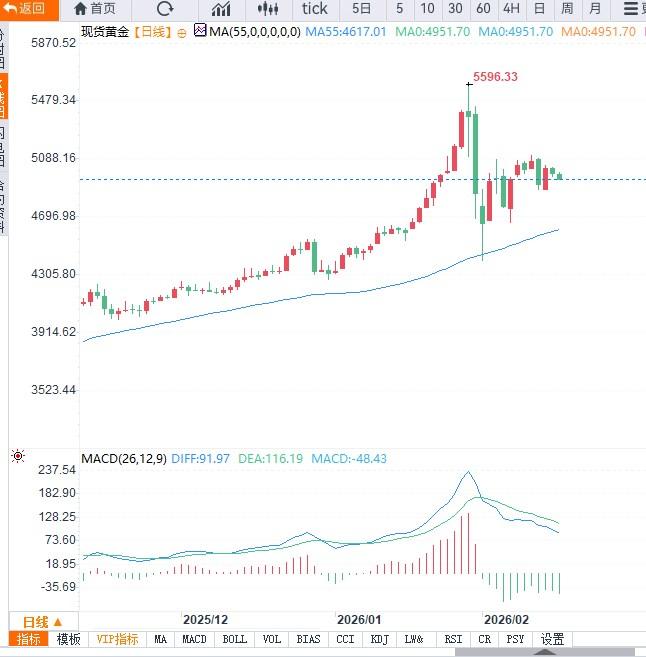
From the daily chart, gold has formed lower highs for three consecutive trading days, indicating significant selling pressure above $5,000 and strong selling pressure near the $5,119 stage high.
The Relative Strength Index (RSI) continues to decline, indicating weakening bullish momentum. If gold prices close below $5,000, bears may further test the $4,900 support area, which is also close to the 20-day exponential moving average.
If it falls below $4,900, the next support level will be $4,800, with further downside support around $4,634, where the 50-day moving average is located.
Conversely, if the price stabilizes above $5,000 again, the first short-term resistance is at $5,050, followed by the previous high area of $5,119.
Editor's Note:
Gold is currently caught in a tug-of-war between "support from expectations of interest rate cuts" and "a temporary rebound in the US dollar." In the medium term, a downward trend in interest rates is favorable for precious metals, but in the short term, given the thin liquidity and a rebounding dollar, prices are more likely to experience a technical correction.
$4,900 will be a key watershed; holding above this level could indicate continued consolidation at higher levels, while a break below could open up further downside potential. Attention should be paid to policy signals from this week's core PCE and the Fed minutes.
The US market was closed on Monday for Presidents' Day, and the Lunar New Year holiday continued, resulting in insufficient overall liquidity and amplifying price volatility. Current market sentiment is generally optimistic, with investors widely expecting the Federal Reserve to cut interest rates at least twice this year.
Previously released US non-farm payroll data showed solid performance, while inflation data was relatively moderate, prompting the market to price in a cumulative easing of about 60 basis points by the end of the year.
However, the rebound in the US dollar index became the main factor suppressing gold. The US dollar index, which measures the dollar's performance against six major currencies, rose 0.22% overnight, returning above 97.00, putting short-term pressure on dollar-denominated gold.
In the bond market, the yield on the 10-year U.S. Treasury note fell from a high of 4.125% to 4.05% last Friday, indicating that market expectations for future interest rate declines have strengthened.
However, Chicago Fed President Austan Goolsbee made hawkish comments, pointing out that inflation in the services sector remains high and emphasizing that more evidence of a decline in inflation is needed before further rate cuts.
This policy stance has limited the upside potential for gold to some extent. Geopolitical factors have also added complexity to the market. Russia and Ukraine will hold talks in Geneva, with territorial issues likely to be a focal point.
Meanwhile, reports indicate that Iran is conducting naval exercises in the Strait of Hormuz, escalating regional tensions and theoretically providing safe-haven support for gold. However, the short-term impact has been offset by a stronger US dollar.
This week's US economic calendar is packed with key indicators, including durable goods orders, housing data, the FOMC meeting minutes, and the core PCE price index. These data may provide new direction for gold price movements.
From the daily chart, gold has formed lower highs for three consecutive trading days, indicating significant selling pressure above $5,000 and strong selling pressure near the $5,119 stage high.
The Relative Strength Index (RSI) continues to decline, indicating weakening bullish momentum. If gold prices close below $5,000, bears may further test the $4,900 support area, which is also close to the 20-day exponential moving average.
If it falls below $4,900, the next support level will be $4,800, with further downside support around $4,634, where the 50-day moving average is located.
Conversely, if the price stabilizes above $5,000 again, the first short-term resistance is at $5,050, followed by the previous high area of $5,119.
Editor's Note:
Gold is currently caught in a tug-of-war between "support from expectations of interest rate cuts" and "a temporary rebound in the US dollar." In the medium term, a downward trend in interest rates is favorable for precious metals, but in the short term, given the thin liquidity and a rebounding dollar, prices are more likely to experience a technical correction.
$4,900 will be a key watershed; holding above this level could indicate continued consolidation at higher levels, while a break below could open up further downside potential. Attention should be paid to policy signals from this week's core PCE and the Fed minutes.
- Risk Warning and Disclaimer
- The market involves risk, and trading may not be suitable for all investors. This article is for reference only and does not constitute personal investment advice, nor does it take into account certain users’ specific investment objectives, financial situation, or other needs. Any investment decisions made based on this information are at your own risk.