Geopolitical tensions failed to offset supply and demand pressures, and the latest oil prices continued their downward trend.
2026-02-18 00:47:43
On Tuesday (February 17), WTI crude oil fell during the US trading session, closing at $62.20 per barrel, a drop of 1.10%, continuing the downward trend that began in February.
WTI crude oil futures: Geopolitical blitzkrieg unlikely to reverse downward trend
On February 17th, international crude oil prices experienced a whirlwind intraday movement between geopolitical maneuvering and diplomatic easing, but this did not reverse the downward trend. Between 8:00 PM and 10:00 PM, Iran temporarily closed part of the Strait of Hormuz due to military exercises, causing WTI crude oil prices to surge by over 2%, breaking through $64. After 10:00 PM, positive progress emerged in US-Iran negotiations, and oil prices quickly fell back to around $62.70, erasing all gains. By the early morning of February 18th, oil prices had further fallen to $61.85 per barrel, highlighting the dominance of fundamental pressures.
OPEC+ will maintain production levels in the short term; supply and demand remain the core factors.
Commerzbank analyst Fritz points out that the US-Iran developments only provide a short-term boost to oil prices and are unlikely to reverse the overall downward trend. OPEC+ announced in January that it would maintain its production levels from March 2nd to 3rd, which can slightly alleviate downward pressure in the short term. The March 1st meeting will finalize production arrangements for April and beyond. Even if production increases resume in the future, due to structural constraints and Russia's export difficulties, the actual increase may be lower than expected.
According to Kpler data, India plans to import 1.16 million barrels of Russian crude oil per day in February, but this figure may decline significantly in the future. If Russia cannot find alternative buyers, it may be forced to reduce production, thereby limiting the decline in oil prices.
Market sentiment and driving logic
The "buy the dip" strategy has completely failed, with oil prices continuing to decline. Buying interest is weak, trading volume is shrinking, and market sentiment is cautious. The current decline is not a simple technical correction; the 50-day moving average has been broken, indicating a bearish technical trend. Geopolitical positive factors are mostly short-term and impulsive, unable to offset the pressure from oversupply and US sanctions against Iran.
As US sanctions against Iran continue to escalate, Iranian crude oil exports are expected to plummet from 2 million barrels per day in October 2025 to less than 300,000 barrels per day in January 2026. Even if negotiations progress, Iranian crude oil is unlikely to re-enter the market in the short term. Goldman Sachs predicts a global crude oil surplus of 2.3 million barrels per day in 2026, which will continue to weigh on market sentiment.
Key technology points analysis
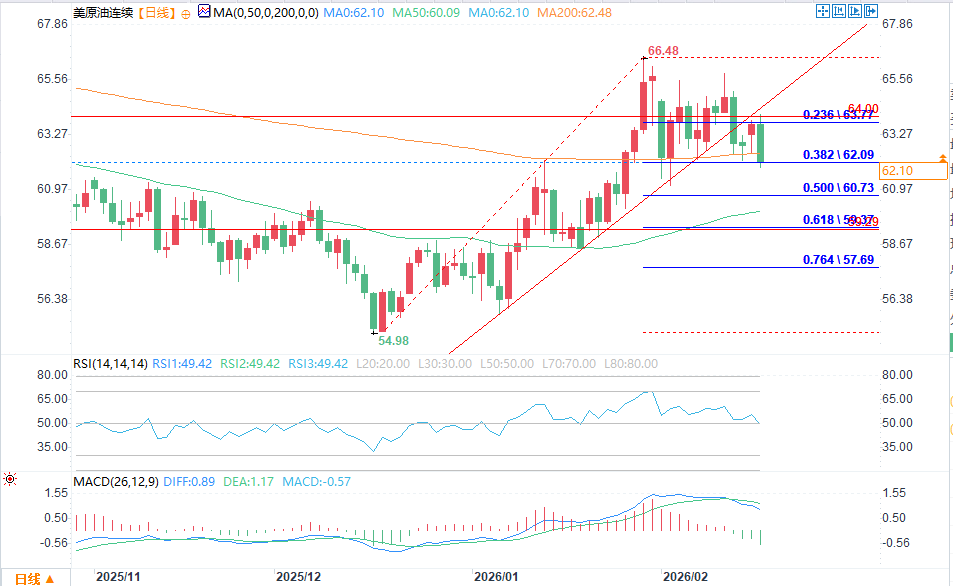
(WTI crude oil daily chart source: FX678)
Based on the latest oil price ($61.85/barrel), the key levels for WTI crude oil delivery in March are as follows:
Key support range: $59.29-$60.83 per barrel (overlapping with two moving averages). Oil prices are currently above this range; a break below would open up further downside potential.
Short-term resistance levels: $63.80/barrel and the $64 mark, which are unlikely to be broken in the short term.
Upside potential is weak: it is unlikely to reach the $65.41 trendline in the short term. If the support zone is breached, it may fall further, aligning with Goldman Sachs' annual average price forecast of $52 per barrel.
Market Outlook
Oil prices are likely to continue their downward trend in the short term, or may temporarily stabilize within a support range. The OPEC+ meeting on March 1 and Russia's export difficulties will influence subsequent trends; a breakdown in US-Iran negotiations may trigger a temporary surge in oil prices, but this is unlikely to reverse the long-term downward trend, as global oversupply remains the core issue.
WTI crude oil futures: Geopolitical blitzkrieg unlikely to reverse downward trend
On February 17th, international crude oil prices experienced a whirlwind intraday movement between geopolitical maneuvering and diplomatic easing, but this did not reverse the downward trend. Between 8:00 PM and 10:00 PM, Iran temporarily closed part of the Strait of Hormuz due to military exercises, causing WTI crude oil prices to surge by over 2%, breaking through $64. After 10:00 PM, positive progress emerged in US-Iran negotiations, and oil prices quickly fell back to around $62.70, erasing all gains. By the early morning of February 18th, oil prices had further fallen to $61.85 per barrel, highlighting the dominance of fundamental pressures.
OPEC+ will maintain production levels in the short term; supply and demand remain the core factors.
Commerzbank analyst Fritz points out that the US-Iran developments only provide a short-term boost to oil prices and are unlikely to reverse the overall downward trend. OPEC+ announced in January that it would maintain its production levels from March 2nd to 3rd, which can slightly alleviate downward pressure in the short term. The March 1st meeting will finalize production arrangements for April and beyond. Even if production increases resume in the future, due to structural constraints and Russia's export difficulties, the actual increase may be lower than expected.
According to Kpler data, India plans to import 1.16 million barrels of Russian crude oil per day in February, but this figure may decline significantly in the future. If Russia cannot find alternative buyers, it may be forced to reduce production, thereby limiting the decline in oil prices.
Market sentiment and driving logic
The "buy the dip" strategy has completely failed, with oil prices continuing to decline. Buying interest is weak, trading volume is shrinking, and market sentiment is cautious. The current decline is not a simple technical correction; the 50-day moving average has been broken, indicating a bearish technical trend. Geopolitical positive factors are mostly short-term and impulsive, unable to offset the pressure from oversupply and US sanctions against Iran.
As US sanctions against Iran continue to escalate, Iranian crude oil exports are expected to plummet from 2 million barrels per day in October 2025 to less than 300,000 barrels per day in January 2026. Even if negotiations progress, Iranian crude oil is unlikely to re-enter the market in the short term. Goldman Sachs predicts a global crude oil surplus of 2.3 million barrels per day in 2026, which will continue to weigh on market sentiment.
Key technology points analysis
(WTI crude oil daily chart source: FX678)
Based on the latest oil price ($61.85/barrel), the key levels for WTI crude oil delivery in March are as follows:
Key support range: $59.29-$60.83 per barrel (overlapping with two moving averages). Oil prices are currently above this range; a break below would open up further downside potential.
Short-term resistance levels: $63.80/barrel and the $64 mark, which are unlikely to be broken in the short term.
Upside potential is weak: it is unlikely to reach the $65.41 trendline in the short term. If the support zone is breached, it may fall further, aligning with Goldman Sachs' annual average price forecast of $52 per barrel.
Market Outlook
Oil prices are likely to continue their downward trend in the short term, or may temporarily stabilize within a support range. The OPEC+ meeting on March 1 and Russia's export difficulties will influence subsequent trends; a breakdown in US-Iran negotiations may trigger a temporary surge in oil prices, but this is unlikely to reverse the long-term downward trend, as global oversupply remains the core issue.
- Risk Warning and Disclaimer
- The market involves risk, and trading may not be suitable for all investors. This article is for reference only and does not constitute personal investment advice, nor does it take into account certain users’ specific investment objectives, financial situation, or other needs. Any investment decisions made based on this information are at your own risk.