Silver Price Forecast: Speculative Funds Withdraw, Lower Silver Prices Create New Value Investment Opportunities
2026-02-18 01:28:19
On Tuesday (February 17), spot silver prices continued their downward trend, falling by about 5% to approximately $72.6 per ounce. The main drag came from two main factors: first, the weakening of international gold prices, which, as a "linked target" in the precious metals sector, put silver under pressure in tandem with gold; second, the continued strengthening of the US dollar index, which reduced the attractiveness of dollar-denominated silver assets and weakened overseas buying interest.
It's worth noting that silver prices are currently clearly trading below the 50-day moving average. This break below this key technical support level not only disrupted the previous consolidation pattern but also opened up further downside potential, leading to a spread of bearish sentiment in the market. After breaking below the 50-day moving average, the 200-day moving average at $51.65/ounce has become the next important support level to watch. If this level fails to hold, silver prices may face a new round of deeper corrections.
Gold is backed by central banks, but silver has lost its core upward momentum.
Looking back at the recent performance of the precious metals market, gold and silver have shown a clear divergence in their trends, primarily due to their fundamentally different supporting logics. For gold, even with the current increased market volatility, if the reports are true, the continued gold purchases by major central banks worldwide will still provide solid support for gold prices, which is the key reason why gold has been able to maintain its relative strength.
Silver's situation was quite different: throughout 2025, silver's steady rise was supported by two main factors—first, the widely circulated expectation of a silver supply gap, and second, strong global industrial demand for silver (silver is widely used in photovoltaics, electronics, chemicals, and other industries, with industrial demand significantly exceeding that of gold). These two factors combined to drive silver prices up, a logic that seemed quite reasonable at the time. However, this all changed with the excessive intervention of highly leveraged speculative funds: as speculators continuously increased leverage to bet on rising silver prices, the market gradually deviated from fundamental support and entered a speculative frenzy. Until the exchange intervened by raising the margin requirements for silver futures trading, significantly reducing the leverage space for speculative funds, the previous speculative bubble began to burst, and the market suddenly began to re-examine whether the previously hyped logic of an inventory gap and strong industrial demand truly reflected the current market situation, and whether related expectations were excessively exaggerated.
Risk aversion intensifies, completely reshaping market trading rules.
The current global financial market environment is vastly different from the period when silver prices surged. On the one hand, the direction of the Federal Reserve's monetary policy remains uncertain. There is significant disagreement in the market regarding whether the Fed will continue to raise interest rates, by how much, and when it will begin a rate-cutting cycle. This policy uncertainty makes funds hesitant to invest heavily in the precious metals market. On the other hand, speculative sentiment across the market continues to cool, with risk aversion becoming one of the core market sentiments. Against this backdrop, asset prices are generally characterized by a "more prone to falling than rising" pattern, and silver is no exception.
Against this backdrop, the market's trading logic has fundamentally shifted: investors are no longer blindly chasing highs and vying for short-term price differences, as they previously did. Instead, they are returning to rationality, actively seeking out undervalued opportunities and patiently accumulating value. In terms of capital structure, long-term investors are particularly composed—having experienced long market cycles and witnessed the dramatic rise and fall of silver prices, they deeply understand the core logic of value investing. Therefore, during the current silver price correction, they have not rushed to exit the market but remain patient, waiting for a more suitable entry point. Short-term speculative funds, on the other hand, are quite different. Due to the current lack of clear upward momentum in silver prices, the difficulty of short-term profits has increased significantly, leading to a withdrawal of these funds from the market and a decrease in short-term trading volume for silver. However, historically, once the market finds its bottom, establishes a reasonable value range, and stabilizes, these short-term speculative funds are highly likely to re-enter the market and participate in trading again.
It's important to clarify that the current silver market is completely different from the surge that occurred from December of last year to January of this year. The market's trading rules and driving logic have undergone profound changes. For skilled traders, adapting to market changes is one of the core competencies. The most crucial strategy at present is to remain patient, wait for clear signals from the market, and avoid blindly buying the dip or shorting.
Deutsche Bank provides reference data, but it should not be over-interpreted.
According to CNBC, analysts at Deutsche Bank pointed out in a research report released on Tuesday (February 17) that after silver prices fell in early trading that day, the current trading price of silver is still about $7 lower than the inflation-adjusted real price in 1790.
However, it is important to emphasize that this statement is not a prediction of future silver price movements, but merely an objective statement based on historical data, and does not provide short-term market guidance. It cannot tell us how much silver will rise or fall tomorrow or next week, nor can it be used as a basis for short-term trading decisions. Its core significance lies in the fact that, from a historical perspective of long-term purchasing power, the current silver price is at a relative discount. This signal may attract the attention of two types of funds: firstly, long-term funds inclined to buy on dips, and secondly, algorithmic trading funds focused on identifying historical value discrepancies. These latter funds may use this as one of the factors in their investment decisions.
This is just further evidence of the value-based investment logic.
Essentially, the historical comparison data provided by Deutsche Bank is highly consistent with my previous core view that "the silver market has entered a value-oriented investment phase." It merely reaffirms the core logic of the current market—traders are no longer chasing short-term price differences, but are actively seeking the intrinsic value of silver, waiting for opportunities to position themselves after prices return to a reasonable range. In short, this data is just another piece of the puzzle in the value-oriented investment logic of silver, not a core variable that will change market trends.
Silver is a trading asset, not a long-term holding asset.
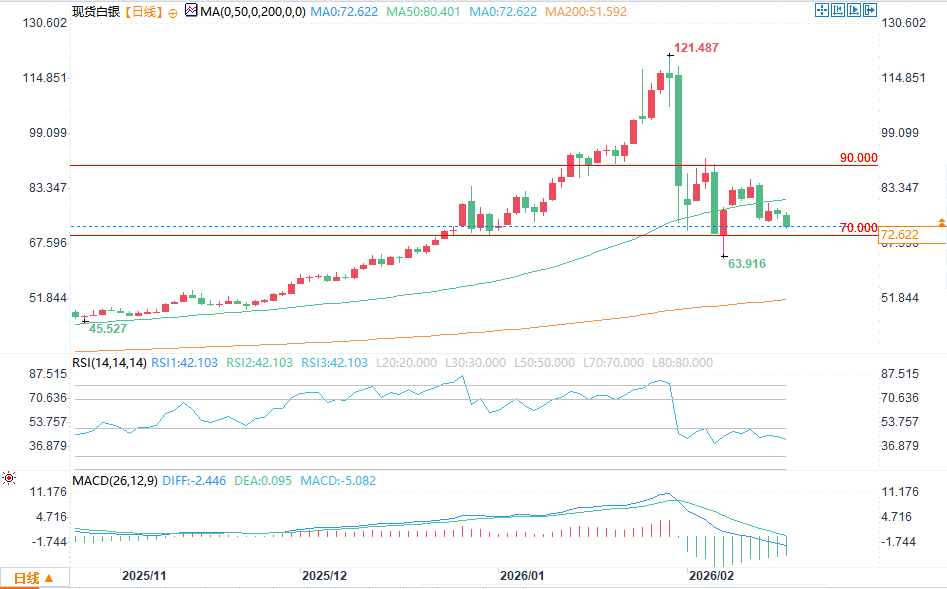
(Spot silver daily chart source: EasyTrade)
For long-term investors, it's necessary to re-evaluate silver's asset attributes: Previously, the market widely considered silver an effective inflation hedge, but recent market performance has gradually disproven this logic—with inflationary pressures persisting, silver has not performed as expected, instead falling in tandem with the market. However, this does not mean silver has no investment value, nor does it mean it will completely lose its price volatility.
In the long run, silver will continue to be influenced by factors such as changes in industrial demand and adjustments in global monetary policy, resulting in periodic price surges. For example, in scenarios involving explosive growth in industrial demand, easing of central bank monetary policy, or escalation of global geopolitical conflicts, silver prices may still experience significant fluctuations. Therefore, silver is more suitable for traders skilled at grasping market cycles and betting on volatility to capture short-term price swings and profit from price differences. For investors seeking long-term, stable appreciation, silver is not an ideal long-term holding asset because it lacks the compounding properties of stocks and funds, which can achieve long-term compound growth through corporate profits and dividends. Simply put, the core investment value of silver lies in "cyclical swing opportunities." Only by accurately timing market cycles and entry and exit points can its asset value be fully realized.
It's worth noting that silver prices are currently clearly trading below the 50-day moving average. This break below this key technical support level not only disrupted the previous consolidation pattern but also opened up further downside potential, leading to a spread of bearish sentiment in the market. After breaking below the 50-day moving average, the 200-day moving average at $51.65/ounce has become the next important support level to watch. If this level fails to hold, silver prices may face a new round of deeper corrections.
Gold is backed by central banks, but silver has lost its core upward momentum.
Looking back at the recent performance of the precious metals market, gold and silver have shown a clear divergence in their trends, primarily due to their fundamentally different supporting logics. For gold, even with the current increased market volatility, if the reports are true, the continued gold purchases by major central banks worldwide will still provide solid support for gold prices, which is the key reason why gold has been able to maintain its relative strength.
Silver's situation was quite different: throughout 2025, silver's steady rise was supported by two main factors—first, the widely circulated expectation of a silver supply gap, and second, strong global industrial demand for silver (silver is widely used in photovoltaics, electronics, chemicals, and other industries, with industrial demand significantly exceeding that of gold). These two factors combined to drive silver prices up, a logic that seemed quite reasonable at the time. However, this all changed with the excessive intervention of highly leveraged speculative funds: as speculators continuously increased leverage to bet on rising silver prices, the market gradually deviated from fundamental support and entered a speculative frenzy. Until the exchange intervened by raising the margin requirements for silver futures trading, significantly reducing the leverage space for speculative funds, the previous speculative bubble began to burst, and the market suddenly began to re-examine whether the previously hyped logic of an inventory gap and strong industrial demand truly reflected the current market situation, and whether related expectations were excessively exaggerated.
Risk aversion intensifies, completely reshaping market trading rules.
The current global financial market environment is vastly different from the period when silver prices surged. On the one hand, the direction of the Federal Reserve's monetary policy remains uncertain. There is significant disagreement in the market regarding whether the Fed will continue to raise interest rates, by how much, and when it will begin a rate-cutting cycle. This policy uncertainty makes funds hesitant to invest heavily in the precious metals market. On the other hand, speculative sentiment across the market continues to cool, with risk aversion becoming one of the core market sentiments. Against this backdrop, asset prices are generally characterized by a "more prone to falling than rising" pattern, and silver is no exception.
Against this backdrop, the market's trading logic has fundamentally shifted: investors are no longer blindly chasing highs and vying for short-term price differences, as they previously did. Instead, they are returning to rationality, actively seeking out undervalued opportunities and patiently accumulating value. In terms of capital structure, long-term investors are particularly composed—having experienced long market cycles and witnessed the dramatic rise and fall of silver prices, they deeply understand the core logic of value investing. Therefore, during the current silver price correction, they have not rushed to exit the market but remain patient, waiting for a more suitable entry point. Short-term speculative funds, on the other hand, are quite different. Due to the current lack of clear upward momentum in silver prices, the difficulty of short-term profits has increased significantly, leading to a withdrawal of these funds from the market and a decrease in short-term trading volume for silver. However, historically, once the market finds its bottom, establishes a reasonable value range, and stabilizes, these short-term speculative funds are highly likely to re-enter the market and participate in trading again.
It's important to clarify that the current silver market is completely different from the surge that occurred from December of last year to January of this year. The market's trading rules and driving logic have undergone profound changes. For skilled traders, adapting to market changes is one of the core competencies. The most crucial strategy at present is to remain patient, wait for clear signals from the market, and avoid blindly buying the dip or shorting.
Deutsche Bank provides reference data, but it should not be over-interpreted.
According to CNBC, analysts at Deutsche Bank pointed out in a research report released on Tuesday (February 17) that after silver prices fell in early trading that day, the current trading price of silver is still about $7 lower than the inflation-adjusted real price in 1790.
However, it is important to emphasize that this statement is not a prediction of future silver price movements, but merely an objective statement based on historical data, and does not provide short-term market guidance. It cannot tell us how much silver will rise or fall tomorrow or next week, nor can it be used as a basis for short-term trading decisions. Its core significance lies in the fact that, from a historical perspective of long-term purchasing power, the current silver price is at a relative discount. This signal may attract the attention of two types of funds: firstly, long-term funds inclined to buy on dips, and secondly, algorithmic trading funds focused on identifying historical value discrepancies. These latter funds may use this as one of the factors in their investment decisions.
This is just further evidence of the value-based investment logic.
Essentially, the historical comparison data provided by Deutsche Bank is highly consistent with my previous core view that "the silver market has entered a value-oriented investment phase." It merely reaffirms the core logic of the current market—traders are no longer chasing short-term price differences, but are actively seeking the intrinsic value of silver, waiting for opportunities to position themselves after prices return to a reasonable range. In short, this data is just another piece of the puzzle in the value-oriented investment logic of silver, not a core variable that will change market trends.
Silver is a trading asset, not a long-term holding asset.
(Spot silver daily chart source: EasyTrade)
For long-term investors, it's necessary to re-evaluate silver's asset attributes: Previously, the market widely considered silver an effective inflation hedge, but recent market performance has gradually disproven this logic—with inflationary pressures persisting, silver has not performed as expected, instead falling in tandem with the market. However, this does not mean silver has no investment value, nor does it mean it will completely lose its price volatility.
In the long run, silver will continue to be influenced by factors such as changes in industrial demand and adjustments in global monetary policy, resulting in periodic price surges. For example, in scenarios involving explosive growth in industrial demand, easing of central bank monetary policy, or escalation of global geopolitical conflicts, silver prices may still experience significant fluctuations. Therefore, silver is more suitable for traders skilled at grasping market cycles and betting on volatility to capture short-term price swings and profit from price differences. For investors seeking long-term, stable appreciation, silver is not an ideal long-term holding asset because it lacks the compounding properties of stocks and funds, which can achieve long-term compound growth through corporate profits and dividends. Simply put, the core investment value of silver lies in "cyclical swing opportunities." Only by accurately timing market cycles and entry and exit points can its asset value be fully realized.
- Risk Warning and Disclaimer
- The market involves risk, and trading may not be suitable for all investors. This article is for reference only and does not constitute personal investment advice, nor does it take into account certain users’ specific investment objectives, financial situation, or other needs. Any investment decisions made based on this information are at your own risk.