The central bank poured cold water on the frenzy: New Zealand dollar bulls collectively "stuck on the sidelines."
2026-02-18 21:08:42
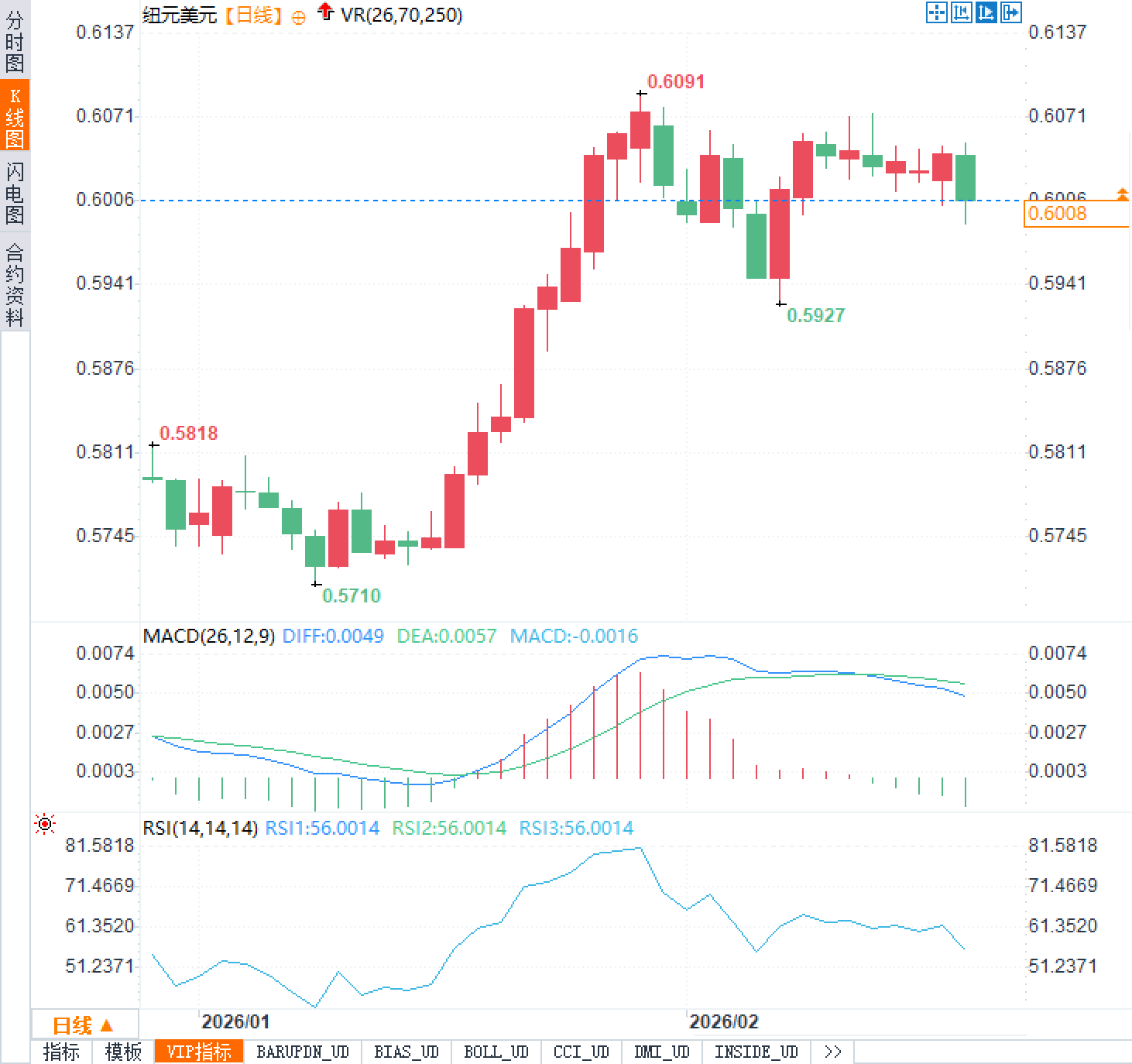
The New Zealand dollar has recently played out a "disappointing expectations" scenario against the US dollar. After a rapid rise from around 0.5710, the exchange rate once surged to a high of 0.6091, and is currently fluctuating around the key level of 0.6000.

Previously, traders were caught up in an optimistic fantasy, generally betting that the Reserve Bank of New Zealand would bring forward its interest rate hike timetable, and even expecting more aggressive hawkish signals. However, when the decision was actually made (February 18), while keeping the interest rate unchanged at 2.25% was in line with apparent expectations, the central bank officials' speeches were like a bucket of cold water. Instead of catering to the market's aggressive expectations, they adopted a cautious tone, emphasizing weaknesses in the economy and deliberately downplaying the urgency of rising inflation. This market logic of "not hawkish enough is dovish" instantly triggered profit-taking, dragging the New Zealand dollar back down to earth.
Analysts point out that when the market has already priced in an extremely optimistic policy path, any outcome that fails to exceed these high expectations will be seen as bearish. The New Zealand dollar's previous continuous rise essentially priced in future positive potential. Once marginal information weakens slightly, the previously crowded long positions will rush to exit, causing the price to quickly retreat to a range more capable of accommodating divergence. This pullback is a necessary cooling of the market's overly excited sentiment, re-anchoring the exchange rate within a reasonable valuation range.
While the New Zealand dollar itself suffered from policy expectations, the US dollar exhibited a relatively strong sideways trend. This wasn't due to a dramatic reversal in the dollar's fundamentals, but rather benefited from the opponent's missteps and the specific nature of its own positioning. Previously released US non-farm payroll data was strong, while CPI data was slightly moderate; this combination did not fundamentally shake the market's overall framework of approximately 60 basis points of interest rate cuts this year. For the dollar, as long as the data doesn't deteriorate significantly, or there are no exogenous shocks disrupting risk appetite, its downside potential is very limited. More importantly, current short positions in the market for the dollar are quite crowded, meaning that a significant driving force is needed for the dollar to continue weakening substantially; conversely, even a slight stabilization could establish relative strength.
In this context, the decline of the New Zealand dollar against the US dollar is more like a relative movement of "one rising while the other falls." The US dollar doesn't need to rise sharply; simply maintaining its current level, coupled with the self-weakening of the New Zealand dollar caused by poor policy communication, is enough to push the exchange rate down. This kind of volatility caused by interest rate expectation management is often more dramatic than simple fundamental changes.
Turning our attention to the short-term trend, the daily chart clearly shows a "consolidation after a sharp rise" technical pattern. Currently, the 0.5920 to 0.5950 area has been established as the first line of defense for the bulls, while the 0.6000 level is the emotional center of contention between bulls and bears. In terms of technical indicators, the MACD shows a DIFF of 0.0049, a DEA of 0.0057, and a MACD histogram of -0.0016. Although the fast and slow lines are at high levels, the momentum bars have weakened, clearly indicating a slowdown in the upward trend and the market entering a rebalancing phase. The coming week will be a crucial moment for the market, with focus on Friday's US PMI and Q4 GDP data. These two data points will directly reflect the resilience of US growth and the stickiness of inflation, and are very likely to change the marginal direction of interest rate pricing.
Furthermore, a potential US Supreme Court ruling on Trump's tariffs could also be a black swan event that stirs up the market. Such macroeconomic events, if triggering sharp fluctuations in risk aversion or risk appetite, will quickly transmit to the New Zealand dollar against the US dollar through the liquidity of the US dollar, amplifying short-term volatility. Analysts believe that 0.6000 is not only a key numerical level but also a benchmark for short-term sentiment. If the exchange rate can stabilize and return above 0.6050, it indicates that the market has digested the Reserve Bank of New Zealand's cautious stance, at which point 0.6091 will become the next target. Conversely, if 0.6000 is repeatedly breached and approaches 0.5927, it means the correction is not yet over, and the market may further revise its expectations for the New Zealand dollar's interest rate premium. Once it breaks below the 0.5920 support level, be wary of a deeper risk of mean reversion.
Previously, traders were caught up in an optimistic fantasy, generally betting that the Reserve Bank of New Zealand would bring forward its interest rate hike timetable, and even expecting more aggressive hawkish signals. However, when the decision was actually made (February 18), while keeping the interest rate unchanged at 2.25% was in line with apparent expectations, the central bank officials' speeches were like a bucket of cold water. Instead of catering to the market's aggressive expectations, they adopted a cautious tone, emphasizing weaknesses in the economy and deliberately downplaying the urgency of rising inflation. This market logic of "not hawkish enough is dovish" instantly triggered profit-taking, dragging the New Zealand dollar back down to earth.
Analysts point out that when the market has already priced in an extremely optimistic policy path, any outcome that fails to exceed these high expectations will be seen as bearish. The New Zealand dollar's previous continuous rise essentially priced in future positive potential. Once marginal information weakens slightly, the previously crowded long positions will rush to exit, causing the price to quickly retreat to a range more capable of accommodating divergence. This pullback is a necessary cooling of the market's overly excited sentiment, re-anchoring the exchange rate within a reasonable valuation range.
The US dollar's "easy win" situation: Opportunities arise from the opponent's mistakes.
While the New Zealand dollar itself suffered from policy expectations, the US dollar exhibited a relatively strong sideways trend. This wasn't due to a dramatic reversal in the dollar's fundamentals, but rather benefited from the opponent's missteps and the specific nature of its own positioning. Previously released US non-farm payroll data was strong, while CPI data was slightly moderate; this combination did not fundamentally shake the market's overall framework of approximately 60 basis points of interest rate cuts this year. For the dollar, as long as the data doesn't deteriorate significantly, or there are no exogenous shocks disrupting risk appetite, its downside potential is very limited. More importantly, current short positions in the market for the dollar are quite crowded, meaning that a significant driving force is needed for the dollar to continue weakening substantially; conversely, even a slight stabilization could establish relative strength.
In this context, the decline of the New Zealand dollar against the US dollar is more like a relative movement of "one rising while the other falls." The US dollar doesn't need to rise sharply; simply maintaining its current level, coupled with the self-weakening of the New Zealand dollar caused by poor policy communication, is enough to push the exchange rate down. This kind of volatility caused by interest rate expectation management is often more dramatic than simple fundamental changes.
Decisive Friday: Data Determines Life or Death and Key Defense Lines
Turning our attention to the short-term trend, the daily chart clearly shows a "consolidation after a sharp rise" technical pattern. Currently, the 0.5920 to 0.5950 area has been established as the first line of defense for the bulls, while the 0.6000 level is the emotional center of contention between bulls and bears. In terms of technical indicators, the MACD shows a DIFF of 0.0049, a DEA of 0.0057, and a MACD histogram of -0.0016. Although the fast and slow lines are at high levels, the momentum bars have weakened, clearly indicating a slowdown in the upward trend and the market entering a rebalancing phase. The coming week will be a crucial moment for the market, with focus on Friday's US PMI and Q4 GDP data. These two data points will directly reflect the resilience of US growth and the stickiness of inflation, and are very likely to change the marginal direction of interest rate pricing.
Furthermore, a potential US Supreme Court ruling on Trump's tariffs could also be a black swan event that stirs up the market. Such macroeconomic events, if triggering sharp fluctuations in risk aversion or risk appetite, will quickly transmit to the New Zealand dollar against the US dollar through the liquidity of the US dollar, amplifying short-term volatility. Analysts believe that 0.6000 is not only a key numerical level but also a benchmark for short-term sentiment. If the exchange rate can stabilize and return above 0.6050, it indicates that the market has digested the Reserve Bank of New Zealand's cautious stance, at which point 0.6091 will become the next target. Conversely, if 0.6000 is repeatedly breached and approaches 0.5927, it means the correction is not yet over, and the market may further revise its expectations for the New Zealand dollar's interest rate premium. Once it breaks below the 0.5920 support level, be wary of a deeper risk of mean reversion.
- Risk Warning and Disclaimer
- The market involves risk, and trading may not be suitable for all investors. This article is for reference only and does not constitute personal investment advice, nor does it take into account certain users’ specific investment objectives, financial situation, or other needs. Any investment decisions made based on this information are at your own risk.